
Colonel George Francis Gillman Stanley CC CD FRSC FRHSC(hon) FRHistS
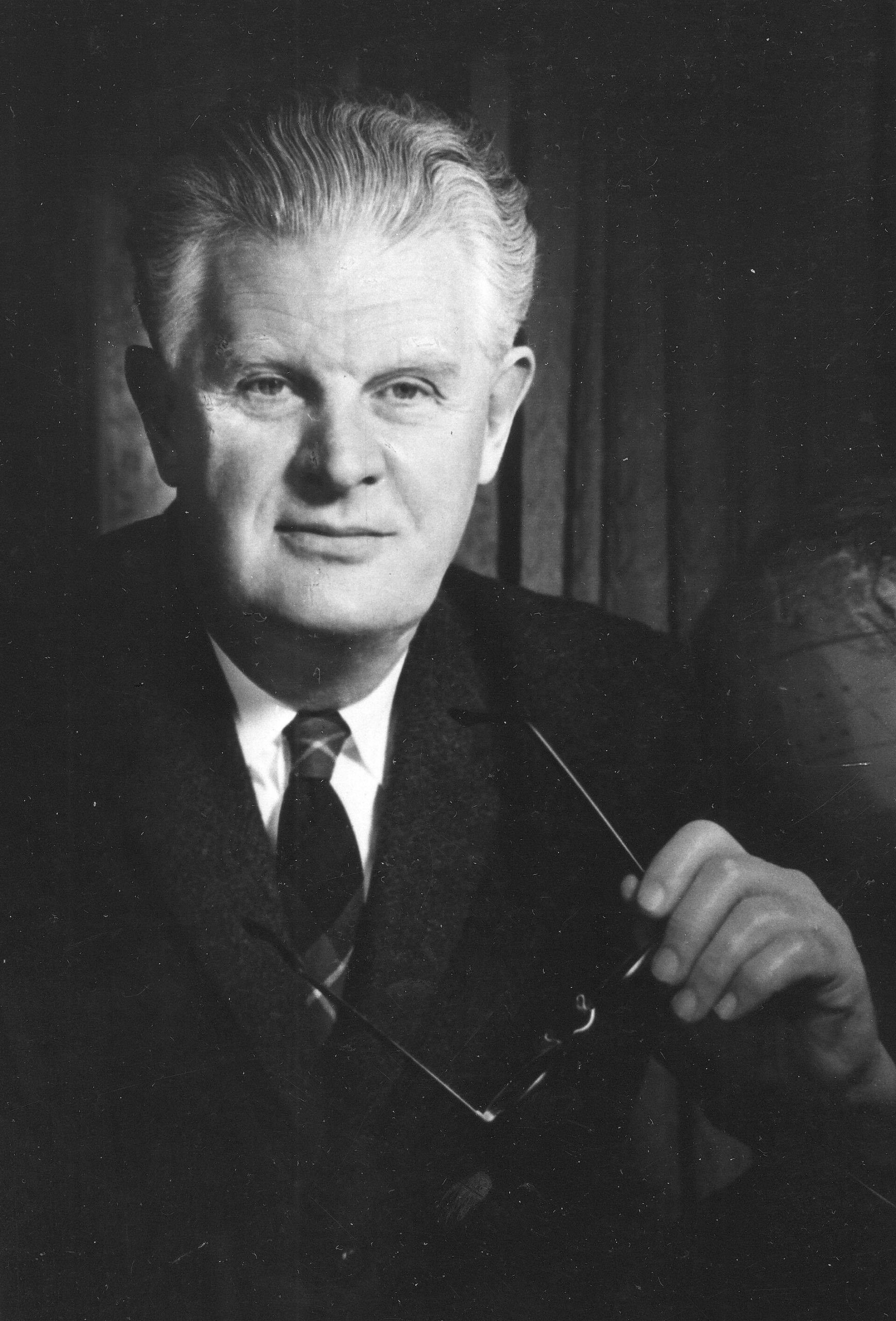
( University of Alberta Libraries Photo0
Portrait of George Francis Gillman Stanley, c1960s.
Colonel George Francis Gillman Stanley CC CD FRSC FRHSC(hon) FRHistS (July 6, 1907 – September 13, 2002) was a Canadian author, soldier, historian at the Royal Military College of Canada and Mount Allison University, public servant, former Lieutenant-Governor of New Brunswick, and designer of the Canadian Flag.
George F. G. Stanley was born in Calgary, Alberta, in 1907 and received a BA from the University of Alberta in Edmonton.[2] He studied at Keble College, University of Oxford, in 1929 as the Rhodes Scholar from Alberta, and held a Beit Fellowship in Imperial Studies and a Royal Society of Canada Scholarship. He earned a BA, MA, MLitt and DPhil. Always a keen athlete, he played for the Oxford University Ice Hockey Club, which won the Spengler Cup in 1931. At Oxford, he wrote his book, The Birth of Western Canada: A History of The Riel Rebellions, and began his lifelong work on Louis Riel.
Stanley returned to Canada in 1936 and was appointed a professor of history at Mount Allison University in New Brunswick. He joined the military upon arriving there and qualified as a lieutenant in the New Brunswick Rangers. He served as an infantry training officer in Fredericton and then proceeded overseas during the Second World War II as historian (rising to Deputy-Director) in the Historical Section at Canadian Army Headquarters in London, England; he was also responsible for administering the War Artist Program, whose staff included Bruno Bobak, Molly Lamb Bobak, Alex Colville, Charles Comfort, Lawren P. Harris and Will Ogilvie. Stanley was discharged as a lieutenant-colonel in 1947. He then taught at the University of British Columbia, holding the first chair in Canadian history in Canada. He came out of military retirement in 1948 to help fight floods in the Fraser Valley and was on the Reserve of Officers until 1967. He was awarded a Guggenheim Fellowship (1949) to do research into the history of Canadian government policy in dealing with Aboriginal people.
In 1949, Stanley began teaching at the Royal Military College of Canada (RMC) in Kingston, Ontario, where he remained for twenty years. At RMC, he became head of the History Department, served as the first Dean of Arts for seven years (1962–1969), and began building a faculty in the humanities and social sciences. He taught the first undergraduate course in military history ever given in Canada and wrote a textbook, entitled Canada’s Soldiers, 1604–1954: The Military History of An Unmilitary People (1954), which became required reading for every service person for three decades. His students included John de Chastelain, Jack Granatstein, and Desmond Morton. Thanks in part to Stanley’s efforts as RMC Dean of Arts, the Royal Military College of Canada Pipes and Drums were equipped in 1965 with most of their highland kit, including the Mackenzie tartan (RMC was established in 1876 when Alexander Mackenzie was prime minister).
While in Kingston he served as secretary and president of the Kingston Historical Society and edited Historic Kingston for several years. He was president of the Arts Society, director of the Art Collection Society, served on various committees working to save Kingston’s old limestone buildings, was president of the St. Andrew’s Society, and acted as clerk of his church’s vestry council. Stanley was president of the Canadian Historical Association (1955–1956), a member of the Massey Commission’s Committee on Historic Sites and Monuments (1950–1951), and a founding member of the Archaeological and Historic Sites Board of Ontario (1953–1969). He was chairman of the federal government’s Centennial Publications Committee and acted as chairman of centennial celebrations in Pittsburgh Township, Ontario. While Stanley was at the Royal Military College, he suggested the design for the Canadian flag, which was adopted on 15 February 1965.

In 1969, Stanley returned to Mount Allison University to become founding director of the new Canadian Studies program, the first of its kind in Canada. He was also the first holder of the Edgar and Dorothy Davidson Chair of Canadian Studies (1969–1975).[4] At Mount Allison, Stanley taught courses in Canadian civilization, dealing with literature, music, architecture and culture. He served as a member of the Commission de Planification Académique de l’Université de Moncton (1969–1972), and a member of the advisory panel on the Symons Commission on Canadian Studies (1972–1975). He was a founding member of the Atlantic Canada Institute. He also served as member of the Federal Government Advisory Board on Canadian Military Colleges (1973–1979), on the Council of the New Brunswick Army Cadet League and of the Maritime Automobile Association, and as president of the New Brunswick Council of St. John Ambulance. He was a director of the Canadian Association of Rhodes Scholars (1983–1987) and of SEVEC,[5] served as a member of the Advisory Board of the Canadian War Museum (1988–1990) and as honorary colonel of the Royal New Brunswick Regiment (1982–1992), and continued his long-standing role as corresponding member of the Institut d’histoire de l’Amérique française.
George Stanley retired from teaching in 1975, but remained active in public life. From 1981 to 1987, he was Lieutenant-Governor of New Brunswick. While Lieutenant-Governor, Stanley continued to act as General Editor of The Collected Writings of Louis Riel in five volumes, which appeared in 1985 after seven years of work by five Canadian scholars; this project was published ahead of schedule and under budget. Well into his nineties, Stanley continued to research, write, read manuscripts, review books, give interviews and talks, encourage young scholars, and maintain an active interest in the militia, cadets, St. John Ambulance, and SEVEC. He answered a steady flow of letters from school children asking about the Canadian flag. He never missed an opportunity to promote Canadian citizenship and love of country. In 1998, he donated his book collection to the Special Collections of the MacKimmie Library at the University of Calgary; his personal papers are now also deposited there. Stanley died in 2002 and was buried with full military honours in Sackville, New Brunswick. (Wikipedia)
In 1946, George Stanley married Ruth L. Hill (1922–2017),[14] ONB, BA, BCL, LLD, DCLJ, MMLJ, FRSA, a Montreal lawyer (she was gold medalist in law at McGill University). They had three daughters: Della M.M. Stanley [Hon. Thomas Cromwell], Professor Marietta R.E. Stanley (1952–2008) [formerly married to Maurice McAtamney], and Laurie C.C. Stanley-Blackwell, [John D. Blackwell. The Stanleys also have two grandchildren: Thomas E.G.S. Cromwell [Megan Ormshaw] and Ruth L.H.Q. Stanley-Blackwell.
In 1976, George Stanley was made an Officer of the Order of Canada and was promoted to Companion in 1994. He was also the recipient of twelve honorary degrees (Laval, Mount Allison, St. Dunstan’s, Alberta, Royal Military College, St. Francis Xavier, University of New Brunswick, Dalhousie, Calgary, Ottawa, Moncton and St. Thomas), in addition to his five earned degrees. He was a Fellow of the Royal Society of Canada (FRSC) and of the Royal Historical Society (FRHistS). In 1983, he was made an Honorary Fellow of the Royal Heraldry Society of Canada (FRHSC). In 1950, he was awarded the Royal Society of Canada’s J. B. Tyrrell Historical Medal. In 1955, he was elected president of the Canadian Historical Association; his landmark presidential address, entitled “Act or Pact? Another Look at Confederation,” has been frequently reprinted and remains a core reading for students of Canadian history. He was Professor Emeritus of both the Royal Military College and Mount Allison University.
Early in his career, Stanley received an Army Efficiency Medal, but in 1992 he was awarded a Canadian Forces’ Decoration (CD); at 85, he was almost certainly the oldest Canadian soldier so to be honoured.[citation needed] Stanley was an Honorary Ex-Cadet #H889 of the Royal Military College. He was made a Knight of Justice of the Order of Saint John (and held the Victoria Medal with bar of the Order), a Knight Grand Cross of the “Acadia Commandery of the Military and Hospitaller Order of Saint Lazarus of Jerusalem, Grand Priory in Canada”, which he helped establish,[19] and a Comendador of the Brazilian Order of São Paulo. He was a Fellow of the Company of Military Historians and a Paul Harris Fellow of Rotary International. He was a Life Member of the Royal Canadian Legion, the New Brunswick Teachers’ Association, the York-Sunbury Historical Society, the Kingston Historical Society, the United Empire Loyalists’ Association of Canada, the Military Institute of Fredericton, the Fredericton Garrison Club, and the Union Club of Saint John. While he was the Queen’s Representative in New Brunswick, he was made an honorary citizen of the “Republic of Madawaska”. In 1994, Stanley was awarded a special certificate of merit by the Kingston Historical Society to mark the 100th anniversary of the Society and to recognize his long devotion to their work and to historical research and architectural conservation.
Historical plaques honouring Stanley have been erected in the Public Library, Stoney Creek, Ontario (includes a bronze bust by Elizabeth Bradford Holbrook),[20] in front of the Public Library, Sackville, New Brunswick,[21] at his boyhood home in Calgary, Alberta, and on the Parade Square, Royal Military College, Kingston, Ontario. Sergeant J.A. Scobbie, 1st Battalion, The King’s Own Scottish Borderers, composed a march for bagpipes to mark the occasion of Col. Stanley’s official visit to Edinburgh Castle in 1986. Lisa Lapointe has composed and recorded a ballad, entitled “One Single Leaf,” honouring Stanley’s role in designing the Canadian maple leaf flag. A street is named for him in Sackville, New Brunswick. In 2003, the annual George F.G. Stanley Lecture series in Canadian Studies was established at Mount Allison University to honour his legacy to the university. Stanley’s name was added the RMC Wall of Honour in 2015. The Dr. George Stanley School was officially opened in Calgary in 2017. As a Canada 150 project, the town of Sackville, New Brunswick, erected in 2018 a life-size bronze sculpture of Stanley designed by Christian Toth. (Wikipedia)
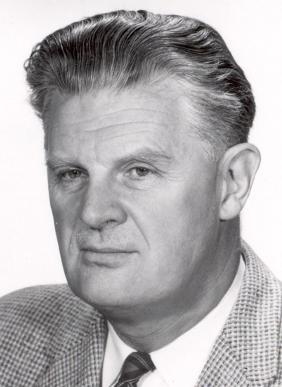
Selected works of G.F.G. Stanley
The Birth of Western Canada: A History of The Riel Rebellions (1936). Reprint (1992) U. of Toronto Press. ISBN 0-8020-6931-2
Canada’s Soldiers, 1604-1954: The Military History of An Unmilitary People (1954) Macmillan, Toronto. ISBN 1-1357-3804-1
Louis Riel, Patriot or Rebel? (1954) Canadian Historical Association. ISBN 0-8879-8003-1
In Search of the Magnetic North: A Soldier-surveyor’s Letters from the North-west, 1843-1844 (1955) Toronto, Macmillan.
In the Face of Danger: The History of the Lake Superior Regiment (1960) ISBN 0-9781-4070-2
For Want of a Horse: Being a Journal of the Campaigns against the Americans in 1776 and 1777 conducted from Canada (1961) Tribune Press.
Louis Riel (1963). Ryerson Press. 1st Paperback Edition, 1972. 5th Printing 1969. ISBN 0-07-092961-0.
The Story of Canada’s Flag: A Historical Sketch (1965) Ryerson Press.[45] ISBN 0-7700-0197-1
New France: The Last Phase, 1744-1760 (1968) McClelland and Stewart. ISBN 0-1969-0375-0
A Short History of the Canadian Constitution (1969) Ryerson Press ISBN 0-7700-0270-6
The War of 1812: Land Operations (1983) Macmillan of Canada. ISBN 0-7715-9859-9
The Collected Writings of Louis Riel/Les Ecrits Complets de Louis Riel (1985) University of Alberta Press. (Text in French and English) ISBN 0-88864-091-9
Toil And Trouble: Military Expeditions To Red River (1989) Dundurn Press Ltd. ISBN 1-55002-059-5
Battle in the Dark: Stoney Creek, June 6, 1813 (1991). ISBN 978-0-919511-46-0
The Role of the Lieutenant-Governor: A Seminar (1992). ISBN 1-5504-8679-9
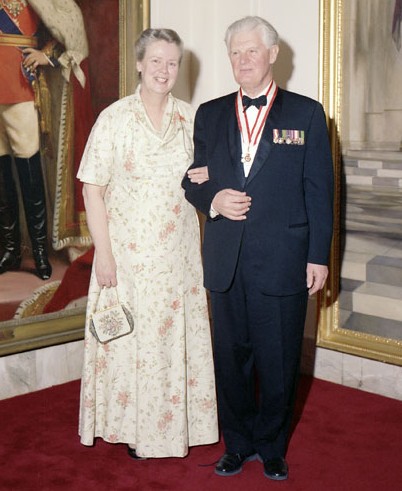
(Library and Archives Canada Photo, MIKAN No. 3608287)
George and Ruth Stanley.