
McDonnell Douglas F-4 Phantom II
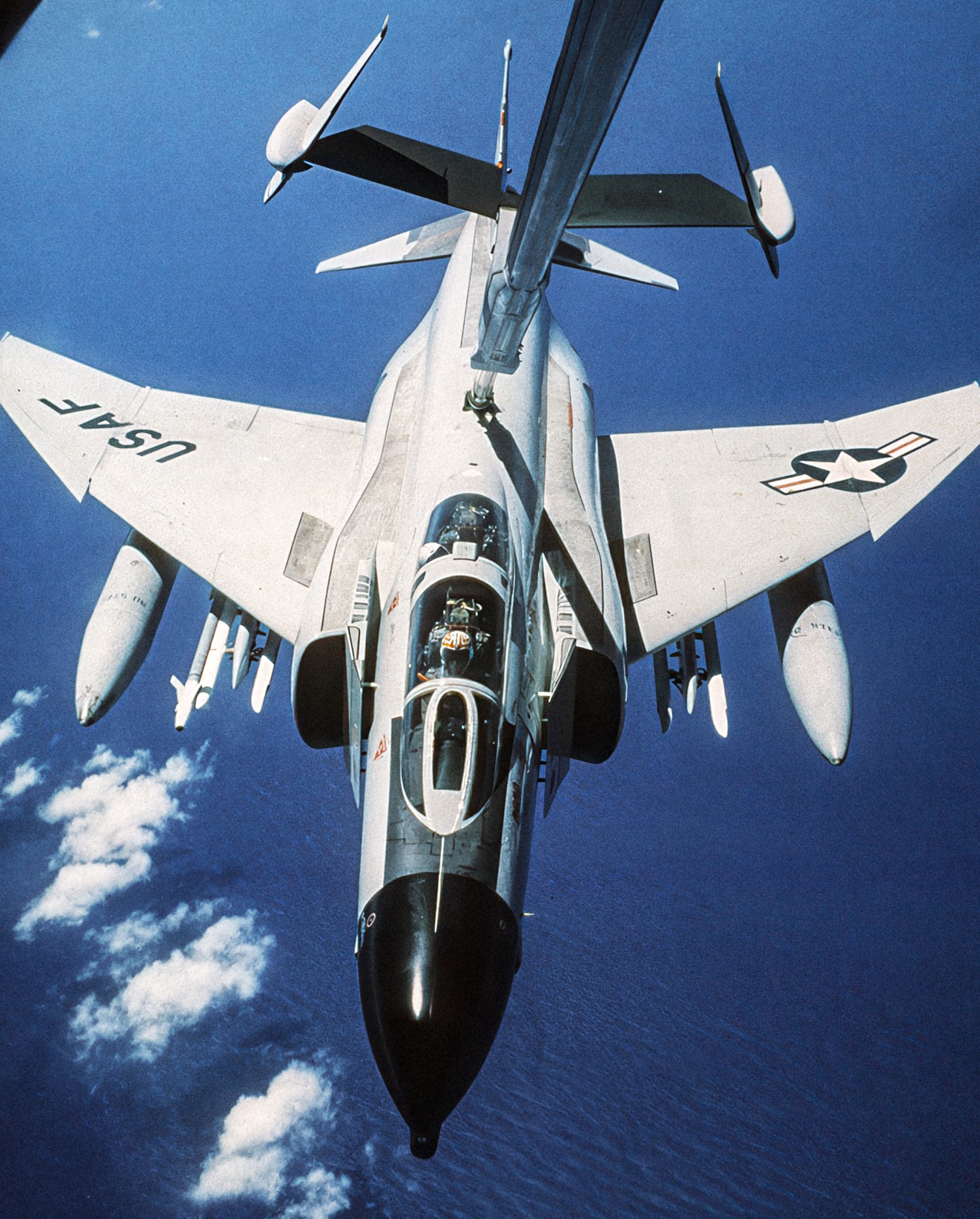
(USAF Photo)
McDonnell Douglas F-4 Phantom II being refueled in flight by a McDonnell Douglas KC-10 Extender aircraft over Hawaii during exercise Cope Canine ’85.
The McDonnell Douglas F-4 Phantom II is an American tandem two-seat, twin-engine, all-weather, long-range supersonic jet interceptor and fighter-bomber originally developed by McDonnell Aircraft for the United States Navy. Proving highly adaptable, it entered service with the Navy in 1961 before it was adopted by the United States Marine Corps and the United States Air Force, and by the mid-1960s it had become a major part of their air arms. Phantom production ran from 1958 to 1981 with a total of 5,195 aircraft built, making it the most produced American supersonic military aircraft in history, and cementing its position as a signature combat aircraft of the Cold War.
The Phantom is a large fighter with a top speed of over Mach 2.2. It can carry more than 18,000 pounds (8,400 kg) of weapons on nine external hardpoints, including air-to-air missiles, air-to-ground missiles, and various bombs. The F-4, like other interceptors of its time, was initially designed without an internal cannon. Later models incorporated an M61 Vulcan rotary cannon. Beginning in 1959, it set 15 world records for in-flight performance,[8] including an absolute speed record and an absolute altitude record.
The F-4 was used extensively during the Vietnam War. It served as the principal air superiority fighter for the U.S. Air Force, Navy, and Marine Corps and became important in the ground-attack and aerial reconnaissance roles late in the war. During the Vietnam War, all five American servicemen who became aces – one U.S. Air Force pilot, two weapon systems officers (WSOs),[10] one U.S. Navy pilot and one radar intercept officer (RIO) – did so in F-4s. The F-4 continued to form a major part of U.S. military air power throughout the 1970s and 1980s, being gradually replaced by more modern aircraft such as the F-15 Eagle and F-16 Fighting Falcon in the U.S. Air Force, the F-14 Tomcat in the U.S. Navy, and the F/A-18 Hornet in the U.S. Navy and U.S. Marine Corps.
The F-4 Phantom II remained in use by the U.S. in the reconnaissance and Wild Weasel (Suppression of Enemy Air Defenses) roles in the 1991 Gulf War, finally leaving combat service in 1996. It was also the only aircraft used by both U.S. flight demonstration teams: the United States Air Force Thunderbirds (F-4E) and the United States Navy Blue Angels (F-4J). The F-4 was also operated by the armed forces of 11 other nations. Israeli Phantoms saw extensive combat in several Arab–Israeli conflicts, while Iran used its large fleet of Phantoms, acquired before the fall of the Shah, in the Iran–Iraq War. The F-4 remains in active service with the air forces of Iran, Greece, and Turkey. The aircraft has most recently been in service against the Islamic State group in the Middle East. (Wikipedia)
Known by many nicknames, in recognition of its record of downing large numbers of Soviet-built MiGs, the Phantom II was called the “World’s Leading Distributor of MiG Parts”.
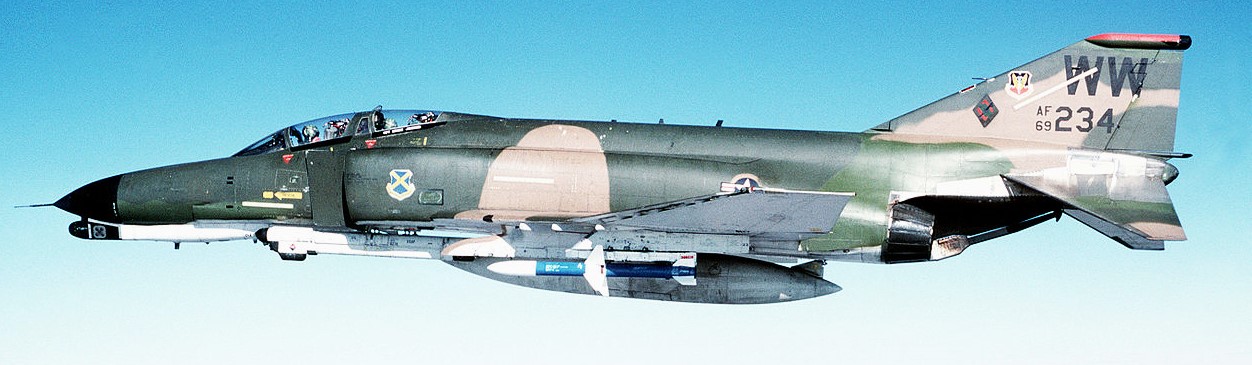
(USAF Photo)
U.S. Air Force F-4G Phantom II (Serial No. 69-7234) in flight during Exercise Gallant Eagle ’82 near George Air Force Base, California (USA), 1 April 1982. The F-4E-43-MC 69-7234 (c/n 3902) was loaned to the RAAF from 1970 to 1973. Subsequently modified to F-4G in 1972, to AMARC in 1991, to QF-4G in 1999.
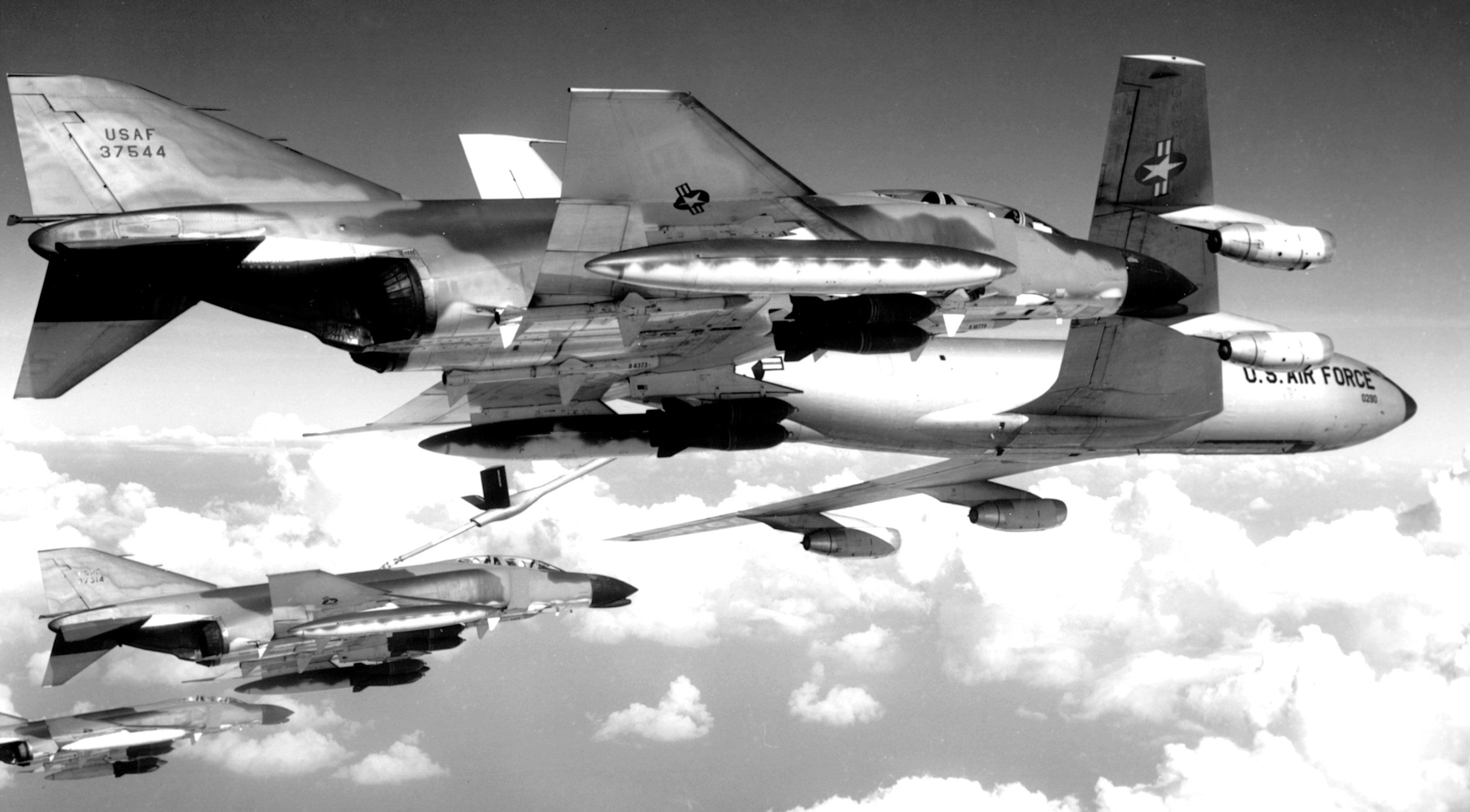
(USAF Photo)
McDonnell F-4C Phantom II fighters refuel from a Boeing KC-135A Stratotanker aircraft before making a strike against targets in North Vietnam. The Phantoms are loaded with six 750 pound general purpose bombs, (three each on triple ejector racks (TER) on the inboard pylons) four AIM-7 Sparrow air to air missles, and 370 gallon external fuel tanks on the outboard pylons.
(USAF Photo)
U.S. Air Force McDonnell Douglas F-4G Phantom II aircraft (s/n 69-7231) of the 37th Tactical Fighter Wing launches an AGM-45 Shrike missile near George Air Force Base, California (USA) on 1 August 1988. This aircraft was retired to the AMARC as FP0838 on 17 April 1992 and later converted to an QF-4G drone.
(USAF Photo)
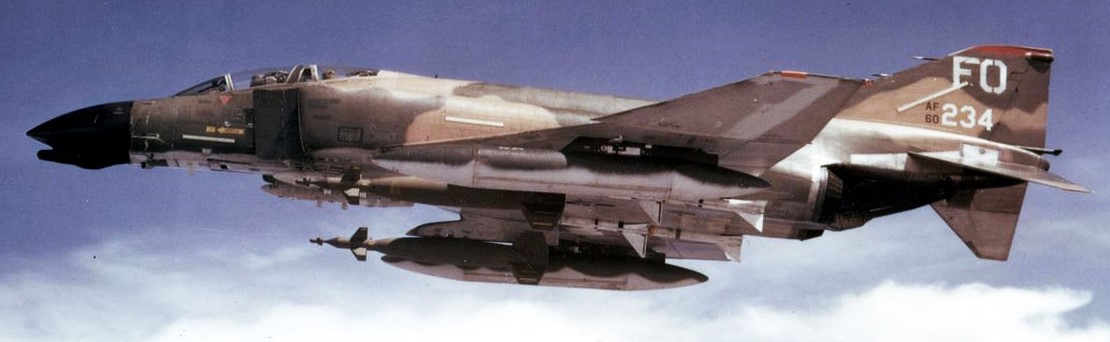
U.S. Air Force McDonnell Douglas F-4D-29-MC (S/N 66-234) of the 435th Tactical Fighter Squadron, 8th Tactical Fighter Wing, armed with two GBU-10s over North Vietnam in September 1972.
(USN Photo)
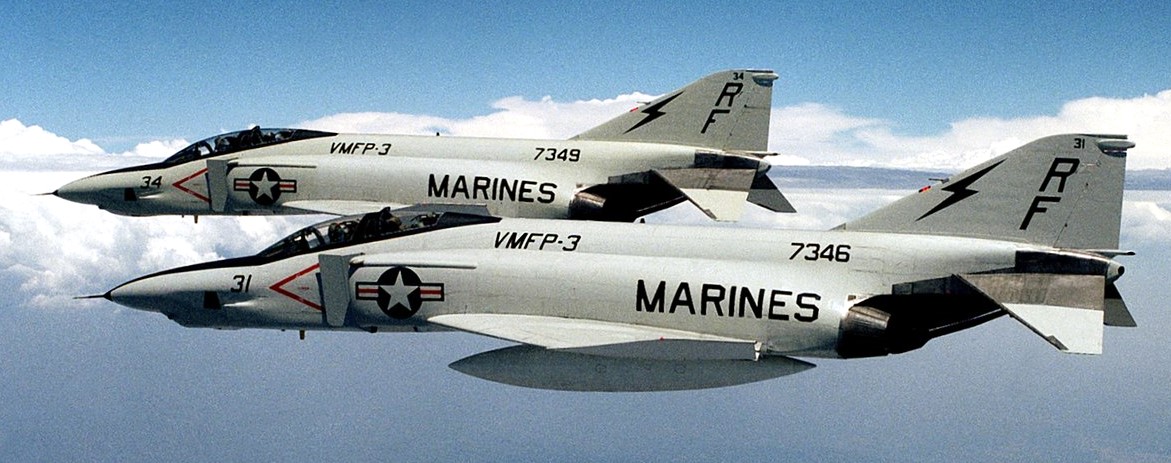
Two McDonnellDouglas RF-4B Phantom II aircraft (BuNos 157346, 157349) from Marine Photo-Reconnaissance Squadron 3 (VMFP-3) pass over the mountains during a flight out of Marine Corps Air Station, El Toro, California. VMFP-3 was the last active-duty naval aviation unit to fly the F-4. Both aircraft were retired on 10 August 1990. 157349 is today on display at the National Museum of Naval Aviation at Pensacola, Florida
(USAF Photo)
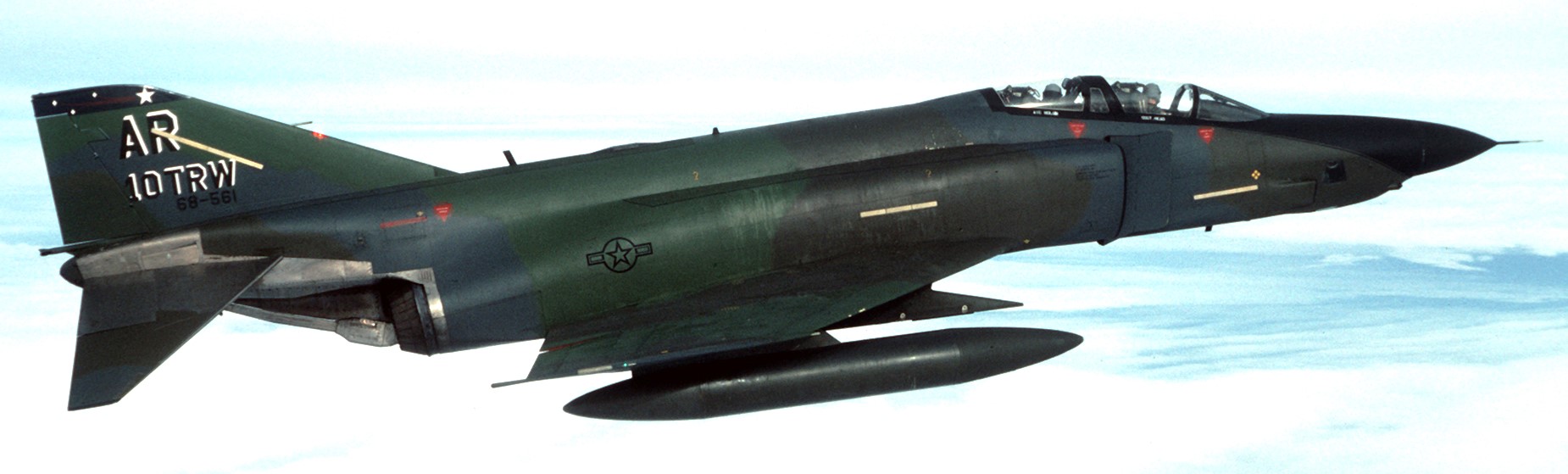
1st Tactical Reconnaissance Squadron RF-4C Phantom aircraft en route to Royal Air Force Alconbury, England, Feb 1987.
(USAF Photo)
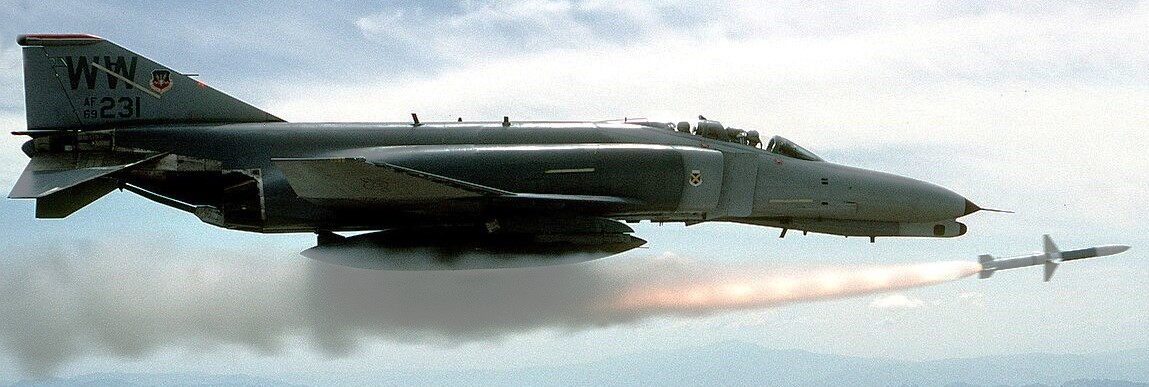
U.S. Air Force McDonnell Douglas F-4G Phantom II aircraft (Serial No. 69-7231) of the 37th Tactical Fighter Wing launches an AGM-45 Shrike missile near George Air Force Base, California (USA) on 1 August 1988. This aircraft was retired to the AMARC as FP0838 on 17 April 1992 and later converted to an QF-4G drone.
(USAF Photo)
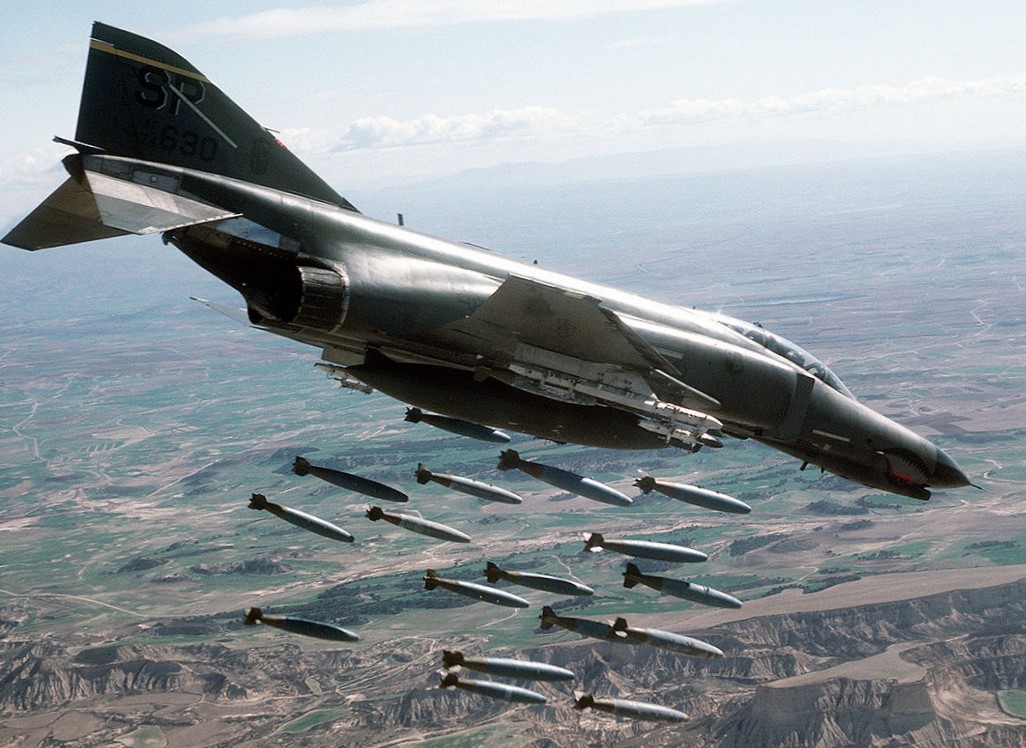
U.S. Air Force McDonnell Douglas F-4E-61-MC Phantom II (Serial No. 74-1630) from the 81st Tactical Fighter Squadron, 52nd Tactical Wing, releasing 18 Mark 82 227 kg bombs over the Bardenas Reales Gunnery Range, Spain, on 25 March 1986.
(USAF Photo)
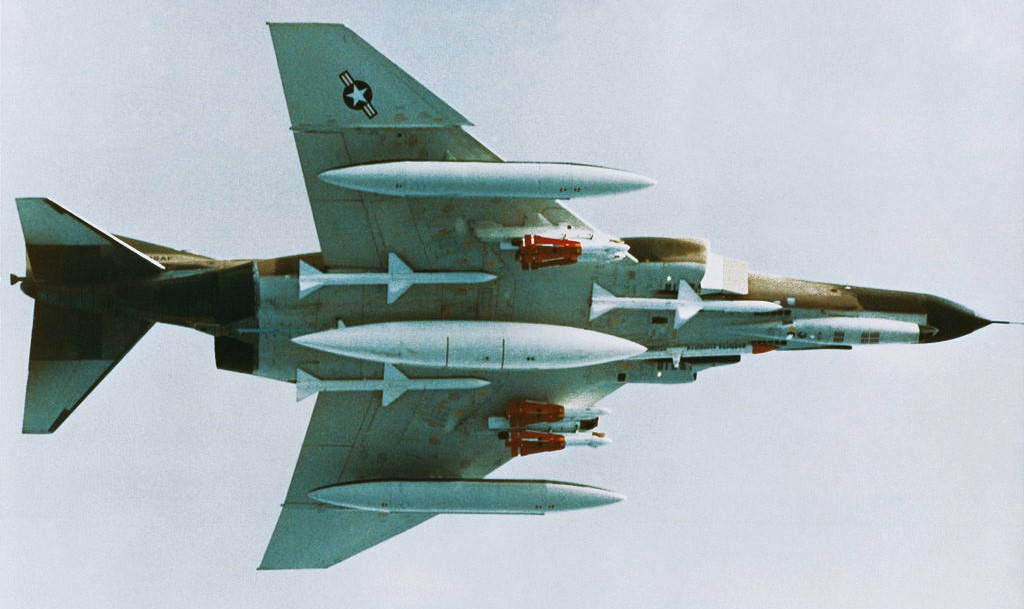
McDonnell Douglas F-4E Phantom II aircraft armed with three AIM-7 Sparrow missiles, an EROS pod, and four red-tailed AIM-4 missiles.
(USAF Photo)
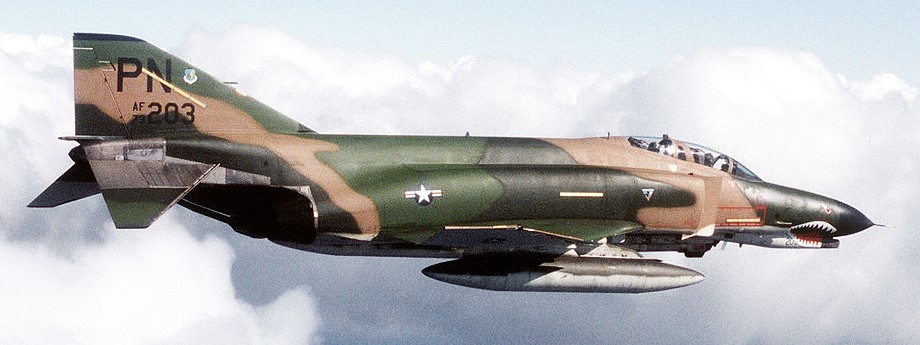
U.S. Air Force McDonnell Douglas F-4E-59-MC Phantom II (Serial No. 73-1203) of the 3rd Tactical Fighter Wing from Clark Air Base, Philippines, flying out of Misawa Air Base, Japan, during exercise “Cope North 80” on 15 October 1980.
(USAF Photo)
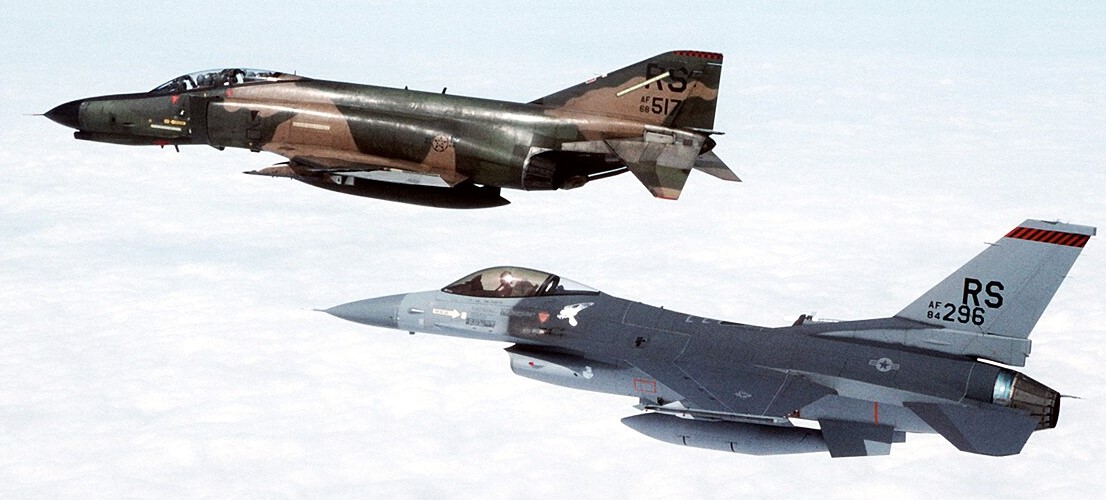
U.S. Air Force General Dynamics F-16C Block 25E Fighting Falcon (s/n 84-1296) and an McDonnell Douglas F-4E-41-MC Phantom II (s/n 68-0517) of the 526th Tactical Fighter Squadron in flight over Germany on 21 May 1986. The F-4E was on one of its last flights before being replaced by the F-16C.
(NMNA Photo)
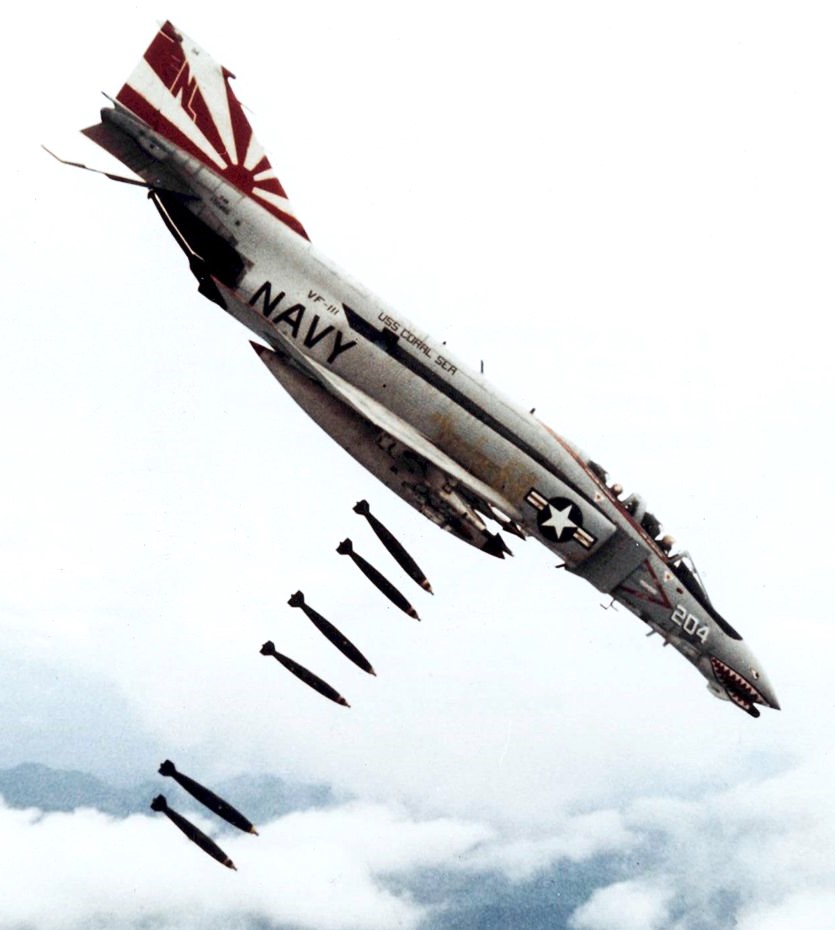
U.S. Navy McDonnell F-4B Phantom II of Fighter Squadron VF-111 Sundowners drops 227 kg Mk 82 bombs over Vietnam during 1971. VF-111 was assigned to Attack Carrier Air Wing 15 (CVW-15) aboard the aircraft carrier USS Coral Sea (CVA-43) for a deployment to Vietnam from 12 November 1971 to 17 July 1972.
(USN Photo)
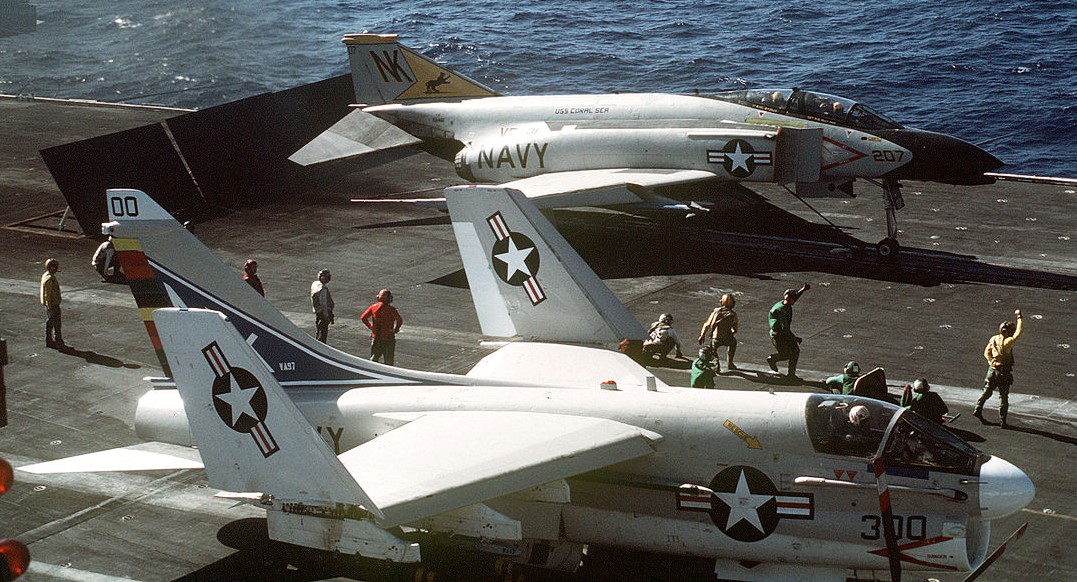
McDonnell F-4N Phantom II aircraft from Fighter Squadron 21 (VF-21) Free Lancers and an A-7E Corsair II aircraft from Attack Squadron 97 (VA-97) Warhawks during preflight preparations on the flight deck of the aircraft carrier USS Coral Sea (CV-43). Other Notes not from source: The F-4N is BuNo. 151461. The A-7E (probably BuNo. 156872) is also the personalized aircraft of the Commander Air Group (CAG) of Carrier Air Wing Fourteen (CVW-14) at that time. 1981/82 Coral Sea was deployed to the Mediterranean and the Indian Ocean.
(USN Photo)
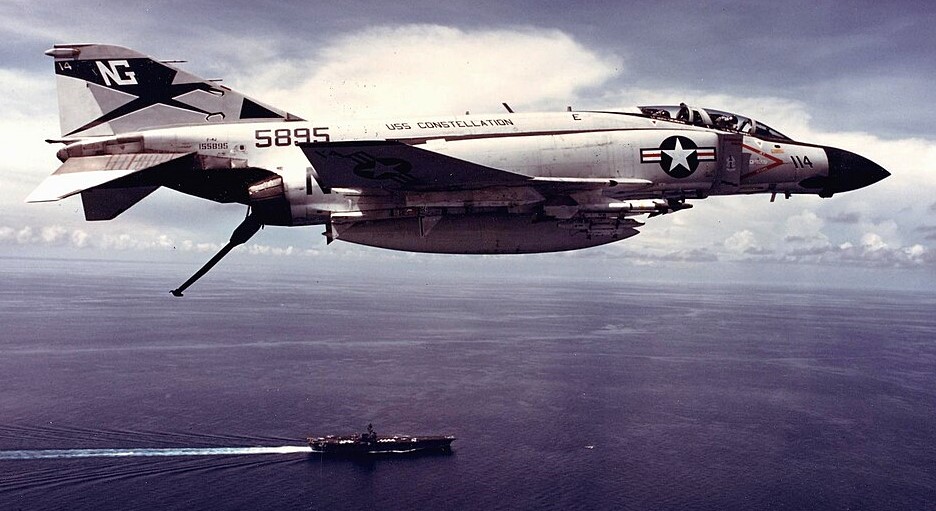
U.S. Navy McDonnell Douglas F-4J Phantom II (BuNo 155895) of Fighter Squadron 96 (VF-96) “Fighting Falcons” in flight over the aircraft carrier USS Constellation (CVA-64). VF-96 was assigned to Attack Carrier Air Wing 9 (CVW-9) aboard the Constellation between 1971 and 1974. The aircraft is fully armed with AIM-7 Sparrow and AIM-9D Sidewinder missiles, indicating that this photo was probably taken during a deployment to Vietnam.
(USN Photo)
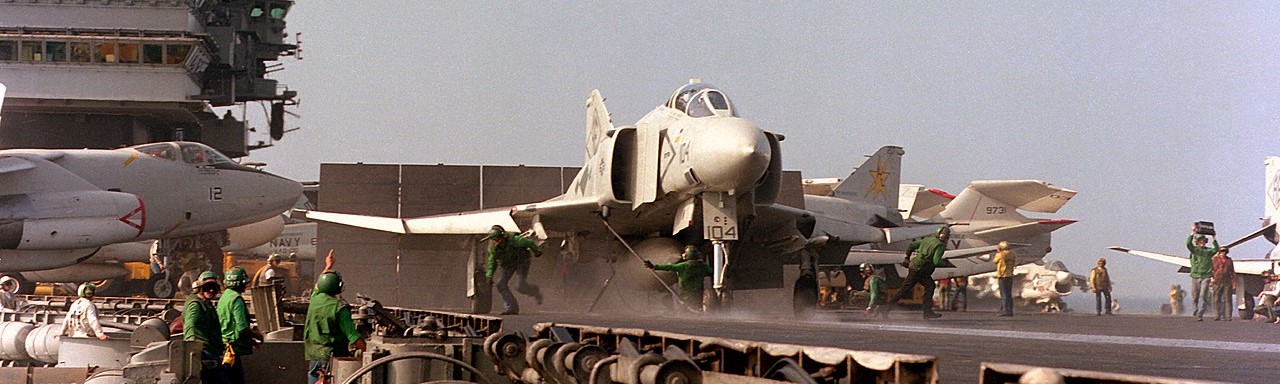
U.S. Navy McDonnell Douglas F-4J Phantom II aircraft from Fighter Squadron 102 (VF-102) just prior to launch from the flight deck of the aircraft carrier USS INDEPENDENCE (CV-62) in 1979. The aircraft was assigned to Carrier Air Wing 7 (CVW-7).
(USN Photo)
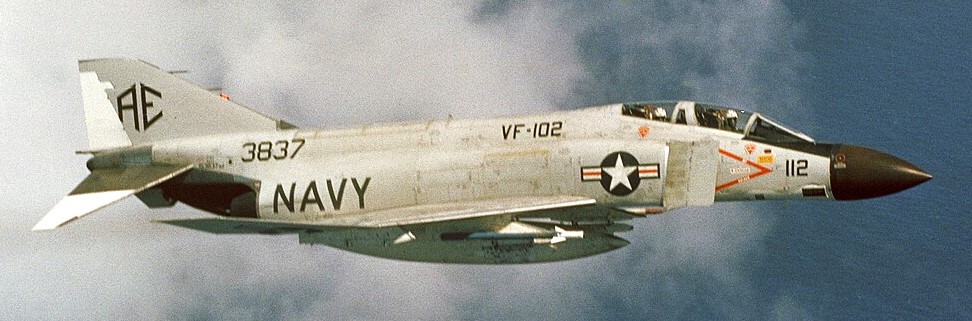
U.S. Navy McDonnell Douglas F-4J Phantom II (BuNo 153837) from Fighter Squadron 102 (VF-102) “Diamondbacks” over the Caribbean Sea. VF-102 was assigned to Attack Carrier Air Wing 6 (CVW-6) the aircraft carrier USS America (CVA-66) for a deployment to Vietnam from 10 April to 16 December 1968. It later crashed on approach to USS Franklin D. Roosevelt (CV-42) on 25 August 1975 while in service with VF-101.
(USN Photo)
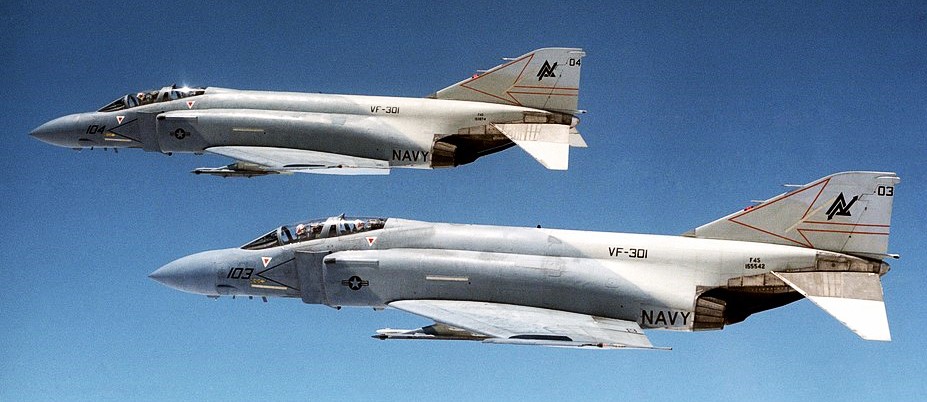
Two F-4S Phantom II, Fighter Squadron (VF)-301, Devil’s Disciples, NAS Miramar, in flight.
(NMUSAF Photo)
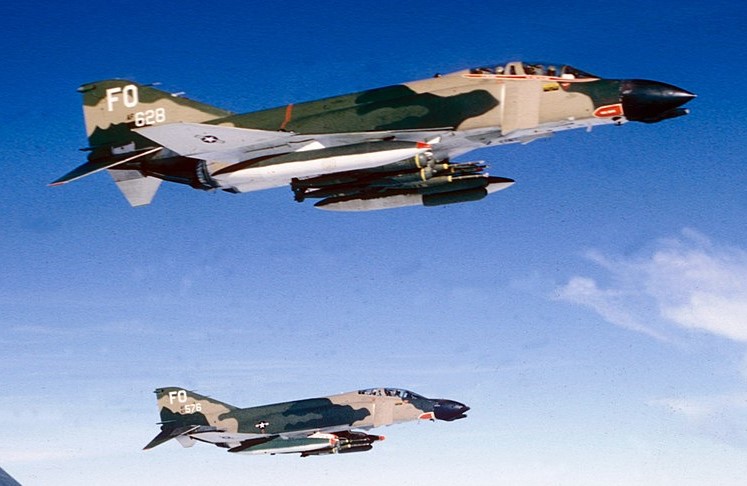
Two U.S. Air Force McDonnell F-4D-30-MC Phantom II fighters (s/n 66-7576, 66-7628) from the 435th Tactical Fighter Squadron, 8th Tactical Fighter Wing, over Vietnam, off the wing of a Boeing KC-135A Stratotanker. Both Phantoms are armed with three SUU-30/B cluster bombs (right wing), three LAU-3 rocket launchers (left wing) and six Mk 82 227 kg bombs (centerline). F-4D 66-7576 was written off in Vietnam on 30 July 1972.
(NMNA Photo)
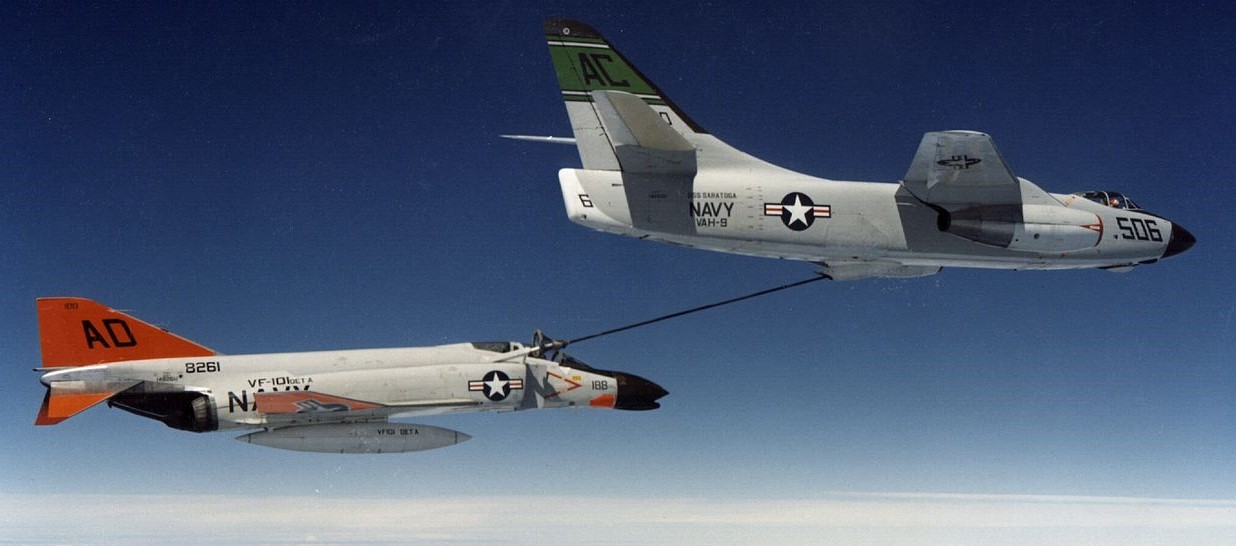
U.S. Navy Douglas A3D-2 Skywarrior (BuNo 142650) from Heavy Attack Squadron VAH-9 Hoot Owls refueling a McDonnell F4H-1F Phantom II (BuNo 148261) from Fighter Squadron VF-101 Det. A Grim Reapers during the “Project LANA Bendix Trophy Race” in 1961. To cap off the Phantom´s successful speed and altitude efforts, the U.S. Navy initiated “Project LANA”, a transcontinental flight by five F4H-1F (after 1962 F-4A). The Roman letter “L” means “50”, “ANA” stood for the “(50th) Anniversary of Naval Aviation”. Refueling problems of BuNo 148261 handed the Bendix Trophy Race contest on 24 May 1961 to the F4H-1F BuNo 148270, which flew from Ontario, California (USA), to Floyd Bennett Field, New York (USA), at an average of speed of 1399.66 kph.
Variants
F-4A, B, J, N and S. Variants for the U.S. Navy and the U.S. Marine Corps. F-4B was upgraded to F-4N, and F-4J was upgraded to F-4S.
F-110 (original USAF designation for F-4C), F-4C, D and E. Variants for the U.S. Air Force.
F-4E introduced an internal M61 Vulcan cannon. The F-4D and E were the most numerously produced, widely exported, and also extensively used under the Semi Automatic Ground Environment (SAGE) U.S. air defense system.
F-4G Wild Weasel VA dedicated Suppression of Enemy Air Defenses (SEAD) variant for the U.S. Air Force with updated radar and avionics, converted from F-4E. The designation F-4G was applied earlier to an entirely different U.S. Navy Phantom.
F-4K and M Variants for the Royal Navy and Royal Air Force, respectively, re-engined with Rolls-Royce Spey turbofan engines.
F-4EJ and RF-4EJ. Simplified F-4E exported to and license-built in Japan. Some modified for reconnaissance role, carrying photographic and/or electronic reconnaissance pods and designated RF-4EJ.
F-4F Simplified F-4E exported to Germany.
QRF-4C, QF-4B, E, G, N and S. Retired aircraft converted into remote-controlled target drones used for weapons and defensive systems research by USAF and USN / USMC.
RF-4B, C, and E. Tactical reconnaissance variants.
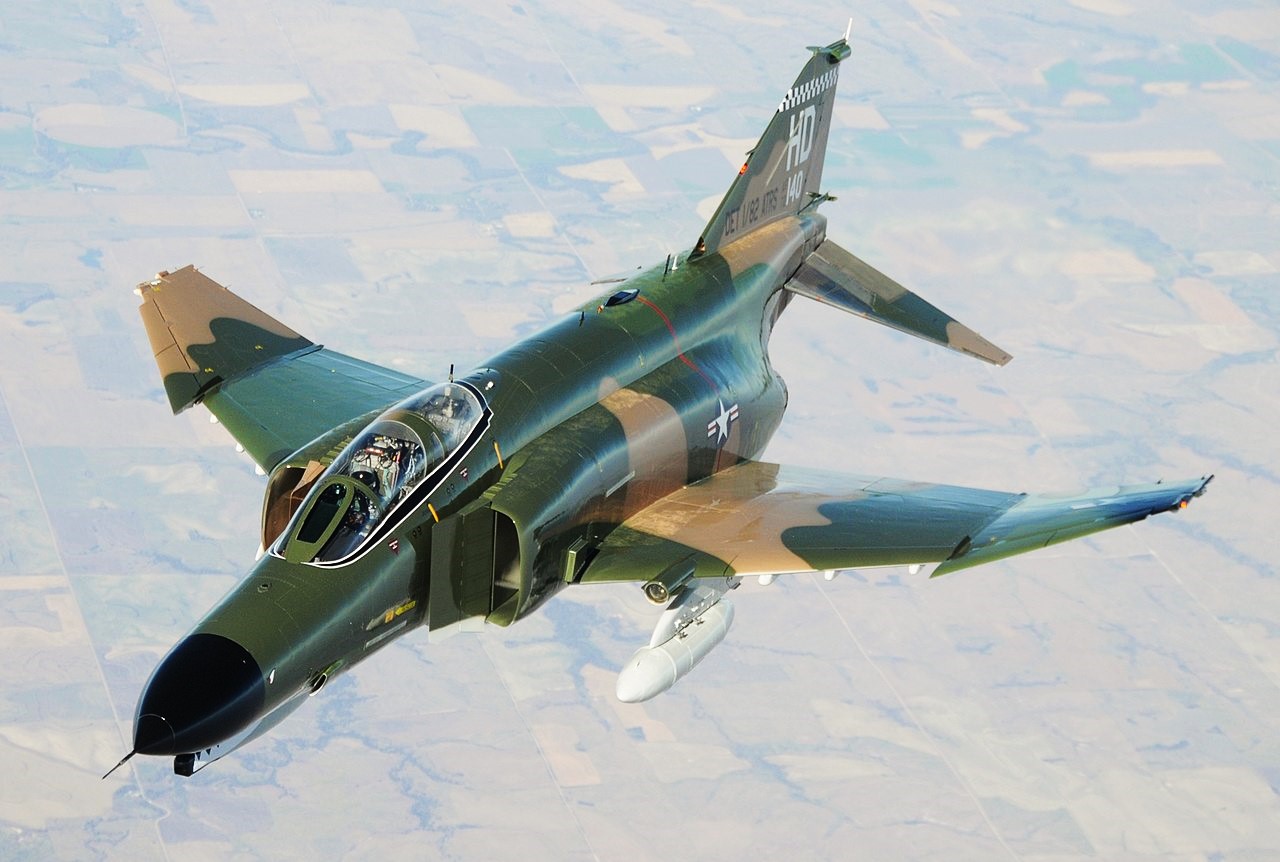
(USGOV-PD Photo)
McDonnell QF-4E Phantom II, with the 82nd Aerial Targets Squadron over White Sands Missile Range in 2008.
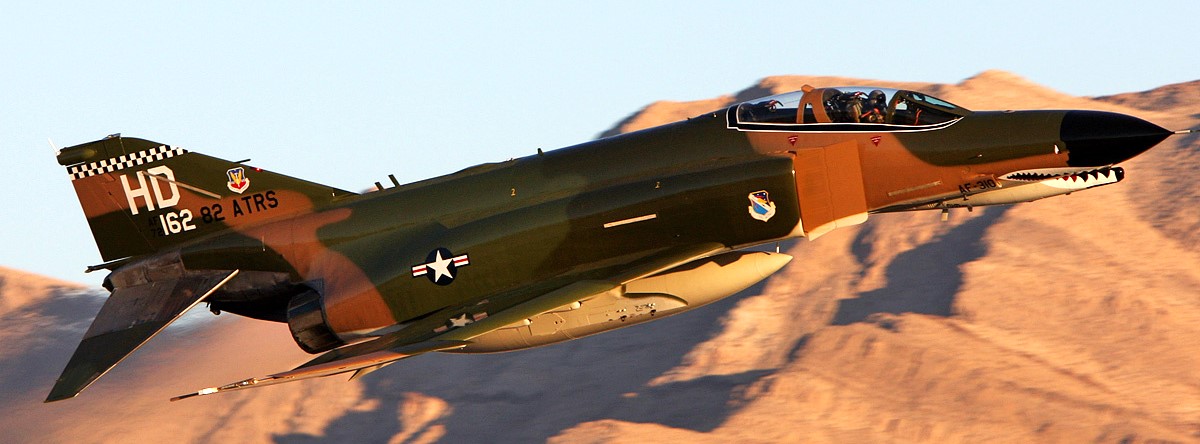
(James Rowson Photo)
McDonnell QF-4E Phantom II (Serial No. 72-0162), coded HD, C/N 4341, at Las Vegas – Nellis AFB, Nevada, 10 Nov 2007.
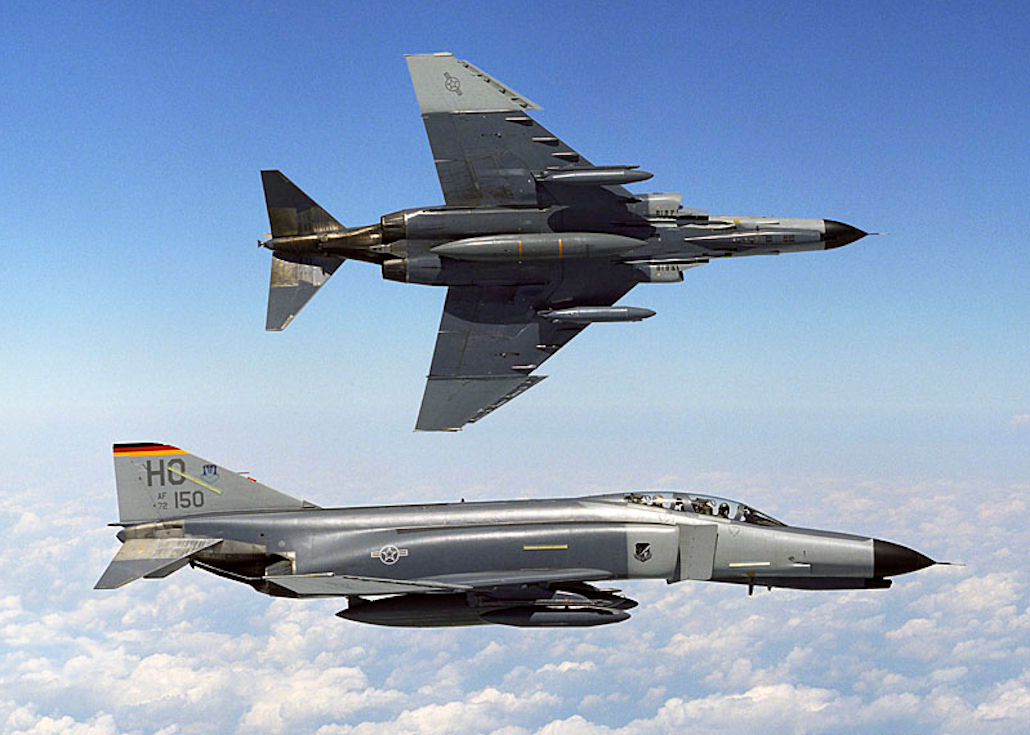
(USAF Photo)
20th Fighter Squadron Luftwaffe McDonnell Douglas F-4F-54-MC Phantom (Serial No. 72-1150), with another F-4F over the skies of Holloman AFB, New Mexico.
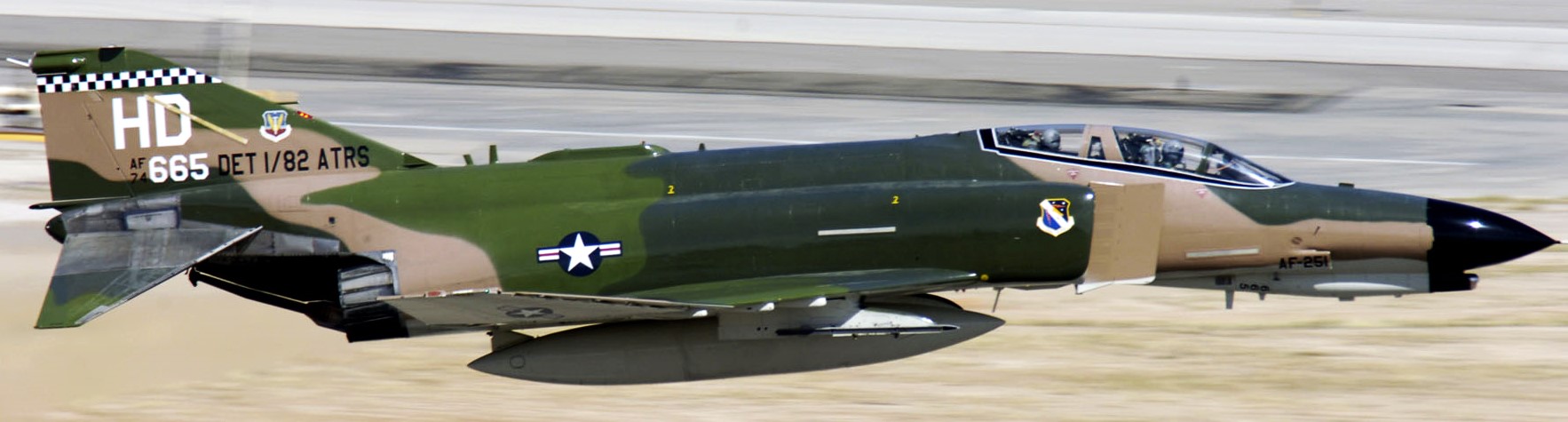
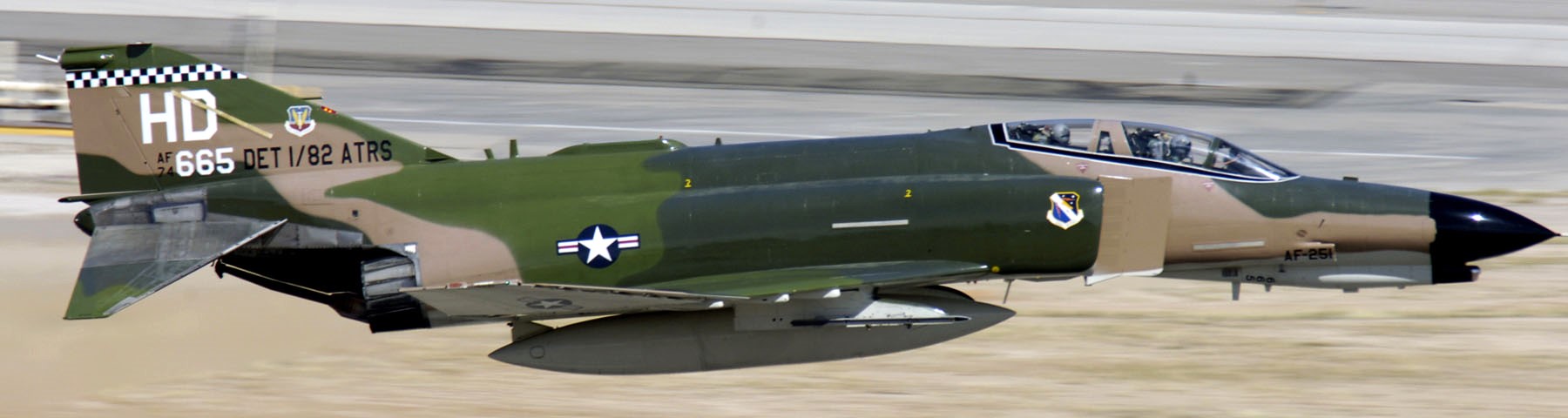
(Senior Airman Jesse Shipps, USAF Photo)
A U.S. Air Force McDonnell Douglas QF-4E Phantom II (s/n 74-0665) of the 82nd Aerial Targets Squadron takes off from Davis-Monthan Air Force Base, Arizona, 3 March 2007, during the 2007 Heritage Conference. The conference provided an opportunity for Air Combat Command demonstration pilots to train together with modern and historic military aircraft in preparation for the upcoming air-show season.
(USN Photo)
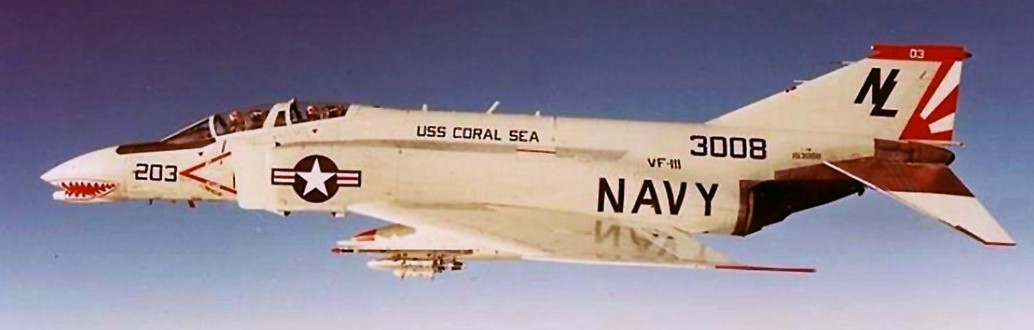
U.S. Navy McDonnell F-4B Phantom II (BuNo 153008) from Fighter Squadron 111 (VF-111) “Sundowners” in flight. VF-111 was assigned to Attack Carrier Air Wing 15 (CVW-15) aboard the aircraft carrier USS Coral Sea (CVA-43) for a deployment to Vietnam from 9 March to 8 November 1973.
(NASA Photo)
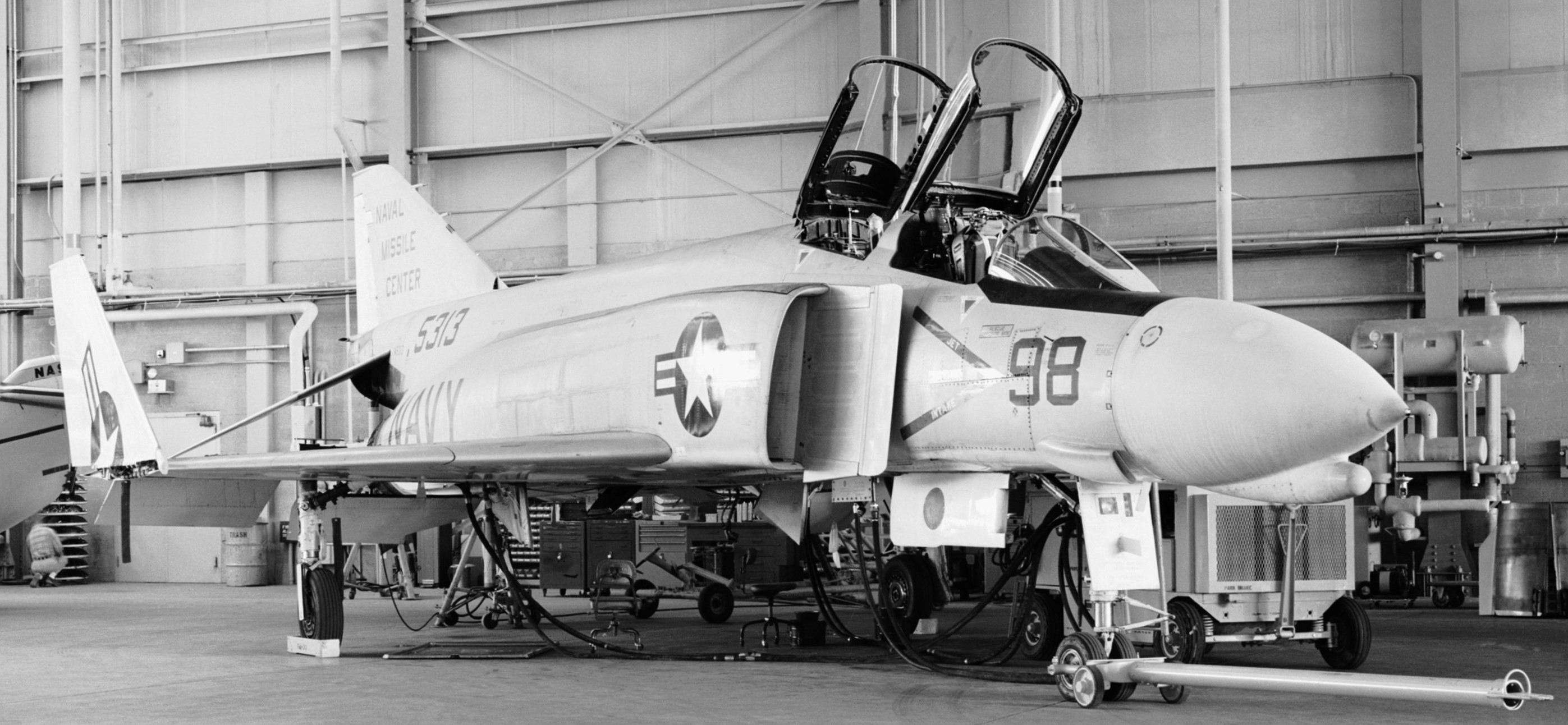
McDonnell F-4A Phantom II in the NASA Flight Research Center hangar undergoing maintenance inspection in preparation for a flight. Notice the large inlet on the right side of the fuselage, the tandem cockpit, and the wing tip folded in an upward position. The F-4A (Navy serial number 145313) arrived at the Flight Research Center (later redesignated the NASA Dryden Flight Research Center) on 3 December 1965. It was damaged by an inflight explosion on 25 July 1967. Able to land despite the explosion, it was later returned to the Navy.
(USN Photo)
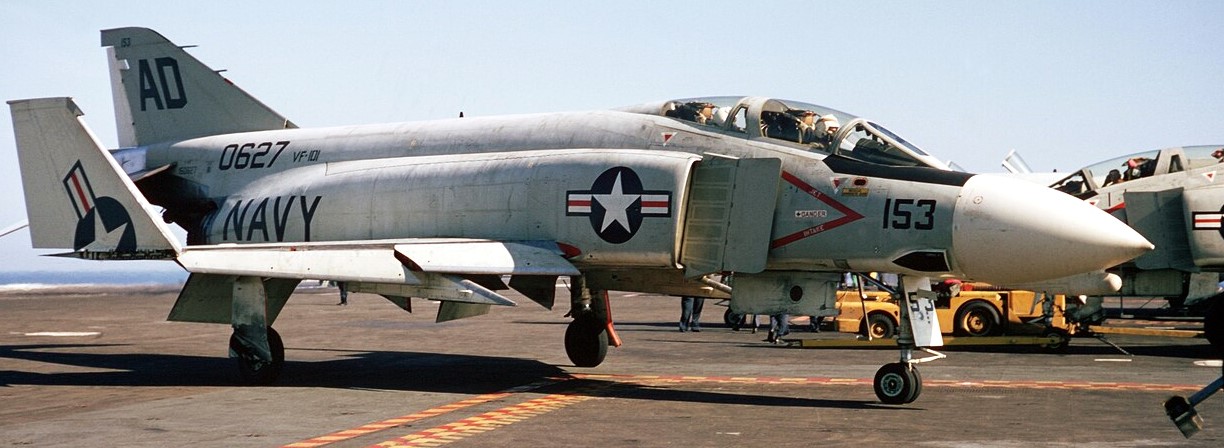
U.S. Navy McDonnell F-4B-14-MC Phantom II (BuNo 150627) aircraft of Fighter Squadron 101 (VF-101) “Grim Reapers” taxis on the flight deck of the aircraft carrier USS America (CVA-66), in 1967. The F-4B 150627 flew into ground in heavy fog at Marine Corps Station El Toro, California (USA), then became briefly airborne, the crew ejected and the plane crashed into a car park on 30 November 1973.
(USAF Photo)
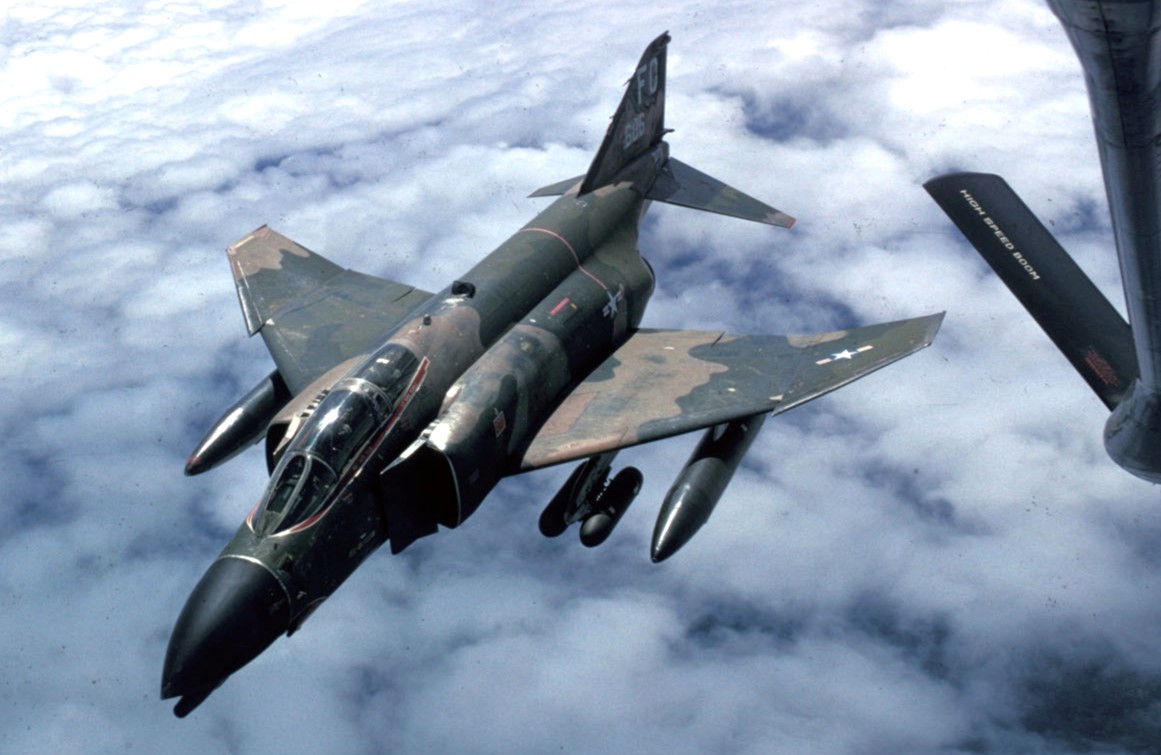
A U.S. Air Force McDonnell F-4D Phantom II of the 435th Tactical Fighter Squadron, 8th Tactical Fighter Wing, approaches a Boeing KC-135A Stratotanker over Vietnam. The aircraft is armed with LAU-3 rocket launchers.
(USAF Photo)
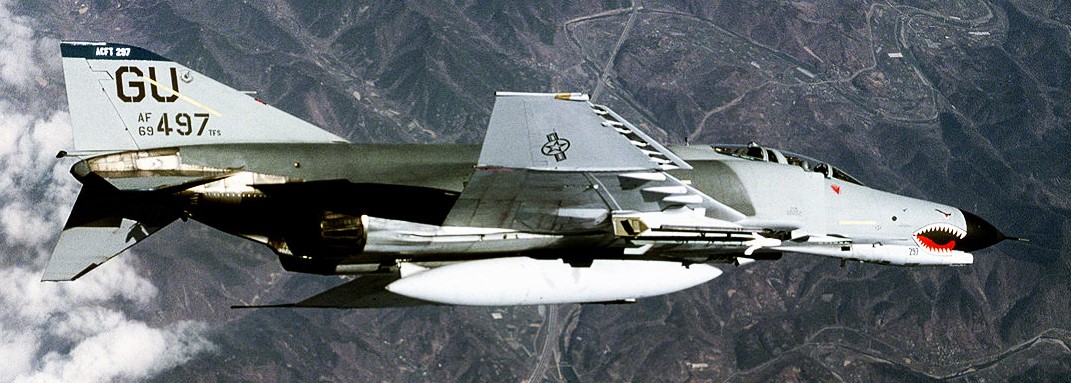
A U.S. Air Force McDonnell Douglas F-4E Phantom II from the 497th Tactical Fighter Squadron, 51st Tactical Fighter Wing, banking to the left over South Korea during exercise “Team Spirit ’86”.
(USAF Photo)
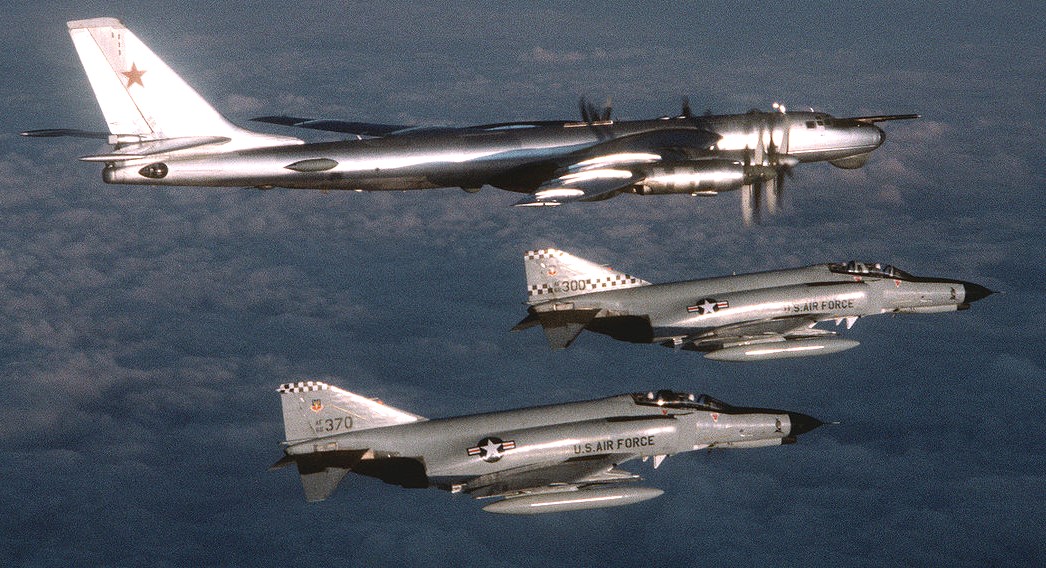
Two U.S. Air Force McDonnell Douglas F-4E Phantom II fighters (s/n 66-0300, 66-0370) intercepting a Soviet Tu-95 Bear D aircraft on 28 September 1980. The F-4Es were assigned to the 57th Fighter Interceptor Squadron based at Keflavik Air Base, Iceland. Both Phantoms were sold to Turkey in 1987. A plane bearing the serial number is 66-0300 is today on outdoor display at Keflavik AB, but it is not actually the original 66-0300.
(USN/Bill Dvorak Photo)
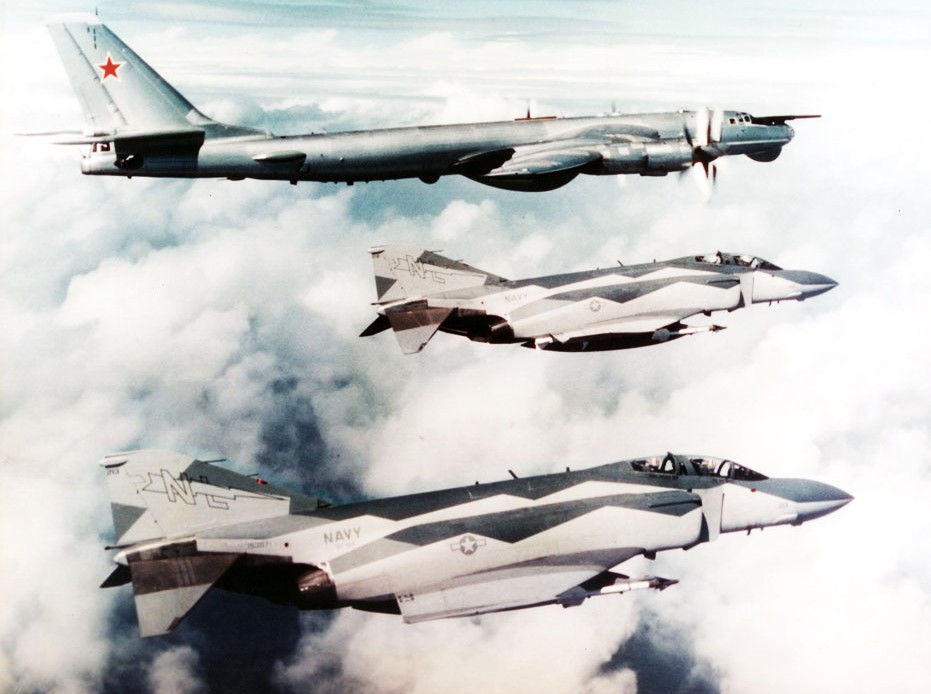
Two McDonnell Douglas F-4J Phantoms of fighter squadron VF-194 Red Lightnings intercept a soviet Tu-95 Bear reconnaissance plane on 10 March 1977. VF-194 was assigned to Carrier Air Wing Fifeteen (CVW-15) aboard the aircraft carrier USS Coral Sea (CV-43). Note the experimental camouflage scheme of the Phantoms. The crew of the F-4S nearer to the camera was William Dvorak/J.T. Walior, the other was Don Duffington/Wayne Cheatum.
(USN Photo)
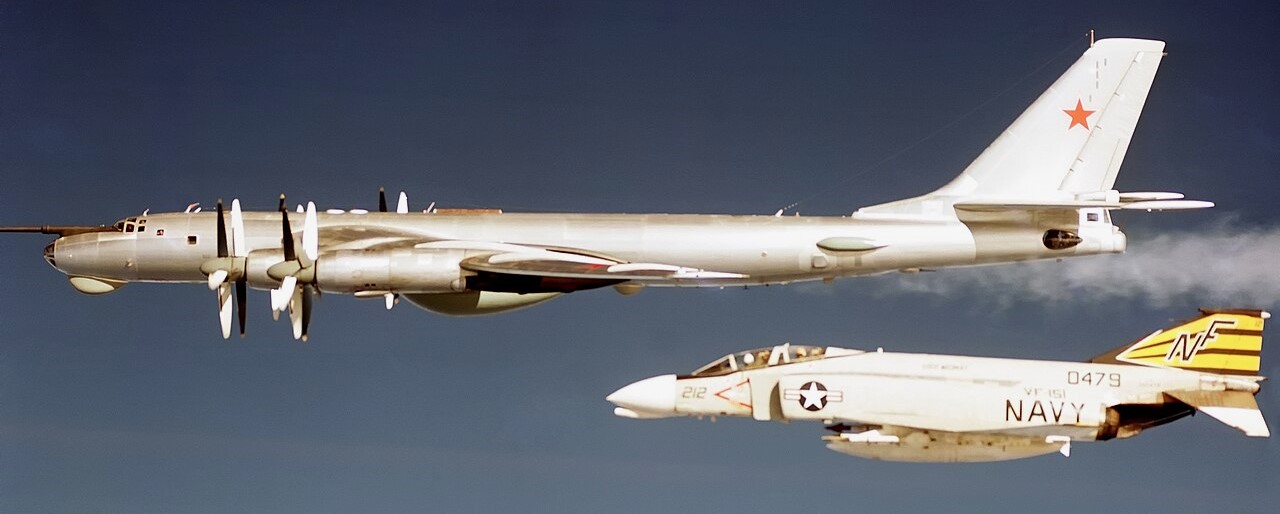
U.S. Navy McDonnell F-4B Phantom II (BuNo 150479) from Fighter Squadron VF-151 “Vigilantes” intercepting a Soviet Tu-95 Bear D aircraft in the early 1970s. The Phantom is armed with AIM-9D Sidewinder and AIM-7 Sparrow missiles. VF-151 was part of Attack Carrier Air Wing Five (CVW-5) and stationed aboard the aircraft carrier USS Midway (CVA-41).
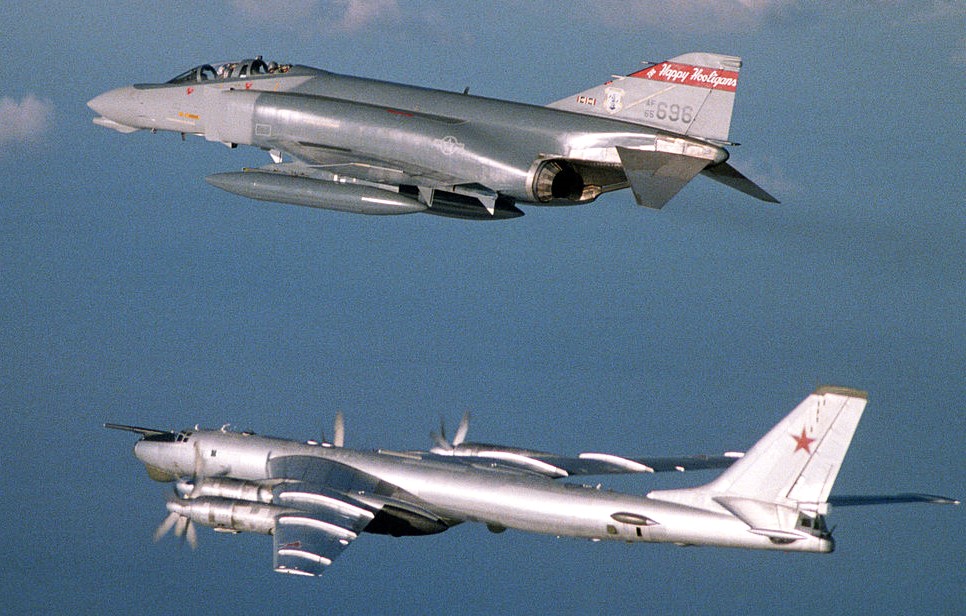
(USAF Photo)
A U.S. Air Force McDonnell F-4D-28-MC Phantom II aircraft (s/n 65-0696) assigned to the 119th Fighter Group Happy Hooligans, North Dakota Air National Guard, intercepts a Soviet Tupolev Tu-95 Bear bomber aircraft over the Arctic Ocean, during a flight to Keflavik, Iceland in 1983. Eight Russian Tu-95s were intercepted by 119th FG pilots during the deployment to Iceland.
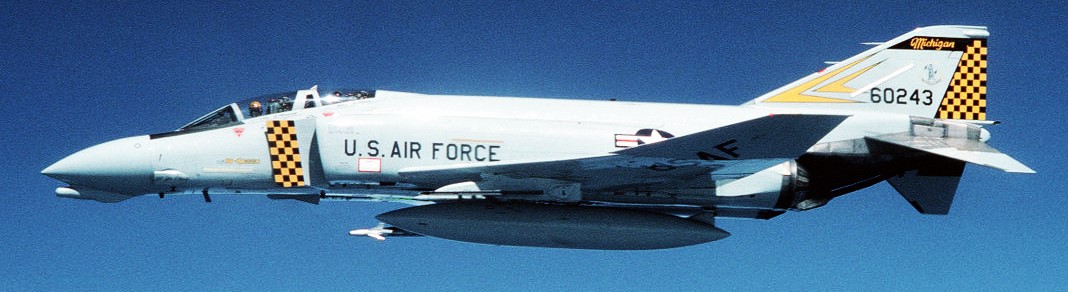
(USAF Photo)
A U.S. Air Force McDonnell F-4D-29-MC Phantom II (s/n 66-0243) from the 171st Fighter Interceptor Squadron, 191st Tactical Reconnaissance Group, Selfridge Air National Guard Base, Michigan (USA), in flight on 17 July 1987.
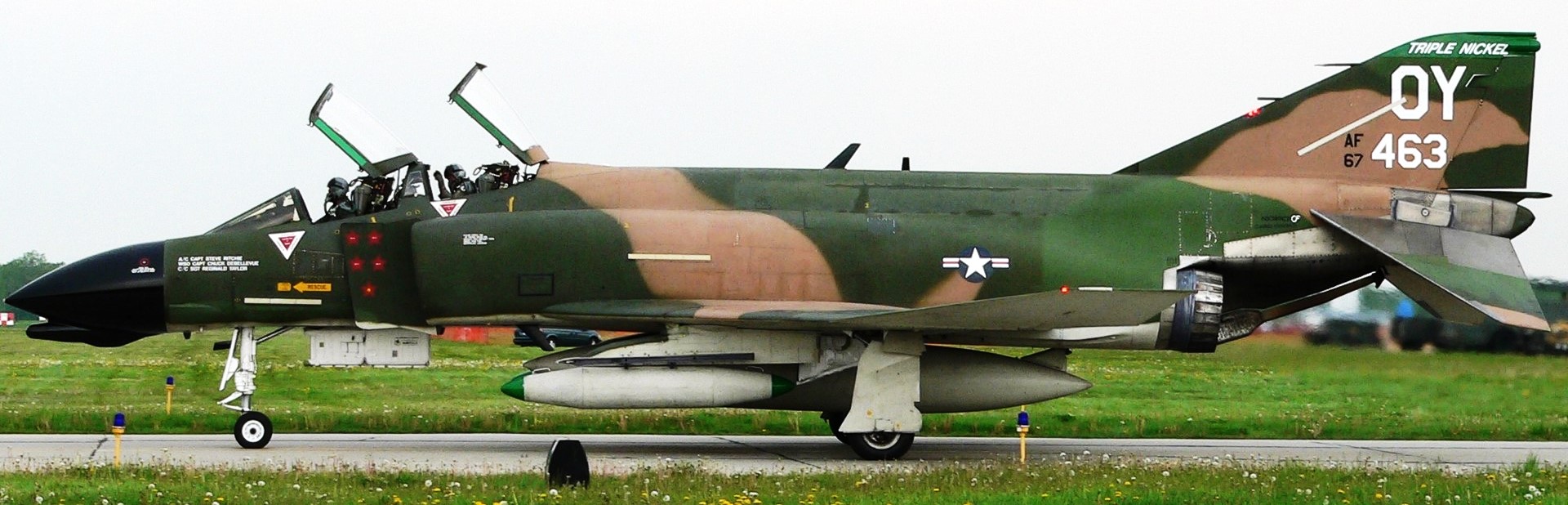
(Jacobst Photo)
An F-4D owned by the Collings Foundation taxis at Selfridge ANGB, Michigan in May 2005. The plane has the markings of the Steve Ritchie / Chuck DeBellevue fighter from the Vietnam War.
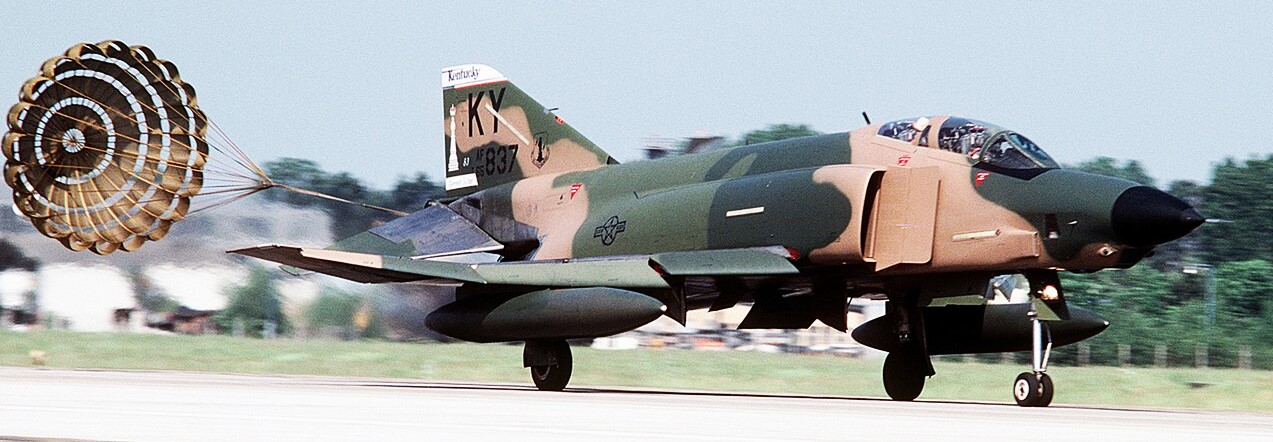
(TSgt. G. Dennis Plummer, USAF Photo)
A U.S. Air Force McDonnell RF-4C-24-MC Phantom II (s/n 65-0837) from the 165th Tactical Reconnaissance Squadron, 123rd Tactical Reconnaissance Group, Kentucky Air National Guard, landing on an airbase in Germany during exercise “Checkered Flag ’83” on 25 May 1983.
(SSgt. F. Serna, USAF Photo)
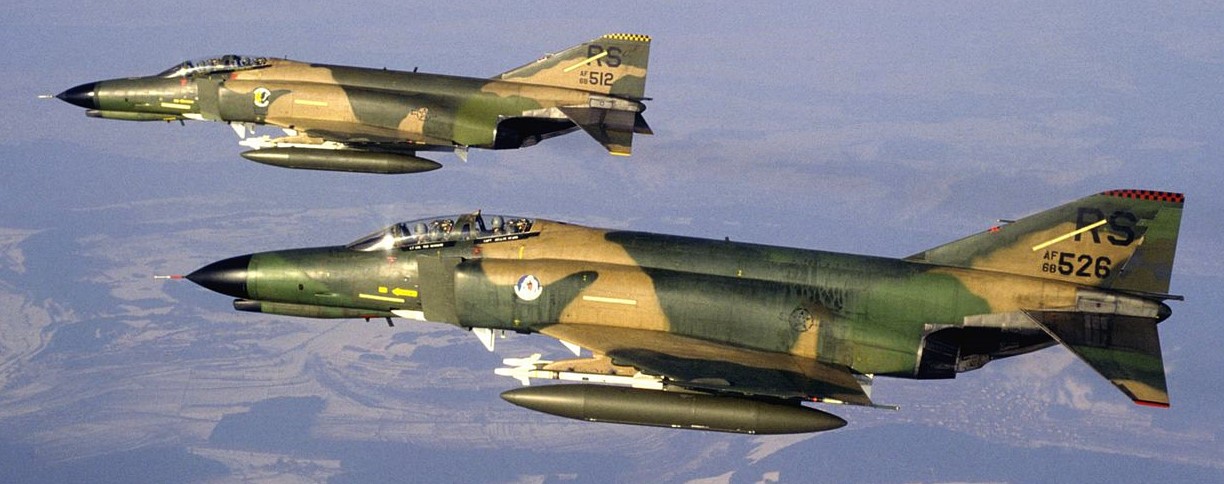
Two U.S. Air Force McDonnell Douglas F-4E-41-MC Phantom II aircraft (68-0512, 68-0526) assigned to the 512th and 526th Tactical Fighter Squadrons, 86th Tactical Fighter Wing, fly one of their last aerial missions on 20 March 1985. Both squadrons from Ramstein Air Base, Germany, replaced their Phantoms with F-16 Fighting Falcon aircraft. 68-0512 was piloted by Lieutenant Colonel Bruce Gillett and navigated by Captain Mike Craig. LtCol Tom Speelman was piloting 68-0526 with 1st Lieutenant John Rogers navigating.
(Don Jay Photo)
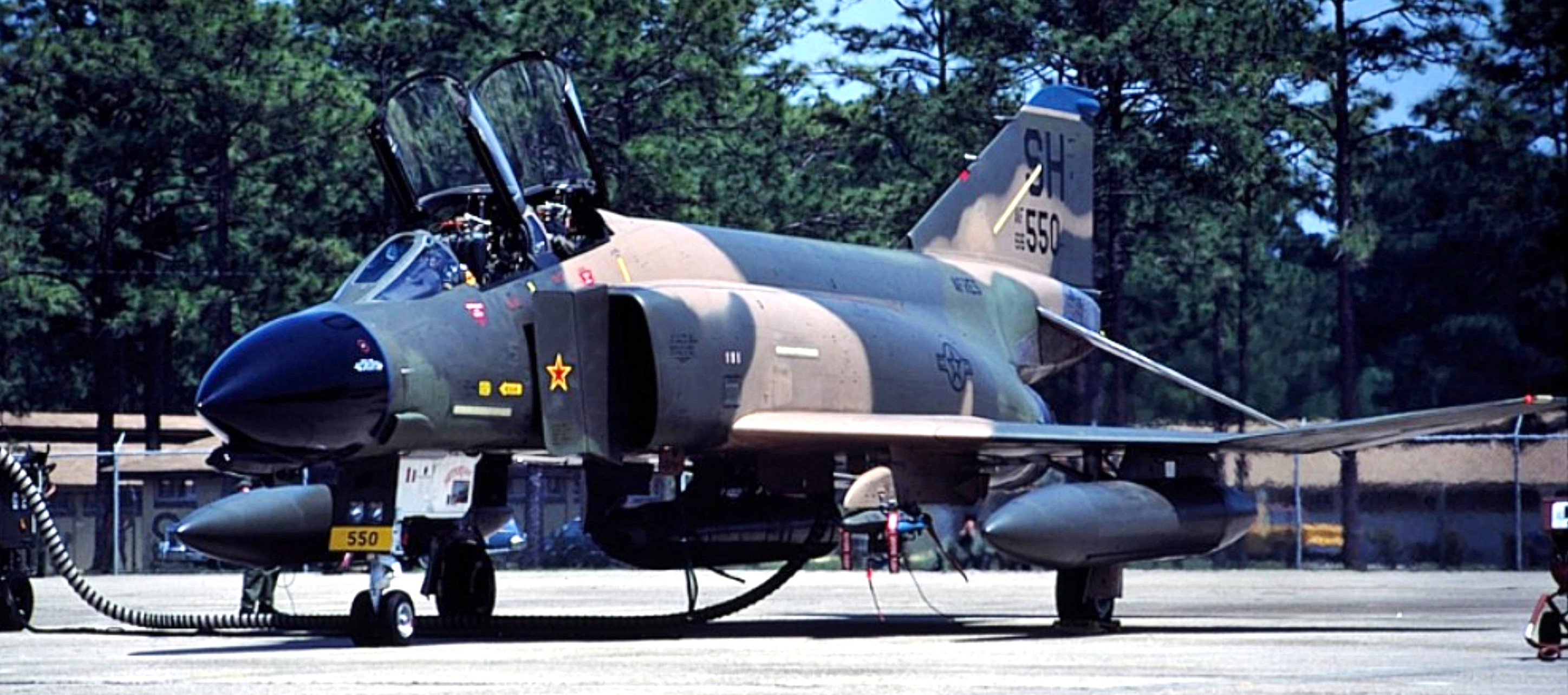
McDonnell F-4D Phantom II assigned to the 507th Tactical Fighter Wing, Air Force Reserves at Tinker AFB, Oklahoma, shown on the flight line during a training deployment during the 1980s. This jet wears a Vietnam-era MiG-kill marking in the form of a red and yellow star on the intake splitter-plate.
McDonnell F-4 Phantom fighters preserved in the USA are listed on a separate page on this website.