
Curtiss H-12 Flying Boat
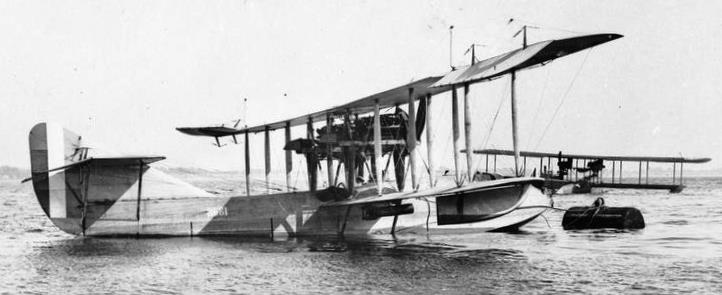
(IWM Photo, Q 68163)
Curtiss H-12 Large America flying boat in RNAS, c 1917.
22 Sep 1917. Canadian Flight Sub-Lieutenants N. A. Magor and C.E.S. Lusk of the RNAS were flying a Curtiss H-12 “Large America” flying boat when they spotted a German submarine near the Belgian coast. They dropped two 230 lb bombs, sinking UB32 (sometimes identified as UC21 or UC72). It was one of the few German U-boats sunk by Allied aircraft during the war.
The Curtiss Model H was a family of classes of early long-range flying boats, the first two of which were developed directly on commission in the United States in response to the £10,000 prize challenge issued in 1913 by the London newspaper, the Daily Mail, for the first non-stop aerial crossing of the Atlantic. As the first aircraft having transatlantic range and cargo-carrying capacity, it became the grandfather development leading to early international commercial air travel, and by extension, to the modern world of commercial aviation. The last widely produced class, the Model H-12, was retrospectively designated Model 6 by Curtiss’ company in the 1930s, and various classes have variants with suffixed letters indicating differences.
The Model H-12 was used extensively by both the Royal Navy and the United States Navy. Upon their adoption into service by the RNAS, they became known as Large Americas. The Model H-12s had 160 hp (118 kW) Curtiss V-X-X engines, but these engines were under powered and deemed unsatisfactory by the British so in Royal Naval Air Service (RNAS) service the H-12 was re-engined with the 275 hp (205 kW) Rolls-Royce Eagle I and then the 375 hp (280 kW) Eagle VIII. Porte redesigned the H-12 with an improved hull; this design, the Felixstowe F.2, was produced and entered service. Some of the H-12s were later rebuilt with a hull similar to the F.2, these rebuilds being known as the Converted Large America.
With the RNAS, H-12s and H-16s operated from flying boat stations on the coast in long-range anti-submarine and anti-Zeppelin patrols over the North Sea. A total of 71 H-12s and 75 H-16s were received by the RNAS, commencing patrols in April 1917, with 18 H-12s and 30 H-16s remaining in service in October 1918.(Wikipedia)
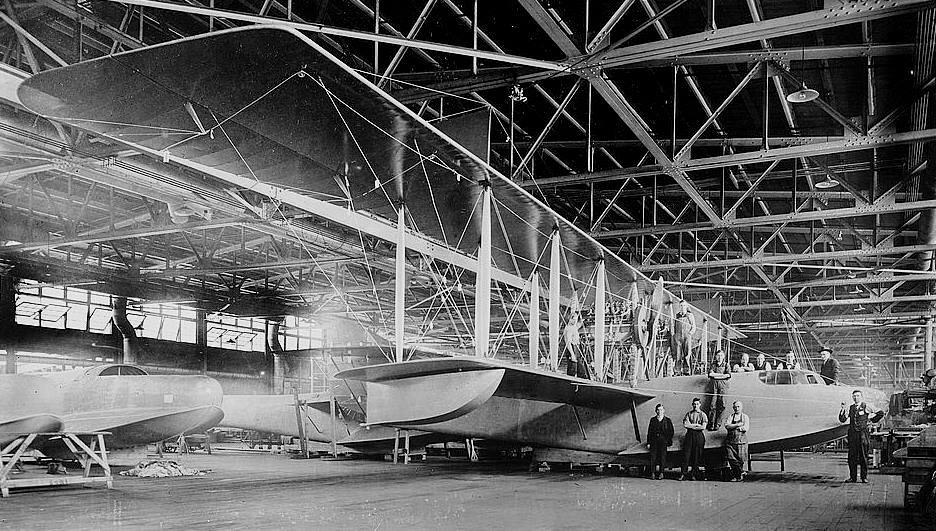
(Library of Congress Photo, ggbain 24017)
Curtiss Flying Boat, Model 12.
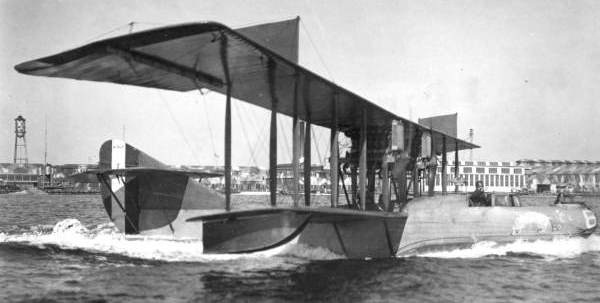
(Florida Photographic collection)
Curtiss H12 Flying Boat, taxiing in 1918.
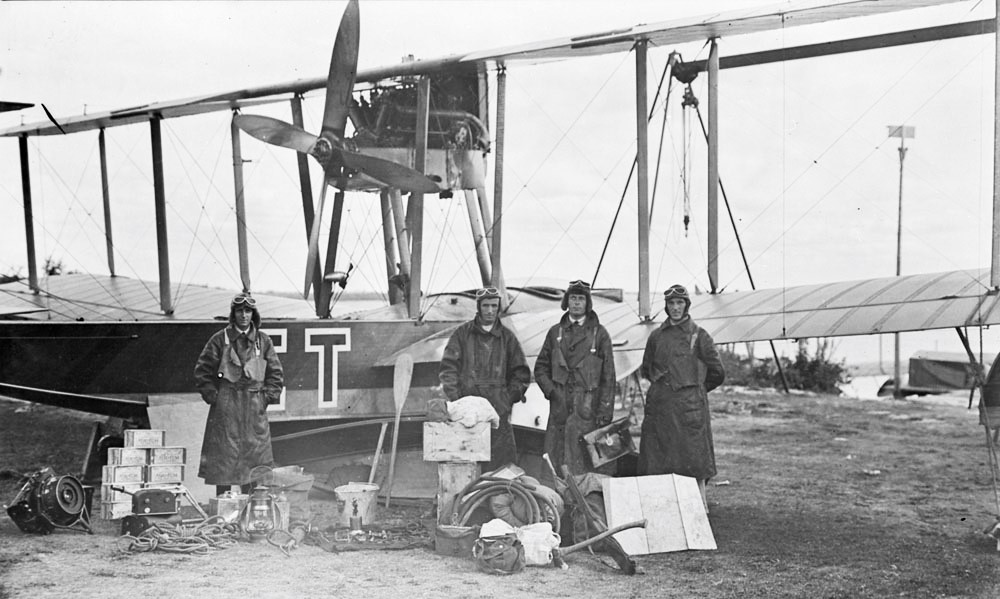
(Library and ArchivesCanada Photo, MIKAN No. 3203284)
Crew of Vickers Viking’ IV aircraft G-CYET of the RCAF (L-R): F/O D.J.R. Cairns, Cpl. A.J. Milne, S/L B.D. Hobbs, Mr. R.D. Davidson, D.L.S, 18 Jul 1924.
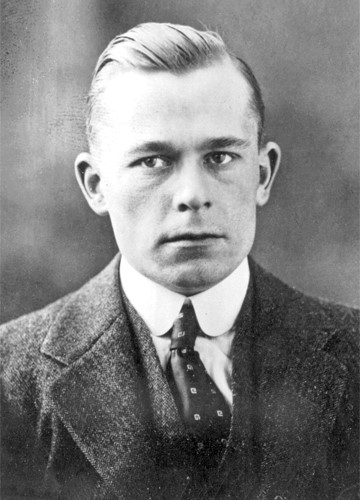
(Library and Archives Canada Photo, MIKAN No.4818430)
Group Captain Basil Deacon Hobbs OBE, DSO, DSC and Bar
Flight Sub-Lieutenant Basil Deacon Hobbs is the second most decorated aviator in Canada. Born 20 Dec 1895 in Berkshire, England. He moved to Canada at a young age where he obtained his education and developed his love of flying. Educated at Sault Ste. Marie, he took a correspondence course in Electrical Engineering. In 1915 he took his flying training at the Wright Flying School in Dayton, Ohio and later joined the Royal Naval Air Service (RNAS) as a Flight Lieutenant. During his career in the war, he was Mentioned in Despatches (MiD) for sinking two German submarines and destroying the German Zeppelin L.43. He later transferred to RAF. In 1920, he joined the CAF and was employed by the Canadian Air Board as a “Certificate Examiner” for civil aircraft and pilot licensing. Canadian Air Board, 1April 1921 to 25 May 1922, and RCAF, 1922-1925. In 1924 he was the sole pilot for the first long-range air survey over northern Saskatchewan and Manitoba which, at the time, was quoted as being one of the most brilliant achievements in aviation. Left RCAF as a Major and went as Engineer with Cleveland Illuminating Company 1925 to 1939.
Hobbs rejoined RCAF, 18 June 1940 in Montreal with the rank of Group Captain and was employed as a Commanding Officer at RCAF Station Dartmouth, Nova Scotia. He also served at RCAF Station Trenton, Ontario, and as Commanding Officer of RCAF Patricia Bay, British Columbia.
Flight Lieutenant B.D. Hobbs received the Distinguished Service Order, Awarded as per London Gazette of 20 July 1917, the Distinguished Service Cross as per London Gazette of 22 June 1917, and a Bar to his DSC as per London Gazette of 30 Nov1917. As an RCAF Group Captain he was made an Officer – Order of the British Empire, while serving at RCAF Station Patricia Bay, as per Canada Gazette of 16June 1945 and AFRO 1127/45 dated 6 July 1946. Governor General’s Records (RG.7Group 26, Volume 59, file 190-I, dossier 7 has citation. “Group Captain Hobbs has served with distinction throughout an extensive period of war service. As Commanding Officer of RCAF Station, Patricia Bay, he has carried out his duties in an exemplary manner. At all times he has given his best to the service and all personnel under him have profited by his experience, good judgement and fine leadership. This officer’s record throughout his career has been outstanding. By his splendid devotion to duty, initiative and efficiency he has rendered highly meritorious service to the Royal Canadian Air Force.”
Hobbs died on 28 November 1965 in Montreal and is buried in Greenwood Cemetery, Sault St Marie, Ontario. (Wikipedia)