
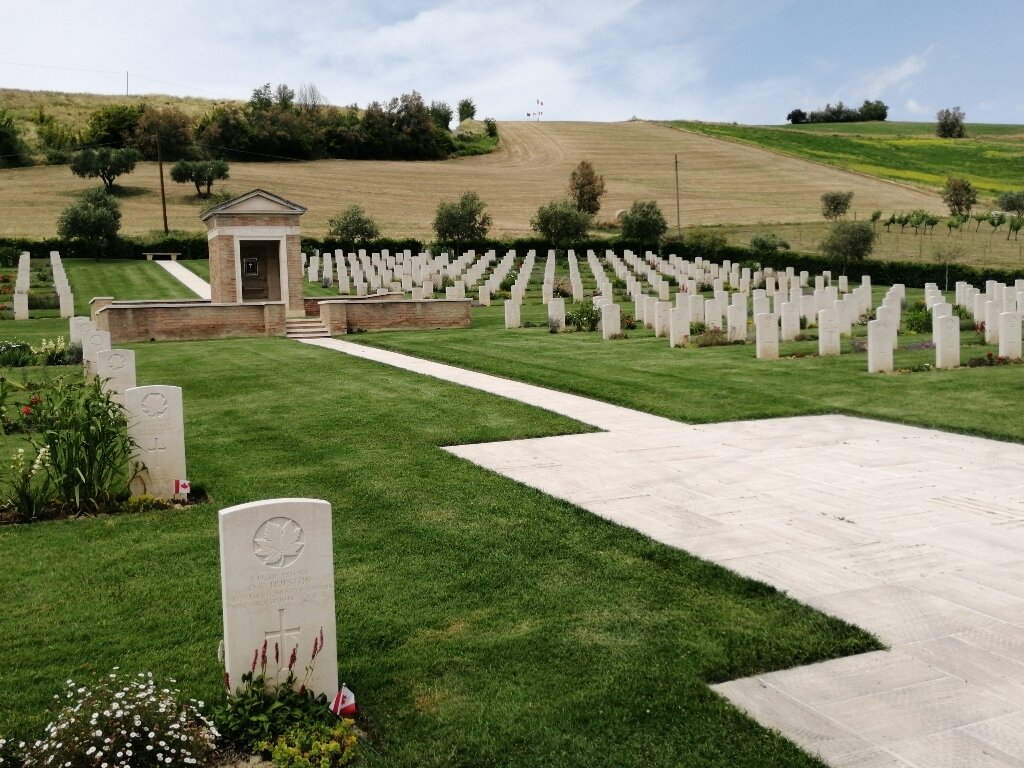
 The Montecchio War Cemetery lies in the locality of Montecchio in the Commune of Montelabbate (Province of Pesaro). It stands on rising ground just north of the main road from Pesaro to Urbino, about 12 kilometres west of Pesaro. Take the SS 423 from Pesaro to Urbino, following the signs for Montecchio. Just before entering the town, the cemetery will be seen on the right hand side of the road. Cemetery address: Via Provinciale s.n. – 61025 Montelabbate (PU) Marche. GPS Co-ordinates: Latitude: 43.860945, Longitude: 12.768968. The cemetery is permanently open and may be visited at anytime.
On 3 September 1943 the Allies invaded the Italian mainland, the invasion coinciding with an armistice made with the Italians who then re-entered the war on the Allied side. Following the fall of Rome to the Allies in June 1944, the German retreat became ordered and successive stands were made on a series of defensive positions known as the Trasimene, Arezzo, Arno and Gothic Lines.
Montecchio lies near the Eastern end of the strong German defensive position known as the Gothic Line. The anti-tank ditch of this defensive system used to run through the valley immediately below the cemetery. Montecchio village was practically razed to the ground for the purposes of defence during the war, and much damage was done in the surrounding country. The site was selected by the Canadian Corps for burials during the fighting to break into the Gothic Line in the autumn of 1944. The site was selected by the Canadian Corps for burials during the fighting to break into the Gothic Line in the autumn of 1944. These graves are in Plot 1, Rows A to F. The rest of the graves were brought in later from the surrounding country. There are now 582, 1939-45 war casualties commemorated in this site. Of these, 4 are unidentified. The cemetery was designed by Louis de Soissons.
Like all such cemeteries, it is laid out in an under-stated, dignified and uniform style, first adopted in the First World War. One of the original designers of Commonwealth war graves (in Normandy), Gertrude Jekyll, wished to create the ambience of an English garden and suggested that small rose bushes should be planted among the graves so that “The shadow of an English rose shall fall at some point each day on every headstone.”
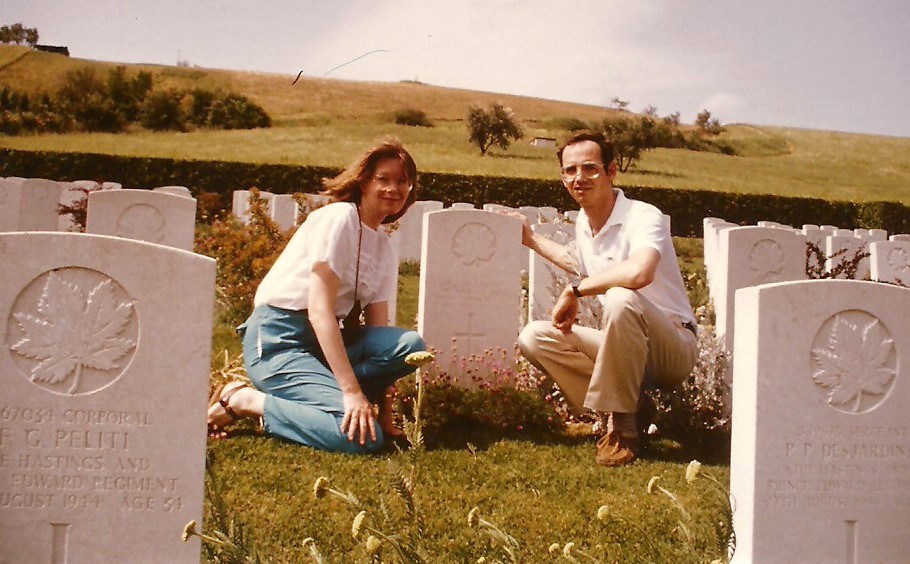
Faye and Harold A. Skaarup visiting Harold J. Skaarup’s War grave, Montecchio War Cemetery, Italy, IT.28, Row III, B.7.
The Commonwealth War Graves Commission’s mission is to ensure those who died in service, or as a result of conflict, are commemorated so that they, and the human cost of war, are remembered for ever. The CWGC is a global organisation, caring for war graves at 23,000 locations in more than 150 countries and territories. We commemorate almost 1.7 million individuals, ensuring that all the Commonwealth men and women who died during both world wars are commemorated in a manner befitting their sacrifice.
Our global estate is run by a multinational and multilingual workforce numbering approximately 1,300 – the vast majority of whom are gardeners and stone masons.
Since our establishment by Royal Charter we have constructed 2,500 war cemeteries and plots, erected headstones over graves and where the remains are missing, inscribed the names of the dead on permanent memorials. More than a million burials are now commemorated at military and civil sites around the world.
Our work is constant, amending records, searching for missing names, building new memorials and where historical inequalities in commemoration are found, ensuring all those who fell are equally remembered.
We also have a duty to ensure our sites remain well visited so remembrance of the war dead continues, creating information centres, volunteering opportunities and education programmes designed to engage and educate generations to come.
The Commonwealth War Graves Commission is a global leader in commemoration. Founded by Royal Charter in 1917, we work on behalf of the Governments of Australia, Canada, India, New Zealand, South Africa and the United Kingdom to commemorate the 1.7 million men and women from the Commonwealth who lost their lives in the two World Wars.
We believe that remembering individuals who have died in conflicts is of universal, perpetual relevance, and that reflecting on their deaths is of continuing and paramount importance for us all.
The cemeteries, memorials, graves, landscapes, and records in our care will be found at 23,000 locations and in more than 150 countries and territories. They are both the practical means of our commemoration of the fallen and vehicles for discovery, inspiration, and engagement.
We believe that each one of those we commemorate were people like us, with their own ambitions, hopes, and dreams. It is our duty and privilege to care for their graves and memorials and through our charitable Foundation, keep their stories alive.
Every year remains are discovered, identified and reburied with honours, their names no longer on our many memorials to the missing but over their final resting place.
Our active public engagement and education programmes ensure the stories of the fallen are told to all generations through talks and tours at our sites and in schools, clubs, societies and organisations. Our War Graves Week every May throws a spotlight on the work we do and the men and women we commemorate.
We constantly care and repair our sites, some of them have reached or will soon be reaching their centenaries and are facing challenges our founders could not have envisaged requiring new materials and processes to ensure their longevity.
Our founders were determined that all the men and women of the British Empire who fell on the former battlefields of the First World War, on land and at sea, should be commemorated equally. The CWGC takes great pride in the principles that drove this work, which said that the organisation would not differentiate between the dead on the grounds of social or military rank, or by religion.
Our Non-Commemoration project works to identify any cases where names have been missed from our records, with extensive research already yielding important information helping ensure all Commonwealth war dead are commemorated as originally promised.
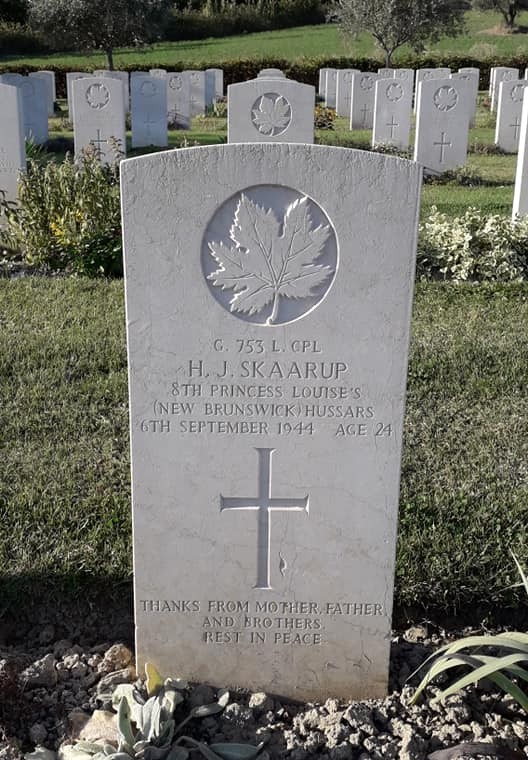
Commonwealth war grave of Corporal Harold Jorgen Skaarup, G/753, at Monteccio, Italy. Harold served with the 8th Princess Louise’s (New Brunswick) Hussars, Royal Canadian Armoured Corps (RCAC) in “A” Squadron, 5th Armoured Regiment.
New Brunswick Hussar, Corporal Harold Jorgen Skaarup
In April 1941, my uncle Harold Jorgen Skaarup, raised in the Danish community of New Denmark, New Brunswick, came down to the City of Fredericton and joined the Canadian Army. His parents Anne and Frederick were well aware of the potential horror of war that Harold would face. Frederick had been wounded many times in the First World War and Anne had received letters that he had been reported killed in action on three separate occasions. One can well imagine the heaviness in their hearts as their son became a soldier – and the worry of what could happen to him. Their fears were well-founded.
Harold served with the 8thCanadian Hussars until he was wounded when his tank was hit by a German anti-tank gun near Monteccio in Italy in August 1944. He died from his wounds a few days later. I can imagine how hard it must have been when an Anglican minister from Centreville came into the driveway of their farm and delivered the telegram to my grandmother Anne. “It was with deep regret that I learned of the death of your son, G753 Lance Corporal Harold Jorgen Skaarup, who gave his life in the service of his Country in the Mediterranean Theatre of War, on the 6th day of September 1944.” The horror of war had come home to her again.
My uncle Frederick Estabrooks served with the Canadian Provost Corps and was in the European theatre when he was injured by an artillery shell and put in the hospital for several months. For both families, the end of the war could not come soon enough. More than 45,000 Canadian servicemembers did not survive the war. When asked what I thought of the anniversary of VE day, it is of the families who were fortunate enough to have had their loved ones survive to come home. Harder, is thinking about what the war did to the families that did not have one of theirs return.
We had fatalities in the Canadian Forces while I served at home and overseas during the Cold War. Every single one of them was hard on those of us who knew and served with them. We were glad to come home mostly intact. Some did not and find it hard to cope. For those who made it back after VE day, many of them must have found it just as hard. They must not be forgotten. As you have often heard on Remembrance Day, there is a line from Laurence Binyon’s poem “For the Fallen”, “At the going down of the sun, and in the morning, we will remember them.”
Major (Retired) Harold Aage Skaarup
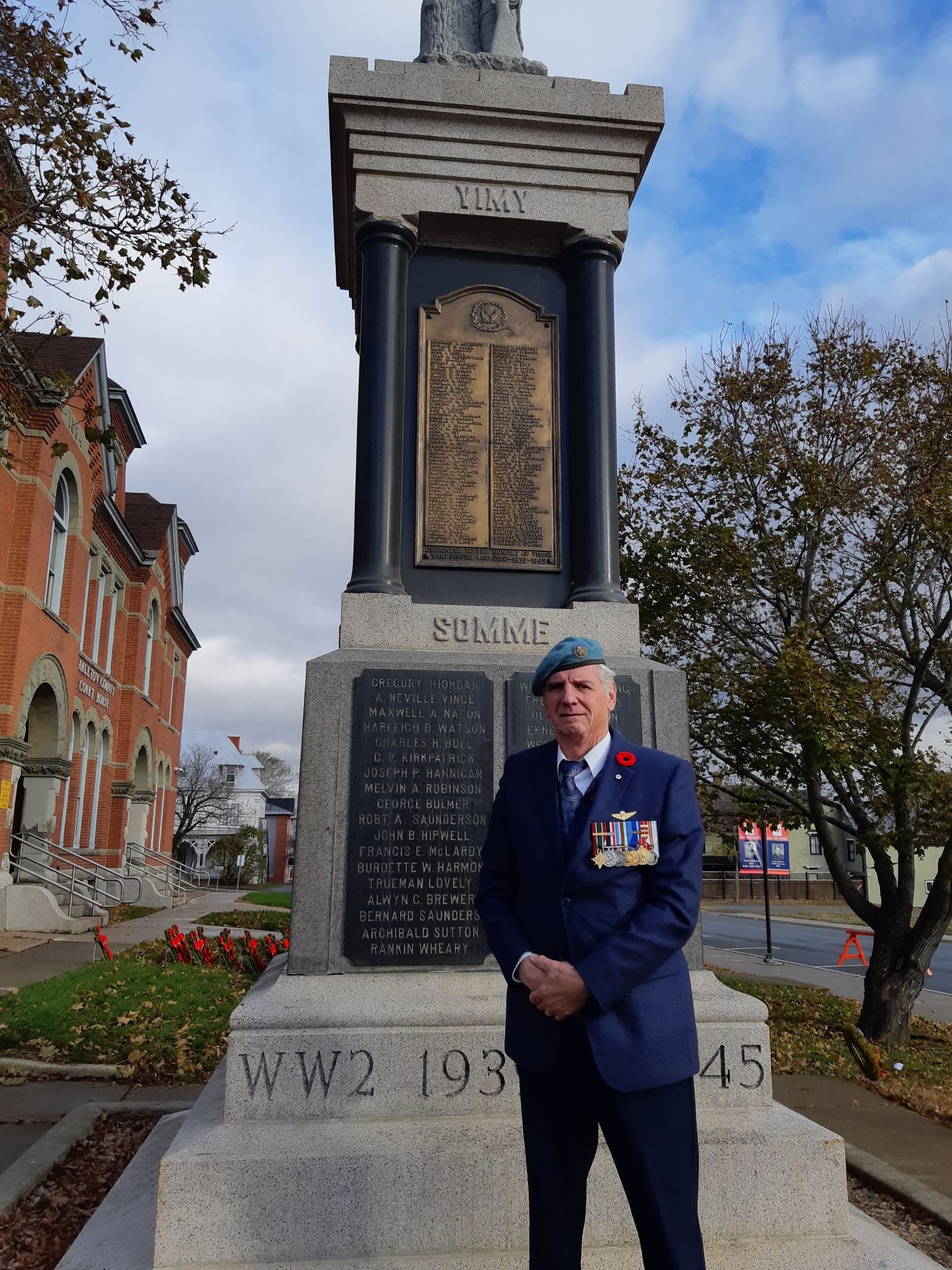
Former Honorary Lieutenant-Colonel Harold Aage Skaarup at the Woodstock cenotaph, 11 Nov 2023. Cpl Harold Jorgen Skaarup’s name is on the cenotaph behind him.
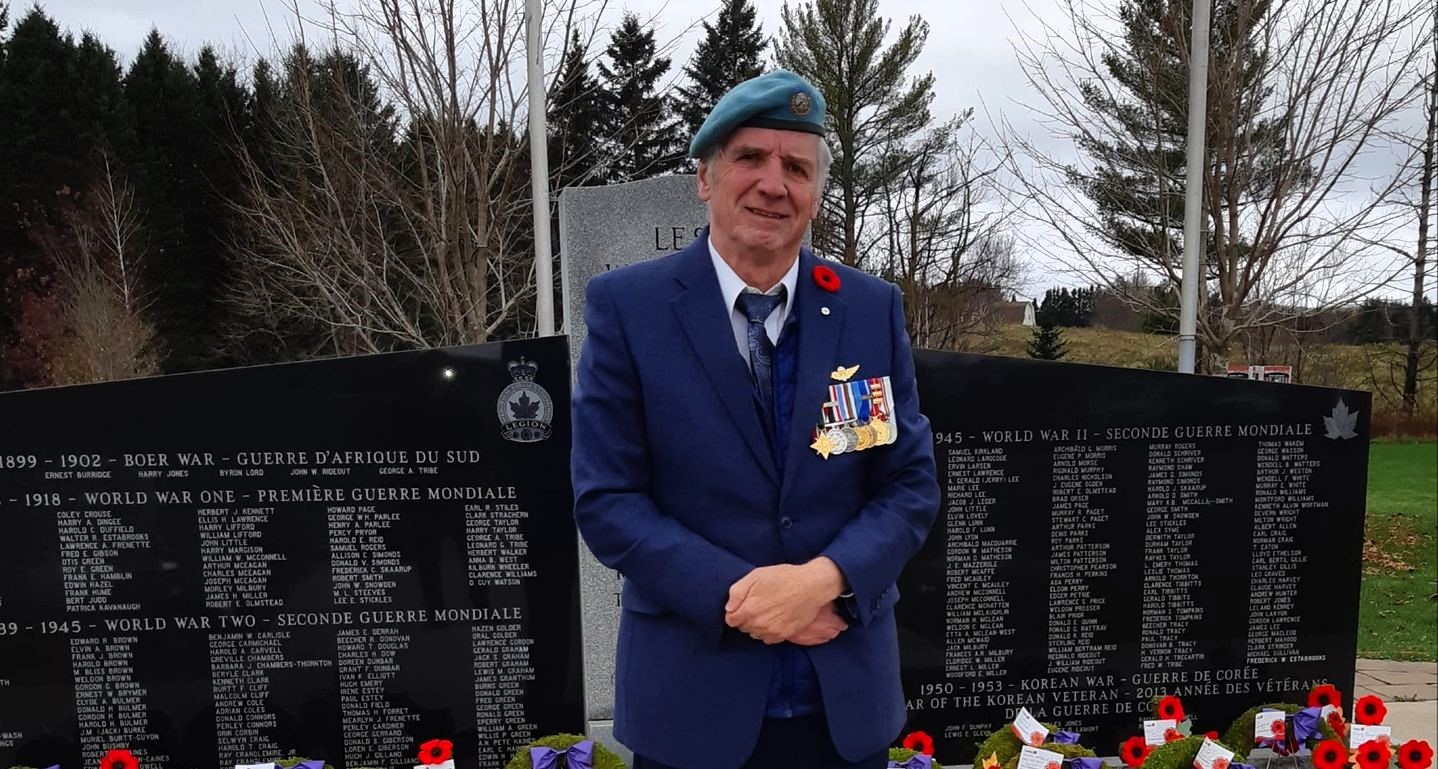
The Centreville cenotaph. We have 12 of 14 family names on this memorial! Grandfathers Fred Skaarup and Walter Estabrooks, both gunners, fought in the First World War, uncles Harold Jorgen Skaarup, 8th Hussars, died of wounds in Italy, Sep 1944, and Fred Estabrooks, C Pro C, Second World War. For the Cold War era, my father WO Aage C. Skaarup, RCAF, uncle WO Carl Skaarup, RCEME, uncle Bernard Estabrooks, C Pro C, aunt Wilhelmine Estabrooks, CWAC (did not want her name on the stone), cousin Fred Skaarup, RCA, brother Lt (Navy) Dale R. Skaarup, RCN, brother Chris L. Skaarup, RCA, Former HLCol Harold Aage Skaarup, C Int C. sister-in-law Lt (Navy) Heather Skaarup, (not on the stone), and my son 2Lt Sean J. Skaarup, RCA. My mother Beatrice L. Skaarup (nee Estabrooks), my wife Faye A. Jenkins and son Jonathan M. Skaarup have been tremendous supporters throughout our numerous deployments.