
Canadian Artillery preserved overseas
If you have information and photographs of Canadian artillery preserved overseas that are missing from this list, and that you are willing to share, updates would be most welcome and may be e-mailed to the author at hskaarup@rogers.com.
Several Canadian artillery monuments are preserved overseas, primarily in France and the Netherlands, commemorating Second World War battles. Key sites include a 25-pounder gun at Point 67 (Côte de Cindais) in Normandy dedicated in 2019, a 25-pounder at Juno Beach, and another in Heerenberg, Netherlands, marking the crucial Rhine crossing and the start of the final advance into the Netherlands
QF 25-pounder field gun at Point 67, Côte de Cindais
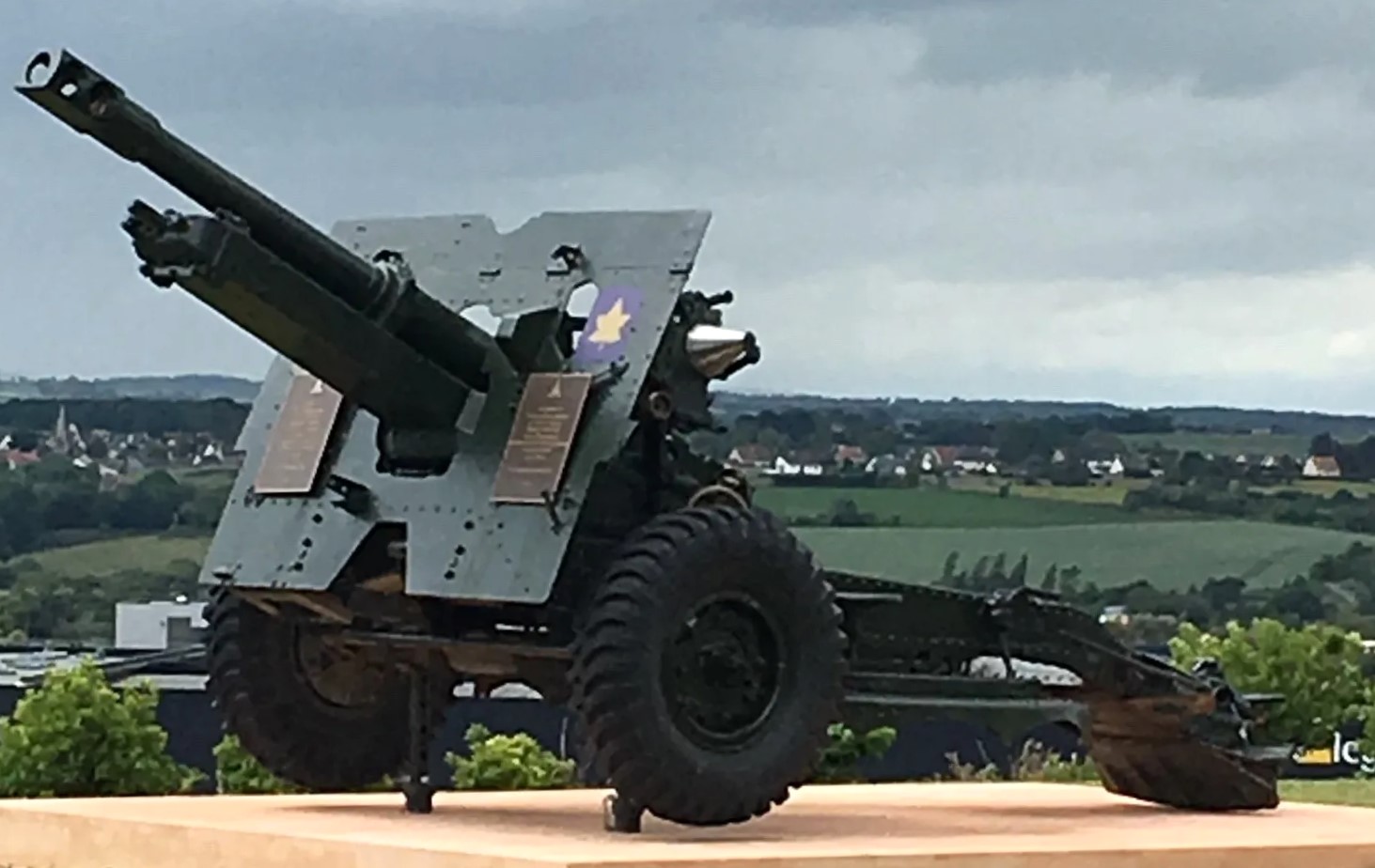
(Major Richard Gratton Photo)
On 8 June 2019, marking the 75th anniversary of the battles to liberate Normandy Royal Regiment of Canadian Artillery unveiled and dedicated a QF 25-pounder field gun at Point 67, known locally as Côte de Cindais, to commemorate in perpetuity, the contribution of the Royal Regiment of Canadian Artillery in the operations and battles in Normandy, France, in the summer of 1944. The Normandy Artillery Memorial located at Point 67 consists of a 25 (S.I.C 9-42) which was manufactured in Canada by Sorel Industries in 1942. From the heights of Point 67, one can see virtually all of the Second World War battlefields of the period from 18 July to 10 August 1944.
The 25-pounder QF Gun was extensively deployed by the RCA during the Second World War. Since 2013, under the auspices of Ireland’s Col Ray Yorke, Lt Col Eamonn Fogarty (Retd) and RSM John Morris (Retd), the Irish Artillery Corps has presented six 25-pounder guns to The Royal Regiment of Canadian Artillery. In addition to one now on display at Point 67, one of these guns is located as a monument at Juno Beach, one is display in the town of Heerenberg, The Netherlands, where the Canadian Army crossed the Rhine and began the final push north to liberate Holland in 1945. Finally, three 25-pounders are located in Canada with one in Toronto (Limber Gunners), one in Montreal (3BAM) and one in Lévis Quebec (6 RAC). (The Artillery Club Newsletter, 13 Sep 2019)
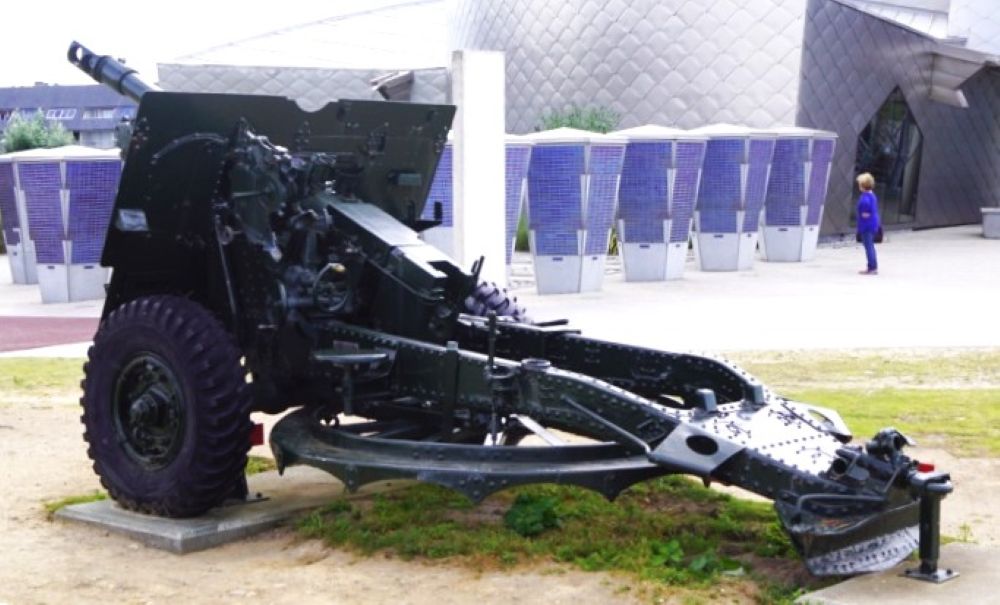
(Juno Beach Centre Photo)
Juno Beach Centre Gun (France): A QF 25-pounder field gun stands outside the Juno Beach Centre in Courseulles-sur-Mer. It was presented by the Irish Defense Forces to represent the men of the Royal Canadian Artillery who fought and died during the Second World War.
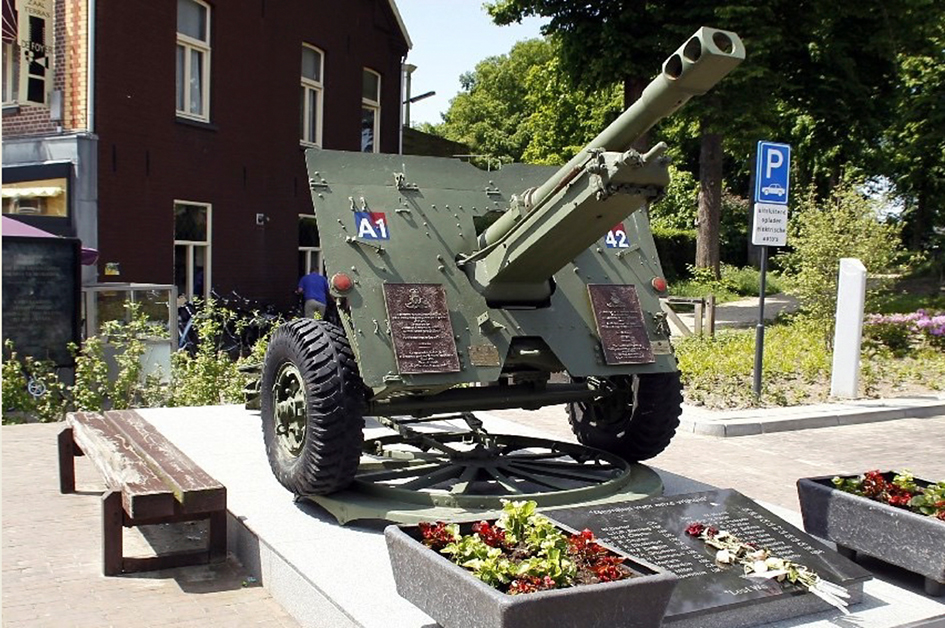
(Nationaal Onderduikmuseum Photo)
‘s-Heerenberg 25-Pounder Monument (Netherlands): Located on De Bleek in ‘s-Heerenberg, this monument was unveiled on 5 May 2010, marking the first city above the Rhine liberated by Canadian Army. This was the beginning of the final push north to liberate the Netherlands.
40mm Bofors Gun (France): Located at the Juno Beach Centre, this anti-aircraft gun was inaugurated in 2011 to further honour Canadian gunners in Normandy.
The 4th Light Anti-Aircraft Regiment, Royal Canadian Artillery was tasked with providing anti-aircraft fire around Courseulles and its harbour. They were equipped with the Polsten 20mm Gun and the 40mm Bofors Gun to engage low-level aircraft. The regiment was commanded by Lt.-Col. C. E. Woodrow.
On D-Day only “A” and “C” Troops of the 32nd Battery landed on Juno Beach. These two troops arrived off Courseulles at midday. The gunners and their guns were transferred from their Landing Ships Tank to Rhino Ferries for the rest of the journey to the shore. “A” Troop arrived on the beach at 1600 Hours while “C” Troop did not arrive until 1830 Hours. The beach was not completely secured at that point as the regiment was shot at by what they called snipers.
Upon landing, “A” Troop moved to Reviers, where it deployed its guns. “C” Troop deployed at Colombiers-sur-Seulles. Both troops were defending bridges over the Seulles River. The regiment’s War Diary noted that during the first 24 hours ashore, 196 prisoners of war were taken by the unit. The troops of the regiment that landed on D-Day took no fatal casualties that day.
All of “B” Troop of the 32nd Battery arrived on 8 June. On 12 June, the Regimental Headquarters, 69th Battery, and 100th Battery landed in Normandy which brought the regiment up to full strength. (Brad St. Croix, PhD)
All comments are subject to our Comment Policy. You must be at least 18 years old to comment.
See a comment that violates our guidelines? Report it here.