
Colorado Springs, National Museum of World War II Aviation, Colorado Springs Airport.
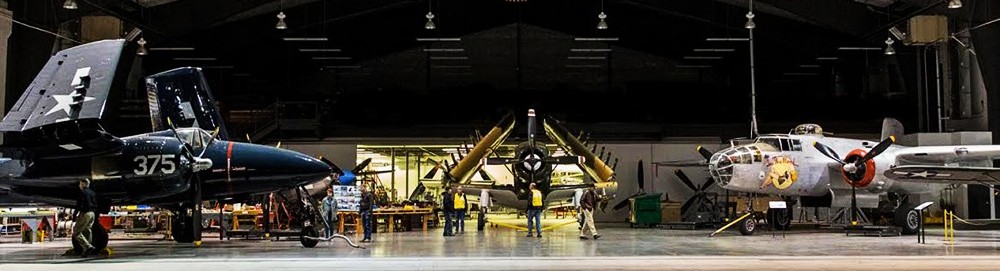
(NMofWWIIA Photo)
Aero L-39 Albatross (Serial No.).
Beechcraft Super 18 (Serial No. ). E-18S. Sold worldwide as a civilian executive, utility, or cargo aircraft (and also sold as a passenger airliner with tailwheels, nose wheels, skis, or floats,) it was also used as a military aircraft. The military versions were the C-45, and 5,200 were built as cargo (C-45/JRB), photo reconnaissance (F-2/JRB), trainers (AT-7/SNB) and bomb-gunnery trainers (AT-11/SNB). The Pratt & Whitney R-985 engine powered a wide variety and large number of military and commercial aircraft, making it one of the most successful reciprocating engines ever built in its power class. This plane is a Beech Super E18S Executive Super Twin. 464 were built from 1953 until 1962. The plane has room for nine passengers in comfort. For extra comfort, this model also has the tall cockpit, providing additional headroom for the crew. This aircraft won the 2003 Airventure Oshkosh Grand Champion award. The post-WWII Super 18 has better performance than the WWII C-45 military variants.
Beechcraft T-34B Mentor (Serial No. ). In March 1953, the USAF ordered it as its new primary trainer, with the T-34A Mentor designation. Early versions of the T-34, dating from around the late 1940s to the 1950s, were piston driven with a Continental O-470, 225 hp engine; a total of 450 were acquired by the USAF but another 1,454 were built by companies in other countries for their use. In 1954, the Navy acquired 423 of the T-34Bs. In 1973, Beech received a Navy research contract to see if the aircraft could be fitted with a 400 h.p. Pratt and Whitney turboprop engine and the latest electronics equipment. These were designated the T-34C Turbo-Mentor. In 1975, the Navy switched to the T-34C as their primary pilot trainer. A T-34C-1 armament systems trainer version was developed with four underwing hard points for bombs, rockets, flares, anti-tank rockets and gun pods. They were widely exported. The T-34 was replaced by the T-37 jet trainer by the USAF in the late 1950s and by the T-6 Texan II for the Navy in the mid-1980s.
Cessna L-19 Bird Dog (Serial No. ). O-1. Bird Dog is an all-metal, tandem seat aircraft with downward sloping sides to increase visibility. In 1950, the company began building 2,400 L-19s for the US Army, USAF, Navy and National Guard. They operated as artillery mspotter and forward air control aircraft during the Korean War. Between 1950 and 1959, a total of 3,431 various models of the Bird Dog were produced for all the services. Initially designated the L-19, in 1962 it was redesignated the O-1 Bird Dog. The primary difference between the Army and the Air Force aircraft were the radios. The Air Force added UHF frequency radios to control the fighter and bomber aircraft which dropped bombs, rockets, or napalm near friendly forces. The Army often carried high explosive and flechette rockets, while the USAF primarily carried white phosphorus rockets to mark targets. The almost 360-degree visibility of the Bird Dog made it a great observation, control, and reconnaissance aircraft. It flew in the midst of the battle to identify friendly from enemy forces, to direct air strikes or artillery, to help with search and rescue, and to make bomb damage assessments. It was highly valued by the ground units it supported and highly feared by enemy units it flew over. During the Vietnam War, 469 O-1 Bird Dogs were lost to all causes. The aircraft were retired from U.S. service in 1974. During 1975, a South Vietnamese Air Force pilot fled the North Vietnamese invasion in an O-1 with his wife and five children in the two-seat aircraft. They landed on the USS Midway helicopter carrier used to evacuate US Embassy officials.
Cessna A-37 Dragonfly (Serial No.).
Canadian Vickers PBV-1A Canso (Serial No. ). Former RCAF patrol aircraft. The Consolidated Catalina and Canso were close cousins. The Canso was the true amphibious version of the design and therefore included a conventional undercarriage to allow for either water or land use.
Douglas SBD-4 Dauntless (BuNo. 10694), is equipped with air-to-surface (ASV) radar, key during reconnaissance missions, and has the hallmark wing trailing edge “dive brakes” to control aircraft speed during dives. It also has the “wishbone” bomb mechanism to ensure proper clearance between the bomb and propeller blades when it is released during nearly vertical dives. This aircraft crashed in Lake Michigan on 14 May 1944, following engine failure after takeoff from the USS Sable, a modified excursion steamer used for training at Great Lakes Naval Air Station. The aircraft’s remains were retrieved from Lake Michigan in the mid-1990s and were subsequently restored to a fully flight-capable aircraft.
Douglas AD-5/A-1E Skyraider (Serial No. ). The Air Force acquired its A-1s in 1962 from the Navy for counter-insurgency duty. During the Vietnam War, the Air Force, Navy, and South Vietnamese Air Force flew them in combat. Two Navy Skyraiders even combined to shoot down a Russian built MiG jet fighter. However, the primary mission of the A-1 was close air support for ground troops because of its heavy ordnance load and accuracy, the most accurate bomber of the Vietnam War. This aircraft served with the Vietnamese Air Force by supporting ground troops. The war ended in 1973, but in 1975 North Vietnamese forces overran South Vietnam. South Vietnamese pilots flew it and three others out of Vietnam to Thailand, filled with family and friends. It was recovered from Thailand and registered in April 1983.
Fairchild PT-19 (Serial No. ). This aircraft was built in the Fairchild plant in Hagerstown, Maryland, and went to the USAAF on 28 May 1943. In June, it was used in a contract flying school, and in October 1944 was first assigned to Chickasha MAP, Oklahoma, before going to Greenville, TX for its final USAAF assignment. It was deemed surplus in May 1945 and sent to the Reconstruction Finance Corporation for disposal. This aircraft had many civilian owners before being donated to the National Museum of World War II Aviation in the fall of 2019.
Grumman F3F-2 biplane fighter (Serial No. ), originally assigned to Marine Fighting Squadron VMF 2, later re-designated VMF-211, in 1937. Records indicate it crashed into a mountain at Wailuku, Maui, Hawaii Jun 24, 1941. It was recovered in 1980s and subsequently restored to the magnificent, flyable aircraft it is today. The F3F was the basis for a design that ultimately became the very effective F4F Wildcat fighter of early WWII. The insignia on the side of the aircraft include the blue wasp with boxing gloves of squadron VF-7 assigned to the U.S.S. Wasp and the fuselage ID of 6F6 of the Enterprise squadron. By December 1941, all carrier fighter squadrons had been re-equipped with F4F Wildcats. Only a handful of F3Fs remain, four or less are flyable.
Grumman G-44A Super Widgeon (Serial No. 1429), Reg. No. N663G, is airworthy. It is one of 76 built beginning 1945 and one of 50 that were converted to Super Widgeon configuration. It is powered by two 340 hp Lycoming GO-480 GID6 engines with provides the Super Widgeon with a maximum speed of 160 mph, a range of 800 miles and a service ceiling of 18,000 ft. There are 28 FAA airworthy Widgeons in operation today. They were flown during World War II as a small patrol and utility aircraft by the U.S. Army Air Forces, U.S. Navy, U.S. Coast Guard and by the Royal Navy’s Fleet Air Arm. The first production military aircraft went to the U.S. Navy as an anti-submarine aircraft. The British Royal Navy gave the aircraft the service name Gosling. The Widgeon was also flown operationally in an antisubmarine role by the Civil Air Patrol.
General Motors (Grumman) TBM-3E Avenger (BuNo. ). This aircraft carries the insignia of VC-65, the squadron serving on the escort Carrier Midway (CVE-62) in 1944. The Midway participated in the Saipan invasion and the Battle of the Philippine Sea. The ship was renamed the St. Lo on October 10th, 1944, and was the first major warship sunk by a kamikaze attack.
Grumman F7F-3 Tigercat (BuNo. 80374). This aircraft became surplus after Korea. Because of its powerful engines, it was purchased as an aerial firefighting tanker with a large tank fixed to the fuselage to carry borate and water (therefore called the “Borate Bomber”) up into the late 1960s. It was restored to wartime appearance about 2007.
Grumman HU-16 Albatross (BuNo. ).
Howard DGA-15 (Serial No. ). In 1924, “Benny” Howard, with only a grammar school education, designed and built his first aircraft, the DGA-1. That was the start of an amazing career designing and building racing airplanes. The greatest and probably the most successful one he built was “Mr. Mulligan.” It won the 1935 Thompson Trophy. Famous aircraft builder Donald W. Douglas said of Benny, “He commenced building and designing other light airplanes to which he gave the basic designation ‘DGA.’ These initials stood for ‘Damn Good Airplane.’ And they are just that.” In 1927, during the Prohibition Years, he built the DGA-2 with a large, extra “fuel tank” for a whiskey smuggler to store his wares. Having started his work in an old factory at Chicago Municipal Airport in 1922, Benny formed the Howard Aircraft Corp in 1936. Production of the Howard Aircraft Corporation from 1936 to 1939 totaled about 30 custom-built aircraft. In 1939, however, the company built the 5-place DGA-15. It produced 520 between 1939 and 1944. Due to the shortage of military aircraft at the beginning of the war, most of the civilian Howards were commandeered by the military. The Army used them as officer transports and as air ambulances, with the designation UC-70B. The Navy, in particular, liked the aircraft and contracted Howard Aircraft Corporation to build 520 DGA-15Ps to its own specifications at the DuPage County Airport west of Chicago. After producing several of the most famous racing and private aircraft of the Golden Age of Aviation, the Howard Aircraft Corporation ceased production in 1944. Howard aircraft will always be remembered for their roominess and comfort for passengers. Although they provided the pilots some excitement when coming in for landings, they were a very durable plane. The FAA lists 107 airworthy DGA-15s in the world today, attesting to their durability and desirability. The aircraft is air worthy.
Lockheed P-38F Lightning (Serial No. 42-12652). Airworthy. “White 33” was dug out of the jungle near Finschhafen Airfield, Papua New Guinea, where it had been buried following the war. It was restored by WestPac Restorations in 2017. It has the most significant combat history of any of the museum’s aircraft. It was assigned to the 39th Fighter Squadron. On a mission on 31 December 1942, pilot Ken Sparks was flying this aircraft and was credited with two aerial victories. He downed one Japanese aircraft by gunfire and found himself engaged with another. While approaching each other a high speed head on, the Japanese banked left but hit Sparks’ outer right wing. It tore several feet from the wingtip, but the Zero lost its wing and crashed. Sparks went on to have 11 aerial victories in several different aircraft.
North American TB-25N Mitchell (Serial No. ), “In the Mood” was built on August 29th, 1944, in Kansas City and became a trainer, first at Turner Field in Georgia, and then at twelve other fields, until it became surplus in 1958. She was a spray tanker for about ten years. It has flown off several carriers, was in the movie Pearl Harbor and is the only B-25 to takeoff from a carrier in dry dock.
North American T-6 Texan (Serial No. ). The T-6 is known by a variety of designations depending on the model and operating air force. The United States Army Air Corps and USAAF designated it as the AT-6, the United States Navy the SNJ, and British Commonwealth air forces as the Harvard, the name by which it is best known outside the U.S. Noorduyn of Canada also built 1,500, called the AT-16, during the war years. Re-designated as T-6s in 1948, a total of 15,495 of all variants were built. This aircraft is one of 1,743 T-6Gs built between 1940 and 1950. Noted for their safety record and maintenance reliability over the years, the T-6 variants trained thousands of pilots throughout the world, plus flew as observation aircraft, gunnery training aircraft, and even as fighters in some countries. The last known military use of the Texan was by the South Africa Air Force as a trainer in 1995, which gives it a working history of 60 years, a figure virtually unrivaled by any other WWII-period aircraft. Today the T-6 remains a popular warbird aircraft used for airshow demonstrations and static displays. It has also been used many times to simulate various Japanese aircraft, including the Mitsubishi A6M Zero, in movies depicting World War II in the Pacific.
North American T-28 Trojan (Serial No. ). The Trojan is a military trainer aircraft with a piston engine used by the United States Air Force and United States Navy beginning in the 1950s.
Republic P-47D Thunderbolt (Serial No. ), delivered to the USAAF in July 1945 and served with various National Guard and Air Force Reserve units until it was sent to Peru. The aircraft was purchased by a collector from Peru in 1969 and was sent to Harlingen, Texas, for restoration. This aircraft had two crashes and, after the second, was restored. It is one of only 3 P-47s with a working turbocharger.
Stinson L-5B Sentinel (Serial No. 44-17141). This “B” model was a re-design of the original 2-seat tandem cockpit with a longer fuselage and larger access door that enabled the evacuation of one wounded soldier on a stretcher. In total 729 of this variant were produced for the military. They were designated L-5B for the U.S. Army and OY-1 for the Navy and Marine Corps. The RAF received 100 L-5s under the lend-lease program. 44-17141, was accepted by the Army Air Forces on Christmas Day, 1944, and delivered to the 360th Base Unit, Third Air Force, Brownwood, It later went to the 1060th overseas Replacement Center in Greensboro, NC, but never made it to the combat area. After the war, it served with several Air Force units until was transferred to the Civil Air Patrol in 1956. In 1965, the aircraft was sent to a college and later sold to various owners. The ground-up restoration took a little over seven years and achieved its successful post-restoration flight on 4 July 2015.
Stinson V-77 Reliant (Serial No. ). The V-77 was a version of the SR-10 civilian model with a 300 hp Lycoming R680-E3B engine, a single door on the left side and a simpler smooth cowl. Internal structure was beefed up significantly over the commercial models. As many as 100 V-77 models are still flying in the United States, plus many pre-war production Reliants. This “gull wing” V-77 Reliant was owned by Tuskegee Airman Frank Macon. He presented it to the museum on 11 November 2019.
Vought F4U Corsair (BuNo. ). From 1942 until the end of production in 1952, three manufacturers—Vought, Goodyear, and Brewster—built more than 12,500 Corsairs. Corsairs from Vought were designated F4U, Goodyear Corsairs were designated FG, and the very rare Brewster Corsairs were designated F3A. The only operational F3A Corsair is also part of the museum’s collection.
Vought F3A Corsair (BuNo. ). Built by the Brewster and Co., Aircraft Division, in Long Island City, NY. It was assigned to VMF-914 at the Cherry Point Marine Corps Air Station. On December 19, 1944, it crashed in a swamp 10 miles southwest of Cherry Point while on a Ground Controlled Interception training mission. The pilot parachuted but was killed. This Corsair spent many years in the swamp until found again. The remains were salvaged in 1990. It underwent a seven-year restoration and is now resident at the museum.
WACO JYM (Serial No. ). The Waco JYM was developed in 1929 to meet the increasing demand in the 1920s for rugged air mail planes. The JYM has a single back seat for the pilot and a forward seat that could handle two slim people or packages, with a metal cover that could enclose the packages or the empty seat. For mail, there were two compartments with a lockable cover in the fuselage, one forward and one aft of the pilot.
Four Waco JYMs were delivered to Northwest Airways, the predecessor of Northwest Airlines, in 1929. They were operated on the 892-mile Contract Air Mail (CAM) route 9 from Chicago to Minneapolis. The route took them to Milwaukee, Madison, and La Crosse enroute. Contract commercial carriers took over the mail routes in 1926. Thirty four mail routes were eventually established. In 1926, Charles Lindberg, at the controls of a DeHavilland DH-4 Jenny, began flying the first route between Chicago and St. Louis. A year later he quit and was catapulted into fame for solo piloting the Ryan “Spirit of St. Louis” nonstop from New York to Paris, a first. Charles Lindberg flew this plane as part of his post-Atlantic trip public relations work for Northwest Airlines. This is the only surviving Waco JYM of the four that were built, and it is flyable. It is typical of the kinds of aircraft that flew in the early 1930s, just a few years before the beginning of WWII. By the time war came, major improvements in aircraft design had resulted in single wing, high performance fighters that could achieve 400 miles per hour.
Under restoration:
Beechcraft Model 18
Consolidated Vultee SNV-1 (Serial No. 2919). Reg. No. N9525H.
Curtiss SB2C Helldiver
Fairchild PT-19
Grumman F6F Hellcat
Grumman F6F Hellcat
Lockheed P-38 Lightning
Naval Aircraft Factory N3N
North American B-25 Mitchell
Republic P-47 Thunderbolt
Vought F4U-4 Corsair
In addition to its aircraft, the museum also maintains a collection of land vehicles:
Chevrolet crash truck
Ford GPW jeep
White M2A1 half-track
White M3A1 scout car
WestPac Restorations Inc.765 Aviation Way, Colorado Springs, CO 80916
All comments are subject to our Comment Policy. You must be at least 18 years old to comment.
See a comment that violates our guidelines? Report it here.