
RN York class cruisers: HMS Exeter (68), HMS York (90)
The York class was the second and final class of heavy cruisers built for the Royal Navy under the terms of the 1922 Washington Naval Treaty. They were essentially a reduced version of the preceding County class, scaled down to enable more cruisers to be built from the limited defence budgets of the late 1920s.
It was initially planned to build seven ships of this class, though in the end only two were constructed. HMS York, started in 1927, and HMS Exeter, started in 1928. Exeter differed in appearance from York because of late changes in her design. The remaining ships were delayed due to budget cuts, and then following the London Naval Treaty of 1930 the Royal Navy decided its cruiser needs were best met by building a greater number of smaller cruisers with 6–in guns.
While both ships served extensively in the first few years of the Second World War, it was Exeter that had the more notable career. Exeter took part in the Battle of the River Plate against the German raider Admiral Graf Spee, and was badly damaged, though later she was repaired and modernized. She escorted a convoy to the Pacific in late 1941, and was again heavily damaged in the Battle of the Java Sea, then was caught and overwhelmed a few days later by four Japanese heavy cruisers. York was sunk in Souda Bay, Crete, by Italian MT boats in 1941, and was raised in 1952 and towed away to be scrapped in Italy. (Wikipedia)
HMS Exeter (68)
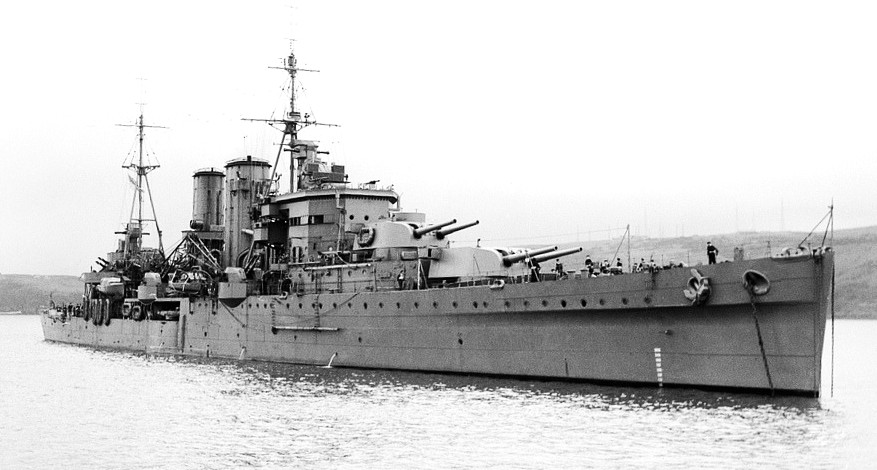
(IWM Photo, A 3553)
HMS Exeter (68) was the second and last York-class heavy cruiser built for the Royal Navy during the late 1920s. Aside from a temporary deployment with the Mediterranean Fleet during the Abyssinia Crisis of 1935–1936, she spent the bulk of the 1930s assigned to the Atlantic Fleet or the North America and West Indies Station. When the Second World War began in September 1939, the cruiser was assigned to patrol South American waters against German commerce raiders. Exeter was one of three British cruisers that fought the German heavy cruiser Admiral Graf Spee, later that year in the Battle of the River Plate. She was severely damaged during the battle, and she was under repair for over a year.
After repairs were completed the ship spent most of 1941 on convoy escort duties before she was transferred to the Far East after the start of the Pacific War in December. Exeter was generally assigned to escorting convoys to and from Singapore during the Malayan Campaign, and she continued on those duties in early February 1942 as the Japanese prepared to invade the Dutch East Indies. Later that month, she was assigned to the Striking Force of the joint American-British-Dutch-Australian Command (ABDACOM), and she took on a more active role in the defence of the Dutch East Indies. The culmination of this was her engagement in the Battle of the Java Sea later in the month as the Allies attempted to intercept several Imperial Japanese Navy invasion convoys. Exeter was crippled early in the battle, and she did not play much of a role as she withdrew. Two days later, she attempted to escape approaching Japanese forces, but she was intercepted and sunk by Japanese ships at the beginning of March in the Second Battle of the Java Sea.
Most of her crewmen survived the sinking and were rescued by the Japanese. About a quarter of them died during Japanese captivity. Her wreck was discovered in early 2007, and it was declared a war grave, but by 2016 her remains, along with other Second World War wrecks, had been destroyed by illegal salvagers. (Wikipedia)
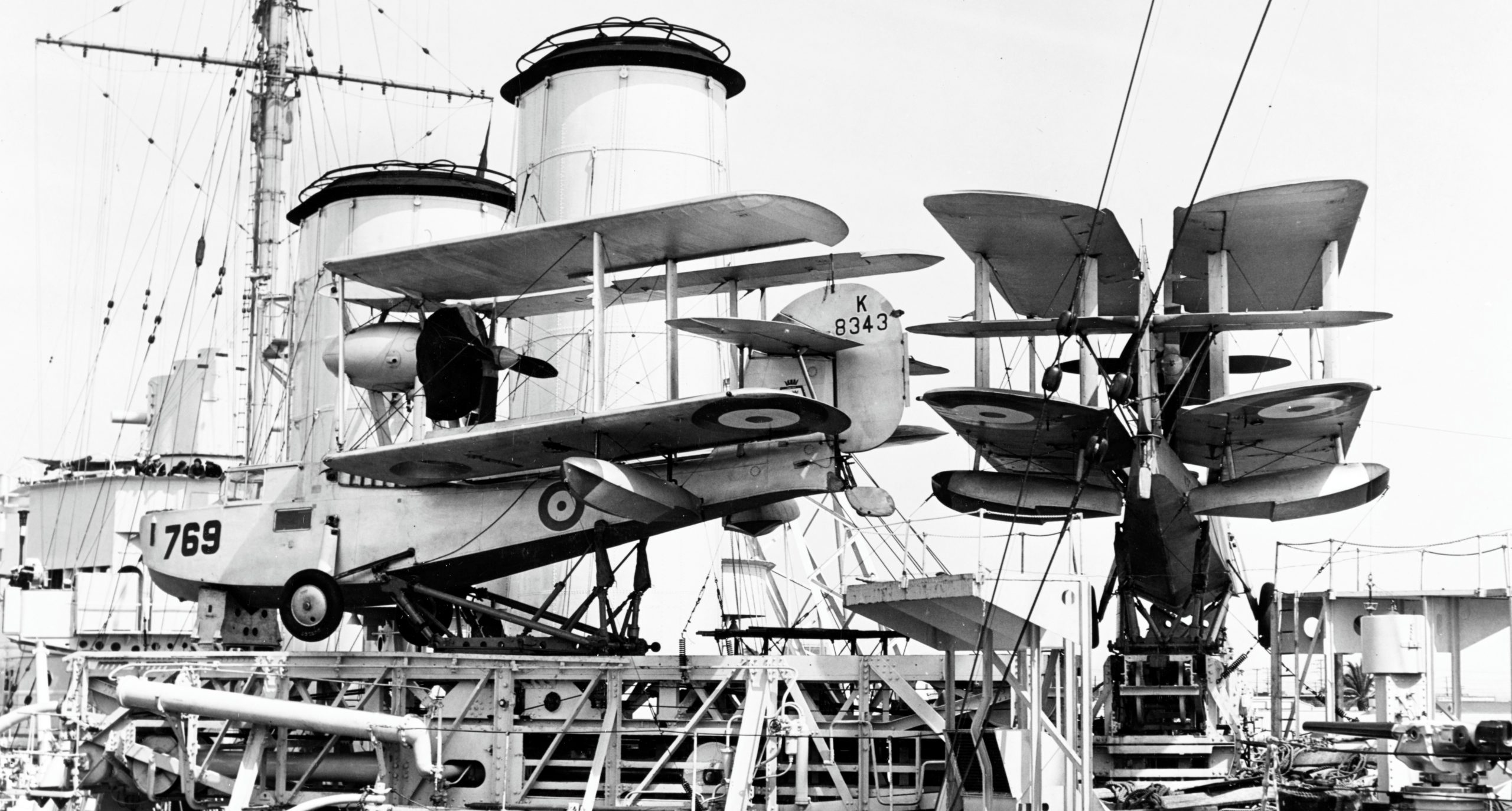
(USN Photo)
Royal Navy Supermarine Walrus flying boats aboard the heavy cruiser HMS Exeter (68), in the 1930s.
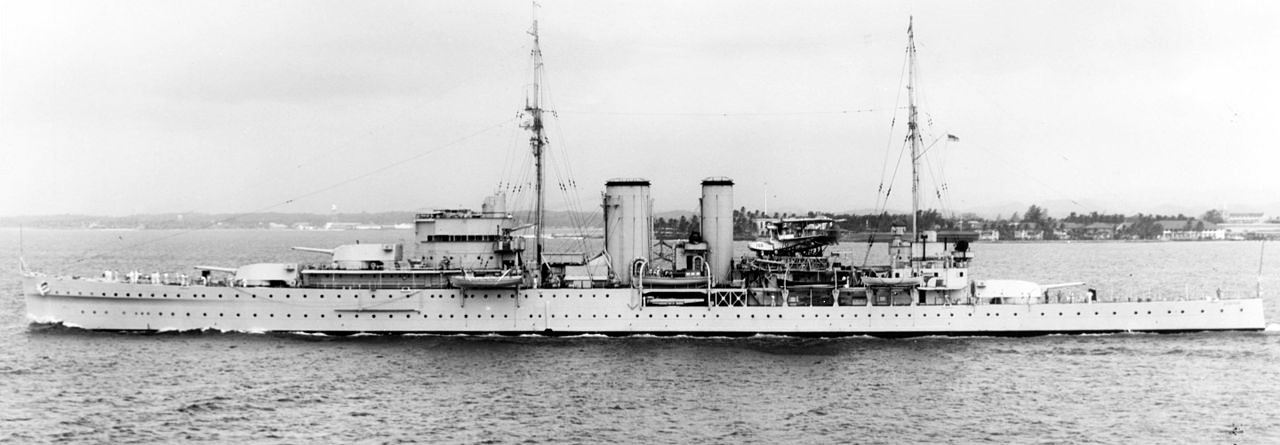
(USN Photo)
HMS Exeter (68) off Coco Solo, Panama Canal Zone, c1939.
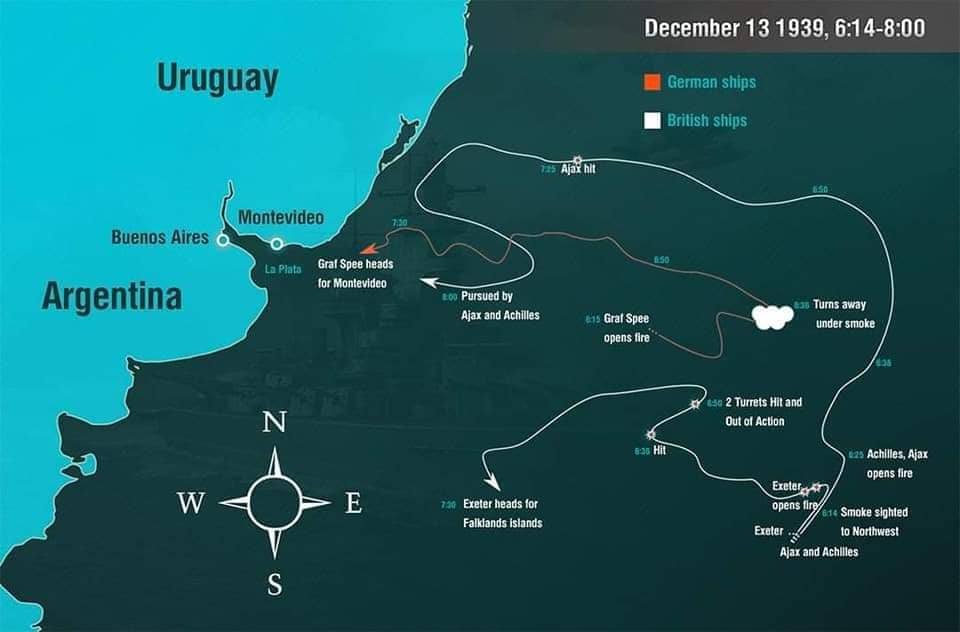
Map of the Battle.
13 December 1939 at 05:20hrs, a British squadron sailing at 14knts in line ahead, HMS Ajax, HMS (HMNZS) Achilles and HMS Exeter in the rear, was proceeding on a course of 060°, around 390 nmi east of Montevideo.
At 06:10hrs, smoke was sighted on a bearing of Red-100, or 320°.
06:14hrs HMS Exeter is despatched by Commodore Harwood to investigate smoke.
06:16hrs HMS Exeter signals “I think it is a pocket battleship.” The smoke is actually from the German Kriegsmarine Heavy Cruiser Admiral Graf Spee. Captain Langsdorff on Graf Spee, identifies Exeter as a cruiser, but believes Ajax and Achilles to be destroyers and that the three3 ships are escorting a convoy. With this in mind he decides to engage.
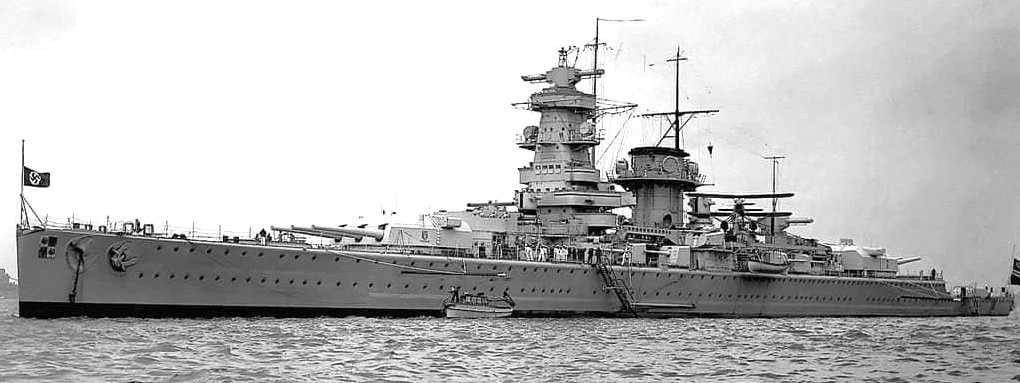
(Kriegsmarine Photo)
Admiral Graf Spee.
06:18hrs Admiral Graf Spee opens fire, Harwood’s squadron immediately set in motion his plan for attacking Graf Spee from different sides, thus splitting the German ships fire. HMS Ajax and HMNZS Achilles turned to 340° to close range and engage the enemy from the eastward, while HMS Exeter turned westward at full speed to engage the enemy from the southward
06:20hrs HMS Exeter opened fire to starboard at 18,700 yards with her forward 8-inch turret guns. Capt Bell had mistakenly called the enemy ship Scheer, in fact his exact words are recorded as ‘There’s the fucking Scheer! Open fire at her!’
06:21hrs HMS Achilles opens fire becoming the first New Zealand unit to engage the enemy in the Second World War, and in fact she was the first New Zealand warship to take part in a naval battle. As the prospect of battle had loomed her signalman had run aft with the New Zealand ensign shouting “Make way for the Digger Flag”
06:22hrs HMS Ajax opens fire. The plan had succeeded in dividing the Admiral Graf Spee’s fire for a while, but due to Exeter’s heavier 8 inch guns she slowly attracted more attention
06:23hrs Admiral Graf Spee’s third concentrated salvo, bursts short amidships, killing HMS Exeter’s starboard tubes’ crews and damaged her searchlights, communications, funnels and aircraft.
06:24hrs while HMS Exeter had fired eight salvos, one shell of Admiral Graf Spee’s 4th salvo knocked out “B” turret, its splinters swept the bridge, killing or wounding all the personnel there except Captain ‘Hooky’ Bell and two colleagues, it also wrecked the wheelhouse and communications. Shortly after this Exeter’s spotter plane was riddled with splinters causing the fuel tanks too leak. The threat of a fire led to the aircraft being ditched overboard. Communications were now being carried out through a chain of messengers.
06:30hrs Admiral Graf Spee could not afford to concentrate and close for the kill, because despite the best efforts of her secondary 5.9-inch guns, HMS Ajax and HMS Achilles were closing, concentrating their fire, so HMS Exeter was reprieved as Langsdorff turned his attention to the 2 light cruisers.
06:31hrs three salvos in quick succession straddled HMS Ajax, forcing her and HMS Achilles to turn away a point or two to confuse the Graf Spee’s fire.
06:32hrs HMS Exeter manages to fire her starboard torpedoes under local control.
06:34hrs the turn away didn’t last long though, now after three minutes the light cruisers turned back to port, to close the range as quickly as they could, with HMS Ajax in the lead but only just.
06:37hrs HMS Ajax launches her aircraft, this gave Harwood an eye in the sky to guide his actions and thinking.
06:38hrs Langsdorff decides to not a slug it out but to extend the range to his advantage and orders a 150° turn, retiring north-west under cover of a smoke screen.
06:40hrs, HMS Exeter turns to starboard to bring her port torpedo tubes to bear, at the same time HMS Achilles is hit killing/seriously wounding f 4our atings in her director control tower. Despite her gunnery officer being stunned, her rate of fire continued unabated.
06:43hrs HMS Exeter fires her port torpedo tubes at Admiral Graf Spee, before steering north-east to close HMS Ajax and HMS Achilles.
06:45hrs HMS Exeter is by now burning fiercely amidships, her remaining aft turret is firing under local control, her compasses are destroyed.
06:46hrs HMS Achilles fire control wireless set broke down, from which point she continued on individual control giving her great difficulty in finding range for a while. Further confusion was caused by reports of Achilles misses being reported to Ajax, which interpreted as her own corrections, causing her to lose the range also.
06:50hrs HMS Exeter is still in the fight, her remaining turret still firing, with a 7° list to starboard and several compartments flooded.
07:08hrs HMS Ajax after nearly a quarter of an hour of being off on range, finally gets it right when the earlier confusion is cleared up and starts to make contact with the Admiral Graf Spee again.
07:10hrs realising the range to the Admiral Graf Spee had reached 16,000 yards, HMS Ajax and HMS Achilles turned westward at full speed.
07:16hrs Admiral Graf Spee made a large turn to port, under cover of a smoke screen, heading straight for HMS Exeter with the aim of finishing her off. HMS Ajax and HMS Achilles, charge the Admiral Graf Spee, firing accurately and setting fire to the Graf Spee amidships, forcing her to turn away from Exeter. Graf Spee soon straddled Ajax at 11,000 yards with three salvos from her 11-inch guns, though the 5.9-inch guns continued to shoot wildly according to all British reports
07:25hrs an 11-inch shell knocked out HMS Ajax’s after turrets. Ajax then launched 4 torpedoes at 9,000 yards range. Admiral Graf Spee avoided the torpedoes with a wide turn to port
07:28hrs HMS Ajax and HMS Achilles turn to close the range still further. Meanwhile Exeter is dropping astern for a while, with it’s after turret still firing, but at 07:30hrs pressure in this turret failed
07:31hrs Harwood receives a report from his aircraft, “Torpedoes approaching; they will pass ahead of you”, taking no chances he turns south, to engage the enemy from the starboard side.
07:32hrs Graf Spee turns westward under cover of smoke to try to confuse the at that point quite accurate gunfire of Ajax and Achilles.
07:36hrs Graf Spee now turns south-west, bringing all her guns to bear on the 2 light cruisers.
07:38hrs Ajax is hit losing her topmast and wireless aerial.
07:40hrs Exeter now turns slowly south-east to repair damage. Ajax now only has 20% of her ammunition left.
At this point Harwood decides the prospects of a continuing successful daylight action were anything but rosy, so acts to break of the fight till dark, when there would be a better chance of closing to successful torpedo range.
07:42hrs Ajax and Achilles turn away under cover of smoke.
07:45hrs it is considered that at this point the first phase of the battle is over and what now happens is more of a chase, the battle had lasted an hour and 22 minutes.
08:00hrs Ajax and Achilles are now 15 miles astern of Graf Spee.
08:07hrs HMS Ajax broadcast the enemy’s position, course and speed, both to inform the Admiralty and to help merchants keep out of danger.
08:14hrs HMS Exeter was now out of sight, so Harwood ordered the aircraft to signal her to close with the rest of the squadron.
09:10hrs the aircraft signalled that HMS Exeter was closing as best she could – although by this point Captain ‘Hooky’ Bell was steering by boat compass.
09:12hrs HMS Ajax recovered the aircraft, Harwood decided to reduce speed to try to help HMS Exeter catch up
09:46hrs Harwood sent a message for HMS Cumberland to make best speed for the plate, his signal didn’t get through in time though, so when she sailed at 12:00hrs it was on the initiative of Captain Fallowfield.
10:00hrs Achilles, over-estimating the speed of the Graf Spee, closes to 23,000 yards. Graf Spee turns suddenly and fires on her, second salvo straddling her. Achilles retires rapidly out of range.
11:04hrs Ajax sights the SS Shakespeare, stopped near the Admiral Graf Spee, which a few minutes later signalled the merchant’s lifeboats would need to be picked up, however this turned out to be a ruse, to buy Graf Spee some time
11:05hrs HMS Exeter signals that she was flooded forward, all turrets out of action, but could still steam at 18 knots.
13:40 HMS Exeter was ordered by Harwood to make for the Falklands – so at 15:10hrs she would turn south. Ajax and Achilles continued to shadow Graf Spee and it became apparent she was heading into the River Plate estuary
19:15hrs Graf Spee fires on Ajax and she turns away under a smoke screen.
20:48hrs Achilles again strays within range and Graf Spee opens fire.
00:10hrs Dec 14 Graf Spee enter Montevideo Harbour.
The battle was over, the British had suffered 100 killed and wounded, Exeter heavily damaged, Ajax and Achilles moderately so. Graf Spee had suffered 96 killed and wounded. Graf Spee would sail again on 17 Dec with a Skeleton crew and be scuttled in the estuary of the River Plate. The crew of Graf Spee were taken to Buenos Aires, where Captain Langsdorff committed suicide on 19 December. He was buried there with full military honours, and several British officers who were present attended. (Jeff Hancock)
Although very heavily damaged, Exeter was still able to make good speed—18 knots—though four feet down by the bows, with a list of about eight degrees to starboard, and decks covered in fuel oil and water, making movement within the ship very difficult. She made for Port Stanley for emergency repairs which took until January 1940. She was repaired and modernised at HM Dockyard, Devonport between 14 February 1940 and 10 March 1941.
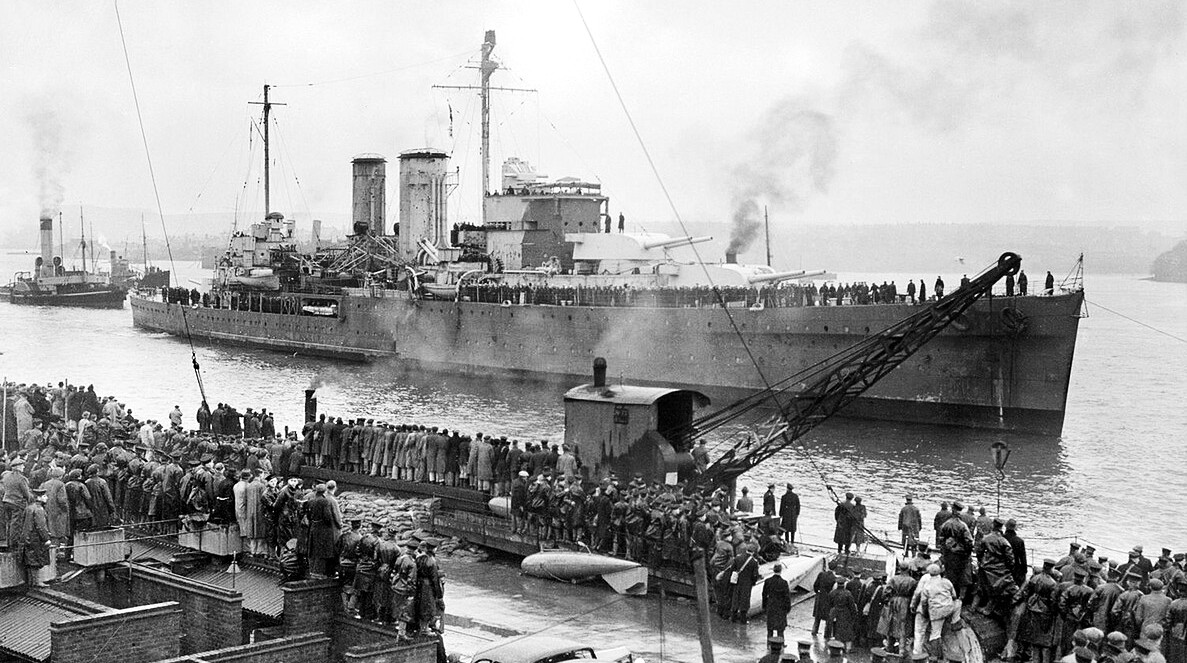
(Royal Navy Photo)
Cruiser HMS Exeter (68) coming into Plymouth on February the 14th 1940 after returning from the battle of The River Plate, December 1939.
HMS Exeter returned to the Fleet and was later attached to the East Indies Squadron, later redesignated as the Far East Fleet. Early in 1942, Exeter was attached to the newly formed American-British-Dutch-Australian Command (ABDACOM), which came into being in early January in Singapore, but soon shifted its headquarters to Java in the Dutch East Indies (present day Indonesia).
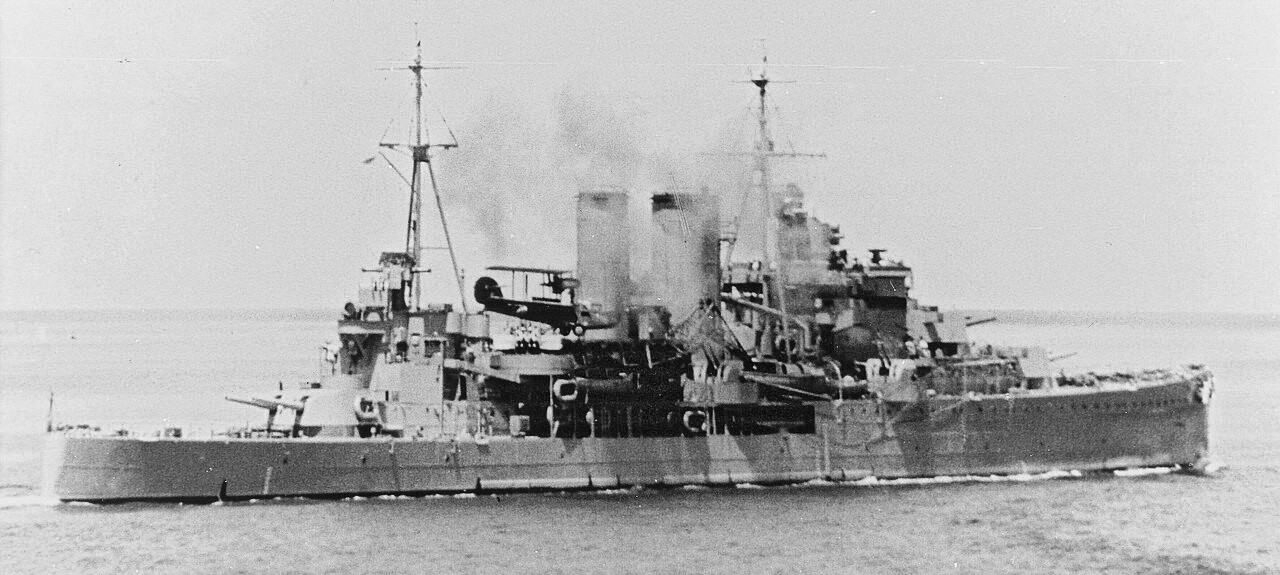
(Fotoafdrukken Koninklijke Marine Photo
HMS Exeter(68) in the Java Sea, February, 1942.
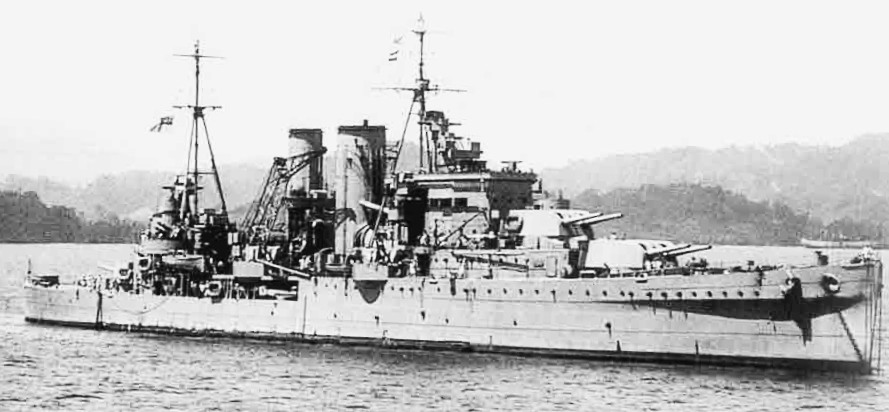
(Royal Navy Photo)
HMS Exeter (68) off the coast of Sumatra (Netherlands East Indies) in 1942.
On 13 February Allied reconnaissance aircraft spotted Japanese invasion convoys north of Bangka Island and the new commander of ABDA naval forces, Vice Admiral Conrad Helfrich of the Royal Netherlands Navy, was ordered to assemble the Allied Striking Force of Exeter and three Dutch and one Australian light cruisers at Oosthaven on the morning of 14 February. Escorted by six American and three Dutch destroyers, the force departed that afternoon. The Dutch Rear Admiral Karel Doorman, commanding the force, took his ships through the Gaspar Strait and then northwest towards Bangka Island. While passing through the strait, the Dutch destroyer Van Ghent struck a rock in poor visibility and another Dutch destroyer was tasked to take off her crew. The Japanese spotted the Allied ships around 08:00 and repeatedly attacked them. The first was a group of seven Nakajima B5N “Kate” torpedo bombers from the light carrier Ryūjō that attacked Exeter with bombs around 10:30. The blast from a near miss badly damaged her Walrus, but the ship was only damaged by shrapnel. They were followed shortly afterwards by a group of 23 Mitsubishi G3M “Nell” bombers from the Genzan Air Group that inflicted no damage as they dropped their bombs from high altitude. Another group of six B5Ns attacked without effect at 11:30.
The repeated aerial attacks persuaded Doorman that further progress was unwise in the face of Japanese aerial supremacy and he ordered his ships to reverse course and head for Tanjung Priok at 12:42. The attacks continued as 27 G3Ms of the Mihoro Air Group then bombed from high altitude. Seven more B5Ns attacked fruitlessly at 14:30; a half-dozen more followed an hour later. The final attack was made by 17 Mitsubishi G4M “Betty” bombers of the Kanoya Air Group shortly before dark. The Japanese attacks were almost entirely ineffectual, with no ship reporting anything more than shrapnel damage. In return, allied anti-aircraft fire was moderately effective with most of the attacking bombers damaged by shrapnel. In addition, one G4M crashed while attempting to land, and another was badly damaged upon landing.
On 25 February, Helfrich ordered all available warships to join Doorman’s Eastern Striking Force at Surabaya. The Exeter and the Australian light cruiser Perth, escorted by three British destroyers, Jupiter, Encounter, and Electra, set sail at once, leaving behind one Australian cruiser and two destroyers that were short of fuel. After they had arrived the following day, Doorman’s entire force of five cruisers and nine destroyers departed Surabaya at 18:30 to patrol off Eastern Java in hopes of intercepting the oncoming invasion convoy which had been spotted earlier that morning. The Japanese were further north than he anticipated and his ships found nothing. His own ships were located at 09:35 on the following morning, 27 February, and were continuously tracked by the Japanese. Doorman ordered a return to Surabaya at 10:30, and his ships were attacked by eight bombers from the Kanoya Air Group at 14:37. They claimed to have made two hits on the Jupiter, but actually they missed the British destroyer. Just as his leading ships were entering harbour, he received reports of enemy ships 90 miles (140 km) to the north and Doorman ordered his ships to turn about to intercept them.
Aware of Doorman’s movements, the Japanese commander, Rear Admiral Takeo Takagi, detached the convoy’s two escorting destroyer flotillas, each consisting of a light cruiser and seven destroyers, to intercept the Allied ships in conjunction with his own pair of heavy cruisers (Nachi and Haguro) which were escorted by a pair of destroyers.[51] His heavy cruisers opened fire at long range at 15:47 with little effect. The light cruisers and destroyers closed to ranges between 13,000 and 15,000 yards (12,000 and 14,000 m) and began firing Type 93 “Long Lance” torpedoes beginning at 16:03. All of these torpedoes failed to damage their targets, although one torpedo hit Exeter and failed to detonate at 16:35. Three minutes later, Haguro changed the course of the battle when one of her shells penetrated the British ship’s starboard aft twin four-inch gun mount before detonating in the ‘B'[54]: Item #19 or aft boiler room,[55] knocking six of her boilers off-line[53] and killing 14 of her crew. The ship sheered out of line to avoid another torpedo and slowed, followed by all of the trailing cruisers. Moments later a torpedo fired from Haguro stuck the Dutch destroyer Kortenaer, breaking her in half and sinking her almost immediately.[57] Perth laid a smoke screen to protect Exeter[58] and the Allied ships sorted themselves into separate groups as they attempted to disengage. Exeter was escorted by one Dutch and all three British destroyers in one group and the other cruisers and the American destroyers formed the other group. The Japanese did not initially press their pursuit as they manoeuvered to use their torpedoes against the crippled Exeter, which could only make 5 knots (9.3 km/h; 5.8 mph), and her escorts.
The Japanese began launching torpedoes beginning at 17:20 at ranges of 10,000 to 18,500 yards (9,100 to 16,900 m), but they all missed. For some reason, two Japanese destroyers, Asagumo and Minegumo, continued to close before firing their torpedoes at 6,500 yards (5,900 m) and Encounter and Electra pulled out of line to counter-attack. Engaging at close range as they closed, Electra damaged Asagumo, but was sunk by the Japanese ship at 17:46. Meanwhile, Exeter continued south to Surabaya, escorted by the Dutch destroyer Witte de With. Doorman’s repeated unsuccessful, and ultimately fatal, attempts to reach the transports concentrated the Japanese on the task of protecting the transports and allowed the damaged British cruiser to reach harbour.
The following day, after making temporary repairs and refuelling, Exeter, escorted by Encounter and the American destroyer Pope, was ordered to steam to Colombo, via the Sunda Strait. They departed on the evening of 28 February, but they were intercepted by the Japanese heavy cruisers Nachi, Haguro, Myōkō, and Ashigara, and by the destroyers Akebono, Inazuma, Yamakaze, and Kawakaze on the morning of 1 March.
At about 0800, the British ships spotted two of the Japanese cruisers, one of which launched its spotting floatplanes. Two others were seen closing in, and both launched their aircraft before opening fire at about 09:30.The Allied ships laid smoke and turned away to the east with the Japanese to their north and south.[68] Exeter was able to reach a speed of 26 knots (48 km/h; 30 mph)[69] before the first hit on her detonated in her ‘A’, or forward, boiler room and catastrophically knocked out all power around 11:20. Now defenseless, as no guns could train or traverse, and wanting to save as many lives as he could, and to avoid the ship’s capture by the Japanese forces, Captain Gordon ordered the ship to be scuttled. As a result, Exeter began listing to port, and that list was said to be at “a considerable angle” by the time the abandonment was completed.[54]: Item #47 Sensing a kill, the Japanese destroyers closed in and fired torpedoes, two of which (out of a total of 18 fired by Japanese combatants) from the Inazuma, hit the ship – starboard amidships, and starboard just forward of A turret, as confirmed when the wreck was first discovered in 2007. As a result, Exeter rapidly righted herself,[54]: Item #47 paused briefly, and then capsized to starboard.[68] Encounter and Pope were also lost; Encounter approximately fifteen minutes after Exeter, while Pope temporarily survived the initial melee, only to be sunk a couple of hours later. Japanese B5N Type-97s armed with one 250 kg (551 lb) and four 60 kg (132 lb) bombs assisted in the sinking of Pope, already crippled by bombing from seaplanes and land-based air, and closed in to make a level bombing attack. No direct hits were scored, but several more near-misses hastened the abandonment and scuttling of the vessel, and she was finished off by gunfire with the late arrival of the two IJN cruisers Ashigara and Myoko. The Japanese rescued 652 men of the crew of Exeter, including her captain, who became prisoners of war. (Wikipedia)
Her wreck, a British war grave, had been destroyed by illegal salvagers by 2016.
HMS York (90)
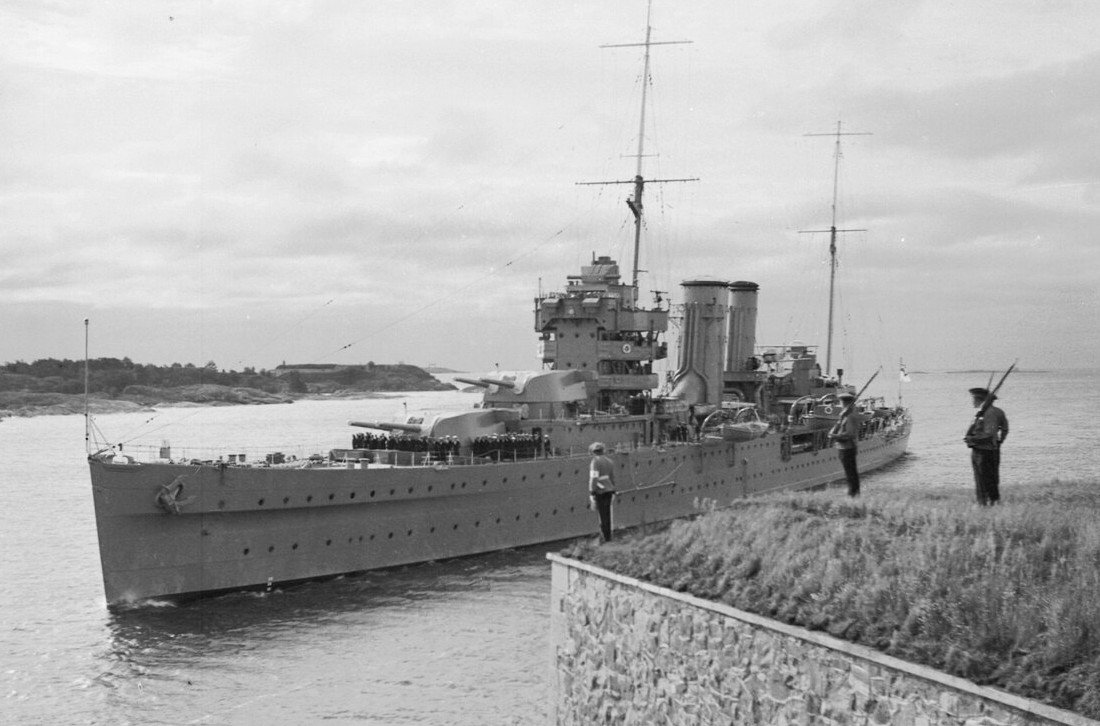
(Historian kuvakokoelma; Valokuvaamo Pietisen kokoelma Photo)
HMS York (90), arriving at Helsinki, Finland on 3 Sep 1933. HMS York was the lead ship of her class of two heavy cruisers built for the Royal Navy in the late 1920s. She mostly served on the America and West Indies Station before the Second World War. Early in the war the ship escorted convoys in the Atlantic and participated in the Norwegian Campaign in 1940. York was transferred to the Mediterranean theatre in late 1940 where she escorted convoys and the larger ships of the Mediterranean Fleet.
HMS York was disabled at Suda Bay in Crete by two Italian explosive motorboats of the Italian Regia Marina assault Flotilla Decima Flottiglia MAS, launched by the destroyers Francesco Crispi and Quintino Sella on 26 March 1941; the two old destroyers were fitted with special cranes to operate assault craft. Six motorboats, belonging to Decima Flottiglia Mas, entered the bay, led by Tenente di vascello Luigi Faggioni, and attacked three targets in pairs; the first was York, second the tanker Pericles and last another ship at anchor. Three of the attacking boats had various problems, either mechanical or human, due to the extreme temperature conditions, but the other three successfully attacked their targets. Two motorboats, packed with 330-kilogram (728 lb) charges in the bows, struck York amidships, flooding both boiler rooms and one engine room. Two British seamen were killed. All Italian sailors survived the attack and fell into British hands. The ship was run aground to prevent her from sinking.[20] The submarine HMS Rover was used to supply electrical power to operate the cruiser’s guns for anti-aircraft defence, until Rover was severely damaged by air attack and had to be towed away for repairs. On 18 May, further damage was inflicted by German bombers and the ship was damaged beyond repair. Her main guns were wrecked by demolition charges on 22 May 1941 when the Allies began to evacuate Crete. York’s wreck was salvaged in February 1952 by an Italian shipbreaker and towed to Bari to be broken up, beginning on 3 March. (Wikipedia)
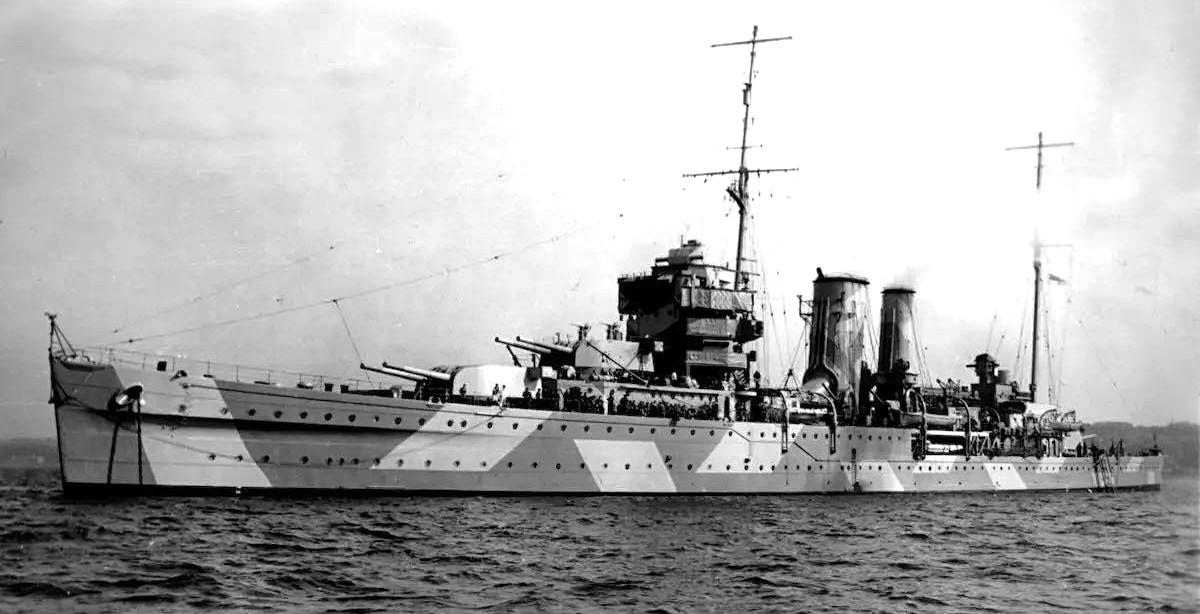
(RN Photo)
HMS York (90).
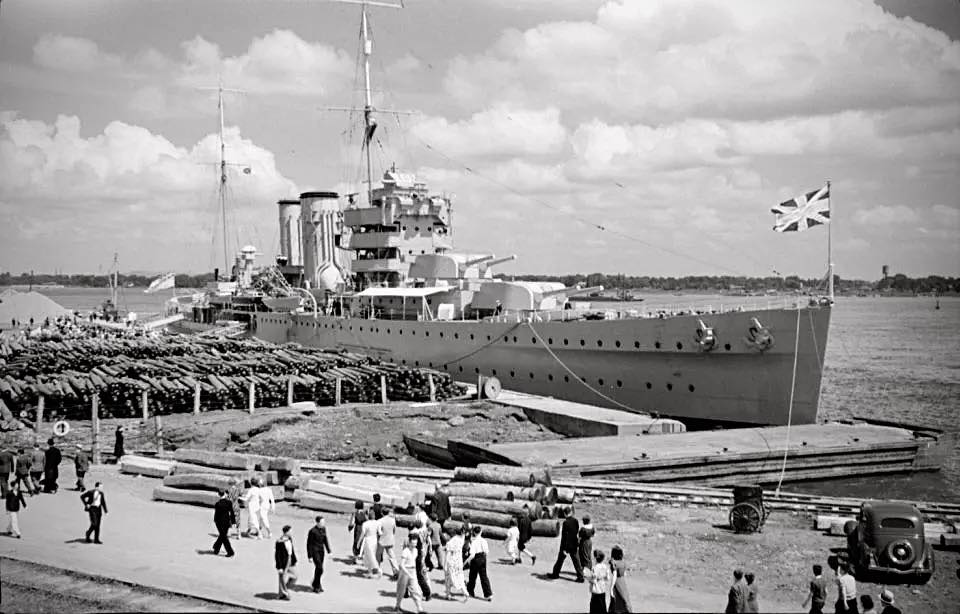
(RN Photo)
HMS York (90), Montreal, Quebec, 20 June 1937.
All comments are subject to our Comment Policy. You must be at least 18 years old to comment.
See a comment that violates our guidelines? Report it here.