RN Arethusa class cruisers
HMS Arethusa (26), HMS Galatea (71), HMS Penelope (97), HMS Aurora (12)
The light armoured cruiser – light cruiser – succeeded the protected cruiser; improvements in machinery and armour rendering the latter obsolete. The Town class of 1910 were rated as second-class protected cruisers, but were effectively light armoured cruisers with mixed coal and oil firing. The Arethusa class of 1913 were the first oil-only fired class. This meant that the arrangement of coal bunkers in the hull could no longer be relied upon as protection and the adoption of destroyer-type machinery resulted in a higher speed. This makes the Arethusas the first “true example” of the warship that came to be recognised as the light cruiser. In the London Naval Treaty of 1930, light cruisers were officially defined as cruisers having guns of 6.1 inches (155 mm) calibre or less, with a displacement not exceeding 10,000 tons.
The Arethusa class was a class of four light cruisers built for the Royal Navy between 1933 and 1937 and that served in the Second World War. It had been intended to construct six ships, but the last pair, Polyphemus and Minotaur, were ordered in 1934 as the 9,100-ton Town-class Southampton and Newcastle.
The Arethusas were a smaller version of the Amphion group of the earlier Leander class, having the unit machinery layout and two funnels of the former. The design was judged to be the minimum required for a “trade route cruiser” to counter the threat of the auxiliary cruiser over which, even with their reduced armament, they would enjoy a comfortable superiority. They were also to be capable of acting as a fleet cruiser (which was fortunate because, in the end, they were used almost exclusively with the fleet). Therefore, no reduction in speed (i.e. machinery) could be accepted, and savings had to be found in armament, size and protection; the Arethusas suppressed ‘X’ 6-inch gun turret and were 50 feet (15 m) shorter and displaced 1,250 tons less than the Leanders. The protection scheme was the same as the Leanders but was generally thinner to save weight. This allowed six Arethusas to be built for every five Leanders within the constraints of tonnage allowed under treaties then in force. Welded construction was widely used for the first time to save weight, over 250 tons being cut off the original specification.
They were armed with six BL 6 inch Mark XXIII in three twin mountings Mark XXI in ‘A’, ‘B’ and ‘Y’ positions. Triple 21-inch (530 mm) torpedo tubes were carried abreast the after funnel, the reduction in beam had reduced training space resulting in the omission of one tube vis-à-vis the Leanders. The secondary armament was four QF 4-inch Mark V on single mountings HA Mark III, controlled by a HACS director on the bridge. The 4-inch magazine was retained in the position of the Leander class well forward, but the guns themselves were moved well aft. As a result, the 4-inch shell and charge had to be transported 200 feet (61 m) along the ship to reach the guns. In Penelope and Aurora eight QF 4-inch Mark XVI on four twin mountings HA/LA Mark XIX replaced the single mounts, and a second HACS director was added aft. A shelter was added for the gun crews between each pair of guns as it was recognised that in wartime the crews would spend a lot of time closed up at action stations and would rapidly fatigue in the open gun mountings. Galatea received similar alteration before the outbreak of war. The light armament consisted of eight 0.5-inch Vickers machine guns in two quadruple mountings.
A rotating catapult for a float plane and a derrick were fitted between the funnels. It had been intended to carry a second aircraft aft, but in the end this never happened. Aurora completed without aircraft facilities, and had a deckhouse for accommodation in lieu for service as commodore. (Wikipedia)
HMS Arethusa (26)
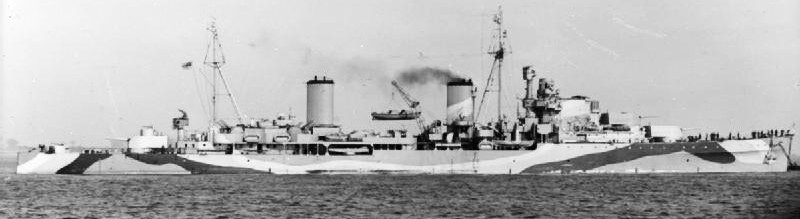
(IWM Photo, FL 889)
HMS Arethusa (26).
HMS Arethusa was the name ship of her class of light cruisers built for the Royal Navy. She was built by Chatham Dockyard, with the keel being laid down on 25 January 1933. She was launched on 6 March 1934, and commissioned 21 May 1935 by Captain Philip Vian.
Arethusa was assigned to the 3rd Cruiser Squadron in the Mediterranean on completion and was still there at the onset of the Second World War in September 1939. However, early in 1940 she and her sister Penelope were recalled to the Home Fleet, where they formed the 2nd Cruiser Squadron with the remainder of the class. She participated in the Norwegian Campaign in April 1940, but on 8 May she joined the Nore Command, where she supported the defending forces in Calais and later aided the evacuations from French Atlantic ports.
On 28 June 1940 she was a component of the newly formed Force “H” at Gibraltar, with which she participated in the action against Vichy French forces at Mers el Kebir in July 1940. With Force “H” she took part in convoy protection patrols in the Atlantic and operated in the Mediterranean. During the sortie of the German battleship Bismarck in May 1941 she was employed in Iceland and Faroese waters, but by July she had returned to the Mediterranean, where she escorted Malta convoys and ran supply trips to the island. Towards the end of 1941 she returned to home waters and took part in the Lofoten raid (Operation Anklet) in December, where she was damaged by near misses. After refit and repair at Chatham until April 1942, she returned to the Mediterranean in June 1942, where she joined the 15th Cruiser Squadron, operating mostly in support of the supply of Malta.
While on Operation Stoneage, a torpedo from an Italian aircraft struck Arethusa on 18 November 1942 and caused many casualties. She received temporary repair work in Alexandria that lasted until 7 February 1943, after which she proceeded to Charleston Navy Yard, Charleston, South Carolina, United States, for full repair. These were completed by 15 December 1943 and the ship then returned to Britain.[a]In 1941 Arethusa had been adopted by the people of Swansea. A memorial relief to the 156 men killed in the November 1942 aircraft attack can still be viewed in the city’s Maritime Quarter. Swansea Museum’s reserve collection at its Landore facility contains the ship’s badge, a 20 mm Oerlikon AA gun salvaged from the Newport scrapyard, and a scale model of the ship.
She did not become fully operational again until early June 1944, when she sailed for the invasion of Normandy, forming part of Force “D” off Sword Beach. She had the honour of carrying King George VI across the channel to Normandy, when he toured the beaches and visited the Allied command headquarters. On 24 June she came under air attack in Seine Bay and sustained some damage. On 25 June a magnetic mine detonated in her wake. The shock damage was fairly extensive, the cruiser went to Portsmouth for repairs then to a commercial yard for yet another refit and did not return to service until September.By January 1945, she was part of the 15th Cruiser Squadron with the Mediterranean Fleet and stayed there until October 1945 when she returned to Britain and was immediately placed in the reserve (at the Nore). There was a tentative plan to sell her to the Royal Norwegian Navy in 1946 but this came to nothing and she was placed in category ‘B’ reserve. Because the Navy considered her class of ships too small to be worth modernising, the Navy used Arethusa for trials and experiments in 1949 before allocating her to BISCO for disposal. On 9 May 1950, she arrived at Cashmore’s, Newport, for breaking up. (Wikipedia)
HMS Galatea (71)
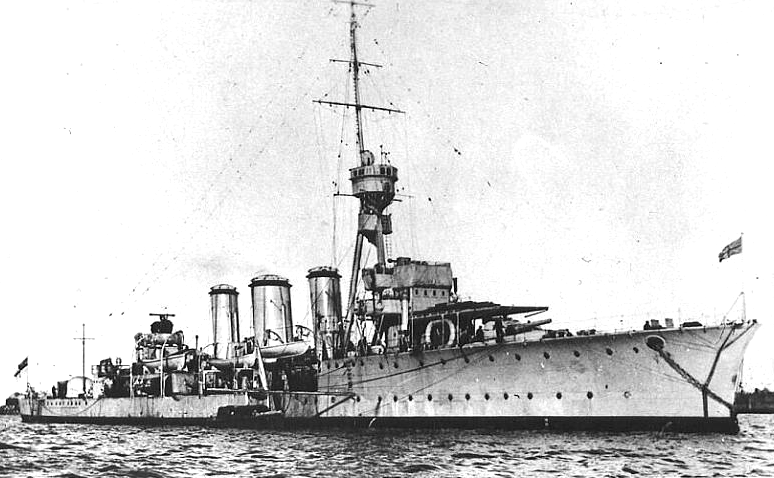
(RN Photo)
HMS Galatea (71)
HMS Galatea was an Arethusa-class light cruiser of the Royal Navy. She was built by Scotts Shipbuilding & Engineering Co. (Greenock, Scotland), with the keel being laid down on 2 June 1933. She was launched on 9 August 1934, and commissioned 14 August 1935.Galatea joined the Mediterranean Fleet on commissioning and except the period from March till September 1938 acted as flagship, Rear Admiral (Destroyers). Based in Malta, upon the outbreak of the Spanish Civil War she was active in joint patrols enforcing the non-intervention policy, periodically in co-operation with the German cruiser Deutschland and Italian destroyers. Later deployed in Alexandria, she remained on alert in course of the Italian invasion of Abissynia. In early to mid 1938 the vessel was on refit at Devonport. She was recommissioned for the Mediterranean, deployed at Malta and Alexandria. On 29 March 1939 in Gandia Galatea took on board the leader of the National Defence Council colonel Segismundo Casado and his entourage; the following day she sailed off and on 31 March Casado was transferred to the hospital ship Maine.
After the outbreak of Second World War she was ordered home, and between February and March 1940 she took part in the operations to intercept Axis merchantmen attempting to break out of Vigo. On 4 April 1940, the Polish destroyers Burza, Grom and Błyskawica reached their new homebase Rosyth. In the afternoon they left the harbour with Galatea, her sister ship Arethusa and three destroyers. They were ordered to conduct a patrol in the North Sea and were later ordered to intercept German invasion groups heading for Norway. In April 1940 she was involved in the Norwegian Campaign, leaving on 25 April transporting part of the Norwegian National Treasury to Britain, and in May joined the Nore Command as Flagship of the 2nd Cruiser Squadron. Arriving at Åndalsnes in late April with troops for the Norwegian campaign she returned to Rosyth with 200 crates, weighing 40 kilograms (88 lb) each, from the Norwegian national treasury.In June 1940 she was involved in the Operation Aerial evacuation of troops from Saint-Jean-de-Luz, France, including Sir Ronald Hugh Campbell, the British Ambassador to France.
On 7 September 1940 the code word “Cromwell” was issued meaning that the Germans might land in Kent at dawn. During that night Galatea was sent to patrol the Straits of Dover but made no contact with the enemy. At dawn while returning to port she struck a naval mine off Sheerness and spent three months in dry dock.She remained with the Home Fleet (under refit, between October 1940 to January 1941) until May 1941, and was involved in hunting the German battleship Bismarck. In July 1941 she joined the Mediterranean Fleet via the Red Sea, and by November was based at Malta with Force “K”, operating against the Axis supply convoys to North Africa.On 15 December 1941 before midnight Galatea was torpedoed and sunk by the German submarine U-557 off Alexandria, Egypt with the loss of 470 crew. Some 100 survivors were picked up by the destroyers Griffin and Hotspur. Less than 48 hours later, U-557 was rammed by the Italian torpedo boat Orione and sank with all hands. (Wikipedia)
HMS Penelope (97)
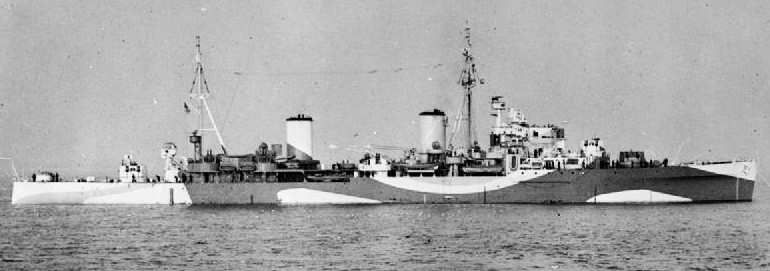
(IWM Photo, FL 4822)
HMS Penelope (97).
HMS Penelope was an Arethusa-class light cruiser of the Royal Navy. She was built by Harland & Wolff (Belfast, Northern Ireland); her keel was laid down on 30 May 1934. She was launched on 15 October 1935, and commissioned 13 November 1936. She was torpedoed and sunk by the German U-boat U-410 near Naples with great loss of life on 18 February 1944. On wartime service with Force K, she was holed so many times by bomb fragments that she acquired the nickname “HMS Pepperpot”.
At the outbreak of the Second World War Penelope was with the 3rd Cruiser Squadron in the Mediterranean, having arrived at Malta on 2 September 1939. Penelope and her sister ship Arethusa were reallocated to the 2nd Cruiser Squadron in the Home Fleet and arrived at Portsmouth on 11 January 1940. On 3 February she left for the River Clyde en route to Rosyth, arrived on 7 February and operated with the 2nd Cruiser Squadron on convoy escort duties. In April and May 1940, she took part in the Norwegian Campaign.
On 11 April Penelope ran aground off Fleinvær while hunting German merchant ships entering the Vestfjord. Her boiler room was flooded and she was holed forward. The destroyer Eskimo towed her to Skjelfjord where an advanced base had been improvised. Despite air attacks, temporary repairs were made and she was towed home a month later. She arrived at Greenock in Scotland on 16 May 1940 where additional temporary repairs were carried out, before proceeding on 19 August to the Tyne for permanent repairs.After repairs and trials were completed in August 1941, Penelope reappeared as ‘a new ship from the water line down’. She returned to the 2nd Cruiser Squadron at Scapa Flow on 17 August 1941. On 9 September she left Greenock escorting the battleship Duke of York to Rosyth. Later that month she was employed in patrolling the Iceland–Faroes passage to intercept enemy surface ships.On 6 October 1941 Penelope left Hvalfjord, Iceland, with another battleship, King George V, escorting the aircraft carrier Victorious for the successful Operation E. J., an air attack on German shipping between Glom Fjord and the head of West Fjord, Norway. The force returned to Scapa Flow on 10 October 1941.
Penelope and her sister Aurora were then assigned to form the core of Force K based at Malta and departed Scapa on 12 October 1941, arriving in Malta on 21 October. On 8 November, both cruisers and their escorting destroyers sailed from Malta to intercept an Italian convoy of six destroyers and seven merchant ships sailing for Libya, which had been sighted by aircraft at 37°53’N – 16°36’E. During the ensuing Battle of the Duisburg Convoy on 9 November off Cape Spartivento, the British sank one enemy destroyer (Fulmine) and all of the merchant ships.
On 23 November, Force K sailed again to intercept another enemy convoy; next day they sank two more merchant ships, Maritza and Procida, west of Crete. Force K received the Prime Minister’s congratulations on their fine work. On 1 December 1941, Force K sank the Italian merchant vessel Adriatico, at 32°52’N – 2°30’E, the destroyer Alvise da Mosto, and the tanker Iridio Mantovani at 33°45’N – 12°30’E. The First Sea Lord congratulated them on 3 December.On 19 December, while operating off Tripoli, Penelope struck a mine but was not seriously damaged, although the cruiser Neptune and the destroyer HMS Kandahar were sunk by mines in the same action. Penelope was sent into the dockyard for repairs and returned to service at the beginning of January 1942. On 5 January, she left Malta with Force K, escorting the Special Service Vessel Glengyle to Alexandria (Operation ME9), returning on 27 January, escorting the supply ship Breconshire.
She left Malta, again with Breconshire on 13 February 1942 and an eastbound convoy aided by six destroyers, Operation MG5, returning to Malta on 15 February, with the destroyers Lance and Legion. On 23 March, she left Malta with Legion for Operation MG1, a further convoy to Malta. Breconshire was hit and taken in tow by Penelope and was later safely secured to a buoy in Marsaxlokk harbour, the whole operation was under the charge of Penelope’s commanding officer, Captain A. D. Nicholl, of whose work the Naval Officer In Command (NOIC), Malta expressed appreciation.
Penelope was holed both forward and aft by near-misses during air attacks on Malta on 26 March. While in the island, she was docked and repaired at the Malta Dry Docks. Day after day she was attacked by German aircraft and the crew worked to fix a myriad of shrapnel holes, so many that she was nicknamed HMS Pepperpot; when these had been plugged with long pieces of wood, HMS Porcupine. Penelope gun-loader, Albert Hewitt, was blown off his feet but regained consciousness still safely holding a four inch shell.[2] Penelope sailed for Gibraltar on 8 April and on the next day was repeatedly attacked from the air. She arrived in Gibraltar on 10 April, with further damage from near-misses. Later that day she received a signal from Vice Admiral, Malta, “True to your usual form. Congratulations”.
The damage was extensive and required several months at home after temporary repairs in Gibraltar. The ship was visited by the Duke of Gloucester on 11 April, who had originally laid down her keel plate. The duke also visited Captain Nicholl in hospital. The First Sea Lord congratulated the ship on her successful arrival in Gibraltar. The question of Penelope’s repairs had been reconsidered, and it was decided to send her to the United States. She accordingly left Gibraltar on 10 May 1942, for the Navy Yard at New York via Bermuda, arriving on 19 May. She was under repair until September and arrived in Norfolk, Virginia on 15 September, proceeding, again via Bermuda, to Portsmouth, England, which she reached on 1 October 1942. The King, at an investiture at Buckingham Palace, decorated 21 officers and men from Penelope as “Heroes of Malta”. Among their awards were two Distinguished Service Orders, a Distinguished Service Cross and two Distinguished Service Medals.
Penelope arrived at Scapa Flow on 2 December and remained in home waters until the middle of January 1943. She left the Clyde on 17 January for Gibraltar, where she arrived on 22 January. She had been allocated to the 12th Cruiser Squadron, in which she operated with the Western Mediterranean Fleet under the flag of Admiral Sir Andrew Cunningham during the follow-up of Operation Torch, the landings in North Africa.
On 1 June 1943, Penelope and the destroyers Paladin and Petard shelled the Italian island of Pantelleria. The force received enemy gunfire in return and Penelope was hit once but suffered little damage. On 8 June 1943, with the cruiser Newfoundland and other ships, she took part in a further heavy bombardment of the island. A demand for its surrender was refused. The same force left Malta on 10 June, to cover the assault (Operation Corkscrew), which resulted in the surrender of the island on 11 June 1943. On 11 and 12 June Penelope also took part in the attack on Lampedusa, which fell to the British forces on 12 June 1943.On 10 July 1943, with Aurora and two destroyers, Penelope carried out a diversionary bombardment of Catania as part of the conquest of Sicily, (Operation Husky, the Allied invasion of Sicily). The flotilla then moved to Taormina where the railway station was shelled. On 11 July, Penelope left Malta with the 12th Cruiser Squadron as part of Force H to provide cover for the northern flank of the assault on Sicily. During the remainder of July and August, she took part in various other naval gunfire support and sweeps during the campaign for Sicily.
On 9 September 1943, Penelope was part of Force Q for Operation Avalanche, the allied landings at Salerno, Italy, during which she augmented the bombardment force. Penelope left the Salerno area on 26 September with Aurora and at the beginning of October was transferred to the Levant in view of a possible attack on the island of Kos in the Dodecanese. On 7 October, with the cruiser Sirius and other ships, she sank six enemy landing craft, one ammunition ship and an armed trawler off Stampalia. While the ships were retiring through the Scarpanto Straits south of Rhodes, they were attacked by 18 Ju 87 “Stuka” dive-bombers of I Gruppe Sturzkampfgeschwader 3 MEGARA. Although damaged by a bomb, Penelope was able to return to Alexandria at 22 knots (41 km/h; 25 mph). On 19 November 1943 the ship moved to Haifa in connection with possible developments in the Lebanon situation. Towards the end of 1943, she was ordered to Gibraltar for Operation Stonewall, (anti-blockade-runner duties), in the Atlantic. On 27 December, the forces in this operation destroyed the German blockade-runner Alsterufer which was sunk by aircraft co-operating with Royal Navy ships. Penelope returned to Gibraltar on 30 December and took part in Operation Shingle, the amphibious assault on Anzio, Italy, providing gunfire support as part of Force X with USS Brooklyn on 22 January 1944. She also assisted in the bombardments in the Formia area during the later operations. She made eight shoots on 8 February.
On 18 February 1944, Penelope, under the command of George Devereux Belben, was leaving Naples to return to the Anzio area when she was torpedoed at 40.55°N 13.25°E by the German submarine U-410 under the command of Horst-Arno Fenski. A torpedo struck her in the aft engine room and was followed sixteen minutes later by another torpedo that hit in the aft boiler room, causing her to immediately begin sinking; 417 of the crew, including the captain, went down with the ship, with only 206 survivors. A memorial plaque commemorating those lost is in St Ann’s Church, HM Dockyard, Portsmouth. (Wikipedia)
HMS Aurora (12)
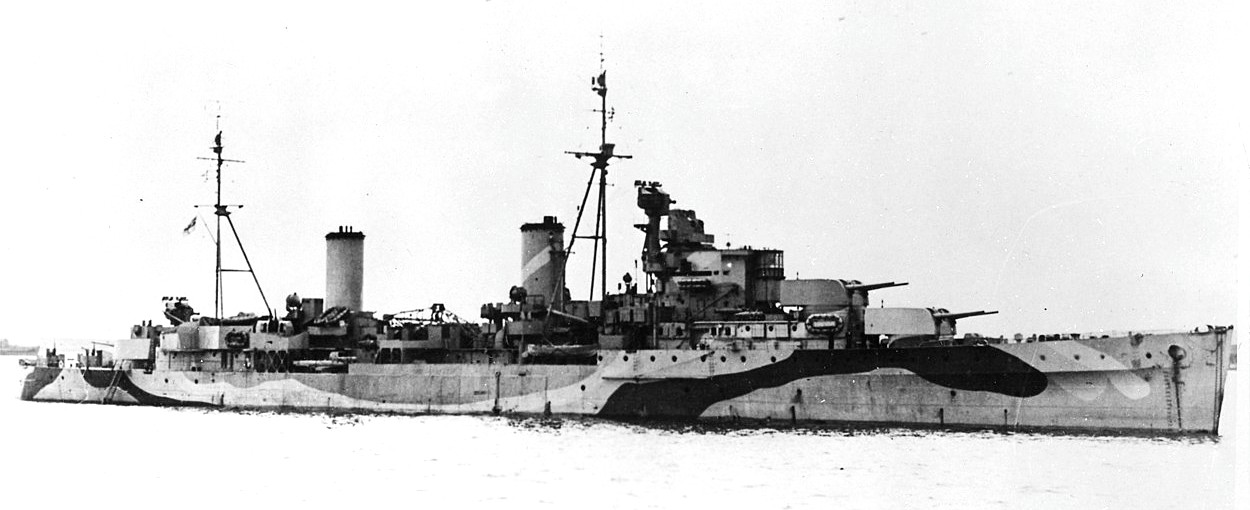
(National Archives at College Park Photo)
HMS Aurora (12)
HMS Aurora was an Arethusa-class light cruiser of the Royal Navy. She was built by Portsmouth Dockyard, with the keel being laid down on 27 July 1935. She was launched on 20 August 1936, and commissioned 12 November 1937.In 1948 it was given to the Nationalist government in China and served as the flagship of the Republic of China Navy, being renamed Chongqing. In February 1949 its crew mutinied and defected to the Communists.
Aurora served with the Home Fleet from completion as Rear Admiral (D). In September 1939 she was with the 2nd Cruiser Squadron, escorting convoys to Scandinavia and engaged in the hunt for the German battleships Scharnhorst and Gneisenau. From October 1940 she was commanded by Captain William Gladstone Agnew. After the Norwegian Campaign she participated in the operations hunting the German battleship Bismarck and, with the cruiser Kenya, intercepted one of the German supply ships, Belchen, on 3 June 1941.
Between July and August 1941, as part of Force K with the Home Fleet, she was involved in operations to Spitzbergen and Bear Island (Operation Gauntlet). After one of these sorties, in company with the cruiser Nigeria, she intercepted a German troop convoy off Northern Norway, and the German Bremse was sunk. In the autumn she was transferred to the Mediterranean and arrived in Malta on 21 October 1941 to join a new Force K. On 9 November 1941 leading Force K, consisting of HMS Penelope, HMS Lance and HMS Lively, she was involved in Battle of the Duisburg Convoy. The Italian destroyer Fulmine was sunk, as well as the German transports Duisburg and San Marco, the Italian transports Maria, Sagitta and Rina Corrado, and the Italian Conte di Misurata and Minatitlan. The Italian destroyers Grecale and Euro were damaged. On 24 November Force K, made up of the British light cruisers Aurora and Penelope and the destroyers Lance and Lively, intercepted an Axis convoy about 100 nautical miles west of Crete. The Axis convoy was bound from the Aegean to Benghazi. The two German transports in the convoy, Maritza and Procida were sunk by Penelope and Lively despite the presence of the Italian torpedo boats Lupo and Cassiopea. On 1 December 1941 Force K with Penelope and Lively attacked the Mantovani Convoy. The Italian destroyer Alvise Da Mosto and the sole cargo ship Mantovani were sunk.
HMS Aurora also participated in the First Battle of Sirte on 17 December 1941. On 19 December while steaming off Tripoli she was severely damaged in a minefield and was forced to retire to Malta. After her return to the Mediterranean she joined Force H, and in November was part of the Centre Task Force for the Landings in North Africa, Operation Torch. Off Oran, she engaged the Vichy French destroyers Tramontane and Tornade on 8 November 1942, sinking the latter and damaging the former so badly that she had to be beached. The following day she badly damaged the destroyer Épervier and drove her ashore. By December she was operating as part of Force Q at Bône against the Axis evacuation and supply convoys between Trapani and Tunis.
Then, as a unit of the 15th Cruiser Squadron, she participated in the Allied invasion of Sicily and the Salerno landings (Operation Avalanche) before moving into the Aegean in October 1943. While escorting British destroyers reinforcing troops on the island of Leros on 30 October, she was attacked by German Junkers Ju 87 and Ju 88 aircraft off Castellorizo, suffering a 500 kg (1,100 lb) bomb hit abaft the after funnel. The explosion and subsequent fire killed 47 crew. Aurora was forced to withdraw to Taranto for repairs which lasted until April 1944.[7] In August 1944 she was at the Operation Dragoon landings in the south of France, then returned to the Aegean, where she assisted in the liberation of Athens. One notable member of crew was the actor Kenneth More, who used his theatre skills in his role as ‘action broadcaster’ to describe to the crew below decks via the public address system what was happening when the ship was in action.
After the war Aurora was sold on 19 May 1948 to the Chinese Navy as compensation for six Chinese custom patrol ships and one cargo ship that the British seized in Hong Kong and lost during the war. She was renamed Chung King, after the Chinese war time capital of Chung King (Chongqing), and became the flagship of the Republic of China Navy under the command of Captain Deng Zhaoxiang. Chiang Kai-shek spent time on the ship observing the worsening military situation at some points. (Wikipedia)
All comments are subject to our Comment Policy. You must be at least 18 years old to comment.
See a comment that violates our guidelines? Report it here.