Royal Navy County class Cruisers: Kent class: HMS Berwick (65), HMS Cornwall (56), HMS Cumberland (57), HMS Suffolk (55), HMS Kent (54), HMAS Australia (D84), HMAS Canberra (D33)
The County class was a class of heavy cruisers built for the Royal Navy and Royal Australian Navy in the years between the First and Second World Wars. They were the first ‘post-war’ cruisers constructed for the Royal Navy and were designed within the limits of the Washington Naval Treaty of 1922. Such ships, with a limit of 10,000 tons standard displacement and 8-inch calibre main guns may be referred to as “treaty cruisers” (the term “heavy cruiser” was not defined until the London Naval Treaty of 1930. The thirteen Counties were built in the Kent, London and Norfolk sub-classes. They were the only 10,000-ton 8-inch gun, or “A”, cruisers that the Royal Navy built. The Counties are remembered for their distinctive three-funnel layout and service in all the major naval theatres of the Second World War. (Wikipedia)
Kent sub-class
HMS Berwick (65)
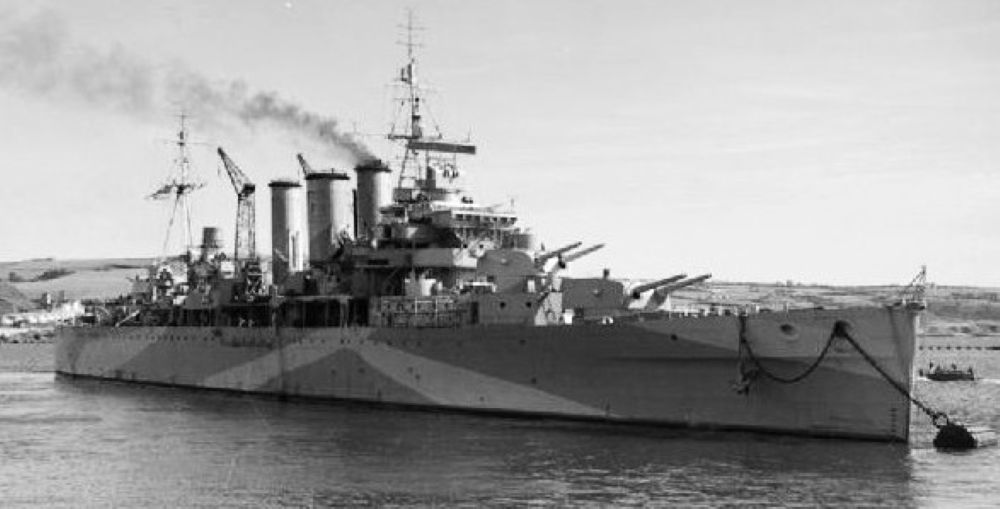
(IWM Photo, FL 1905)
HMS Berwick (65), Nov 1942.
HMS Berwick (65), was a County-class heavy cruiser of the British Royal Navy, part of the Kent sub-class. She was built by Fairfield Shipbuilding and Engineering Company, Govan, Scotland, with the keel being laid down on 15 Sep 1924. She was launched on 30 March 1926 and commissioned 12 July 1927. When completed, Berwick was sent to the China Station, where she remained until a temporary detachment to the Mediterranean in 1936. Along with the rest of her Kent class sub-group of County-class ships, Berwick underwent reconstruction between 1937 and 1938, where her single 4-inch guns were replaced with double mounts, numerous light machine guns were added, along with a significant addition of note; a cemented 4-inch (100 mm) thick and 6 feet (1.8 m) deep armoured belt was added to both sides of her hull beginning at the armoured deck down past her water line.
After these modifications, she completed her sea trials and then proceeded west, to serve on the North America and West Indies Station with the 8th Cruiser Squadron, arriving on 18 January 1939. Once there, she replaced HMS York as station flagship. When the Second World War started, she served on ocean convoy escort duties, then formed part of Force “F”, with York, when hunting groups were created to find German raiders. She did not make contact with any raider, but did intercept the mercantile blockade runners Wolfsburg and Uruguay in the Denmark Straits during March 1940.
On 9 April 1940 she participated in the Norwegian Campaign and on 10 May 1940 in the Invasion of Iceland. She was then allocated to Force “H” at Gibraltar arriving on 7 November. On 27 November, while taking part in Operation Collar, Berwick was hit by a single 203 mm (8 in) shell from an Italian heavy cruiser, either Pola or Fiume, which knocked out her “Y” turret and killed seven men. A second round that struck her some minutes later destroyed the aft electric switchboard, leaving the cruiser’s aft section without power. Some sources credit the second hit to an Italian Trento-class cruiser, either lead ship Trento or her sister-ship Trieste, the only Italian Royal Navy heavy cruisers within range at the time of the strikes.
On 25 December 1940, Berwick engaged the German heavy cruiser Admiral Hipper off the Canaries when she formed part of the escort to convoy WS-5A, a troop convoy to the Middle East. Despite being thoroughly ready for combat, Berwick got the worst of the encounter. She scored no hits on Admiral Hipper, and sustained a fair amount of damage, being hit by several 8-inch (which for the most part passed right through the ship) and 4.1-inch shells. The action did however, drive off Admiral Hipper, and saved the convoy from any losses. Four of her complement were killed and she had to return to Britain for repairs, which lasted until June 1941.
When repaired Berwick joined the Home Fleet and for the remainder of her wartime career she was escorting convoys to North Russia and operating in the northern North Sea, where she served under the captaincy of Norman Vere Gracefrom January to August 1944. In late October 1944 the ship carried Free Norwegian Forces from Britain to Murmansk, so that they could participate in the Liberation of Finnmark. She escorted two carrier raids against the German battleship Tirpitz in 1944 and again in 1945. Berwick’s last role was to escort carriers that were raiding the Norwegian coast in 1945. After the war she was allocated to BISCO for scrapping on 15 June 1948 and arrived at Hughes Bolckow, Blyth, on 12 July for breaking up. (Wikipedia)
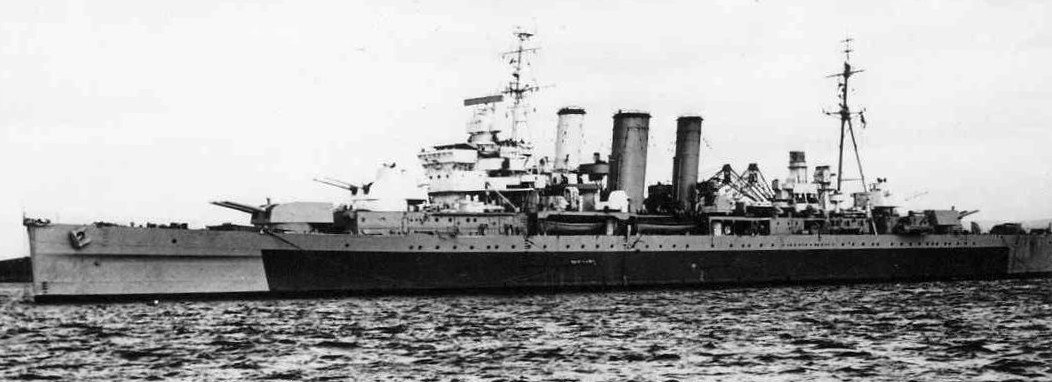
(RN Photo)
HMS Berwick (65).
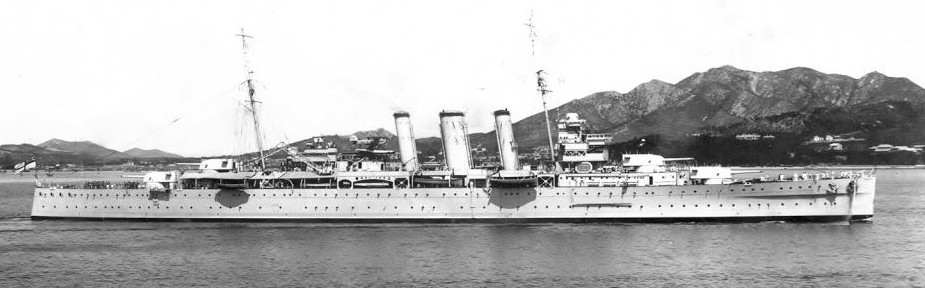
(RN Photo)
HMS Berwick (65).
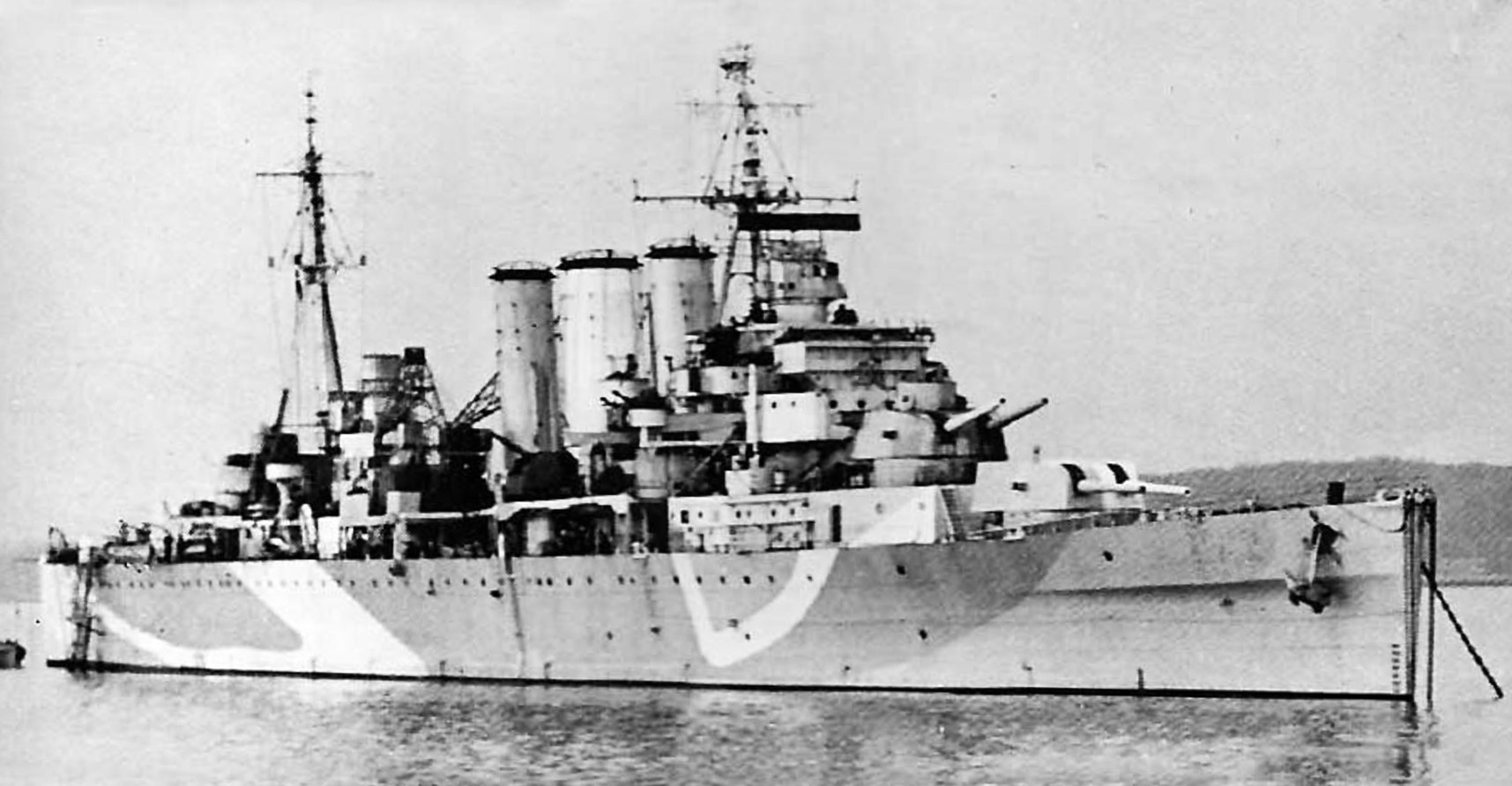
(RN Photo)
HMS Berwick (65)
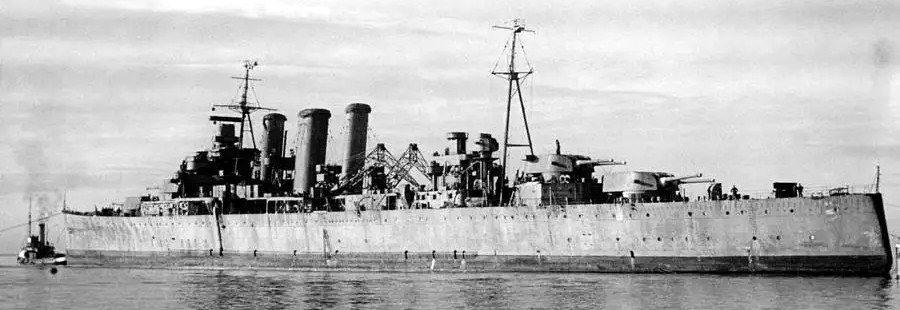
(Blyth Spirit Photo)
The Kent Class Heavy Cruiser, HMS Berwick (65) arriving at the the knackers yard, Hughes Bolkow, Blyth, 12th July 1948.
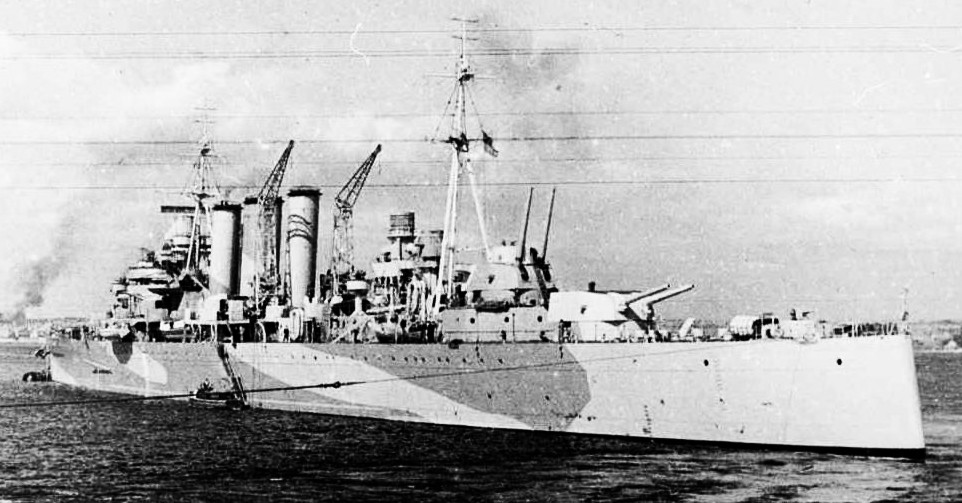
(RN Photo)
HMS Berwick (65).
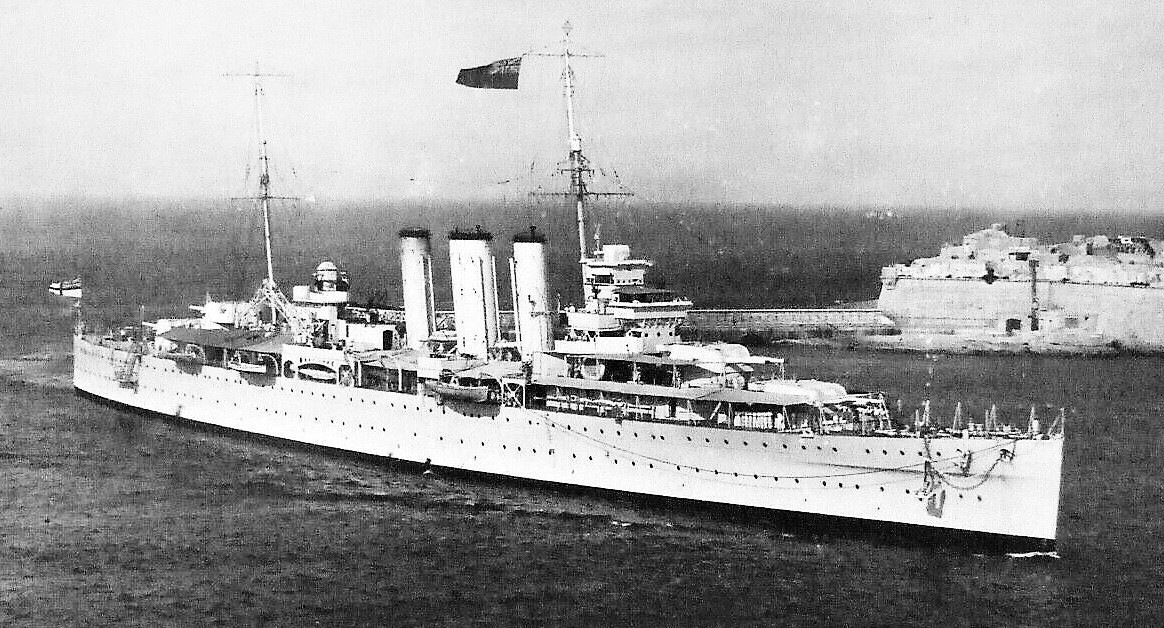
(RN Photo)
HMS Berwick (65) flying both the Red Ensign and the White Ensign, entering Grand Harbour, Valetta Malta La Valletta, 24 June 1937.
HMS Cornwall (56)
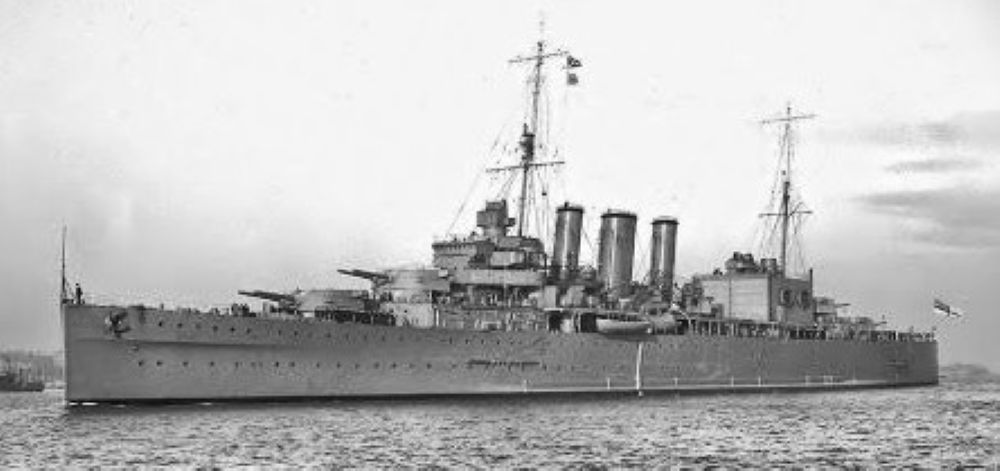
(RN Photo)
HMS Cornwall (56), was a County-class heavy cruiser of the Kent sub-class built for the Royal Navy inthe mid-1920s. The ship spent most of her pre-Second World War career assigned to the China Station. Shortly after the war began in August 1939, she was assigned to search for German commerce raiders in the Indian Ocean. Cornwall was transferred to the South Atlantic in late 1939 where she escorted convoys before returning to the Indian Ocean in 1941. She then sank the German auxiliary cruiser Pinguin in May. After the start of the Pacific War in December 1941, she began escorting convoys until she was transferred to the Eastern Fleet in March 1942. The ship was sunk on 5 April by dive bombers from three Japanese aircraft carriers during the Indian Ocean Raid.
Cornwall, the fifth ship of her name to serve in the Royal Navy, and was named after the eponymous county. The ship was laid down at Devonport Dockyard on 9 Oct 1924 and was launched on 11 March 1926. Completed on 6 Dec 1927, she was assigned to the 5th Cruiser Squadron (CS) on the China Station and spent the bulk of the interbellum period there. In 1929–30 she received a High-Angle Control System, used to direct her anti-aircraft guns, and a catapult was fitted the following year. Two quadruple Vickers .50-calibre (12.7mm) Mark III machine guns were added in 1934.
In July 1936, Cornwall returned home to begin a major refit, which included a 4.5-inch (114 mm) Krupp cemented armour belt abreast the engine and boiler rooms as well as the dynamo room and the fire control transmitting station. This belt extended 6 feet (1.8 m) down from the lower deck. Four inches of armour were also added to protect the sides of the boiler room fan compartments. A hangar for her aircraft was added and a new, more powerful catapult was installed. The ship’s director was moved to the roof of the hangar and a new power-operated director-control tower was installed in its original location. Her single four-inch AA guns were replaced with twin-gun mounts for Mark XVI guns of the same calibre. Two octuple-barrel 2-pounder mounts were added abreast the searchlight tower and the original 2-pounder guns were removed. The changes raised the ship’s displacement by 107 long tons (109 t) and cost an estimated £215,000. After the refit was completed in Dec 1937, the ship was assigned to the 2nd Cruiser Squadron before rejoining the 5th CS in 1939.
On 5 October 1939, a month after the start of the Second World War, she was assigned to Force I to hunt for German commerce raiders in the Indian Ocean and spent most of the rest of the year there. Cornwall was then transferred to the South Atlantic for convoy escort duties. On 13 Sep 1940, the ship rendezvoused with a convoy that was carrying troops intended to capture Dakar from the Vichy French, but was detached to intercept the Vichy French light cruiser Primauguet that was escorting an oil tanker to Libreville, French Equatorial Africa, five days later and forced them to return to Casablanca in French Morocco. She then returned to the Indian Ocean and sank the German commerce raider Pinguin on 8 May 1941. Cornwall rescued 3 officers, 57 ratingsa nd 22 prisoners after the battle.
After the start of the Pacific War on 7 December, the ship began escorting convoys across the Indian Ocean, examples being Convoy JS.1 from Colombo, Ceylon, to the Dutch East Indies in late Jan–early Feb 1942[10] and the troop Convoy MS. 5 to Australia in early March. Later that month, she was assigned to the fast Force A of the Eastern Fleet. On 2 April, Cornwall and he rhalf sister, HMS Dorsetshire, were detached from the fleet, Dorsetshire to resume an interrupted refit and Cornwall to escort convoy SU-4 (composed of the U.S. Army transport USAT Willard A. Holbrook and Australian transport MV Duntroon)to Australia and the aircraft carrier HMS Hermes to Trincomalee in Ceylon for repairs. On 4 April, the Japanese fleet was spotted and the two cruisers left harbour and, after a hurried refuelling at sea, set out for Addu Atoll shortly after midnight. The following day, the two cruisers were sighted by a spotter plane from the Japanese cruiser Tone about 200 miles (370 km) south-west of Ceylon.
As part of the engagement known as the Easter Sunday Raid, a wave of Aichi D3A dive bombers took off from three Japanese carriers to attack Cornwall and Dorsetshire, 320 kilometres (170 nmi; 200 mi) south-west of Ceylon, and sank the two ships. British losses were 424 men killed; 1,122 survivors spent thirty hours in the water before being rescued by the light cruiser Enterprise and two destroyers. (Wikipedia)
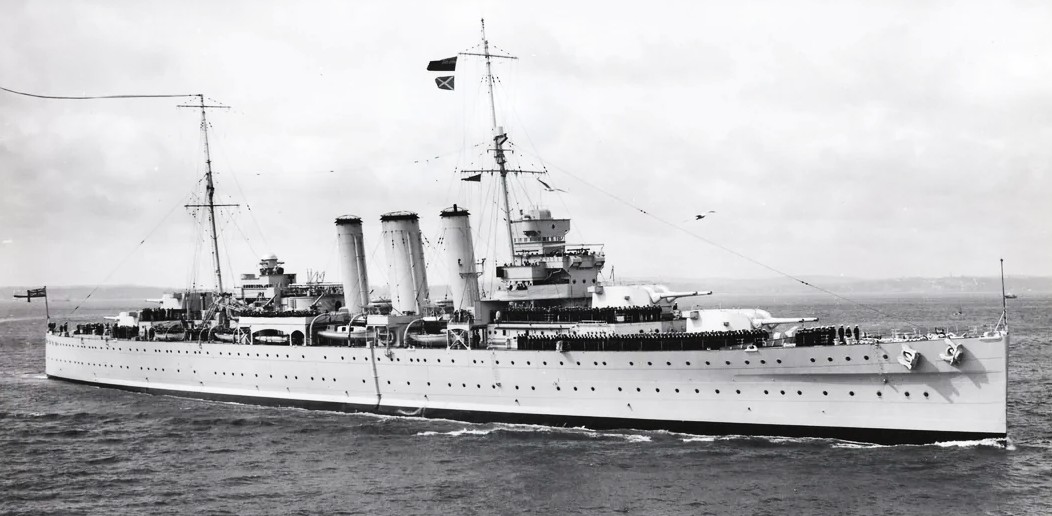
(RN Photo)
HMS Cornwall (56).
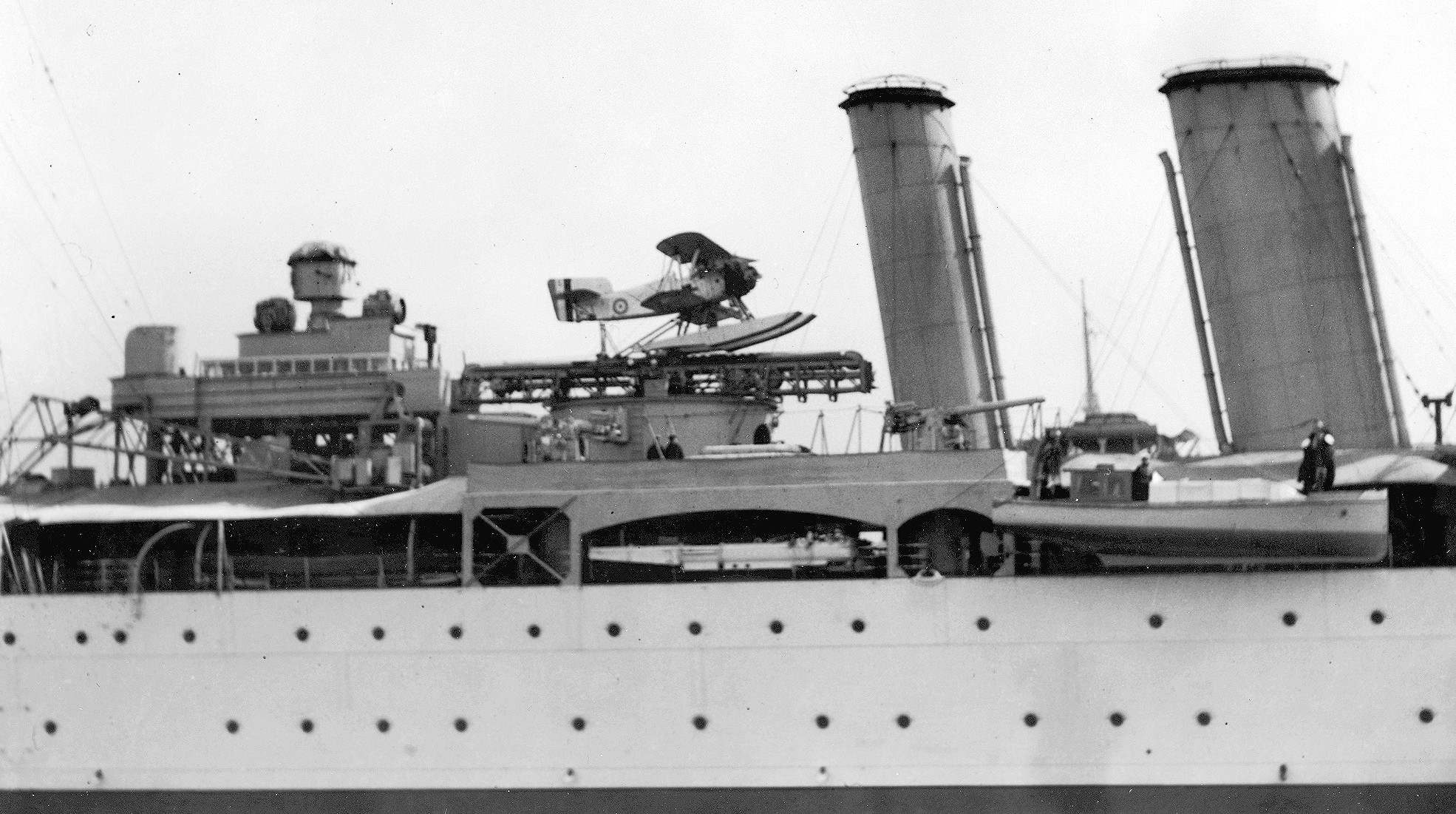
(RN Photo)
HMS Cornwall (56), with its floatplane mounted on a catapult.
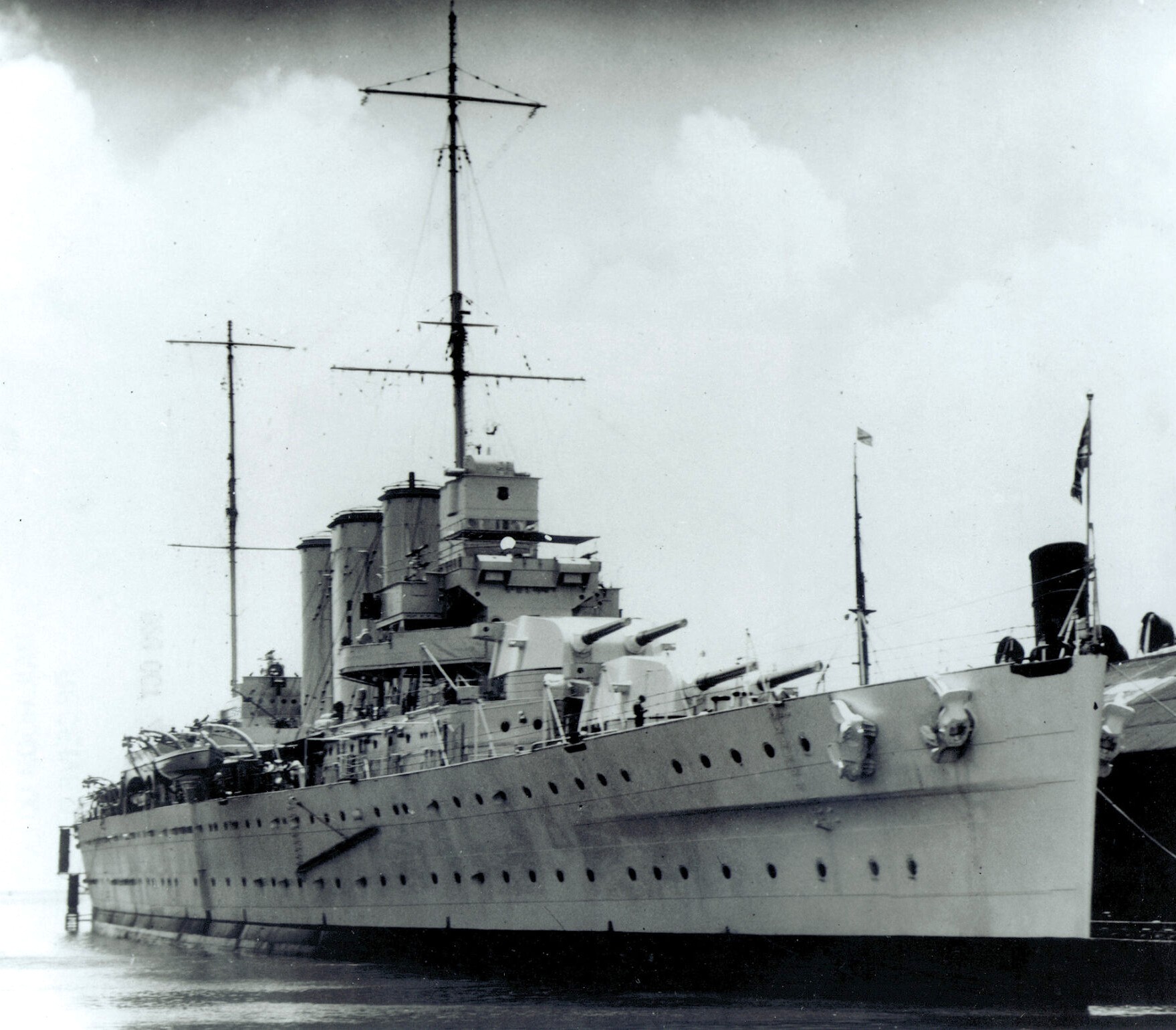
(USN Photo)
HMS Cornwall (56), at Pearl Harbor in 1928. At the time she was one of the leading cruisers in the world.
HMS Cumberland (57)
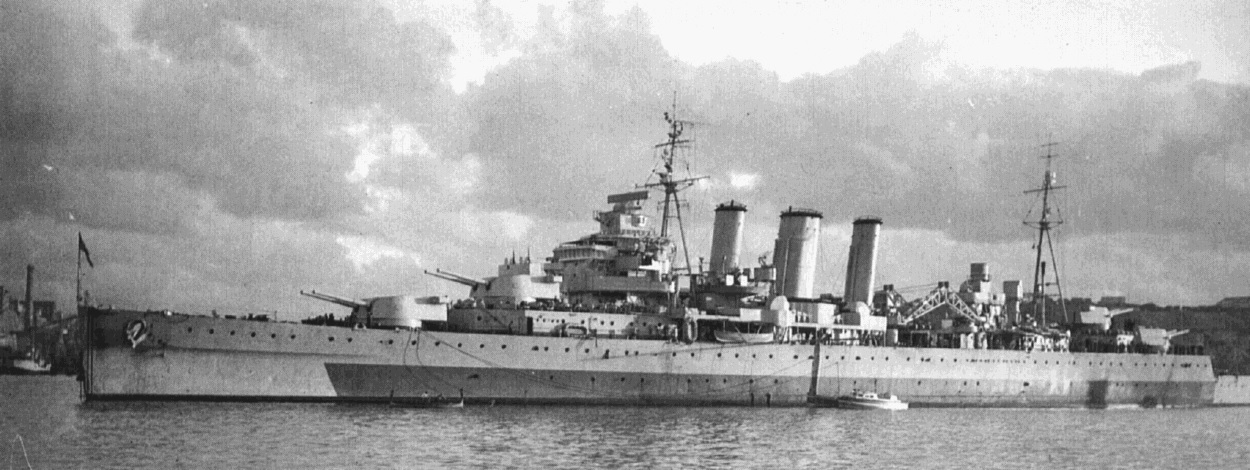
(IWM Photo, A 31120)
HMS Cumberland (57), Grand Harbour, Malta, c1946.
HMS Cumberland (57) was a County-class heavycruiser of the Royal Navy that saw action during the Second World War.Cumberland was built by Vickers-Armstrongs at Barrow-in-Furness in 1926.According to the builders she was 10,000 long tons (10,000 t) displacement, 630feet (190 m) overall × 68 feet 3 inches (20.8 m) × 43 feet 4 inches (13.2 m)capable of 32.25 knots (59.73 km/h; 37.11 mph) with engines rated at 80,000horsepower (60,000 kW). She served on the China Station with the 5th CruiserSquadron from 1928 until 1938, returning to the UK in March 1935 for a refit.In 1938, she joined the 2nd cruiser squadron on the South American station.
At the start of the Second World War in 1939, Cumberland was assigned to 2ndCruiser Squadron Force G, the South American Division. At the start ofDecember she was forced to refit in the Falkland Islands, thus depriving theforce of their strongest unit. Without her, HMS Exeter, Ajax and Achillesengaged the German raider Admiral Graf Spee in the Battle of the River Plate on13 December. Cumberland received a garbled indication that a contact was beingmade and moved north to reinforce, arriving at the River Plate at 22:00 on 14December, after steaming 1,014 nmi (1,878 km; 1,167 mi) in 34 hours, at 29.8 kn(55.2 km/h; 34.3 mph). Admiral Graf Spee had put into neutral Montevideo andwas trapped there, as Cumberland along with Ajax and Achilles (Exeter havingbeen severely damaged) patrolled the estuary, resulting in Admiral Graf Speebeing scuttled by her crew on 17 December.
After this, Cumberland sailed to Simonstown, South Africa, spending betweenJanuary and February undergoing a refit. She then escorted convoys along theAfrican coast, bound for the Middle East. In July, she was tasked, along withher sister, HMS Cornwall, with hunting down the German commerce raider Thor(known as Raider E to the Royal Navy). Whilst on patrol, she intercepted theVichy French merchant Poitiers, which had been carrying ammunition to the IvoryCoast. Rather than see their ship fall into enemy hands, the crew promptlyopened its seacocks and set fire to its cargo. Later that month, she attacked Dakar, suffering damage from a French coastal battery. In December, Cumberlandwas again hunting for the merchant raider Thor, but the search provedunsuccessful.
In October 1941, Cumberland joined the 1st Cruiser Squadron Home Fleetescorting the Arctic convoys until January 1944, winning the battle honourArctic 1942-1943.
She was then transferred to the Far East, as part of 4th Cruiser SquadronEastern Fleet. In September, she carried out raids on Northern Sumatra. Duringthis period, Cumberland won the battle honours Sabang 1944 and Burma 1945. On 7 February 1945, Cumberland was back in Simonstown to have her rudder repaired.
Cumberland returned to the United Kingdom on 12 November 1945 and transportedtroops until June 1946, when she was placed in reserve until 1949. She was thenrefitted at Devonport (1949–1951) for further service as a gunnery trials ship.She lost her 8-inch turrets, and for a few years had a prototype dual 6-inchautomatic turret (testing the concept for later installation in the thenbuilding Tiger-class cruisers) in ‘B’ position, and a prototype automatic dual3-inch turret (also slated for the Tigers) in ‘X’ position. For the 1956 filmThe Battle of the River Plate, Cumberland played herself, arriving withunexpected speed from the Falklands after the battle, to replace the damagedHMS Exeter. Although she was without her 8-inch gun turrets at this time andwas refitted with lattice masts, she is very recognisable as the last of thethree-funnelled heavy cruisers to remain in service. (In the final scenes, HMSJamaica represented Cumberland as one of the British trio patrolling offMontevideo).
Between 1955 and 1956, HMS Cumberland was fitted with a number of trialanti-A-bomb and anti-H-bomb defences. Her first voyage in this configurationwas delayed after some “defects” were found in her engine room, whichwere not explained as normal mechanical faults. In April 1956, having set sailon another secret test mission, she returned to port within 36 hours, followinganother unexplained “defect” in her main gearbox. Sabotage was suspected. HMS Cumberland finally paid off in 1958, arriving at Cashmore’s, Newport, on 3November 1958 for scrapping. (Wikipedia)
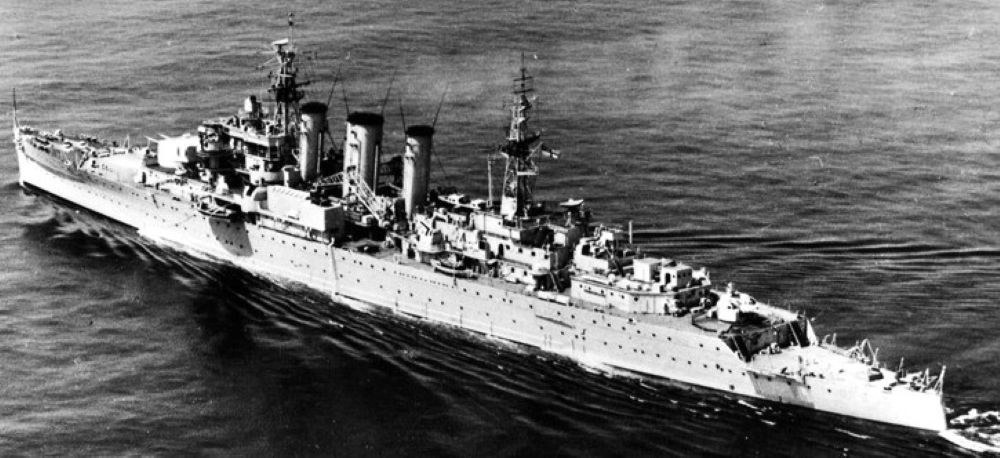
(RN Photo)
HMS Cumberland (57).
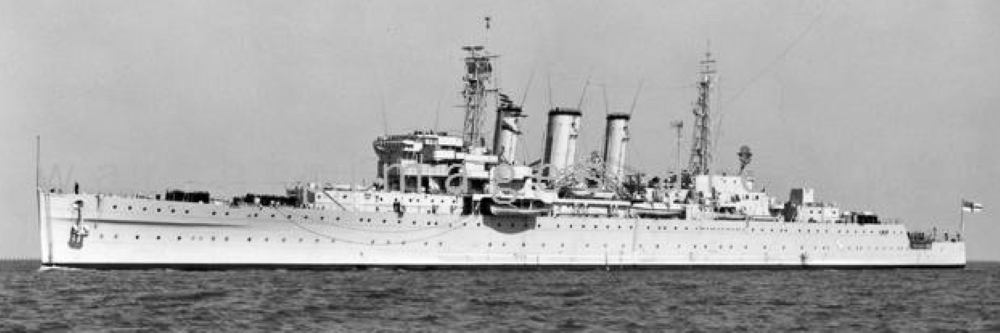
(RN Photo)
HMS Cumberland (57).
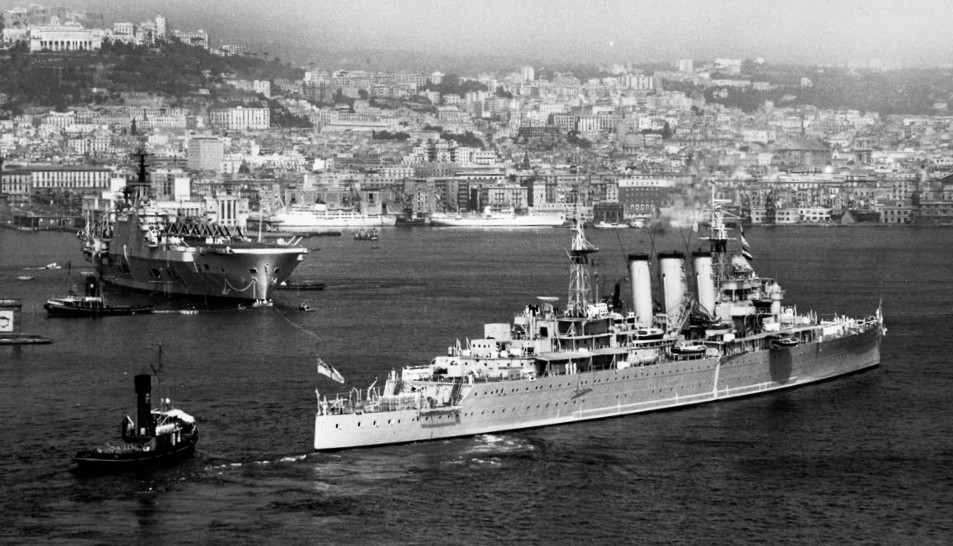
(USN Photo)
HMS Cumberland (57) and the aircraft carrier HMS Eagle at Naples, 5 August 1955.
HMS Suffolk (55)
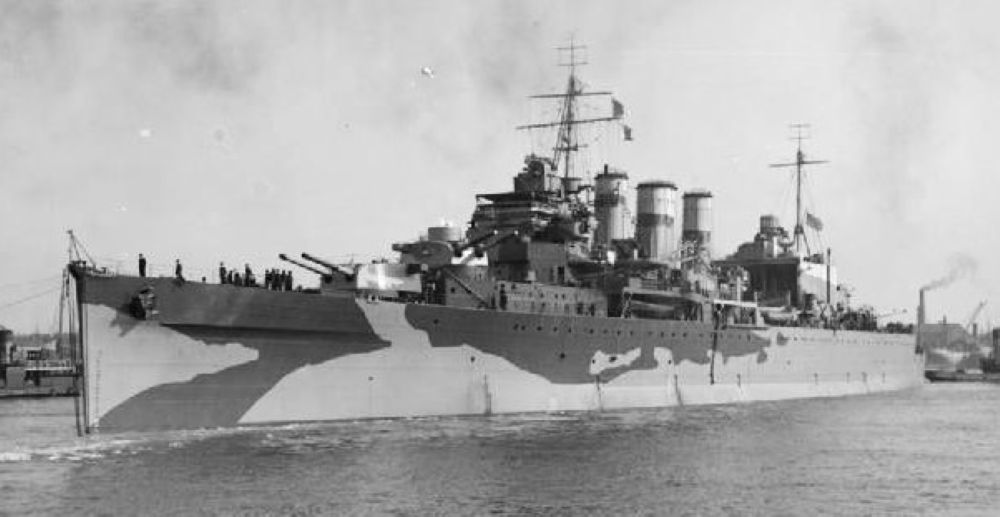
(IWM Photo, FL 3942)
HMS Suffolk (55).
HMS Suffolk (55), was a County-class heavy cruiser of the Royal Navy, and part of the Kent subclass.She was built by Portsmouth Dockyard, Portsmouth, UK, with the keel being laiddown on 30 September 1924. She was launched on 16 February 1926, andcommissioned on 31 May 1928. During the Second World War, Suffolk took part inthe Norwegian Campaign in 1940 and then the Battle of the Denmark Strait in1941, before serving in the Arctic throughout the following year. After a refitthat concluded in April 1943, the cruiser served in the Far East until the endof the war. In the immediate post-war period, Suffolk undertook transport duties between the Far East, Australia and the United Kingdom before beingplaced in reserve in mid-1946. The vessel was sold off and then scrapped in 1948.
Suffolk, like her sisters, served on the China Station,[2] save forreconstruction, until the outbreak of the Second World War. In early 1934 she becamethe flagship of the China Station when Admiral Sir Frederick Dreyer dispatchedKent for a refit in Liverpool. She returned home to Portsmouth in July1935 laden with 100 cases of “priceless” Chinese artefacts for anexhibition at the Royal Academy of Arts. During the 45 day journey a total of 1022 pieces were transported, of which 780 belonged to the Beijing Palace Museum. The transfer and exhibition were overseen by Dr C W Cheng from theChinese Embassy in London, Palace Museum curator Chuang Yen and other Chinese officials
Suffolk came home in 1939 to be equipped with a Type 79Z radar system[7] andafter the outbreak of the Second World War patrolled the Denmark Strait inOctober 1939. In April 1940 she participated in the Norwegian Campaign. On 13April 1940 the ship arrived at Tórshavn to commence the British occupation ofthe Faroe Islands. On 14 April 1940 Suffolk sank the German tanker Skagerraknorth-west of Bodø, Norway. On 17 April 1940, Suffolk and four destroyers, HMSKipling, HMS Juno, HMS Janus and HMS Hereward, were sent to bombard theairfield at Sola, Norway. The operation had little effect and the retaliationfrom German bombers severely damaged the aft of the ship, forcing her to returnto Scapa Flow. Suffolk was out of action from April 1940 until February 1941while she was repaired at the Clyde. The ship was part of the 4th Cruiser Squadron.
During May 1941 Suffolk was involved in the Battle of the Denmark Strait and the sinking of the German battleship Bismarck. Suffolk had engaged thebattleship twice during the battle, firing several salvoes on her. Using her radar, Suffolk was able to track the Bismarck through the Denmark Strait and maintained contact long enough for other units to vector into Bismarck’s path. During the battle the battlecruiser HMS Hood was sunk with heavy loss of life and the battleship HMS Prince of Wales was damaged and forced to retreat. Afterwards,Bismarck was shadowed from a distance by Suffolk, Norfolk and the damagedPrince of Wales by using the cruisers radar equipment, but Bismarck managed to elude the ships which had been shadowing her by making a 270° turn behind their wakes. As Bismarck was losing oil, her captain Ernst Lindemann decided to attempt to reach Brest, France for repairs but was sighted by an RAF Catalina, damaged by torpedo bombers sent from the aircraft carrier HMS Ark Royal and eventually sunk after a punishing near 100-minute long bombardment from the battleships HMS King George V and HMS Rodney which were supported by the heavy cruisers HMS Norfolk and HMS Dorsetshire.
After her repairs Suffolk served with the Home Fleet in Arctic waters until theend of 1942, then underwent a refit between December 1942 and April 1943 when”X” turret was removed and replaced with additional AA guns. Oncompletion of this the ship was ordered to the Eastern Fleet, operating in theIndian Ocean until the end of the war.
From 26 August 1945 Suffolk was used to transport military and civilianpersonnel from Australia, and the Far East, back to the UK. On her returnSuffolk underwent repairs at Chatham Dockyard between November 1945 and January 1946. On completion she sailed to Australia again, returning in April 1946. Herfinal voyage was to Singapore arriving there in May, and returning in July1946.
In the summer of 1946 she was placed in unmaintained reserve until 1948. With the post-war economic difficulties of Britain hitting hard in 1947–1948 the reserve fleet was quickly sold off, and Suffolk was decommissioned and allocated to BISCO on 25 March 1948. She was towed to J Cashmore’s (Newport,Wales) where she arrived on 24 June 1948 and scrapping began immediately. (Wikipedia)
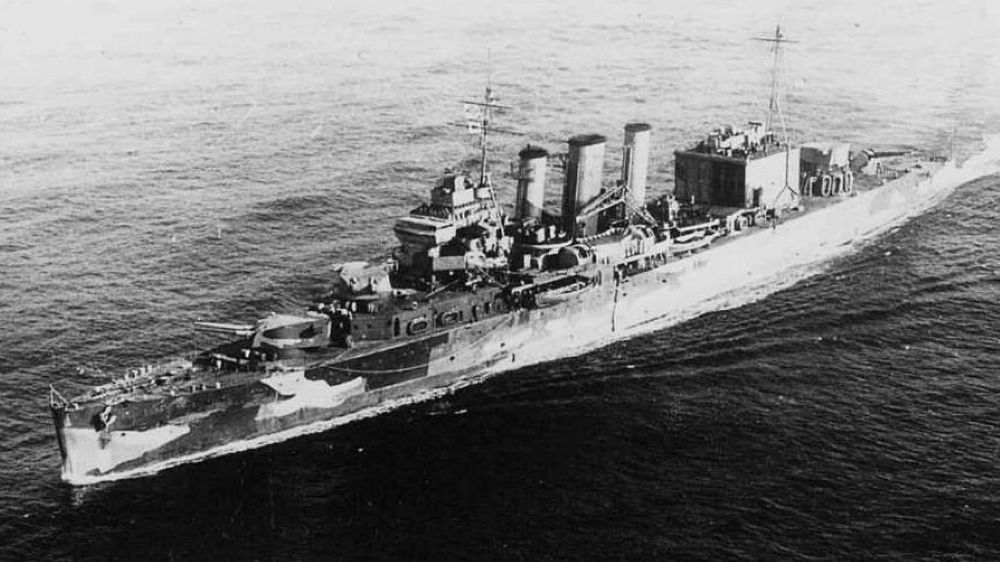
(RN Photo)
HMS Suffolk (55).
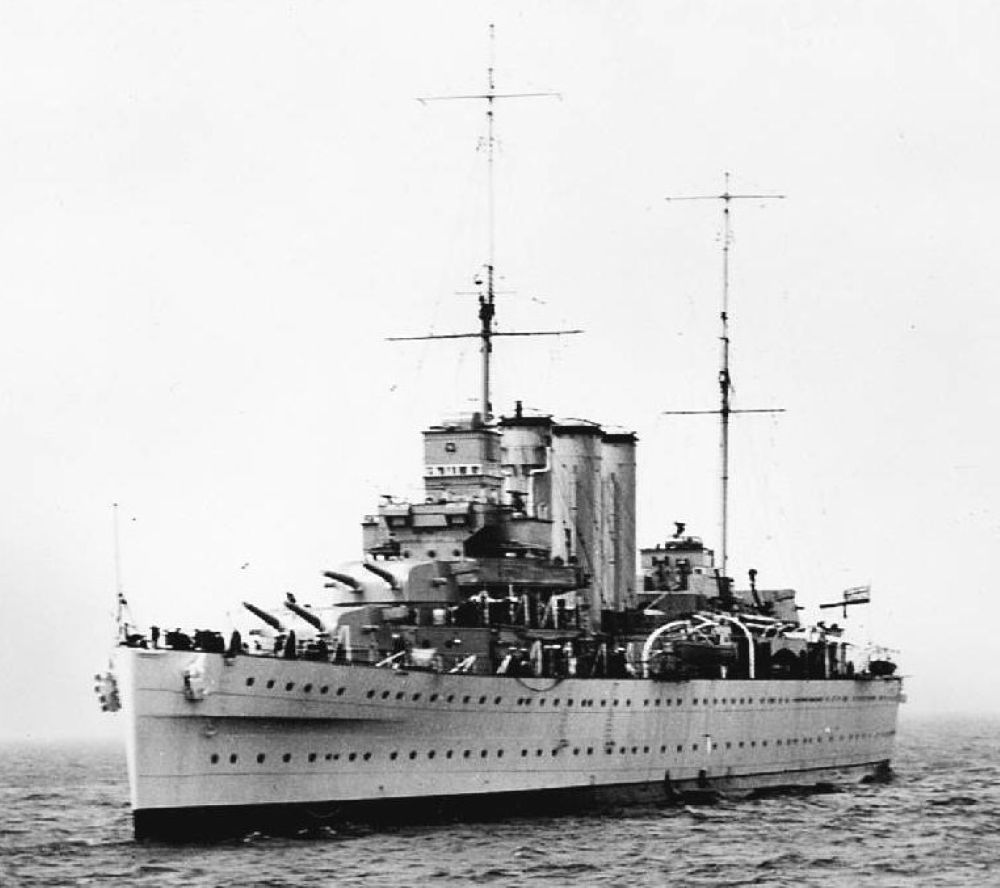
(RN Photo)
HMS Suffolk (55).
HMS Kent (54)
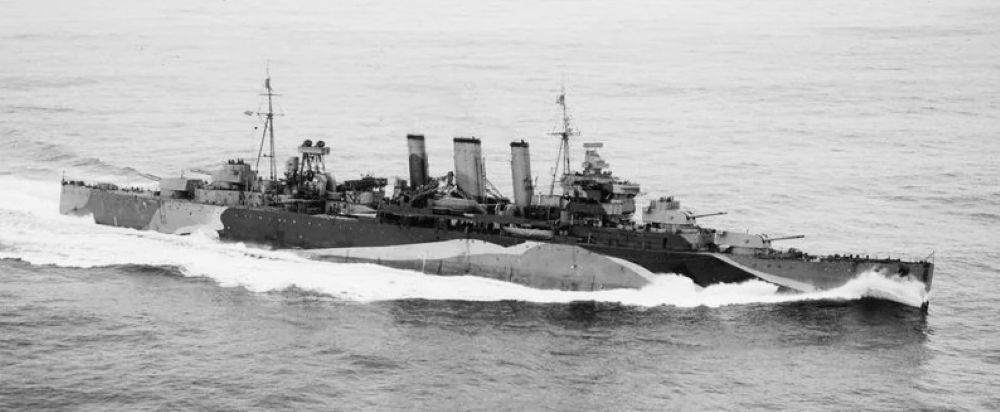
(IWM Photo)
HMS Kent (54)
HMS Kent (54) was a County-class heavy cruiser built for the Royal Navy in the late 1920s. She wasthe lead ship of the Kent subclass. After completion the ship was sent to theChina Station where she remained until the beginning of the Second World War,aside from a major refit in 1937–38. Kent hunted the German pocket battleshipAdmiral Graf Spee in the East Indies in late 1939 and then was reassigned totroop convoy escort duties in the Indian Ocean in early 1940. She wastransferred to the Mediterranean in mid-1940, but was torpedoed shortly afterarriving. The ship was under repair for a year and was then assigned to HomeFleet where she escorted convoys to and from North Russia for the next severalyears. In mid-1944 Kent escorted British aircraft carriers as their aircraftmade attacks on German shipping and airfields in Norway. A few months later shewas flagship of a force that intercepted a German convoy in Norwegian watersand sank two freighters and five escorts. The ship was paid off in early 1945and placed in reserve until she was used as a target. Kent was sold for scrapin 1948.
Kent displaced 9,850 long tons (10,010 t) at standard load and 13,520 long tons(13,740 t) at deep load. The ship had an overall length of 630 feet (192.0 m),a beam of 68 feet 5 inches (20.9 m) and a draught of 20 feet 6 inches (6.2 m).She was powered by Parsons geared steam turbines, driving four shafts, whichdeveloped a total of 80,000 shaft horsepower (60,000 kW) and gave a maximumspeed of 31.5 knots (58.3 km/h; 36.2 mph). Steam for the turbines was providedby eight Admiralty 3-drum water-tube boilers. Kent carried a maximum of 3,425long tons (3,480 t) of fuel oil that gave her a range of 13,300 nautical miles(24,600 km; 15,300 mi) at 12 knots (22 km/h; 14 mph). The ship’s complement was784 officers and men.
The ship mounted eight 50-calibre 8-inch (203 mm) guns in four twin gunturrets. Her secondary armament consisted of four QF 4-inch (102 mm) Mk Vanti-aircraft (AA) guns in single mounts. Kent mounted four single 2-pounder(40 mm) light AA guns (“pom-poms”). The ship carried two quadrupletorpedo tube above-water mounts for 21-inch (533 mm) torpedoes.
Kent was only lightly protected with little more than a single inch of platingprotecting vital machinery. Her magazines were the exception and were protectedby 2–4.375 inches (50.8–111.1 mm) of armour. Space and weight was reserved forone aircraft catapult and its seaplane, but they were not fitted until aftershe was completed.
Kent was built by Chatham Dockyard and laid down on 15 November 1924. She waslaunched on 16 March 1926 and commissioned 25 June 1928. The ship was assignedto the 5th Cruiser Squadron on the China Station and spent the bulk of theinterbellum period there.[4] In 1929–30 she received a High-Angle ControlSystem, used to direct her anti-aircraft guns, and an aircraft catapult wasalso fitted. Her AA armament was reinforced by the addition of two single4-inch guns abreast the forward funnel in 1932–33.[5]
In January 1934, while serving as the flagship of Admiral Sir Frederick Dreyer,she attended the Far Eastern Naval Conference in Singapore together withTerror, Veteran, Wren and Eagle.[6] At the conclusion of the conference, Dreyertransferred his flag to the Suffolk and Kent was dispatched to the UnitedKingdom for a refit.[7] During the 1934 refit two quadruple Vickers .50-calibre(12.7 mm) Mark III machine guns were added.
In 1937, Kent returned to Chatham and underwent a major refit, which included a4.5-inch (114 mm) Krupp cemented armour belt abreast the engine and boilerrooms as well as the dynamo room and the fire control transmitting station.This belt extended 6 feet (1.8 m) down from the lower deck. Four inches ofarmour were also added to protect the sides of the boiler room fancompartments. The ship’s aft director was moved to a pedestal abaft thesearchlight tower that replaced the original aft control station. Twooctuple-barrel 2-pounder mounts were added abreast the searchlight tower. Thechanges raised the ship’s displacement by 74 long tons (75 t) and cost anestimated £161,000. Unlike her sister ships, no aircraft hangar was addedbecause that would have pushed her over the Washington Naval Treaty limits, buther catapult was replaced with a more powerful one capable of handling theheavier Supermarine Walrus flying boat.
In November 1939 she joined with the French heavy cruiser Suffren and theAustralian destroyers Voyager and Vampire to hunt for the German pocketbattleship Admiral Graf Spee in the East Indies and then was reassigned toescort troop convoys in the Indian Ocean in January 1940.
Following the declaration of war by Italy, she was transferred to theMediterranean Fleet, arriving at Alexandria in August 1940 with the 3rd CruiserSquadron.[10] On 17 August 1940, Kent, the battleships Warspite, Malaya,Ramillies and twelve destroyers bombarded Italian positions near Bardia andFort Capuzzo. Two weeks later the ship participated in Operation Hats,escorting a convoy from Alexandria to Malta.
On 15 September 1940 the battleship Valiant, the aircraft carrier Illustrious,Kent, the anti-aircraft cruisers Calcutta and Coventry, and seven destroyersleft Alexandria bound for Benghazi. During the night of 16/17 September 1940,aircraft from the Illustrious mined the harbour of Benghazi. They also attackedshipping in the harbour with torpedoes and bombs, sinking two destroyers andtwo merchant ships. Kent and two destroyers were detached to bombard Bardiawhile returning to Alexandria. During the night of 17/18 September 1940 theship was hit in the stern by a torpedo from Italian Savoia-Marchetti SM.79bombers from the 279th Independent Torpedo Squadron (Italian: SquadrigliaAutonoma Aerosiluranti) led by Carlo Emanuele Buscaglia. She was towed back tobase by the destroyers with great difficulty.[12]
Kent was given temporary repairs at Alexandria from 19 September to 18 Octoberto allow her to return to the United Kingdom. Extensive repairs at DevonportDockyard followed from 1 January to 20 September 1941. During this time sixOerlikon 20 mm light AA guns were added and the ship received a variety ofradars. These included Type 284 radar for surface gunnery control, Type 285anti-aircraft gunnery radar, and a Type 281 air warning radar.[13] When herrepairs were completed in September 1941, she spent several months working up.On 8 December Kent sailed from Scapa Flow carrying the British ForeignSecretary, Anthony Eden, and the Soviet Ambassador to Great Britain, IvanMaisky. She reached Murmansk on 12 December where the diplomats disembarked tomeet with Joseph Stalin. Kent sortied on 17 December, with two Sovietdestroyers, in a failed attempt to intercept the German 8th Destroyer Flotillathat was engaging two British minesweepers attempting to rendezvous with ConvoyPQ 6. The ship brought Eden back home by 29 December.
The cruiser was assigned to the Home Fleet and escorted convoys to and fromNorth Russia. She briefly escorted Convoy QP 8 on the return leg from Russia inMarch 1942 and provided distant cover for Convoy QP 10 the following month.Kent attempted to rendezvous with the damaged light cruiser Trinidad west ofBear Island as she returned from Murmansk in May, but Trinidad was sunk byGerman aircraft before that could happen. On 21 May the ship joined Convoy PQ16 as part of the close escort.
After her return from the Soviet Union, the ship was refitted in Liverpool from18 July to 7 November. Her catapult and quadruple .50-calibre machine guns wereremoved and six more single 20 mm Oerlikon guns were added.[13] In earlyJanuary 1943 the cruiser provided cover for Convoy RA 51 and, several weekslater, Convoy JW 52. While on the latter mission, Kent was unsuccessfullyattacked by the German submarine U-625.[16] During a brief refit between 22September and 4 October at Chatham Dockyard, the ship exchanged six single 20mm guns for three twin 20 mm gun mounts.[13] In November she provided cover toConvoys RA 54A, JW 54A and JW 54B. The ship covered the outbound Convoys JW56A, JW 56B and the returning Convoy RA 56 in January–February 1944. Thefollowing month Kent was part of the covering force for Convoy JW 57.
On 17 July 1944, the ship was formed part of the covering force protectingthree British aircraft carriers flying off aircraft to attack the Germanbattleship Tirpitz during Operation Mascot. Kent escorted three aircraftcarriers that attacked the German airfield at Kristiansand on 10 August. Sheescorted two carriers on 12 September while their aircraft attacked German shippingnear Stadlandet. On the night of 13/14 November 1944, as flagship ofRear-Admiral Rhoderick McGrigor during Operation Counterblast, the ship, withthe light cruiser Bellona and four destroyers, attacked Convoy KS.357 offListerfjord, south-east of Egersund, Norway. The convoy consisted of fourfreighters escorted by the minesweepers M.416, M.427 and four submarinechasers. Opening fire at 2300 hrs, the cruisers and destroyers sank two of thefreighters and all the escorts above except one unidentified vessel.
With the Naval War in the Atlantic winding down, the ship’s age and materialcondition, and a shortage of crews to man her; Kent was paid off in January1945 and remained in reserve for several years until she was used as a target.The ship was struck off the Naval List (the first of the Countys to go) andallocated to BISCO on 22 January 1948 and arrived at Troon on 31 January to bebroken up by West of Scotland Shipbreakers. (Wikipedia)
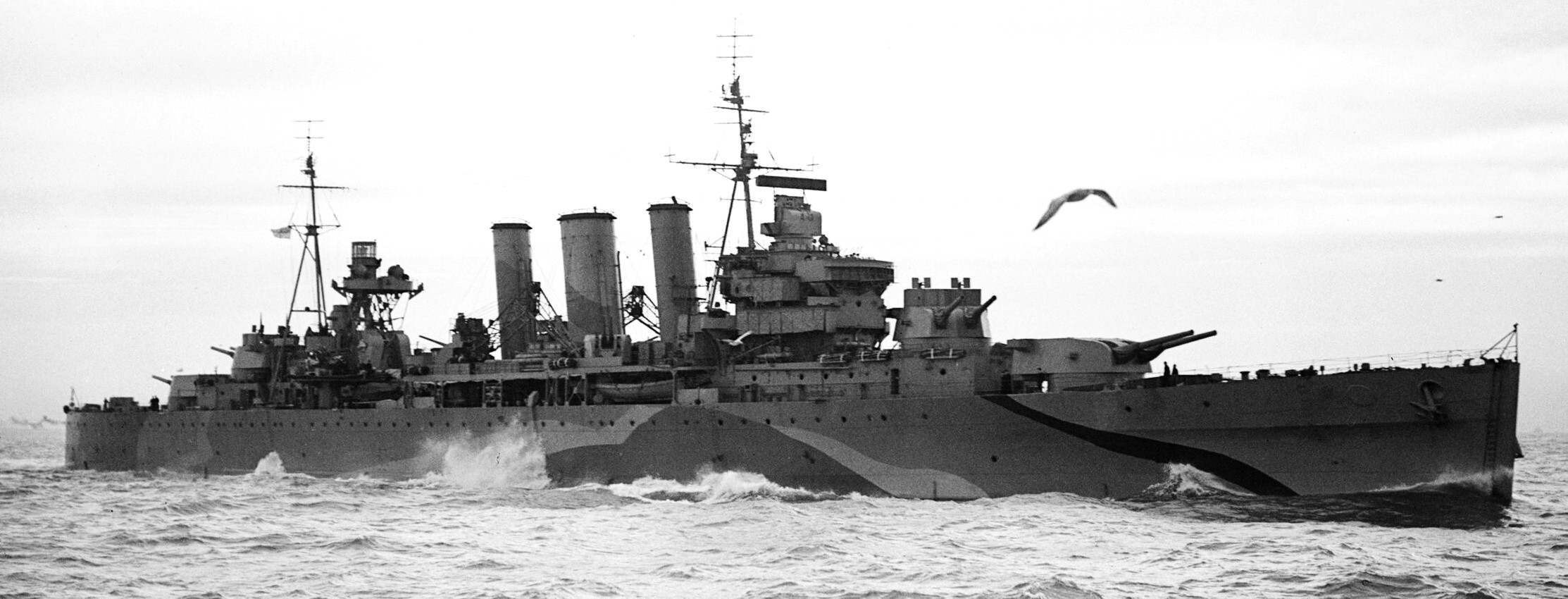
(IWM Photo, A12591)
HMS Kent (54) underway at speed, 28 October 1941.
HMAS Australia (D84)
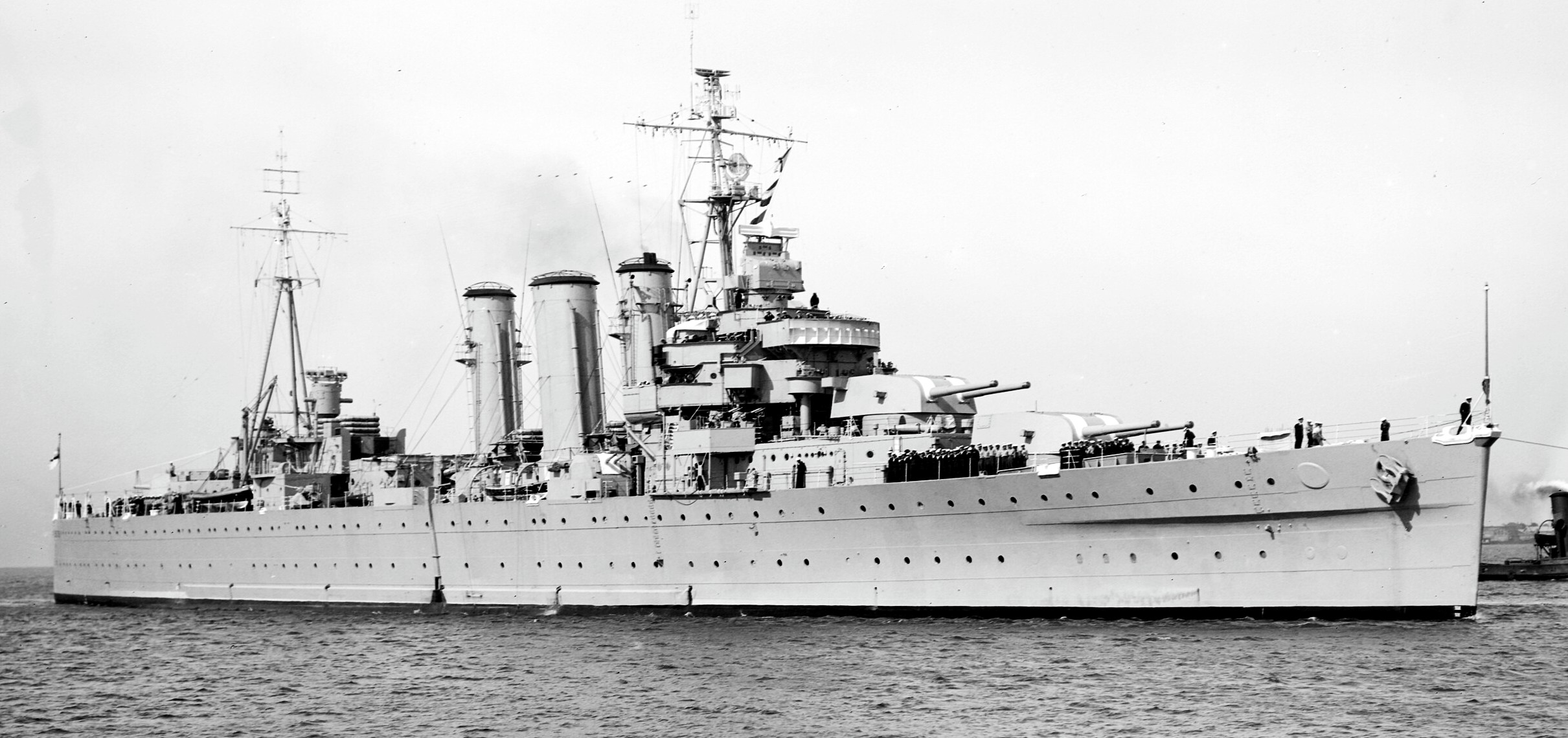
(State Library of Victoria Photo)
HMAS Australia (D84), Oct 1937.
HMAS Australia (I84/D84/C01) was a County-class heavy cruiser of the Royal Australian Navy (RAN). One of twoKent-subclass ships ordered for the RAN in 1924, Australia was laid down inScotland in 1925, and entered service in 1928. Apart from an exchangedeployment to the Mediterranean from 1934 to 1936, during which she becameinvolved in the planned British response to the Abyssinia Crisis, Australia operated in local and South-West Pacific waters until the Second World War began.
HMAS Australia (I84/D84/C01) was a County-class heavy cruiser of the RoyalAustralian Navy (RAN). One of two Kent-subclass ships ordered for the RAN in 1924, Australia was laid down in Scotland in 1925, and entered service in 1928.Apart from an exchange deployment to the Mediterranean from 1934 to 1936,during which she became involved in the planned British response to theAbyssinia Crisis, Australia operated in local and South-West Pacific watersuntil the Second World War began.
The cruiser remained near Australia until mid-1940, when she was deployed for duties in the eastern Atlantic, includinghunts for German ships and participation in Operation Menace. During 1941,Australia operated in home and Indian Ocean waters, but was reassigned asflagship of the ANZAC Squadron in early 1942. As part of this force (which waslater redesignated Task Force 44, then Task Force 74), Australia operated insupport of United States naval and amphibious operations throughout South-EastAsia until the start of 1945, including involvement in the battles at the CoralSea and Savo Island, the amphibious landings at Guadalcanal and Leyte Gulf, andnumerous actions during the New Guinea campaign. She was forced to withdrawfollowing a series of kamikaze attacks during the invasion of Lingayen Gulf.The prioritisation of shipyard work in Australia for British Pacific Fleetvessels saw the Australian cruiser sail to England for repairs, where she wasat the end of the war.
During the late 1940s, Australia servedwith the British Commonwealth Occupation Force in Japan, and participated in several port visits to other nations, before being retasked as a training shipin 1950. The cruiser was decommissioned in 1954, and sold for scrapping in1955. (Wikipedia)he
The cruiser remained near Australia until mid-1940, when she was deployed forduties in the eastern Atlantic, including hunts for German ships andparticipation in Operation Menace. During 1941, Australia operated in home andIndian Ocean waters, but was reassigned as flagship of the ANZAC Squadron inearly 1942. As part of this force (which was later redesignated Task Force 44,then Task Force 74), Australia operated in support of United States naval andamphibious operations throughout South-East Asia until the start of 1945,including involvement in the battles at the Coral Sea and Savo Island, theamphibious landings at Guadalcanal and Leyte Gulf, and numerous actions duringthe New Guinea campaign. She was forced to withdraw following a series of kamikazeattacks during the invasion of Lingayen Gulf. The prioritisation of shipyardwork in Australia for British Pacific Fleet vessels saw the Australian cruisersail to England for repairs, where she was at the end of the war.
During the late 1940s, Australia served with the British Commonwealth Occupation Force in Japan, and participated in several port visits to othernations, before being retasked as a training ship in 1950. The cruiser wasdecommissioned in 1954, and sold for scrapping in 1955. (Wikipedia)
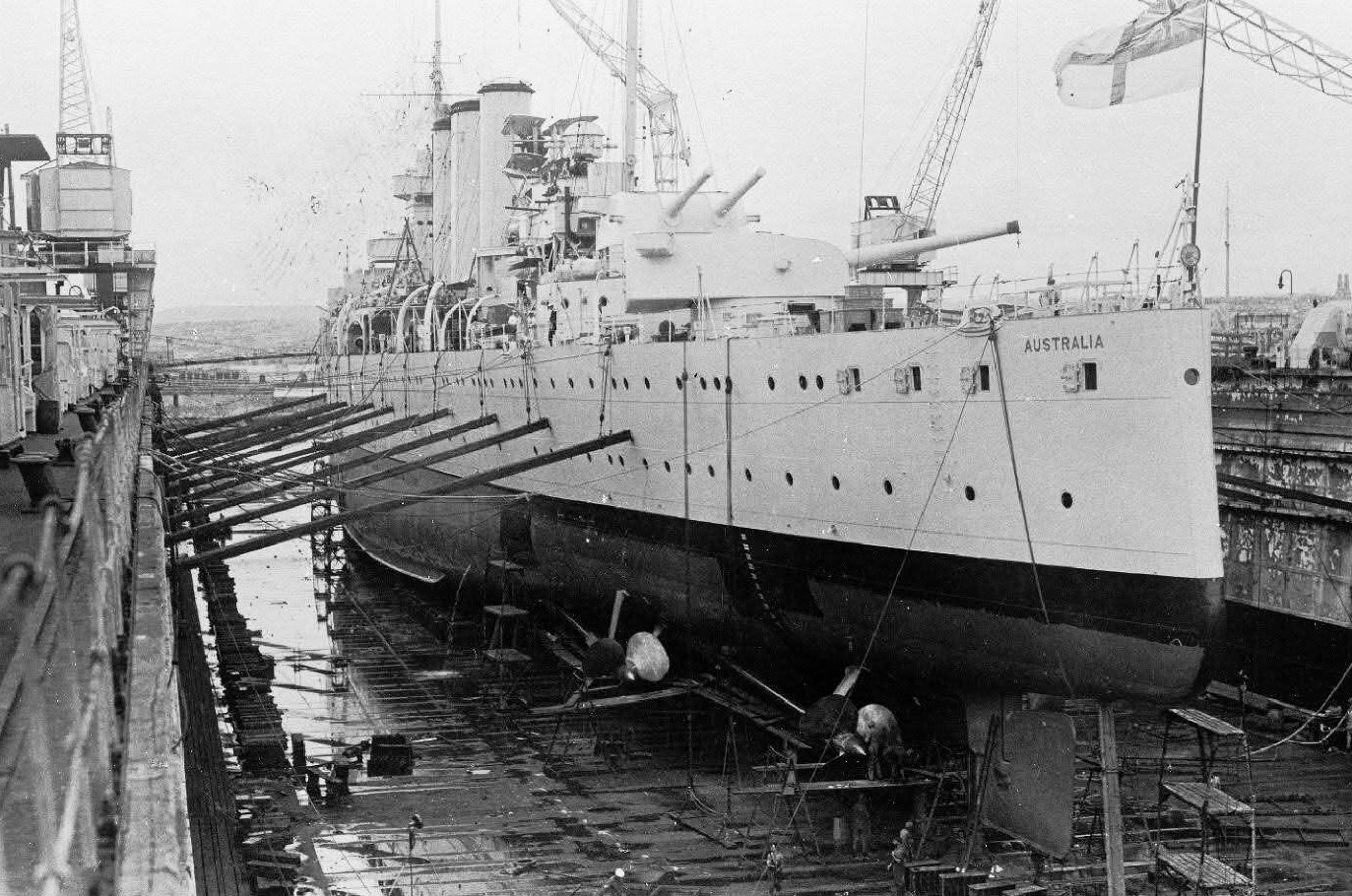
(RAN Photo)
The County class heavy cruiser HMAS Australia undergoing repairs inside the floating drydock at Malta in April of 1936. HMAS Australia had left for the United Kingdom in December of 1934 to represent her country for King George V’s Silver Jubilee Naval Review. The cruiser would end up staying longer due to the Abyssinia Crisis. Had the Royal Navy attacked the Italian Navy at this time, Australia would have operated as part of the British fleet. Luckily, nothing came to pass and Australia was able to return home in July of 1936.
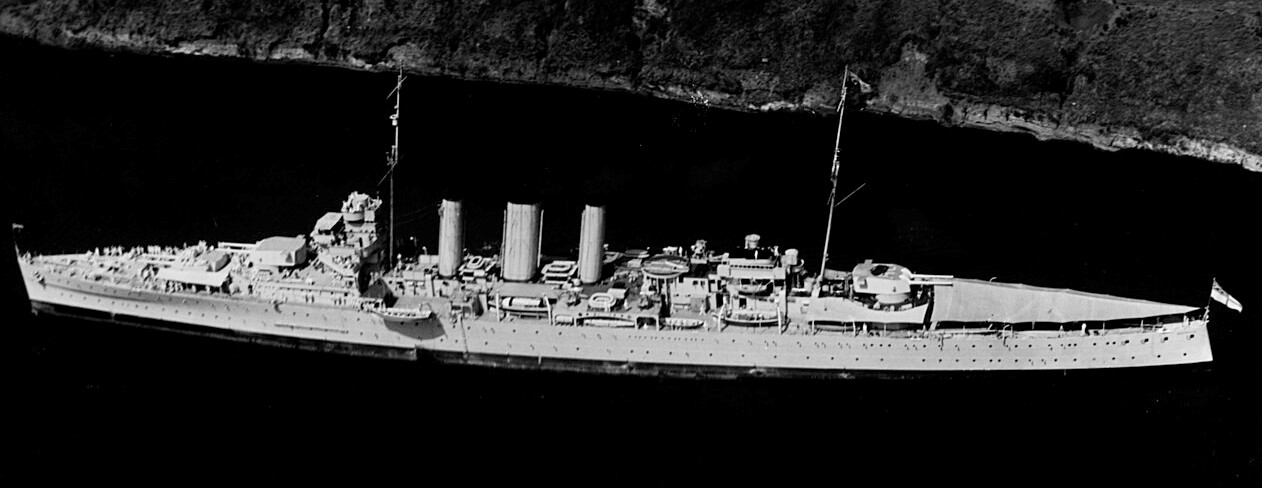
(USN Photo)
Aerial photograph of the Royal Australian Navy heavy cruiser HMAS Australia (D84) passing through the Panama Canal, March 1935.
(Australian War Memorial Photo, 017623)
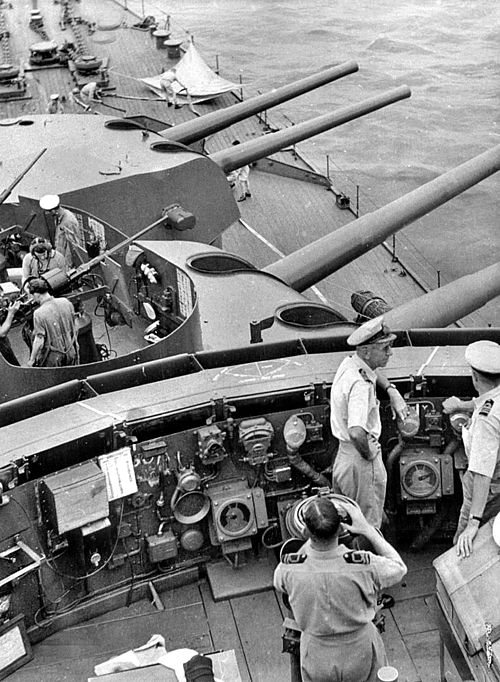
View of the bridge and forward 8-inch gun turrets of heavy cruiser HMAS Australia, 4 September 1944. The officer facing to the right is Captain Emile Dechaineux, commander of the Australia, who was killed during the kamikaze attack of 21 October 1944.
(USN Photo)
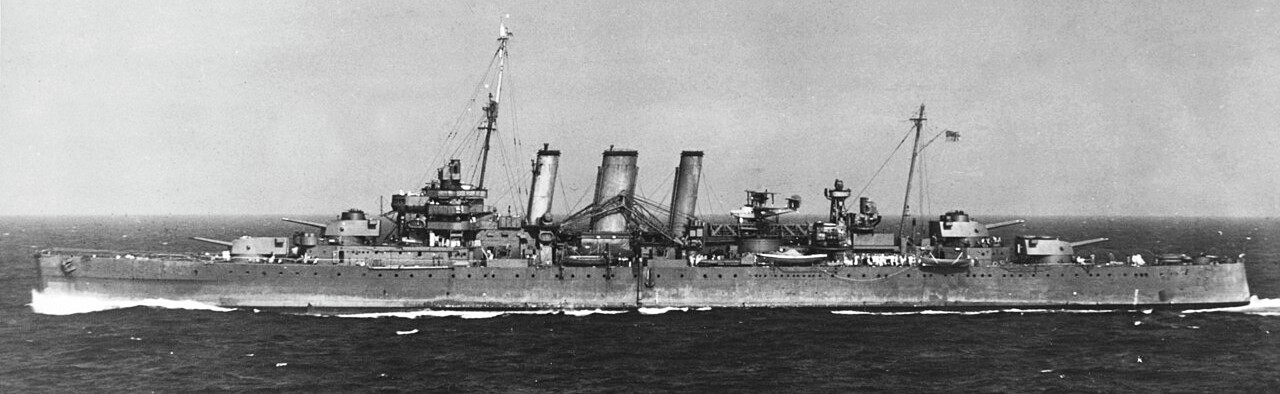
The Royal Australian Navy heavy cruiser HMAS Australia (D84) at sea during operations in the vicinity of the Solomon Islands, 31 August 1942.
HMAS Canberra (D33)
(Photographic Archive, Alexander Turnbull Library, Wellington, New Zealand Photo)
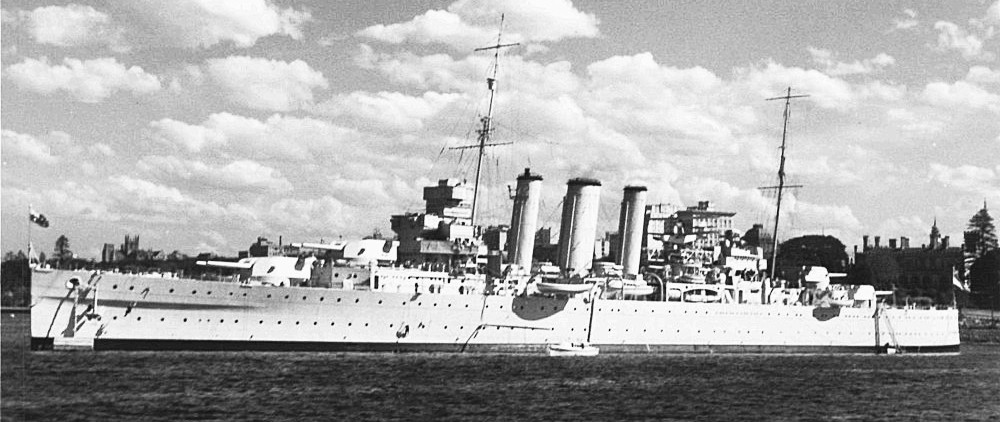
HMAS Canberra (D33)
HMAS Canberra (I33/D33), named after the Australian capital city of Canberra, was a Royal Australian Navy (RAN) heavy cruiser of the Kent sub-class of County-class cruisers. Constructed in Scotland during the mid-1920s, the ship was commissioned in 1928, and spent the first part of her career primarily operating in Australian waters, with some deployments to the China Station.
At the start of the Second World War, Canberra was initially used for patrols and convoy escort around Australia. In July 1940, she was reassigned as a convoy escort between Western Australia, Sri Lanka, and South Africa. During this deployment, which ended in mid-1941, Canberra was involved in the hunt for several German auxiliary cruisers. The cruiser resumed operations in Australian waters, but when Japan entered the war, she was quickly reassigned to convoy duties around New Guinea, interspersed with operations in Malaysian and Javanese waters. Canberra later joined Task Force 44, and was involved in the Guadalcanal campaign and the Tulagi landings.
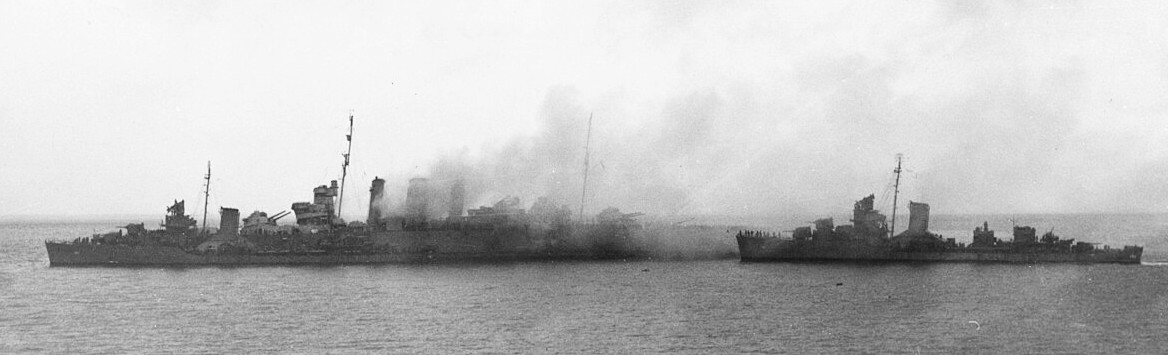
On 9 August 1942, Canberra was struck by the opening Japanese shots of the Battle of Savo Island, and was quickly crippled, and according to the crew, she was torpedoed by friendly fire. Unable to propel herself, listing heavily and burning, the cruiser was evacuated and then sunk in Ironbottom Sound by two American destroyers. The United States Navy Baltimore-class cruiser USS Canberra was named in honour of the Australian ship. Later, in 2023, the US Navy named the new Independence-class littoral combat ship USS Canberra after Canberra, which became the first US warship commissioned in a foreign port. (Wikipedia)
(RAN Photo)
HMAS Canberra (D33)
(State Library of Victoria Photo)
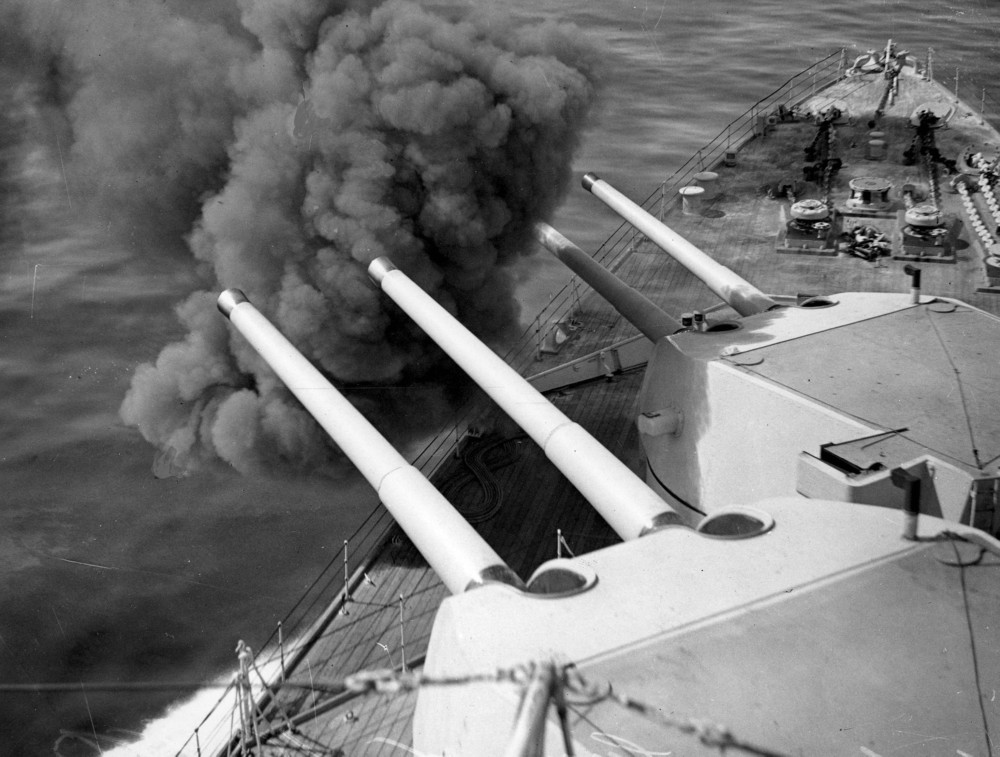
HMAS Canberra‘s forward 8-inch gun turrets (designated “A” and “B”), c1930.

(USN Photo)
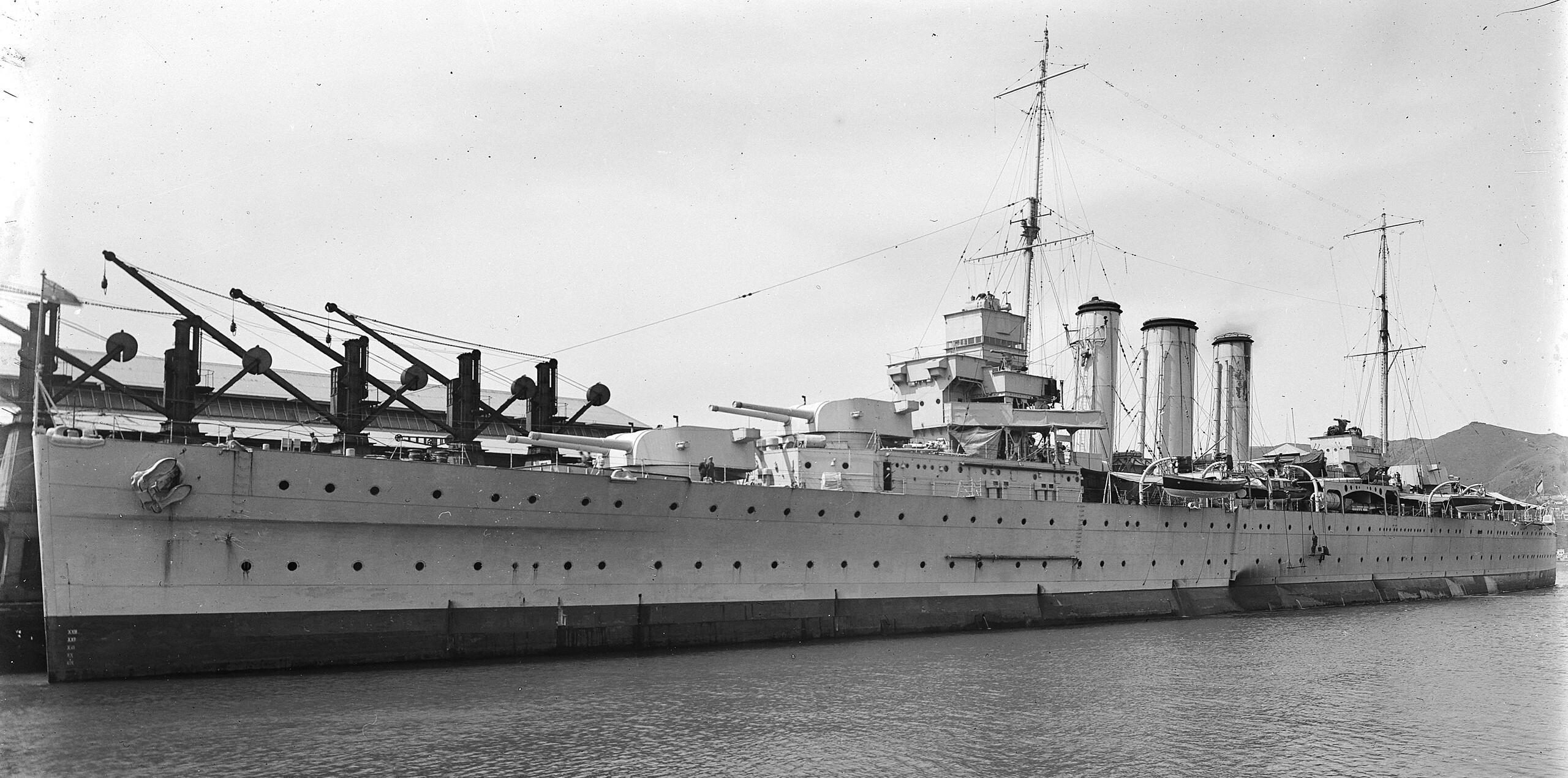
HMAS Canberra (D33) leaving Wellington, New Zealand, on 22 July 1942. She was en route to participate in the invasion of Guadalcanal and Tulagi.
(USN Photo)
U.S. Navy destroyers remove the crew from the sinking Royal Australian Navy heavy cruiser HMAS Canberra (D33) after the Battle of Savo Island, 9 August 1942. USS Blue (DD-387) is alongside Canberra´s port bow, as USS Patterson (DD-392) approaches from astern.
All comments are subject to our Comment Policy. You must be at least 18 years old to comment.
See a comment that violates our guidelines? Report it here.