
RCAF Western Air Command. HQ Vancouver, British Columbia
Western Air Command was the part of the Royal Canadian Air Force’s Home War Establishment responsible for air operations on the Pacific coast of Canada during the Second World War. Formed at Vancouver, British Columbia on 1 March 1938; moved to Victoria, British Columbia on 25 November 1939 and returned to Vancouver on 1 January 1943; during the Second World War, operated as both a command and an operational group headquarters, as well as controlling No. 4 Group at Prince Rupert, British Columbia and, for a short time, No. 2 Group at Victoria; disbanded on 1 March 1947 on the formation of No. 12 Group of North West Air Command.
Commanders A/C G.O. Johnson, MC 5 Apr 38 -20 Oct 39.A/C A.E. Godfrey, MC, AFC 21 Oct 39 – 31 Dec 41.AVM L.F. Stevenson, CB 1 Jan 42 -9 Jun 44.AVM F.V. Heakes, CB 10 Jun 44 – 13 Feb 46 ret.AVM J.L. Plant, CBE, AFC 14 Feb 46 – 1 Mar 47.
When Canada declared war against Germany in September 1939 the command consisted of only five squadrons. Four of them equipped with obsolete aircraft including a bomber squadron with aircraft from the Great War and there were no fighter aircraft at all for its only fighter squadron (113 Fighter Squadron was thus disbanded). With the Japanese threat after Pearl Harbor it grew rapidly and played a critical role in fighter and anti-submarine operations in Canadian and American waters during the Aleutian Islands Campaign. It was there that Squadron Leader K.A. Boomer of No. 111 Squadron shot down a Japanese Rufe fighter, the RCAF’s only kill in the Pacific Theatre. On 7 July 1942 a Bristol Bolingbroke pressed home an attack on the Japanese submarine Ro-32 the pilot F/Sgt. P.M.G. Thomas of No. 115 Squadron RCAF then led American destroyers to sink the damaged submarine.
By January 1943 Western Air Command had expanded to include many bomber, fighter and operational units under its control. By the end of the war the command would involve some twenty squadrons when the last units to join were added in 1943. These were the 163 Army Cooperation Squadron in March flying Bristol Bolingbrokes and Hawker Hurricanes. In May the 160 Bomber-Reconnaissance Squadron was added flying Cansos (Catalinas) from Sea Island BC (before moving to Yarmouth, NS in July) and the 166 Communication Squadron formed in September flying various types. In addition to the new squadrons, new aircraft types came on line replacing the command’s remaining Supermarine Stranraers and Blackburn Sharks with Cansos and the Bolingbrokes and Beauforts with the Lockheed Ventura. Countless training missions and operational patrols bolstered the air activity over the coastal areas but there was not much action until RCAF Western Command was on the look out for General Kusaba’s fire balloons that the Japanese called the Fūsen Bakudan Campaign.
In February and March 1945, P-40 fighter pilots from 133 Squadron, Royal Canadian Air Force operating out of RCAF Patricia Bay (Victoria, British Columbia), intercepted and destroyed two fire balloons, On 21 February, Pilot Officer E. E. Maxwell While shot down a balloon, which landed on Sumas Mountain, in Washington State. On 10 March, Pilot Officer J. O. Patten destroyed a balloon near Salt Spring Island, British Columbia. During another interception a Canso forced down a fire balloon which was examined at the army headquarters.
Patrol activity was joined by the Operational Training Schools (OTS) operated by Number 4 Training Command of the BCATP. They were the No. 3 OTS flying the Canso and Catalina and No. 32 OTS with Ansons, Beauforts and Swordfish at Patricia Bay. In April, 1944 the No. 5 OTS Heavy Conversion unit stood up at Boundary Bay when 16 B-24 Liberators arrived fresh from American factories. By the end of September 1944 RCAF 5 O.T.U. had grown to a sizeable force of some 87 aircraft including 38 B-24 Liberators, 35 B-25 Mitchells, 5 Bolingbrokes, 8 P-40 Kittyhawks and a single Norseman.
With the end of the war in Europe these aircraft were joined by a number of Victory Aircraft Lancaster X bombers which were to be used to train the British Commonwealth’s Very Long Range Bomber Tiger Force that would soon be sent to bomb the Japanese mainland from Okinawa. With the unconditional surrender of Japan the RCAF’s Tiger Force bomber squadrons were disbanded before they flew overseas and the total draw down of the Western Air Command was suddenly undertaken. Within several months almost all the flying squadrons would be completely stood down. (Wikipedia)
1943 Order of Battle
No. 2 Group, HQ Victoria, British Columbia. Formed at Victoria, British Columbia on 1 January 1943 as a temporary formation to cover the move of Western Air Command Headquarters from Victoria to Vancouver; disbanded on 15 March 1943. Commander A/C E.L. McLeod 1 Jan 43 – 15 Mar 43. Higher Formation and Group Location, Western Air Command:Victoria, B.C. 1 Jan 43 – 15 Mar 43.
No. 4 (BR) Squadron. No. 4 (Bomber Reconnaissance) Squadron RCAF was active before and during the Second World War. It was formed on 17 January 1933 at RCAF Station Jericho Beach and flew civil operations until 1939, conducting forestry, customs and fishing patrols as well as aerial photography. On 1 January 1938, it was redesignated as a General Reconnaissance (GR) Squadron but continued with the same aircraft, and began training for war operations. On 10 September 1939, the unit was mobilized for the war and redesignated again, this time as a Bomber Reconnaissance (BR) Squadron, and it began carrying out anti-submarine patrols under the direction of Western Air Command while based out of RCAF Station Tofino, in British Columbia. During the war, the squadron flew the Blackburn Shark Mk. III, Canadian Vickers Vancouver Mk. II, Canadian Vickers Vedette, Canadian Vickers Stranraer, Boeing Canada Canso A, Consolidated Catalina Mk. IV, Fairchild 71, before disbanding on 7 August 1945.
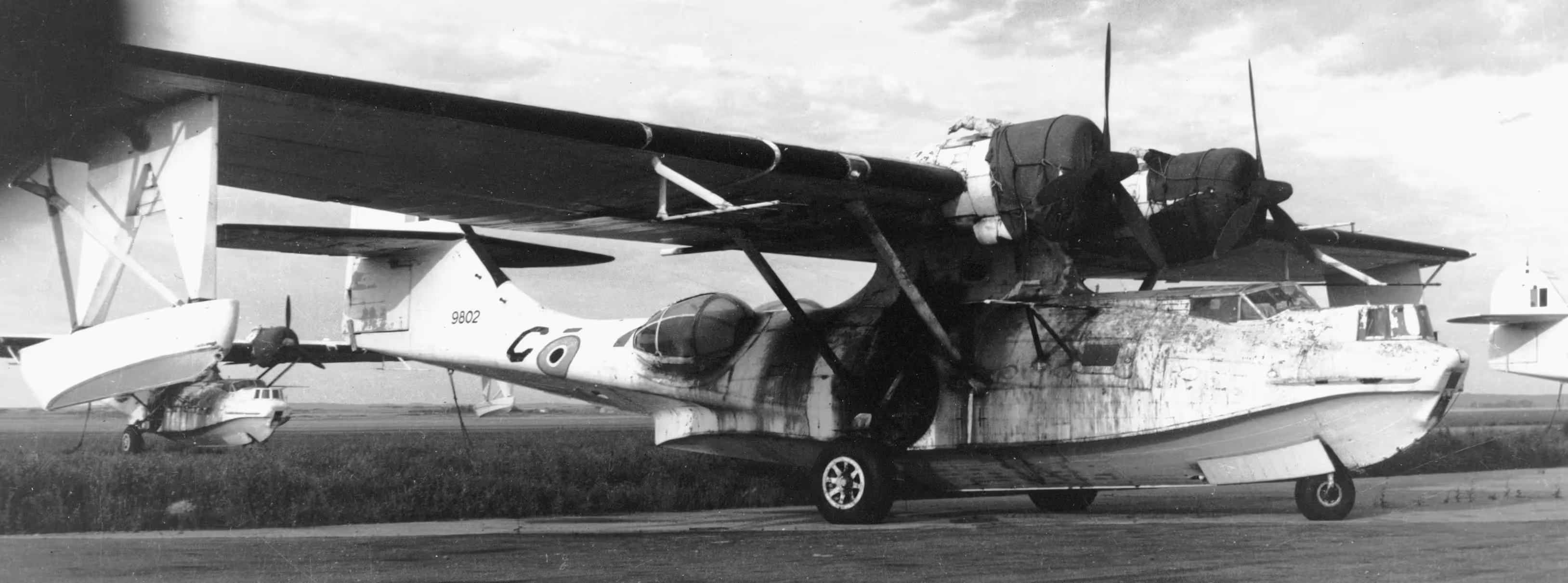
(DND Photo)
Boeing Canada Canso A, RCAF (Serial No. 9802). Taken on strength at Western Air Command (WAC) on 21 June 1943. 9802 was serving with No. 4 (BR) Squadron when it nosed in, then water looped to port and sank while landing in Ucluelet Inlet beside Lyche Island, British Columbia, on 9 July 1943. The aircraft was recovered and subsequently repaired at Canadian Pacific airlines in Vancouver, BC on 12 July 1943.
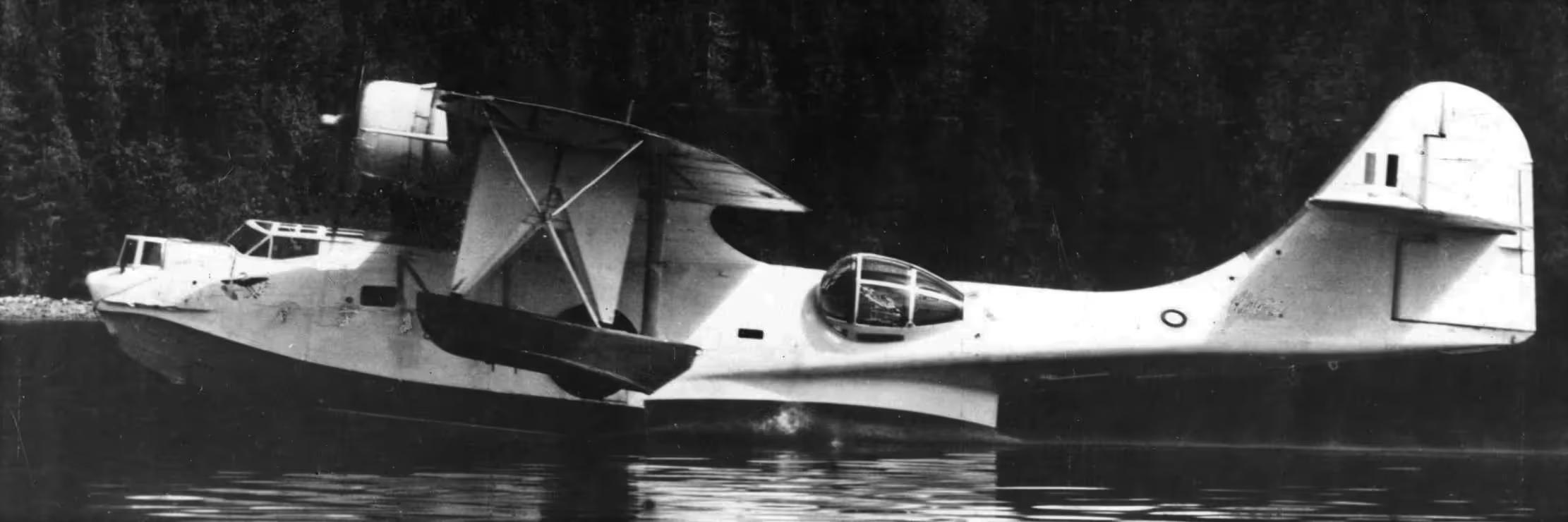
(RCAF Photo)
Canadian Vickers Canso A (Serial No. 9771), c/n 22000. No. 4 (BR) Squadron – note the stork crest on the nose.
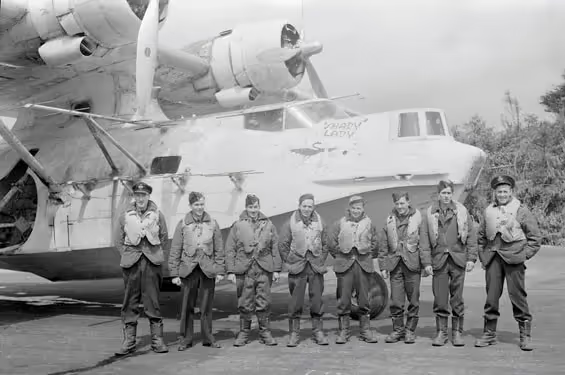
(Library and Archives Canada Photo, MIKAN No. 3586797)
Boeing Canada Canso A, RCAF (Serial No. 9752), “Shady Lady,” of No. 4 (BR) Squadron, RCAF, 21 May 1944.
(RCAF Photo)
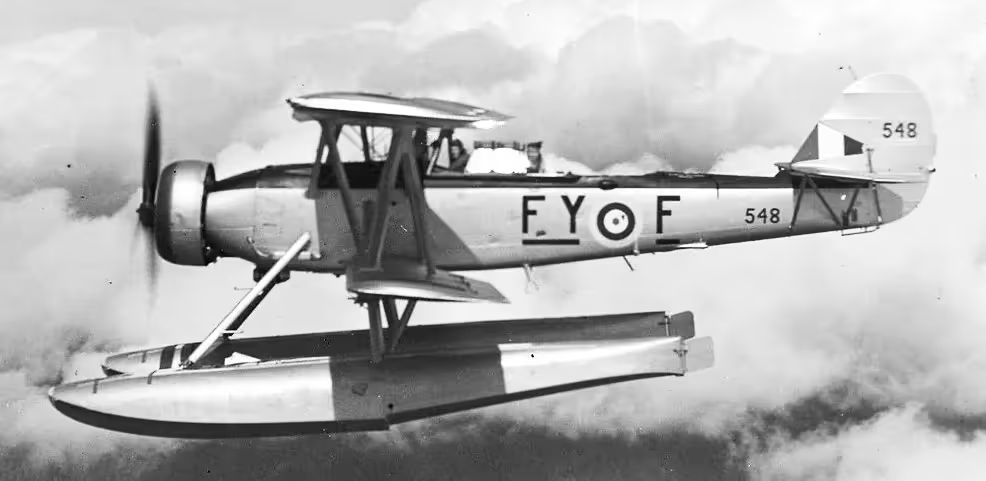
Blackburn Shark Mk. III, RCAF (Serial No. 548), coded FY-F, No. 6 (Torpedo Bomber) Squadron, British Columbia, ca 1939.
(Library and Archives Canada Photo, MIKAN No. 3580999)
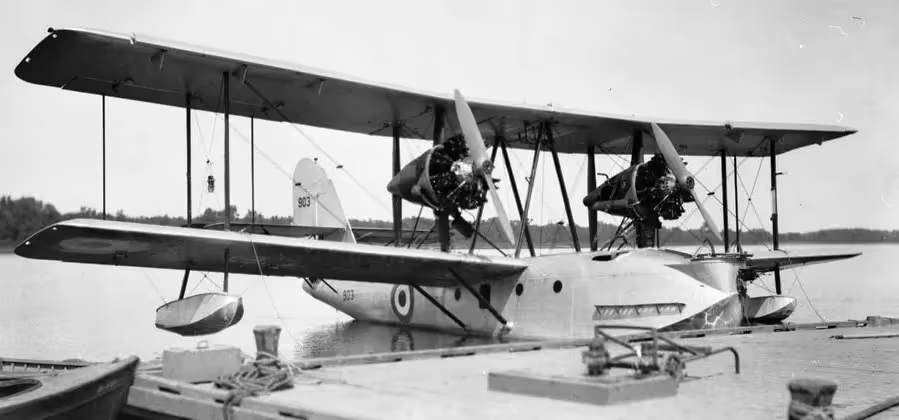
Canadian Vickers Vancouver, RCAF (Serial No. 903), No. 4 (Flying Boat) Squadron, 19 Aug 1936.
(Library and Archives Canada Photo, MIKAN No. 3545934)
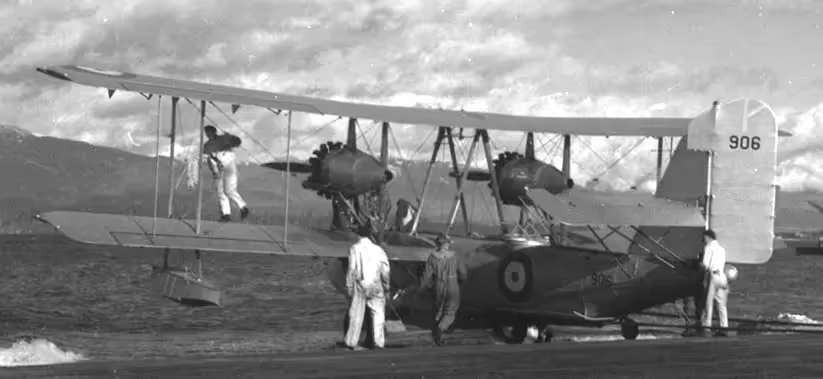
Canadian Vickers Vancouver Mk. II, RCAF (Serial No. 906), No. 4 (FB) Squadron, Jericho Beach, BC, 1939.
(Library and Archives Canada Photo, MIKAN No. 3650431)
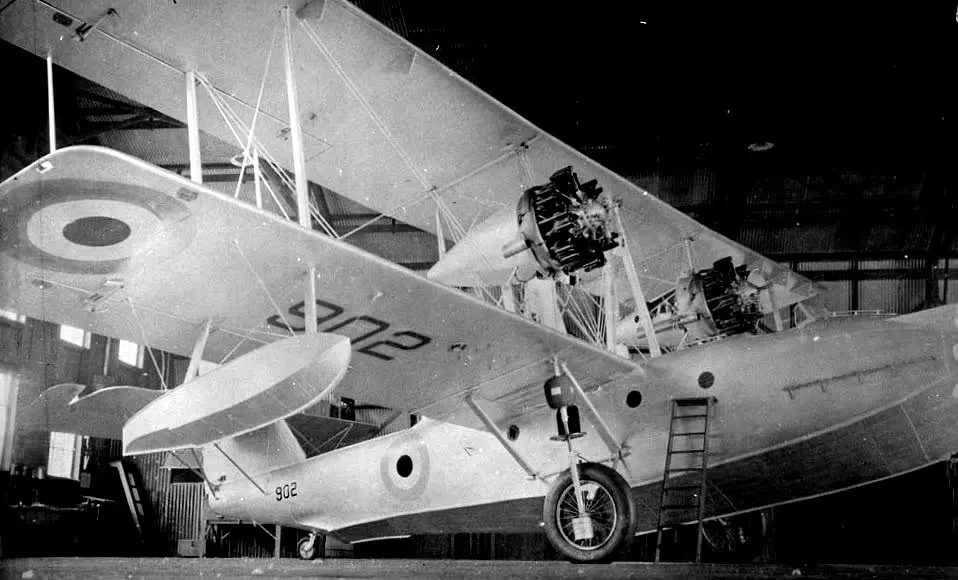
Canadian Vickers Vancouver Mk. II, RCAF (Serial No. 902), No. 4 (Flying Boat) Squadron, Jericho Beach, BC, 1936.
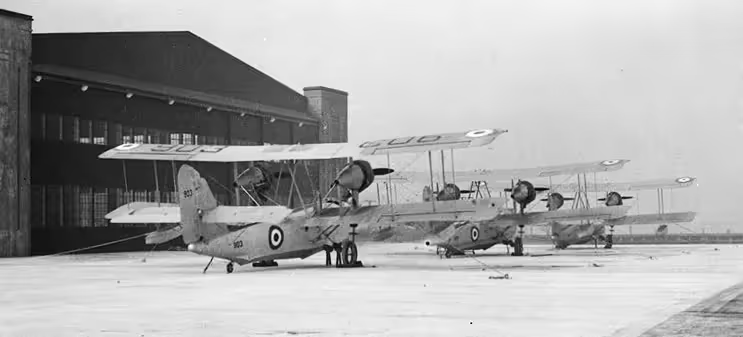
(Library and Archives Canada Photo, MIKAN No. 3205706)
Canadian Vickers Vancouver Mk. II flying boats of No. 4 (GR) Squadron, RCAF, 11 March 1938.
(Library and Archives Canada Photo, MIKAN No. 3198910)
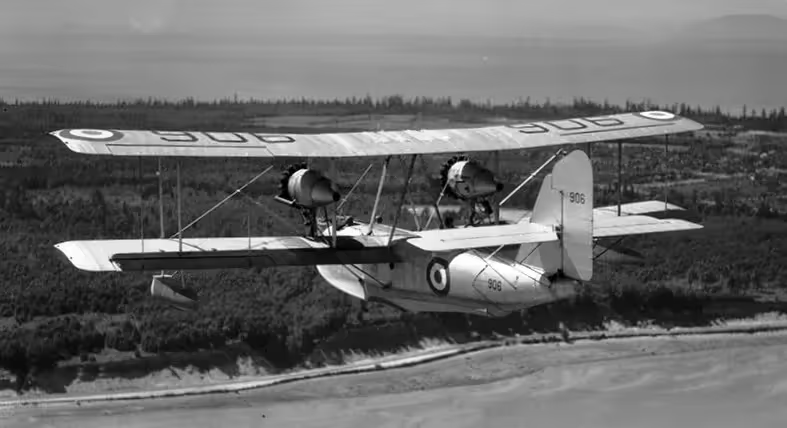
Canadian Vickers Vancouver Mk. II flying boat, RCAF (Serial No. 906), No. 4 (Flying Boat) Squadron, over English Bay, British Columbia, 1936.
(SDASM Archives Photo)
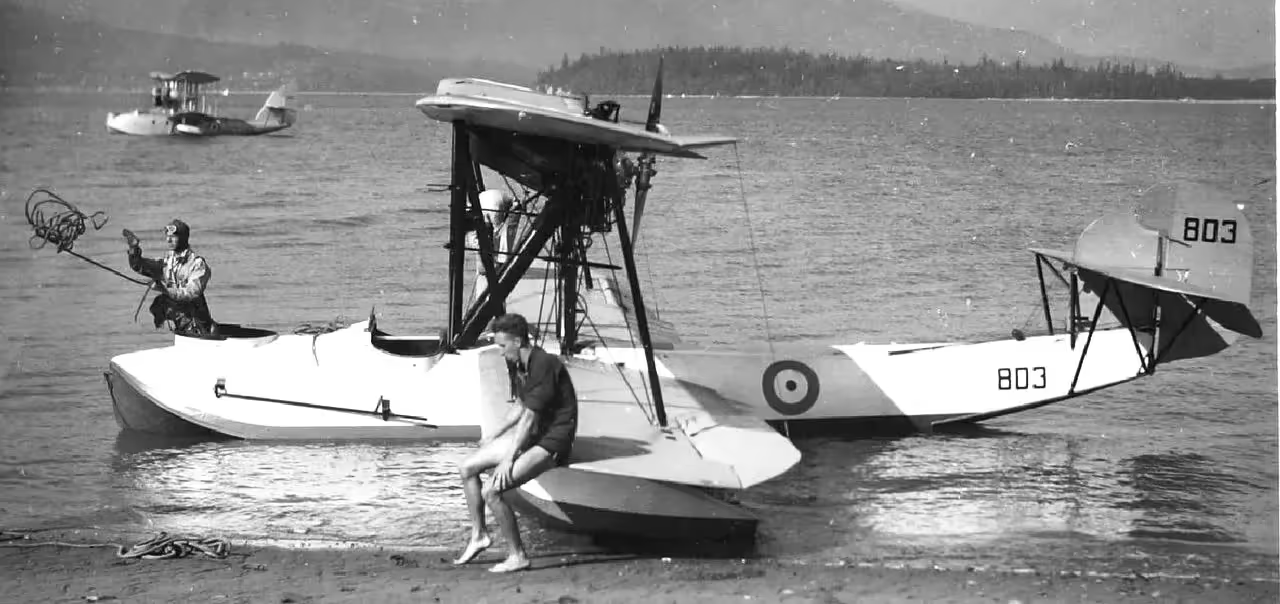
Canadian Vickers Vedette Mk. VA, RCAF (Serial No. 803). Canadian Vickers Vancouver, RCAF, in the background. Jericho Beach, Vancouver, British Columbia. Originally (Serial No. 116). The aircraft sustained Cat A damage after a crash at Point Grey at 14:30 hours on 4 Nov 1935 while with No. 4 (Flying Boat) Squadron. The squadron was based at Jericho Beach. After being written off, it was reduced to spares and produce.
(DND Photo, PL-1176, via Mike Kaehler)
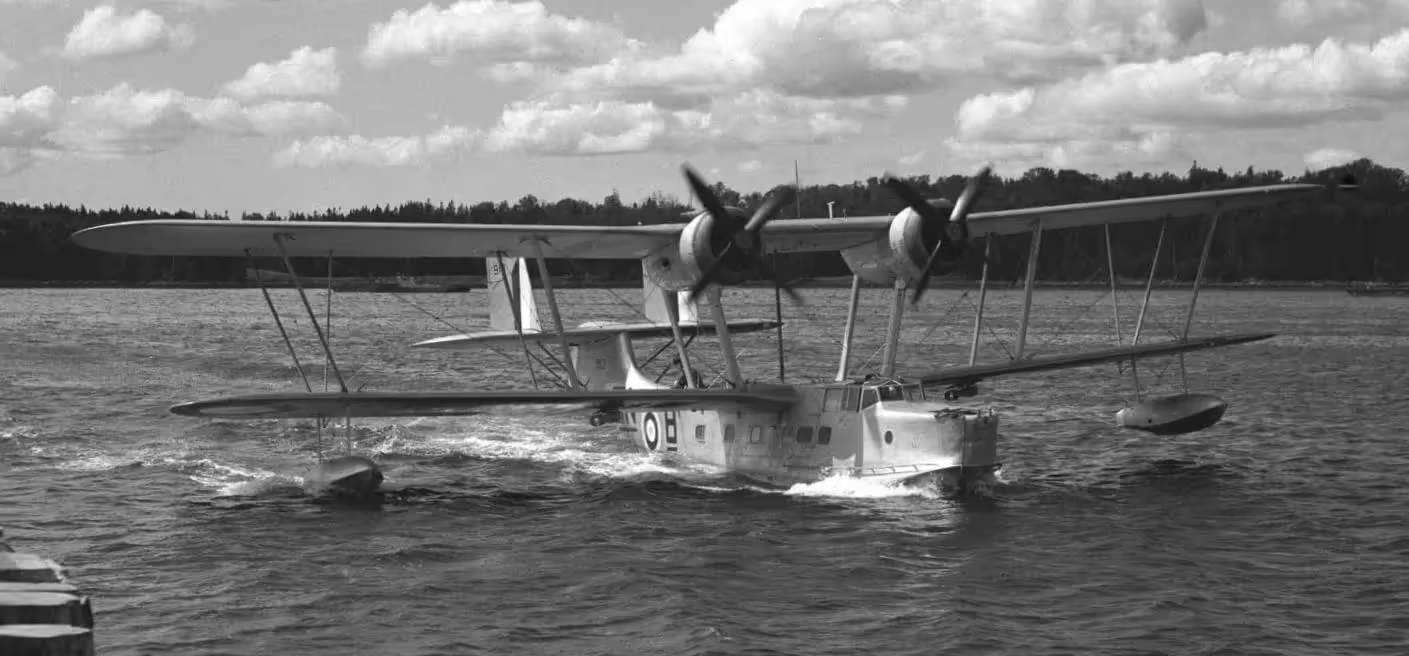
Canadian Vickers Stranraer, RCAF (Serial No. 913), CV190, coded QN-B, No. 5 (Bomber Reconnaissance) Squadron, RCAF Station Dartmouth, Nova Scotia, sometime between 1938 and 1941. Note the lines under the QN-B code indicate this is an aircraft from a Canadian Home Defence Establishment Unit. It is carrying bombs under the wings. 913 flew with No. 4 (BR) Squadron, RCAF Station Jericho Beach, British Columbia, in mid 1940. It was later flown by No. 120 (BR) Squadron at RCAF Station Coal Harbour, British Columbia, from 1941 to 1943.
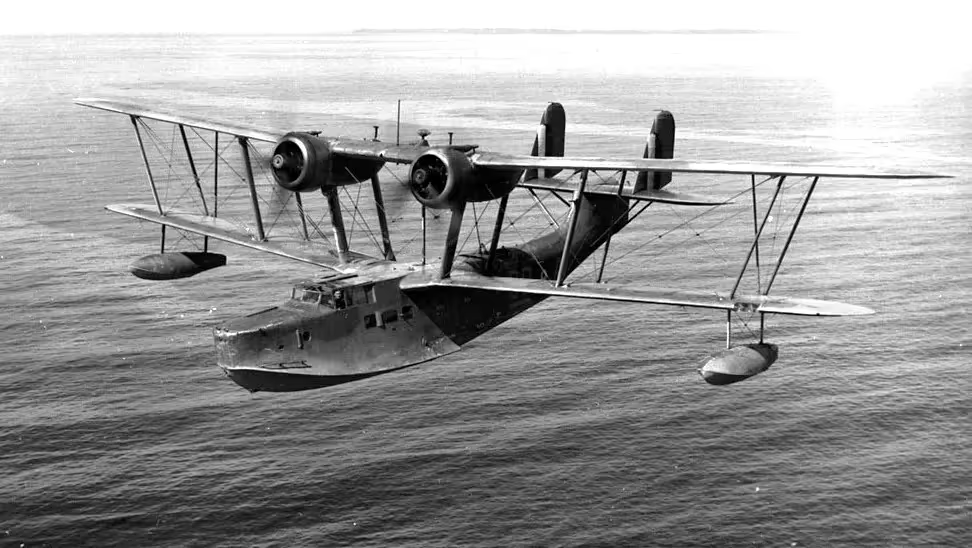
(Library and Archives Canada Photo, MIKAN No. 3584227)
Canadian Vickers Stranraer, RCAF, coded BO-?, No. 4 (Bomber Reconnaissance) Squadron based at Ucluelet, British Columbia. The photo was taken in 1942. The use of squadron codes by Home War Establishment squadrons within Eastern and Western Air Commands ceased immediately, effective the 16th of October, 1942 for security reasons. Prior to 1942, the squadron’s code was ‘FY’ (1939-1942) (Chris Charland)
(Library and Archives Canada Photo, MIKAN No. 3203454)
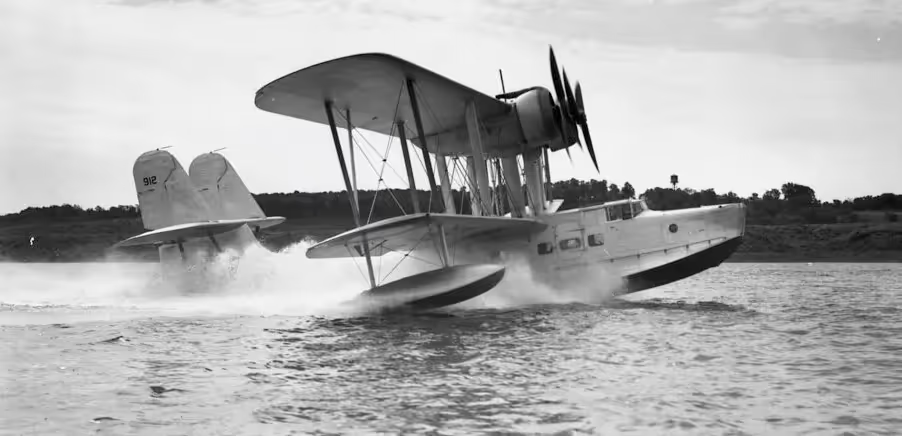
Canadian Vickers Stranraer, RCAF (Serial No. 912), shown here on the Ottawa River on 13 July 1939. It was later based at RCAF Station Jericho Beach, British Columbia, with No. 4 (Bomber Reconnaissance) Squadron, from 16 July 1939. 912 was the first Stranraer to this unit. It later flew with No. 120 (Bomber Reconnaissance) Squadron at Coal Harbour, British Columbia in 1942.
(RCAF Photo via Joel Rushworth)
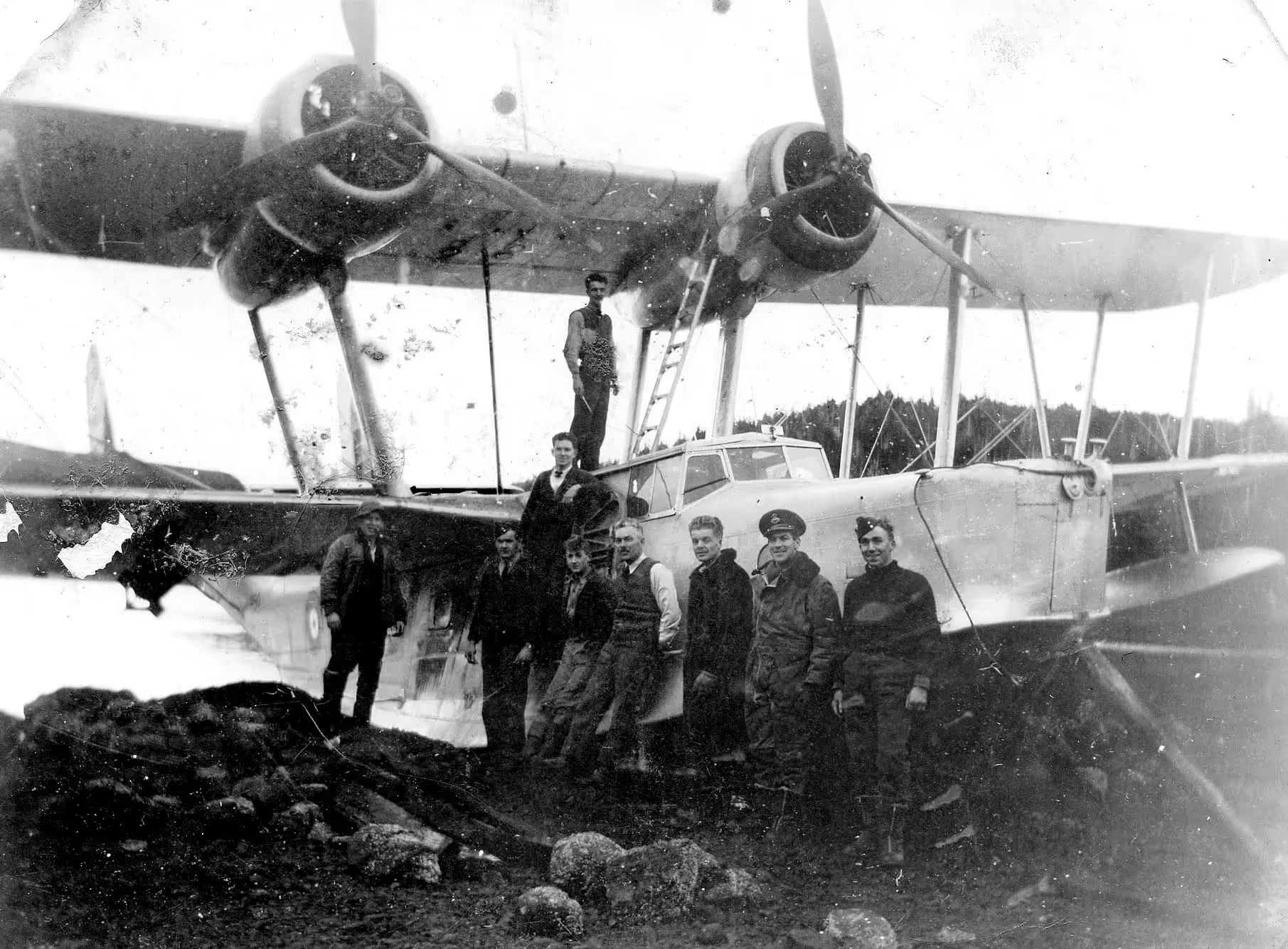
Canadian Vickers Stranraer, RCAF (Serial No. 910), No. 4 (Bomber Reconnaissance) Squadron, after a forced landing, Coal Harbour, British Columba, 1942. 910 was flown directly to No. 5 (BR) Squadron, RCAF Station Dartmouth, Nova Scotia, early in 1939. It was taken on strength at Dartmouth, on 30 May 1939. it later served with No. 4 (Bomber Reconnaissance) Squadron at RCAF Stations Jericho Beach and Ucluelet, British Columbia, from 1939 to c.1942. It returned to No. 5 (BR) Squadron in 1942.
(CFJIC, DND Photo via Don Smith)
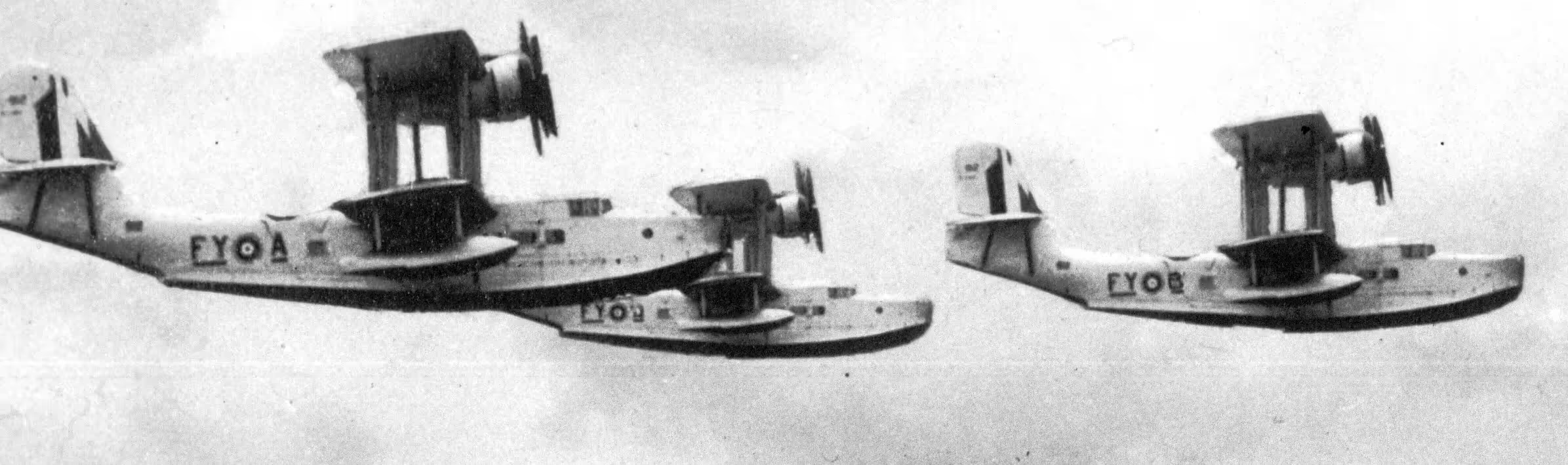
Canadian Vickers Stranraer formation, RCAF (Serial No.), coded FY-A, (Serial No. 903), coded FY-D and (Serial No. 915), coded FY-B, No. 4 (Bomber Reconnaissance), Squadron, Tofino, British Columbia.
(RCAF Photo)
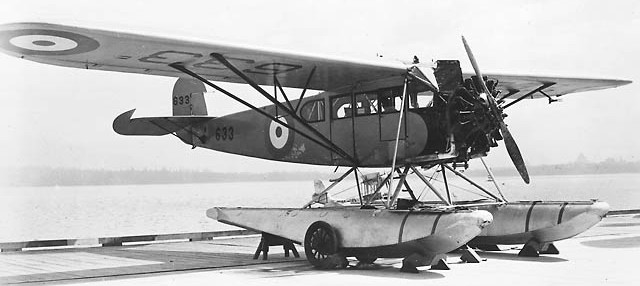
Fairchild 71B, RCAF (Serial No. 633), previously Reg. No. G-CYVX, on floats. This aircraft was operated by No. 4 (GR) Squadron on coastal patrols in the 1930s.
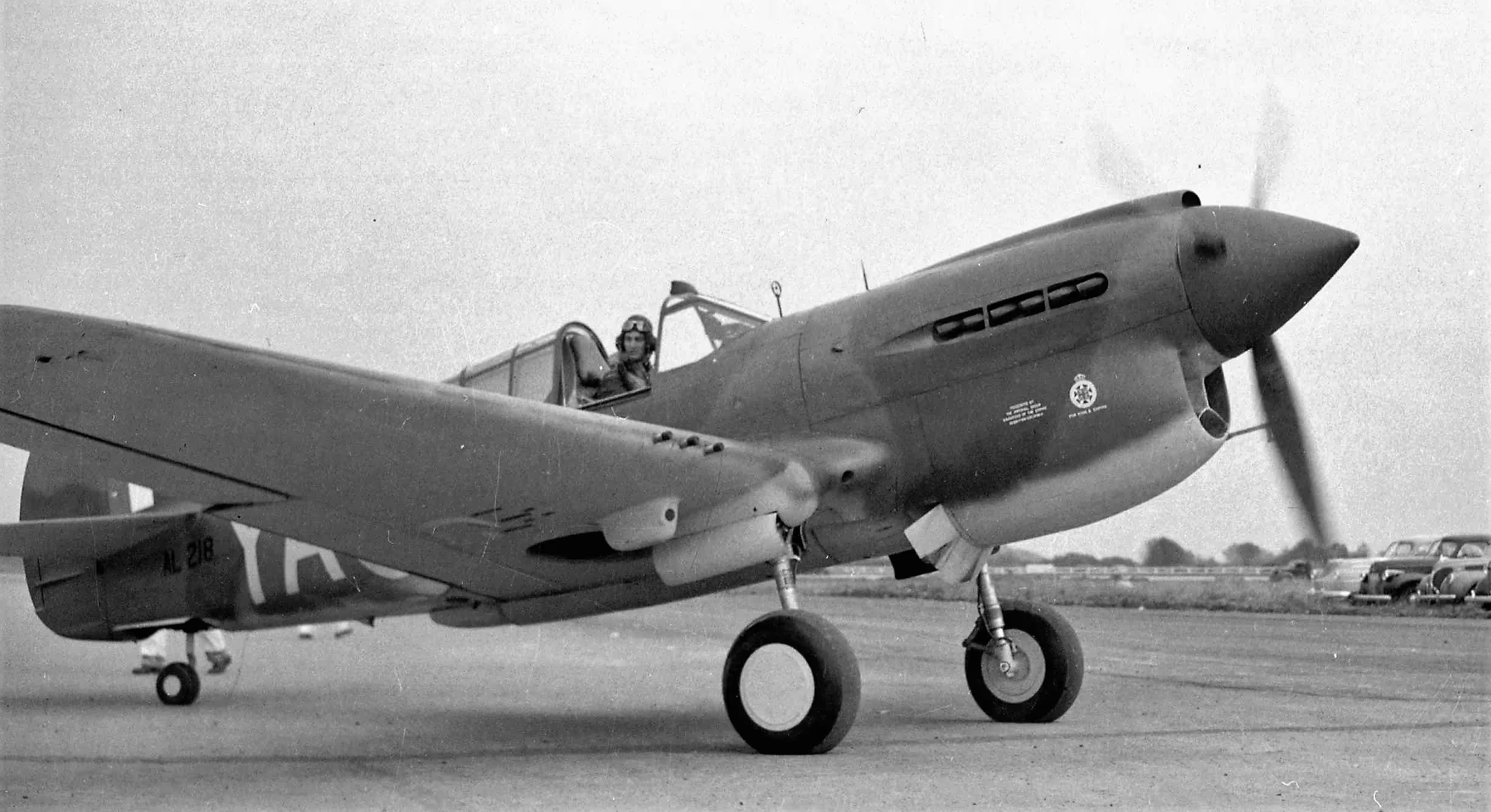
No. 14 (F) Squadron. The unit was first activated in 1942 flying Curtis Kittyhawks as No. 14 (Fighter) Squadron with RCAF Western Air Command due to the threat to Canada’s west coast after the Pearl Harbor attack. The squadron moved to Alaska and participated on strafing and bombing missions against then-Japanese held Kiska during the Aleutian Islands Campaign. The squadron was then renumbered to No. 442( Fighter Squadron) and transferred to England in January 1944 and flew attack and long-range bomber escort sorties in Northwest Europe flying the North American Mustang IV, claiming over 58 enemy aircraft and hundreds of vehicles, locomotives and rail cars. The squadron was disbanded in England in 1945 following the end of hostilities, and reformed a year later at RCAF Station Sea Island as an auxiliary fighter squadron.
(City of Vancouver Archives Photo, AM1184-S3-: CVA 1184-1132)
RCAF Curtiss Kittyhawk, No. 14 (F) Squadron, Vancouver, British Columbia, ca 1942. The badge on the nacelle seems to be that of the ANAF Vets or the Royal Canadian Legion. It reads “For King and Empire”.
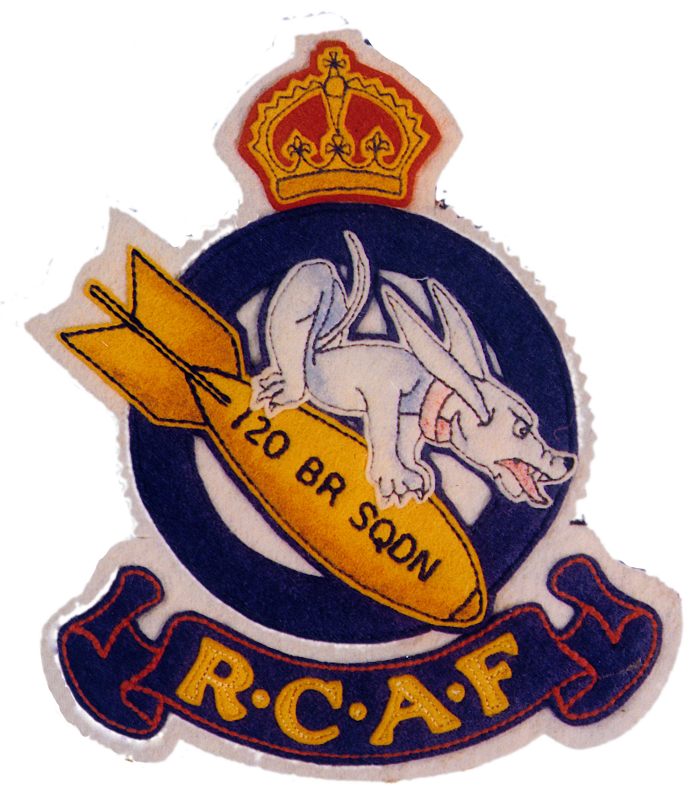
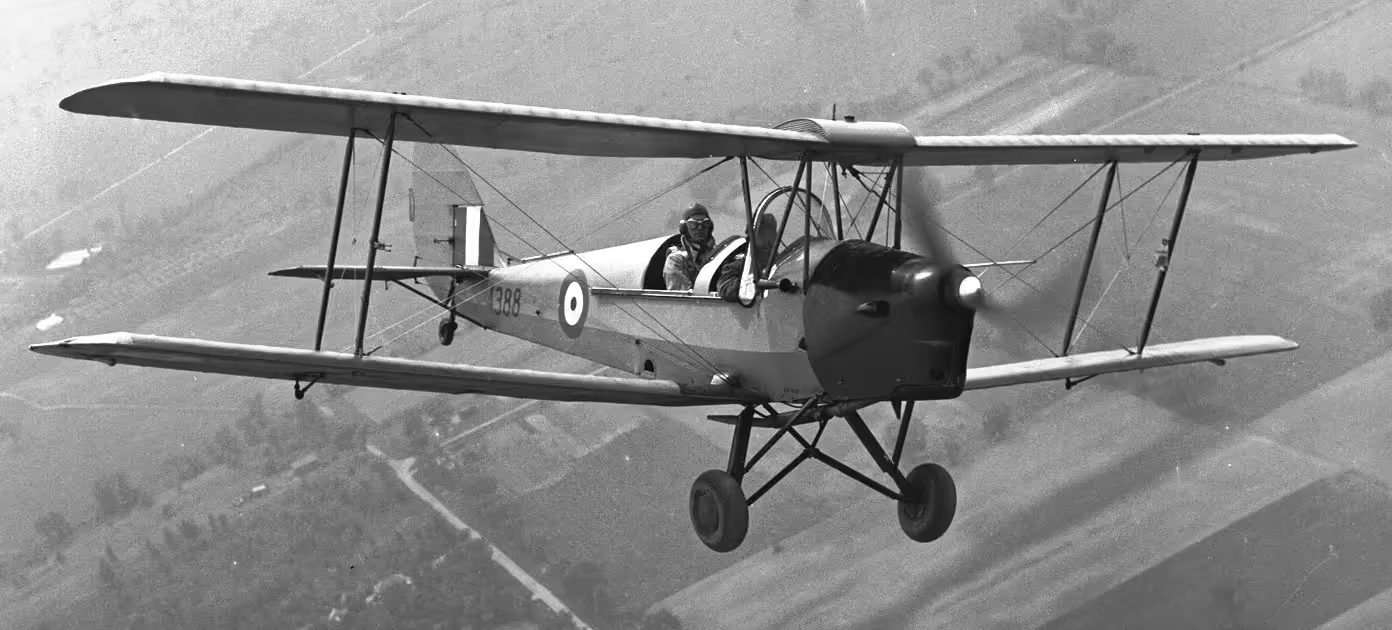
No. 120 (B) Squadron (Reserve), Regina, Saskatchewan. de Havilland DH.82 Tiger Moth. 31 Oct 1939, re-designated Bomber Reconnaissance (BR). No. 120 (BR) Squadron, Coal Harbour, British Columbia. Canadian Vickers Stranraer.
(DND Archives Photo, PL-3582)
de Havilland DH.82C Tiger Moth, RCAF (Serial No. 4388).
(Library and Archives Canada Photo, MIKAN No. 3203454)
Canadian Vickers Stranraer, RCAF (Serial No. 912), shown here on the Ottawa River on 13 July 1939. It was later based at RCAF Station Jericho Beach, British Columbia, with No. 4 (Bomber Reconnaissance) Squadron, from 16 July 1939. 912 was the first Stranraer to this unit. It later flew with No. 120 (Bomber Reconnaissance) Squadorn at Coal Harbour, British Columbia in 1942.
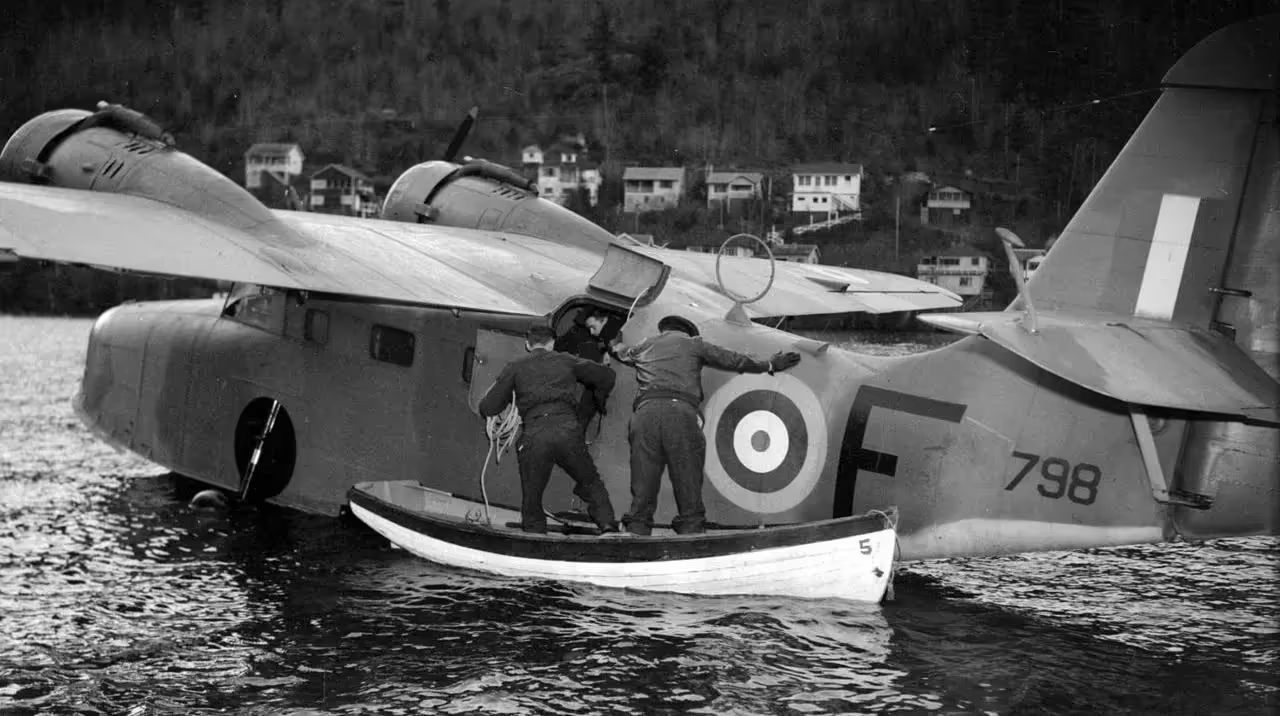
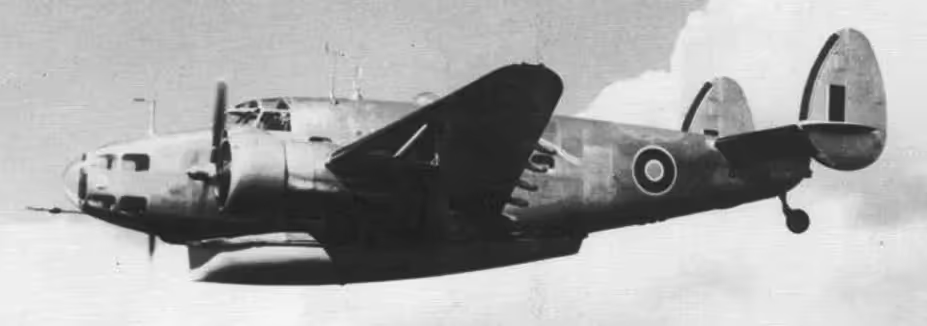
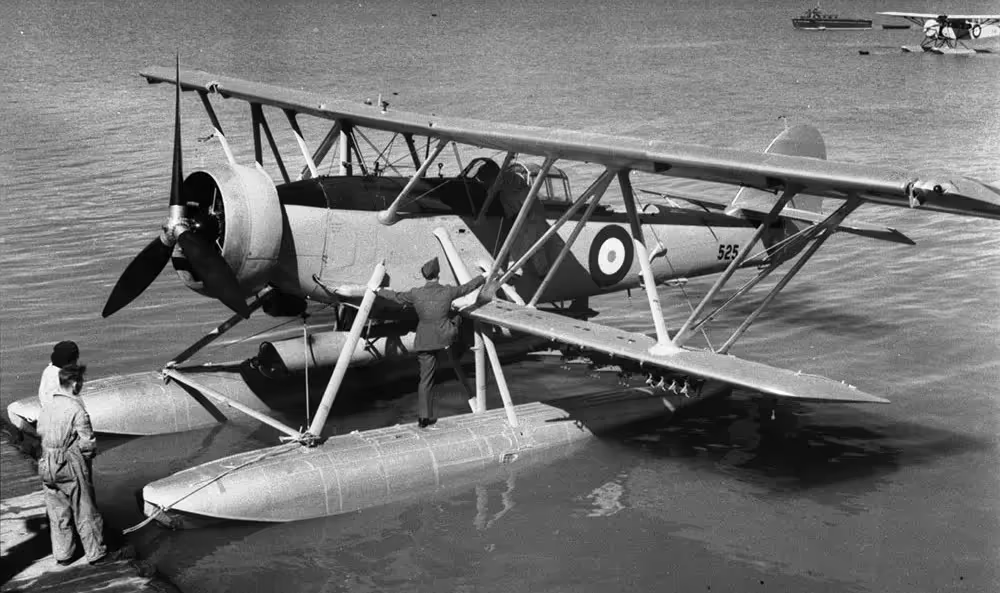
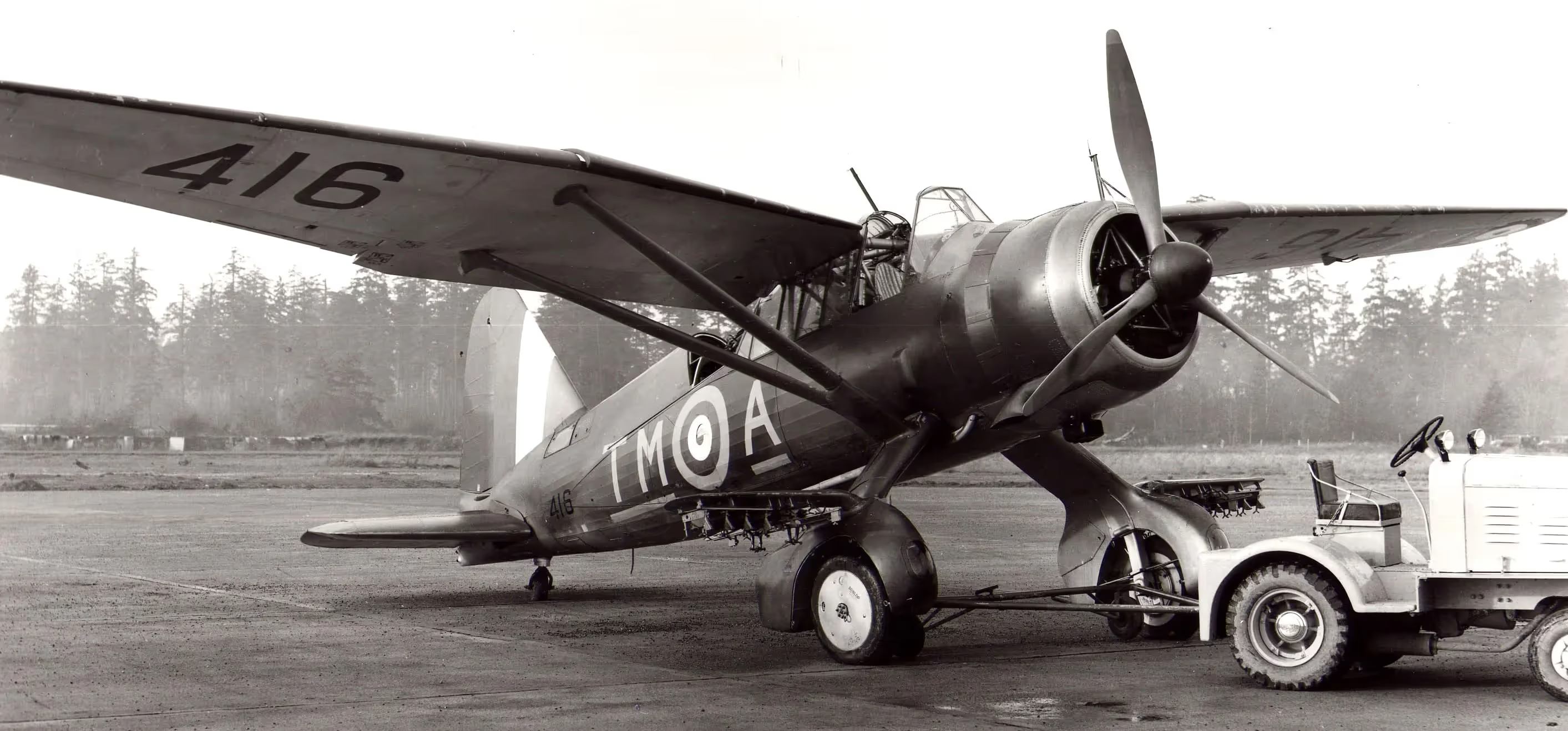
No. 122 (K) Squadron, Patricia Bay, British Columbia. Authorized as ‘No.122 (Composite) Squadron’ 10 January 1942. 15 Sep 1945, disbanded. The squadron flew on communications, artillery cooperation and rescue operations under ‘Western Air Command’. Various aircraft.
(City of Vancouver Archives Photo, Ref No. CVA 1184-1561)
Grumman Goose Mk. II, RCAF (Serial No. 798), flown by No. 122 (K) Squadron, a composite unit at Patricia Bay, British Columbia, c1943.
(RCAF Photo)
Lockheed Hudson Mk. III (Serial No. BW628), RCAF No. 122 (Composite) Squadron based at RCAF Station Patricia Bay (now Victoria International Airport), British Columbia. In this photo it is carrying an air droppable life boat . When released, it descended by parachute. The aircraft was later equipped in December, 1945 with ASV (Air-to-Surface Vessel) radar.
(Library and Archives Canada Photo, MIKAN No. 3208198)
No. 122 (Composite) Squadron flew aircraft like this Blackburn Shark Mk. III, RCAF (Serial No. 525), No. 6 (Torpedo Bomber) Squadron, May 1939.
(RCAF Photo)
No. 122 (Composite) Squadron flew aircraft like this Westland Lysander Mk. II, RCAF (Serial No. 416), Patricia Bay, 1 Nov 1941. No. 416 was the first Canadian-produced example, joining the RCAF on 7 September 1939.
No. 132 (F) Squadron, Tofino, British Columbia. Curtis Kittyhawk Mk. I. Authorized 14 April 1942. 30 Sep 1944, disbanded.
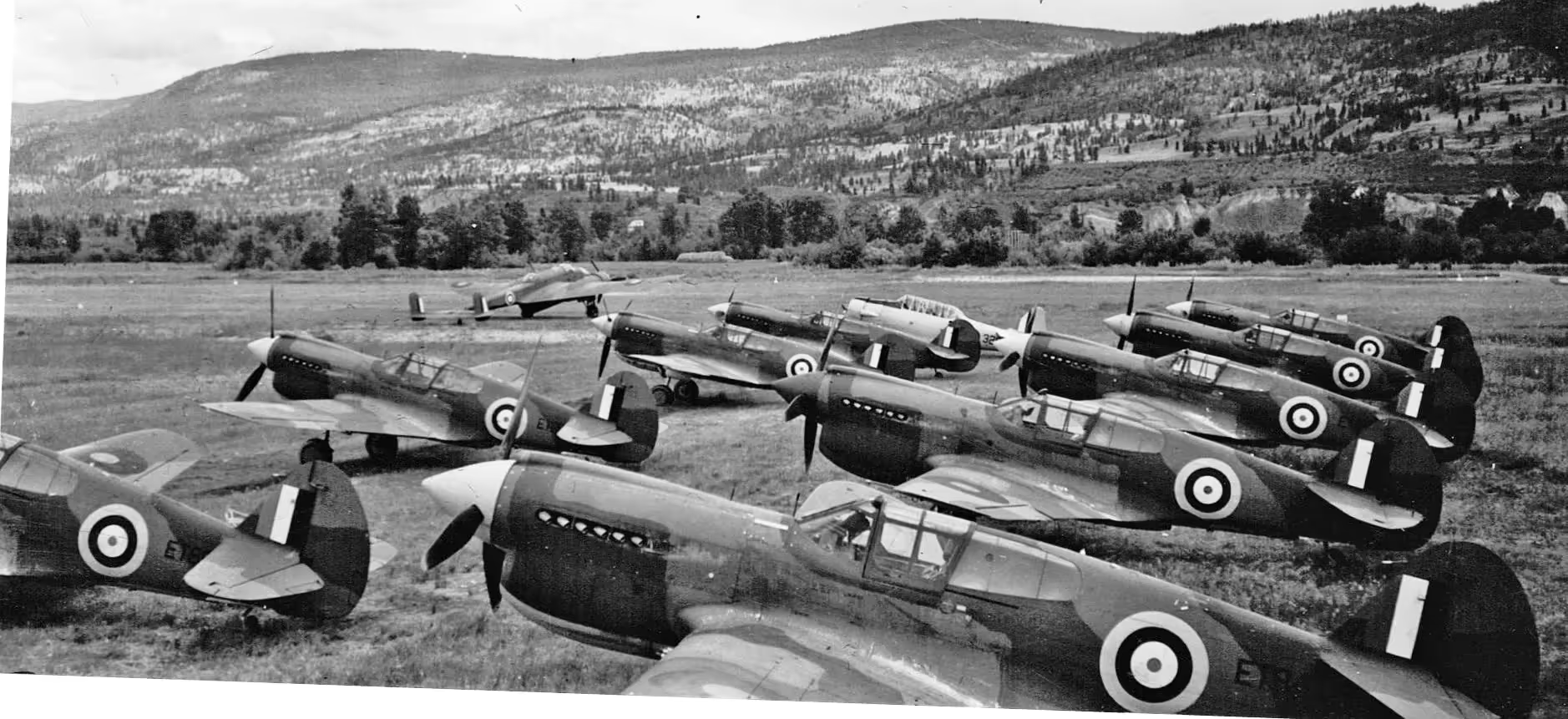
(DND Photo via Shuan Mullins)
Curtiss Kittyhawk Mk. IAs (Model H87-A4) bearing RAF serials in the ET series from a batch of 480 P-40E-1 aircraft ordered under USAAF Serial Nos. 41-35874/36353, c/n 19395/19474, a number of which were diverted to the RCAF. The identity of the nearest Kittyhawk, Serial No. ET84-, is likely one of three aircraft:
P-40E-1 41-36199 cn 18720, RAF ET845, became RCAF 720, to No. 132 (F) Squadron, Western Air Command, in 1942.
P-40E-1 41-36200 cn 18721, RAF ET847, became RCAF 721, to No. 132 (F) Squadron, Western Air Command, in 1942.
P-40E-1 41-36201 cn 18722, RAF ET849, became RCAF 722, to No. 132 (F) Squadron, Western Air Command, in 1942.
A Handley Page Hampden is taxiing in the background and a Harvard completes the airfield line up. The Kittyhawks belonged to No. 132 (F) Squadron. This Flying Party flew from Lethbridge, Alberta to Penticton, BC, on the 8th of June, 1942. They were grounded there by weather. The Flying Party finally arrived at Sea Island, BC, from Penticton on the 12th of June. The Hampden could have been shepherding the aircraft out to the west coast or just visiting.
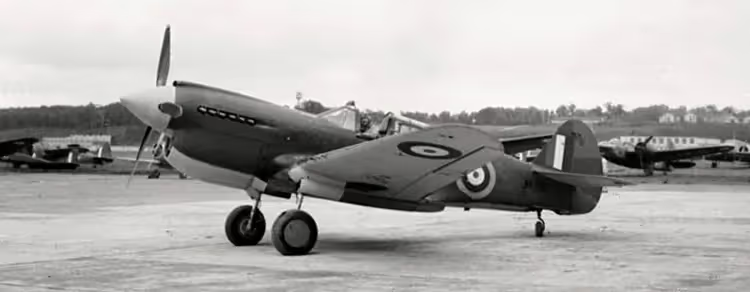
(Library and Archives Canada Photo, MIKAN No. 3643698)
Curtiss P-40 Kittyhawk (Serial No. AK752), later RCAF (Serial No. 1028), RCAF Station Rockcliffe, Ontario, 25 May 1942. This aircraft served with No. 132 (F) Squadron and No. 133 (F) Squadron. This P-40 was built as a Kittyhawk Mk. I for the RAF. She was purchased by the British Purchasing Commission and did not fall under any Lend-Lease agreement and therefore did not receive a US Army serial number. She was given the RAF serial AK752 but was handed over to Canada and received the RCAF serial 1028. During her service with No. 132 (F) and No. 133 (F) Squadrons in defence of Canada’s West Coast, it is reported that pilots of this aircraft downed two Japanese balloon bombs.
No. 133 (F) Squadron, Sea Island, British Columbia. Authorized 3 June 1942. 10 Sep 1945, disbanded. The squadron flew Curtis Kittyhawk Mk. I, and de Havilland DH.98 Mosquito FB Mk. 26.
In early 1945 pilots from No. 133 Squadron RCAF, operating Kittyhawks out of RCAF Station Patricia Bay, Victoria, British Columbia, intercepted and destroyed two Japanese balloon-bombs, which were designed to cause wildfires on the North American mainland. On 21 February, Pilot Officer E. E. Maxwell shot down a balloon, which landed on Sumas Mountain in Washington State. On 10 March, Pilot Officer J. 0. Patten destroyed a balloon near Saltspring Island, BC. The last interception took place on 20 April 1945 when Pilot Officer P.V. Brodeur from No. 135 Squadron out of Abbotsford, BC, shot down a balloon over Vedder Mountain. (Wikipedia)
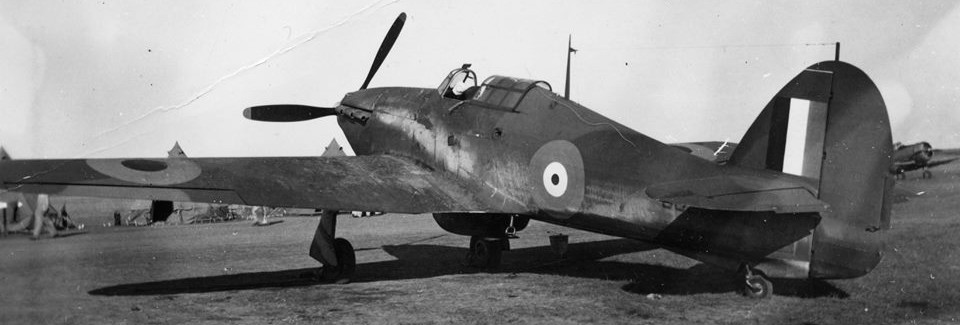
(DesMazes collection Photo)
Hawker Hurricane Mk. XII, Lethbridge Alberta in late 1942-early 1943. It was one of the No. 133 Fighter Squadron Hawker Hurricanes that made an historic trip to Boundary Bay in Feb 1943. Boundary Bay had been re-designated a Home War Defence Station and No. 133 was tasked with protecting the Air space of the Greater Vancouver Area from possible attack from Japanese Forces. The Squadron made the trip non stop from Lethbridge and by the time they reached Boundary Bay they were “sucking fumes”, recalled Pilot Officer McGowan. “We had no fuel left, not even enough to circle the aerodrome and so we landed in Squadron Formation of three at a time, all twelve aircraft. As far as I know it was never done before or since, (during the Second World War), as it was very dangerous, if someone screwed up it would be catastrophic.”
v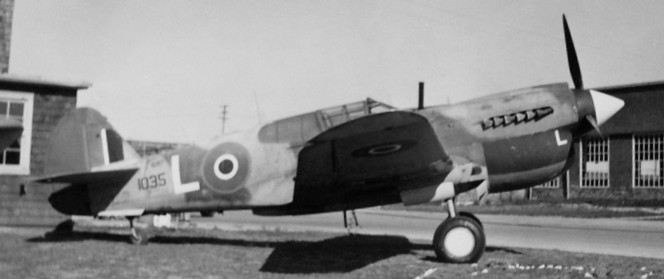
(p40hawksnest photo)
Curtis Kittyhawk Mk. I (Serial No. AK809/1035), No. 133 (F) Squadron RCAF.
No. 135 (F) Squadron, Patricia Bay, British Columbia. Curtis Kittyhawk Mk. I, Hawker Hurricane Mk. XII. 10 Sep 1945, disbanded.
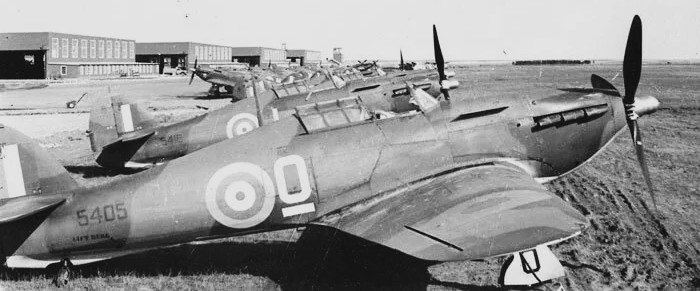
(VWC Photo)
Newly arrived and marked Hawker Hurricane Mk. XIIs warm in the sun at Mossbank, Saskatchewan in 1942. Hurricane RCAF (Serial 5405) in the foreground was delivered to No. 4 Training Command for No. 135 (F) Squadron at Mossbank, Saskatchewan on 20 July 1942. 5405 remained with this unit when it transferred to Western Air Command.
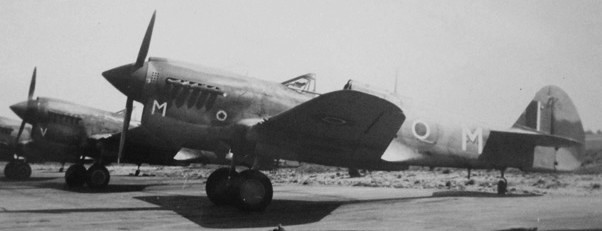
(RCAF No. 111 (F) Squadron Photo)
Curtis P-40N Kittyhawks, Ni. 135 Squadron, probably at Patricia Bay, BC. P-40N (Serial No. 866) wore the letter M in No. 135 Squadron.
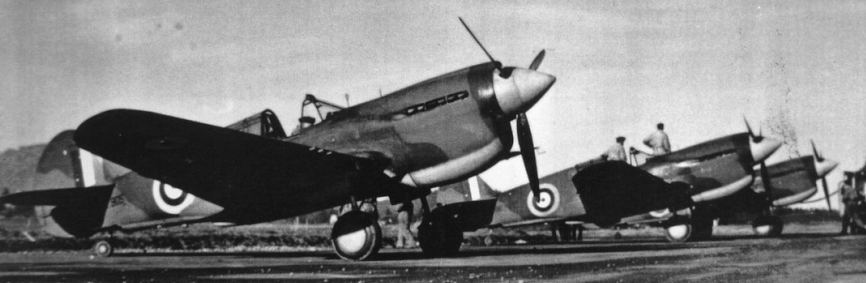
(DND Photo, PBG-1436)
P-40E Kittyhawks refueling at RCAF Patricia Bay, British Columbia. They were brand new and still hadn’t had their Squadron Identification markings added.
No. 147 (BR) Squadron, Sea Island, British Columbia. No. 147 Squadron RCAF was a Canadian Home War Establishment (HWE) Squadron. It was formed as part of Western Air Command (WAC) on 1 July 1942 at Sea Island, B.C. where it served as a Bomber Reconnaissance (BR) unit tasked with anti-submarine duty. No. 147 Squadron moved to RCAF Station Tofino, B.C. in March 1943 and, with the reduced threat of Japanese action on the Canadian Pacific coast, was disbanded 15 March 1944. The squadron flew the Fairchild Bolingbroke Mk. II. The two letter Squadron code was briefly SZ from July 1942 until the use of Squadron codes was discontinued in the RCAF HWE on the 16 Oct 1942, “for security reasons”.
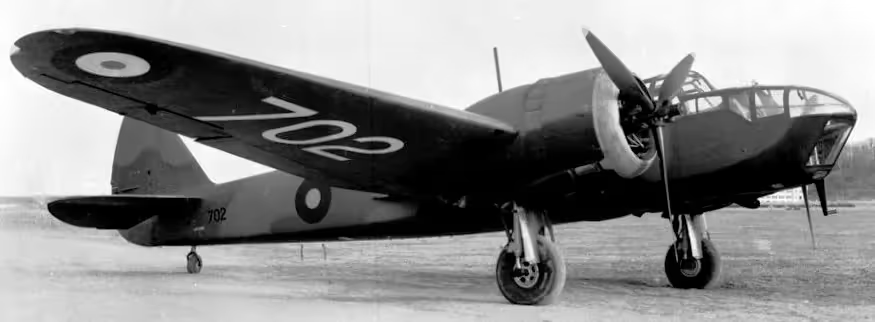
(Library and Archives Canada Photo, MIKAN No. 3521026)
Fairchild Bolingbroke Mk. I, RCAF (Serial No. 702), 22 Nov 1939. This aircraft was flown by No. 147 (Bomber Reconnaissance) Squadron from July 1942 to March 1944)
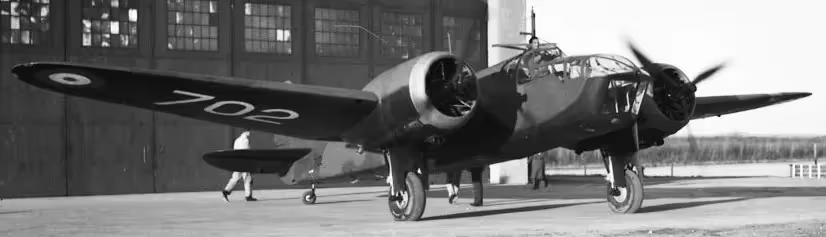
(Library and Archives Canada Photo, MIKAN No. 3199833)
Fairchild Bolingbroke Mk. I, RCAF (Serial No. 702), No. 147 (Bomber Reconnaissance) Squadron.
No. 149 (TB) Squadron, Patricia Bay, British Columbia.
No. 149 (TB) Squadron, RCAF, was formed as a Torpedo Bomber unit at Patricia Bay, British Columbia, on 26 October 1942. This squadron was the only home unit to be equipped with the Bristol Beaufort to meet the Japanese naval threat from the Aleutians. When the Japanese withdrew in the summer of 1943, the squadron was redesignated Bomber Reconnaissance (BR) and re-equipped with Lockheed Ventura aircraft. It was employed on West Coast anti-submarine duty until it was disbanded at Terrace, BC, on 15 March 1944. (S. Kostenuk and J. Griffin)
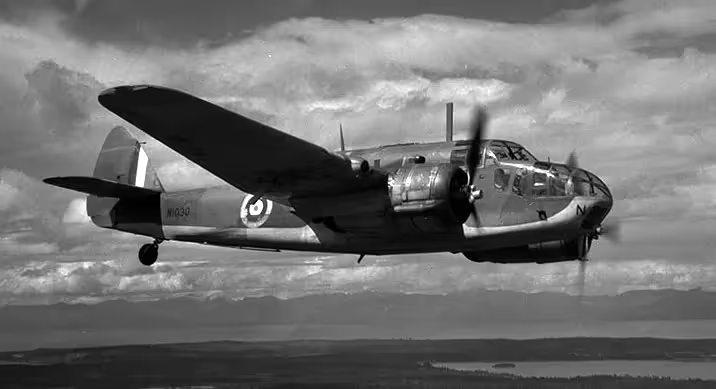
(Library and Archives Canada Photo, PB-1406, MIKAN No. 3225024)
Bristol Beaufort Mk. I (Serial No. N1030), coded N, No. 149 (Torpedo Bomber) Squadron, RCAF, on patrol over Patricia bay, British Columbia, 18 June 1943
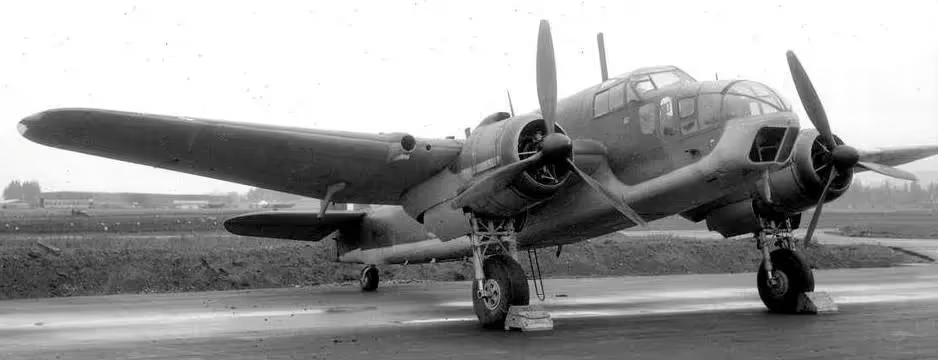
(British Columbia Archives Photo)
Bristol Beaufort Mk. I, RCAF (Serial No. unknown), No. 149 (Torpedo Bomber) Squadron, Patricia Bay, British Columbia.
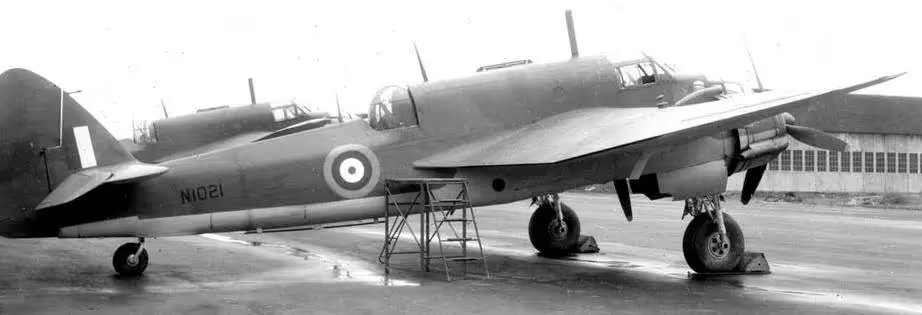
(British Columbia Archives Photo)
Bristol Beaufort Mk. I, RCAF (Serial No. N1021), coded B. No. 149 Squadron RCAF, possibly previously operated in combat by 32 OTU under RCAF control, coded RD and later OP. Built by Canadian Associated Aircraft at St. Hubert, Quebec. Taken on strength at No. 1 Wireless School, at Montreal. To Western Air Command on 11 September 1941, for use by No. 32 Operational Training Unit at RCAF Station Patricia Bay, BC. Coded “RD*D” and later “OP*D”. Assigned to No. 149 (TB) Squadron at RCAF Station Patricia Bay, BC on 8 October 1942. Coded “B”. Category A crash at Patricia Bay at 15:03 on 23 February 1943. One engine failed on approach to landing. Pilot could not keep aircraft straight, and it crashed into a hanger. 2 crew slightly injured.
No. 4 Group, HQ Prince Rupert, British Columbia. Western Air Command. Formed at Prince Rupert, British Columbia on 16 June 1942 to provide administrative and operational control of RCAF units in northern British Columbia and the Yukon; disbanded on 1 April 1944. Commanders: G/C R.C. Gordon 16 Jun 42 – 11 Jun 43. G/C R.H. Foss 12 Jun 43 – 1 Apr 44. Higher Formation and Group Location: Western Air Command: Prince Rupert, B.C. 16 Jun 42 – 1 Apr 44.
No. 6 (TB) Squadron was authorized as a Torpedo Bomber unit on 4 March 1936 at the RCAF main training base in Trenton, Ontario, under the control of RCAF headquarters. It began service training with Canadian Vickers Vedette flying boats before receiving Blackburn Shark torpedo bombers from England in January 1937. Flight Lieutenant C.L. Trecarten became commander on 23 November 1936; subsequent prewar commanders were RAF Flight Lieutenant E.A. Springall from 18 February 1938, and Wing Commander A.H. Hull from 13 June of the latter year. In November 1938 it relocated to Jericho Beach, British Columbia, joining Western Air Command there on 5 November after departing Trenton on the first day of the month. The squadron trained in torpedo dropping at Jericho Beach.
It was mobilized for the Second World War on 10 September 1939, and flew its first mission on the next day – a patrol of the Strait of Georgia area from Gabriola Island to the Pender Islands. These patrols, which had been begun by the RCAF on 2 September, were to identify and report all shipping transiting the Vancouver area. Between 12 September 1939 and 1 May 1940 the squadron detached two aircraft to Ucluelet. It was redesignated as a bomber reconnaissance squadron on 31 October 1939, and flew anti-submarine patrols for the rest of the war. Squadron Leader L.E. Wray replaced Hull on 4 February 1940; subsequent wartime commanders were Squadron Leaders M.G. Doyle from 6 November, B.N. Harrop from 25 August 1941, H.J. Winny OBE from 1 April 1942, G.C. Upson from 25 August, V.A. Margetts from 14 December, and L.A. Harling from 22 September 1943. Its last commander was Wing Commander A.C. Neale AFC from 20 September 1944. The squadron relocated to Alliford Bay on 15 May 1940, and during the year received at least three Noorduyn Norseman floatplane utility aircraft. After receiving Supermarine Stranraer flying boats in November 1941, it gave up its Sharks and Norsemans in December of that year. The squadron came under the control of the newly formed No. 4 Group RCAF on 16 June 1942 and reverted to Western Air Command on 1 April 1944 when the latter was abolished. Between 19 November and 3 December 1942 the squadron relocated to Bella Bella for a movement exercise. The Stanraers were replaced by the Consolidated Canso A between April and May 1943. In September of that year it received Consolidated Catalina IB and IIIAs, giving up its Cansos in November. The squadron again received Cansos in March 1944, operating these and the Catalinas for the rest of its existence. The squadron relocated to Coal Harbour on 23 April 1944, remaining there for the rest of its existence.
On 12 March 1945, the Canso crew of Flight Lieutenant Moodie sighted a partially deflated Japanese fire balloon over Rupert Inlet, and forced it down on the south side of Rupert Arm by flying above it. The balloon was subsequently recovered by a ground party and sent to Western Air Command headquarters for inspection. As the war drew to a close, the squadron was disbanded on 7 August after flying its last patrol on 1 August. The squadron flew 2,506 sorties during the war, and had a total of 11,716 operational flying hours and 10,565 non-operational flying hours. Its only losses were two aircraft and nine aircrew killed in non-operational incidents. None of its personnel received decorations.[2] It earned the battle honour Pacific Coast 1941-1945, but was never awarded it due to its disbandment. (Wikipedia)
The squadron flew the Canadian Vickers Vedette, 1936–1937, Blackburn Shark Marks II and III, 1937–1941, Supermarine Stranraer, 1941–1943, Consolidated Canso A, 1943, 1944–1945, Consolidated Catalina Marks IB and IIIA, 1943–1945, Noorduyn Norseman, 1940–1941, before disbanding on 7 August 1945.
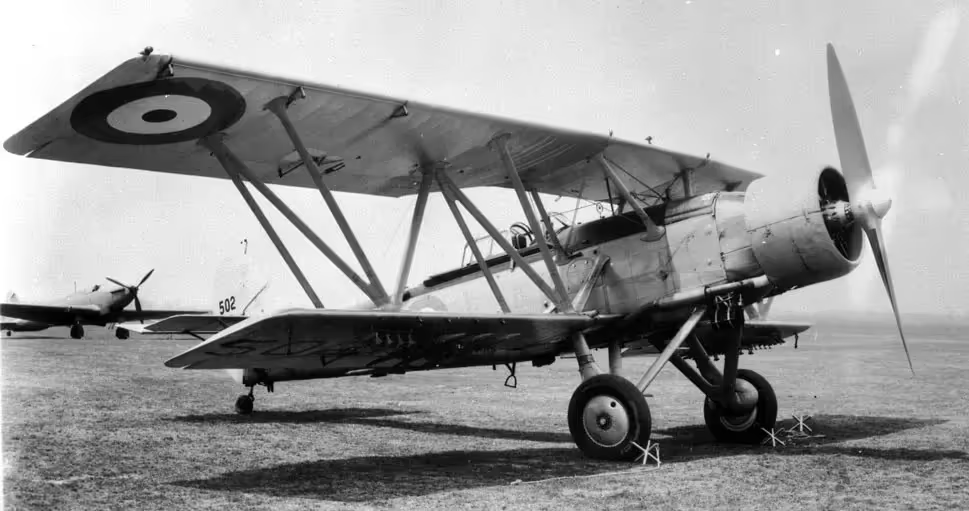
(Library and Archives Canada Photo, MIKAN No. 3583642)
Blackburn Shark Mk. II, RCAF (Serial No. 502), No. 6 (Torpedo Bomber) Squadron, 8 Dec 1944.
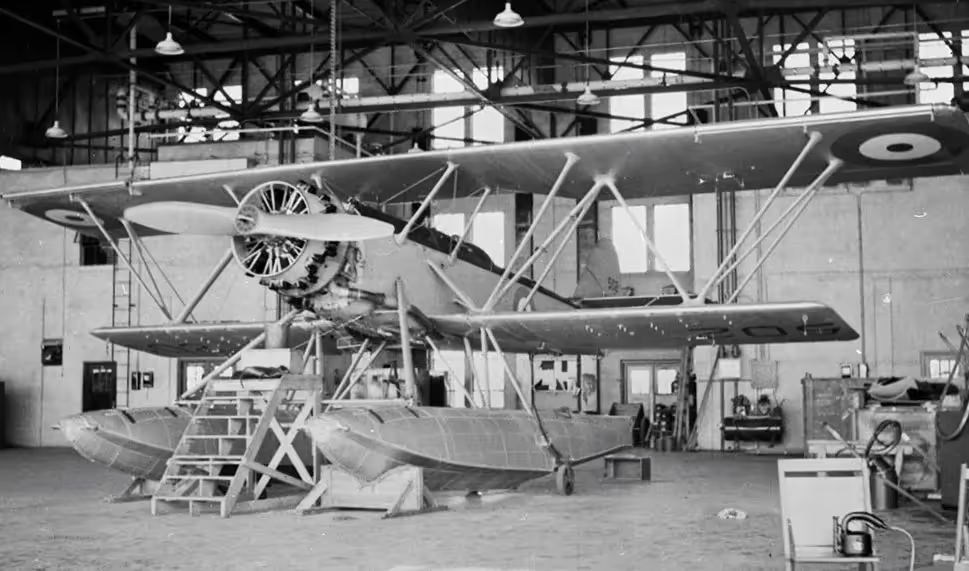
(Library and Archives Canada Photo, MIKAN No. 3203457)
Blackburn Shark Mk. II, RCAF (Serial No. 502), No. 6 (Torpedo Bomber) Squadron, May 1937.
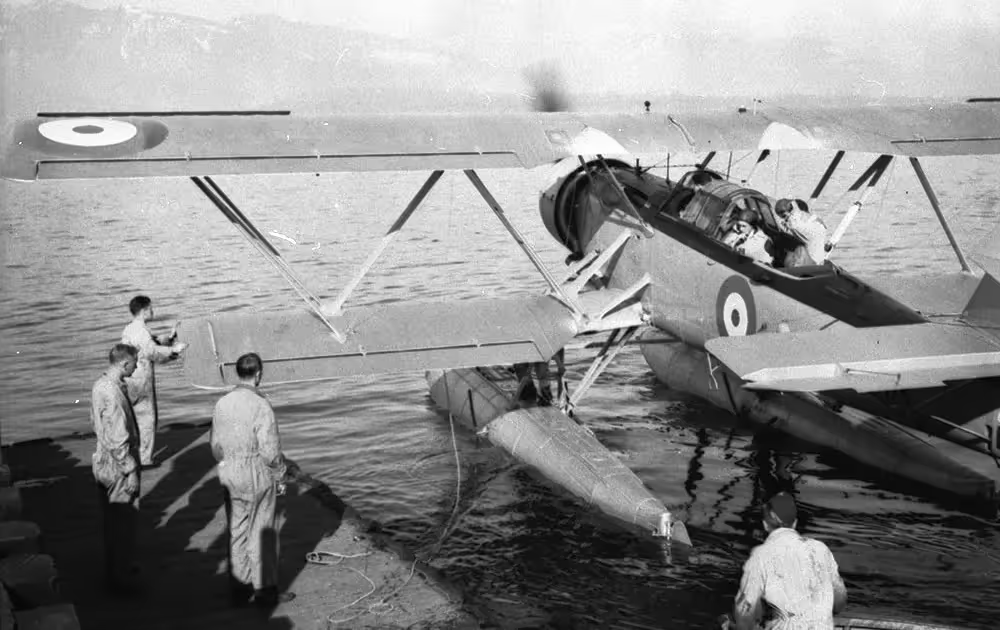
(Library and Archives Canada Photo, MIKAN No. 3545879)
Blackburn Shark Mk. II, RCAF No. 6 (Torpedo Bomber) Squadron, May 1939.
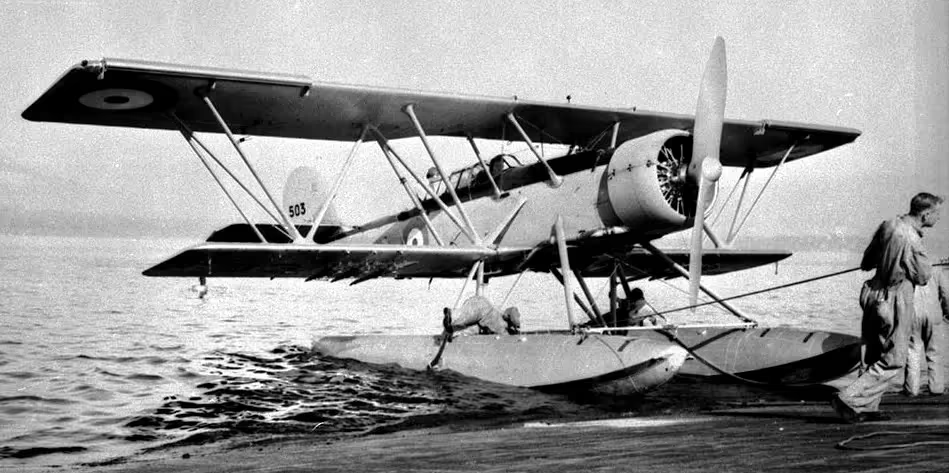
(Library and Archives Canada Photo, MIKAN No. 3545880)
Blackburn Shark Mk. II, RCAF (Serial No. 503), No. 6 (Torpedo Bomber) Squadron, May 1939.
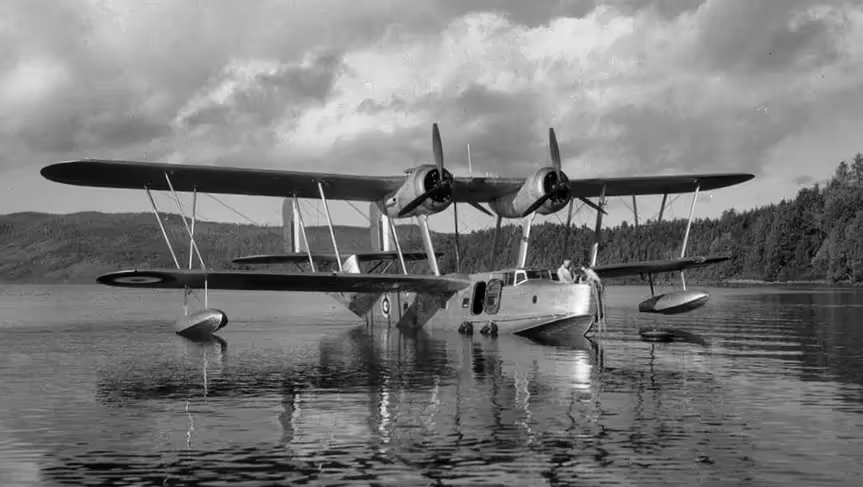
(Library and Archives Canada Photo, 3199160)
Canadian Vickers Stranraer, RCAF (Serial No. 948), No. 6 (BR) Squadron, at its base at Alliford Bay, British Columbia. 948 was flown by No. 6 (Bomber Reconnaissane) Squadron, from RCAF Station Alliford Bay from 1941 to 1943
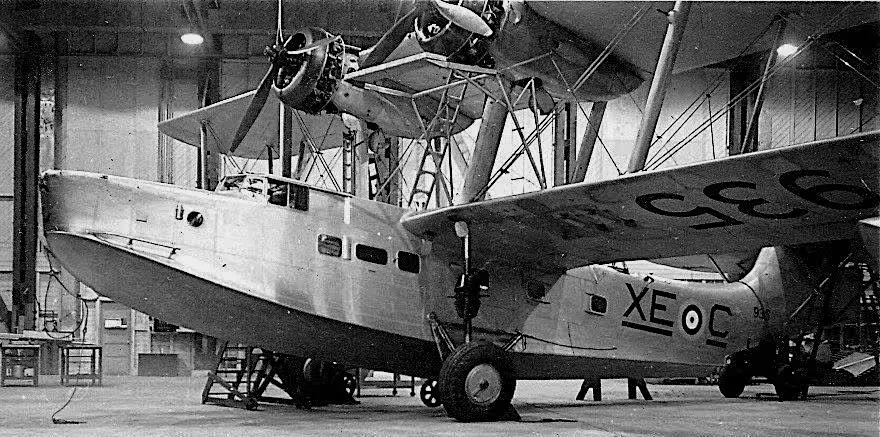
(Comox Air Force Museum Photo via WO CD Cunningham)
Canadian Vickers Stranraer, RCAF (Serial No. 935), coded XE-C, No. 6 (Bomber Reconnaissance) Squadron, at RCAF Station Alliford Bay, British Columbia, in 1941. The unit code of XE-C is underlined indicating a home based squadron.
No. 7 (BR) Squadron, Alliford, British Columbia. It was amalgamated from various Rockcliffe based flights on 29 January 1936 at RCAF Station Rockcliffe near Ottawa, Ontario, as No. 7 (General Purpose) Squadron and was disbanded on 10 September 1939 to allow its personnel to bring more critical combat units up to strength with the start of the Second World War. It was reformed at RCAF Station Prince Rupert on 8 December 1941 as an anti-submarine unit with RCAF Western Air Command. The squadron flew the Blackburn Shark, Supermarine Stranraer, Consolidated Canso and Consolidated Catalina before disbanding a final time on 25 July 1945.
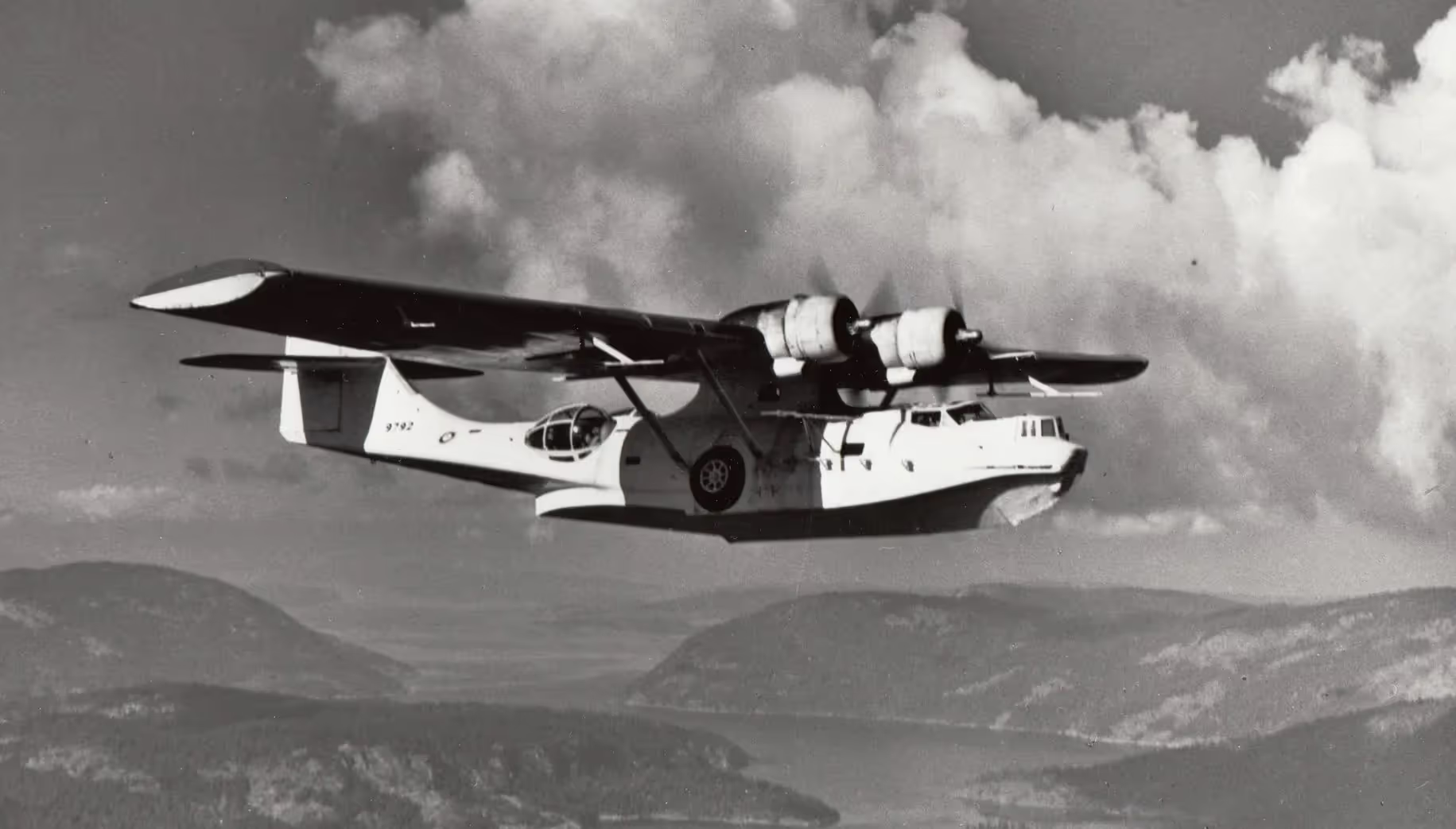
(Library and Archives Canada Photo, MIKAN No. 3388268)
Boeing Canada Canso A, RCAF (Serial No. 9792). With No. 7 (BR) Squadron at Prince Rupert, BC from 24 February 1944. Back to No. 3 OTU on 11 April 1944. Shown here with No. 3 OTU, RCAF, Patricia Bay, British Columbia, 3 May 1944.
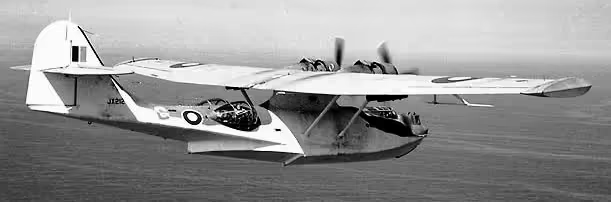
(RCAF Photo)
Consolidated Aircraft (San Diego) Catalina Mk. IV, RCAF (Serial No. JX212), coded G. To Western Air Command on 14 January 1944, for use by No. 7 (BR) Squadron at RCAF Station Alliford Bay, BC. Shown here with No. 117 (BR) Squadron, on patrol.
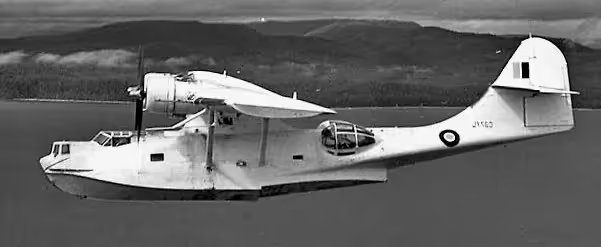
(RCAF Photo)
Consolidated Aircraft (San Diego) Catalina Mk. IV, RCAF (Serial No. JX580) in flight. To Western Air Command on 12 October 1943, for use by No. 7 (BR) Squadron at Alliford Bay, BC. With No. 3 Operational Training Unit at RCAF Station Patricia Bay, BC by 15 December 1944.
No. 9 (BR) Squadron, Bella Bella, British Columbia. Authorized as No. 9 (General Reconnaissance) Squadron’ on 1 April 1938. Redesignated ‘No. 9 (Bomber Reconnaissance) Squadron’ 8 December 1941. The squadron served primarily in an anti-submarine role with Western Air Command. The squadron flew the Canadian Vickers Stranraer, Consolidated Catalina, and the Boeing Canada Canso before disbanding on 1 September 1944.
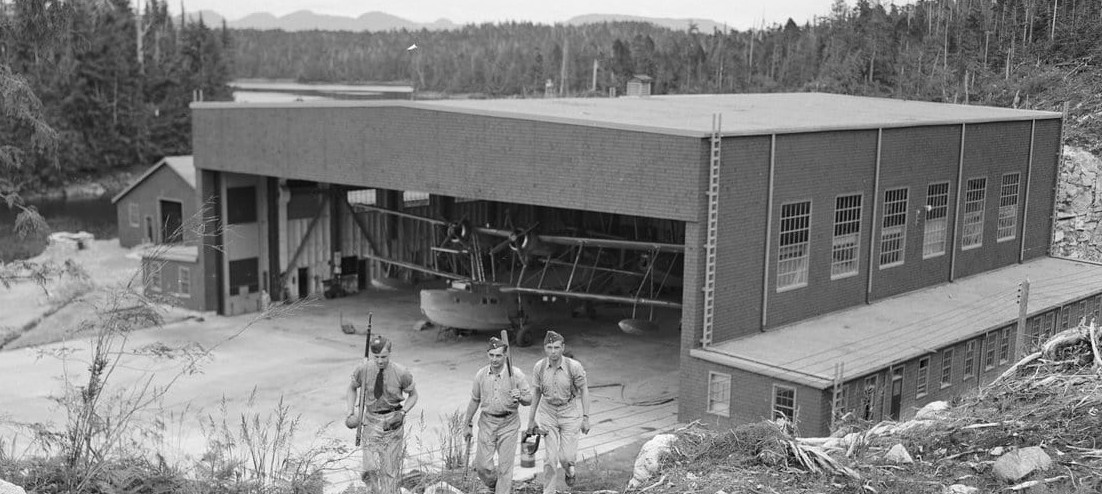
(DND Photo, PL-9575)
Canadian Vickers Stranraer in a hangar at Bella Bella, BC. (Left to right): LAC W.E. Colley, LAC S.F. McLeod, LAC J.J. Knelson, Dundurn, 20 July 1942.
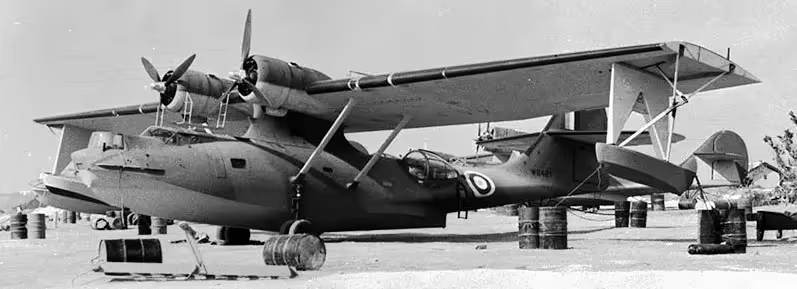
(Library and Archives Canada Photo, MIKAN No. 3545899)
Consolidated Aircraft (San Diego) Catalina Mk. I, RAF (Serial No. W8432), on beaching gear. This aircraft did not go to the UK for the RAF, and remained in North American where it served with the RCAF. Operated by No. 9 (BR) Squadron, RCAF Station Bella Bella, BC, in 1944. Crashed near Bella Bella at the end of a patrol on 8 June 1944.
RCAF Wings, Detached Operations, Alaska.
The men of the Home War Establishment (HWE) did not expect they would ever fight beyond Canada’s borders. Yet, this happened in 1942: the Pacific crisis was then at its peak; the U.S. fearing an attack on the northernmost point of the Pacific coast enlisted Canada’s help in agreement with the mutual assistance treaty ratified by the Canada-U.S. Permanent Joint Board on Defence. The RCAF, well aware of its weaknesses in the Prince-Rupert area, agreed to post No 115 (Fighter) Squadron to the U.S. air base on Annette Island, Alaska, some 100 km north of Prince Rupert.
The Allies’ fears materialized on 5 May 1942, when U.S. intelligence intercepted wireless communications revealing that a Japanese naval attack against Midway was imminent, to be coupled with an assault on the Aleutian Islands in Alaska. Despite its defeat at Midway on 4 June 1942, Japan went on with the Aleutian operation on 6 and 7 June 1942, and Vice-Admiral Boshiro Hosogaya captured Kiska and Attu islands.
At that time, two additional RCAF squadrons, No 8 (Bomber-Reconnaissance) and No 111 (Fighter) were already on their way to support the U.S. Air Force. Transiting by Annette Island, then by Juneau and Yukutat, they landed at Fort Richardson near Anchorage, on June 8th.. Meanwhile No 118 (Fighter) Squadron left Dartmouth, Nova Scotia, and flying clear across North America reached Annette Island. Canadians soon realized how dangerous flying such long distances between air bases could be, and how unpredictable was the foggy and stormy weather under those latitudes.
In August the Bolingbrokes of No 8 Squadron and the Curtis Kittyhawks of No. 111 (F) Squadron were transferred to Nome and Umnak islands. On 25 Sep, the U.S. and RCAF attacked, Squadron Leader K.A. Boomer commanding No. 111 (F) Squadron. They bombed the Japanese installations on Kiska and strafed the fleet. The Japanese had only two fighter planes in flying condition, Rufe fighters (Zero’s converted into floatplanes). Both took part in the response and, during the skirmish that ensued, Boomer shot down one of the Rufes, the only Second World War kill ascribed to the HWE.
Despite those raids, Kiska and Attu remained under Japanese control. On account of the bad and increasingly cold weather, no attempts to retake the islands were made before the following year. The Canadian squadrons, therefore, had to remain on those remote Alaskan bases to take part in patrols and defence operations. On 11 May 1943, the 7th Division (U.S.) finally drove the Japanese from Attu. A joint task force made up of the 7th Division (U.S.) and the 13th Infantry Brigade (Canadian) launched an attack on Kiska on 13 August. They found a deserted island: the enemy having already fled under cover of the fog. (Juno Beach Centre)
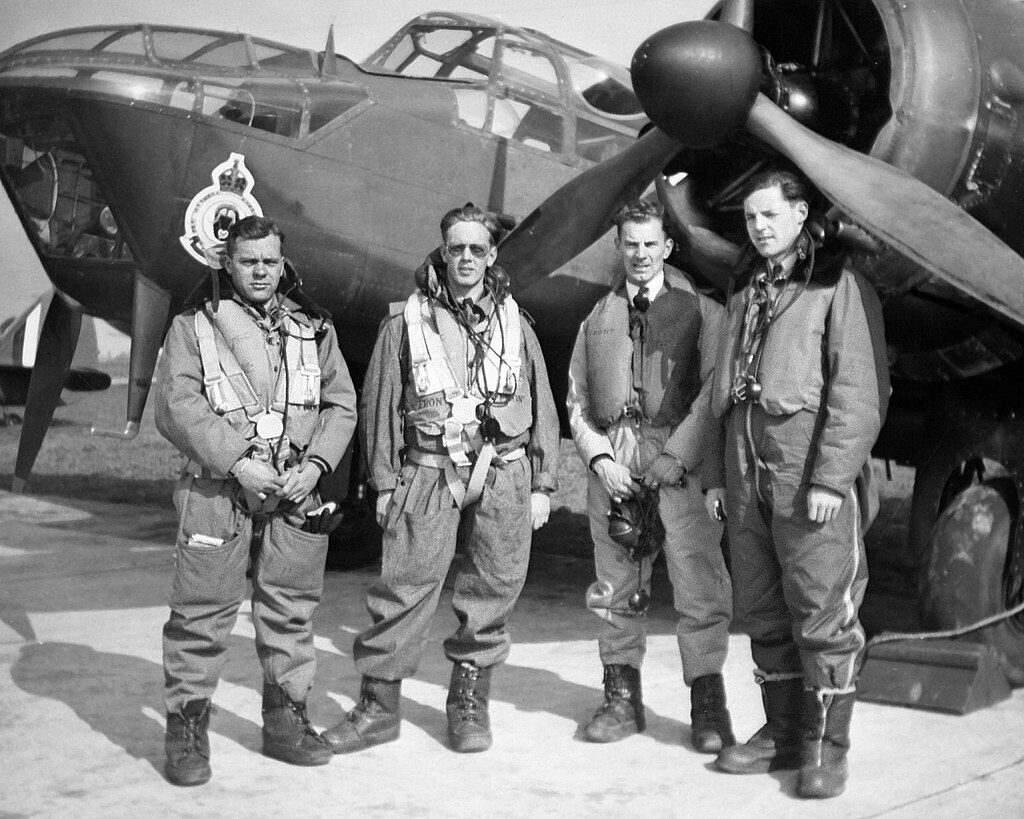
No. 8 (GR) Squadron was formed on the 14 February 1936 as a General Purpose (GP) squadron at Winnipeg, Manitoba. The squadron moved to Ottawa/Rockcliffe Airport in February 1937, where it was tasked as a photographic unit, equipped with Fairchild 71, Bellanca Pacemaker and Canadian Vickers Vedette. Mobilized on the 10 September 1939 as No. 8 (GR) Squadron at Sydney, Nova Scotia, It was redesignated Bomber Reconnaissance (BR) at the end of October 1939. Equipped with Northrop Deltas and Bristol Bolingbrokes, the squadron was tasked with anti-submarine duty while serving with RCAF Eastern Air Command. In December 1941, after the Japanese attack on Pearl Harbor the squadron was moved to RCAF Station Sea Island on the west coast of Canada as part of RCAF Western Air Command. In June 1942 in response to the Japanese attack on the Aleutians, it was moved to Alaska flying the Bristol Bolingbroke V as part of RCAF X Wing, operating from Elmendorf Army Airfield (Anchorage), with small detachments stationed at Naval Air Station Kodiak and Marks Air Force Base (Nome). The squadron returned to RCAF Station Sea Island in March 1943. Having converted to Lockheed Ventura GR.V in May 1943, the squadron continued with anti-submarine duty based from RCAF Station Port Hardy and RCAF Station Patricia Bay. No. 8 Squadron was disbanded at Patricia Bay, B.C. 25 May 1945. (Wikipedia)
(RCAF Photo, PMR79-781)
Aircrew with their Fairchild Bolingbroke, No. 8 (BR) Squadron RCAF, probably in Alaska, 1942. Left to Right: Flight Sergeant G.A. Anderson (Wireless Air Gunner), J.M. McArthur (Pilot), W.J. Smith (Pilot), Flight Sergeant F.W. Johnston (Wireless Air Gunner).
(RCAF Photo, PMR79-781)
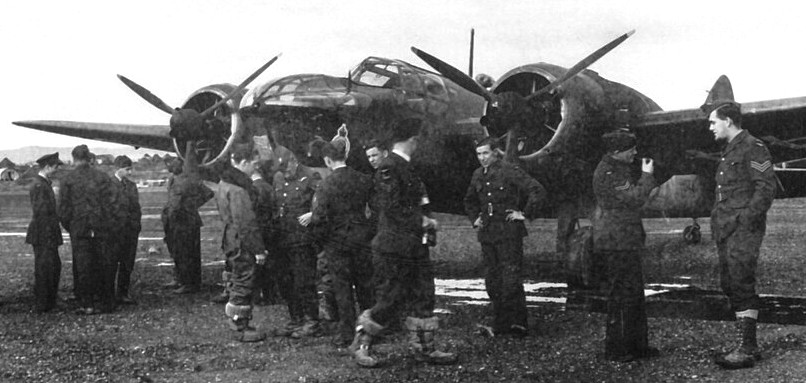
No. 8 (BR) Squadron RCAF personnel with their Fairchild Bolingbroke, Alaska, 1942.
No. 14 Squadron RCAF. The squadron moved to Alaska and participated on strafing and bombing missions against then-Japanese held Kiska during the Aleutian Islands Campaign.
No. 111 (CAC) Squadron (Reserve), Sea Island, British Columbia. Avro 621 Tutor, and Avro 626 Prefect. 31 October 1939, re-designated Bomber Reconnaissance (BR). No. 111 (F) Squadron, Kodiak, Alaska, USA. Curtis Kittyhawk Mk. I.
(Library & Archives Canada Photo, MIKAN No. 3211090)
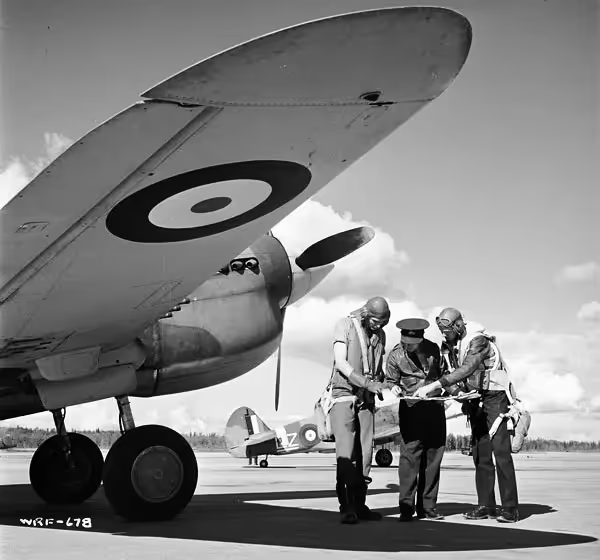
Curtis P-40 Kittyhawk Mk. I, RCAF No. 111 (F) Squadron pilots, Sep 1942.
The squadron was authorized in Vancouver on 5 October 1932 as No. 11 (Army Co-Operation) Squadron, an auxiliary squadron of the Royal Canadian Air Force. It received its first aircraft, four de Havilland DH.60M Gipsy Moths, settling down to a routine of flying training at the weekends, with an annual summer camp. In 1935, it received a single Fleet Fawn trainer, equipped for blind-flying training, and in 1937, received two Avro Tutors.[8] The squadron was redesignated No. 111 (Coast Artillery Co-Operation) Squadron on 15 November 1937, with the duty of spotting for coastal defence artillery, although any operational training was still geared to the army-cooperation role. In March 1938, a single Avro 626 replaced one of the squadron’s Gipsy Moths, allowing the squadron to carry out more realistic training, and in August that year, it received a single de Havilland Tiger Moth, with the squadron’s two remaining Gipsy Moths withdrawn in June 1939.
At the outbreak of the Second World War the squadron formed a detachment at Patricia Bay on Vancouver Island, now Victoria International, before being redesignated No. 111 (Fighter) Squadron on 1 July 1940. At this time the squadron flew the Westland Lysander as no modern fighter aircraft were available. It was disbanded on 1 February 1941 and then reformed on 3 November 1941 flying the Curtis Kittyhawk.[1][9] The squadron and took part in air defence operations in Western Canada and the Aleutian Islands Campaign under RCAF Western Air Command.[9] The squadron had the distinction of shooting down the only Japanese fighter by the RCAF home air force during the war. From the new American base in Umnak, Alaska, flying the Curtis P-40K from American stock, 111 Squadron took part in several raids against the Japanese base at Kiska. On 26 September 1942 the Commanding Officer, Squadron Leader K A Boomer, shot down an intercepting Nakajima A6M2-N Rufe fighter while leading four Canadian-manned P-40s involved in flak suppression.
After the squadron moved to RAF Ayr where it was redesignated No. 440 (Fighter Bomber) Squadron on 8 February 1944 as an Article XV squadron under the control of the British Royal Air Force.[12] It was the third Canadian Typhoon equipped squadron of 143 Wing. The squadron was equipped with the Hawker Hurricane for working up but changed to the Hawker Typhoon once they were delivered. (Wikipedia)
(DND Photo)
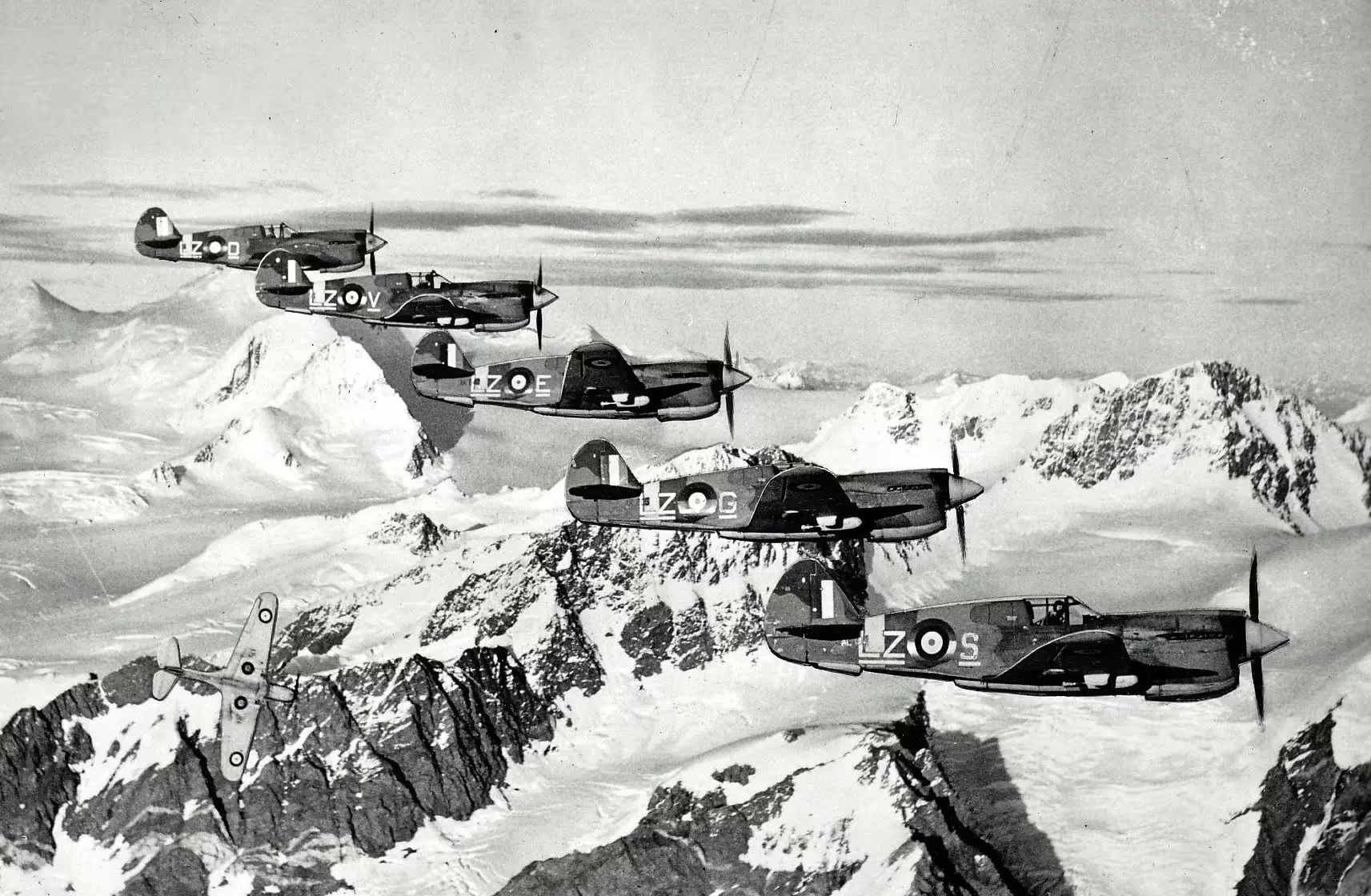
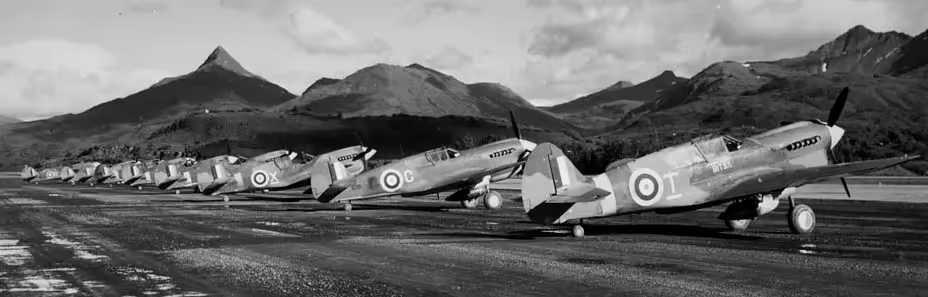
RCAF Curtiss Kittyhawk formation including (Serial No. AZ138) coded LZ-S, and LZ-G, LZ-E, LZ-V and (Serial No. AL166), coded LZ-O, No. 111 (F) Squadron over the Rockies, ca 1942.
(Library & Archives Canada Photo, MIKAN No. 4332918)
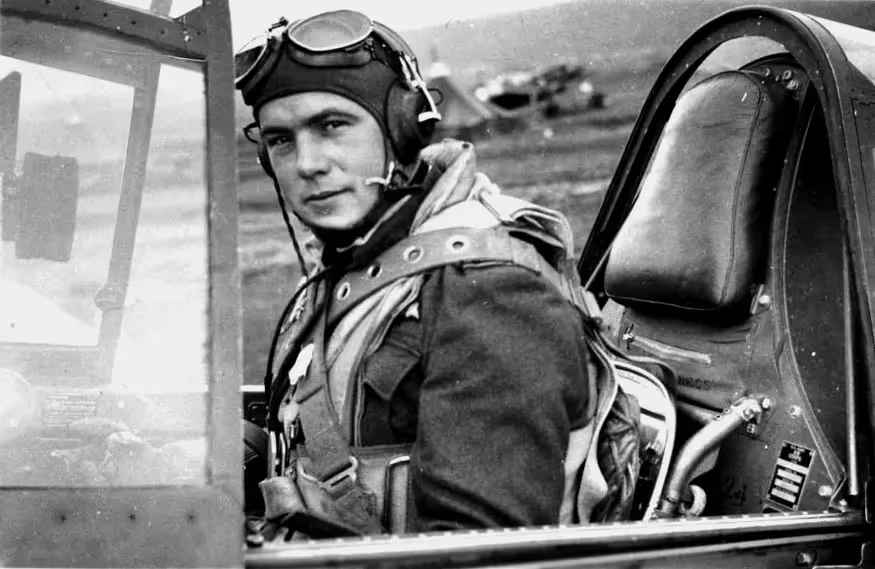
Curtiss P-40 Kittyhawk, RCAF No. 111 Sqn, SL Kenneth Boomer, DFC, KIA 2 Oct 1944.
(Library & Archives Canada Photo, MIKAN No. 4105388/National Defence Image Library, PMR 80-197).
Curtiss P-40E Kittyhawks, No. 111 (F) Sqn, RCAF, Kodiak Island, Alaska, spring 1943. The aircraft marked “BITSA” (Built In Time To Save Alaska) is reported to have been flown by SL K.A. Boomer when he shot down a Japanese Rufe, 25 Sep 1942. BITSA was” pranged” on final approach at Nak Nek 75 miles West of Lake Illiamna in July 1942 on a re-location flight from Elmendorf to Umnak, Island. For operations, the RCAF utilized the P-40K for the “Kiska Strike” on 25 Sep 1942 and onward until operations ceased in August 1943. (Eva Forbes)
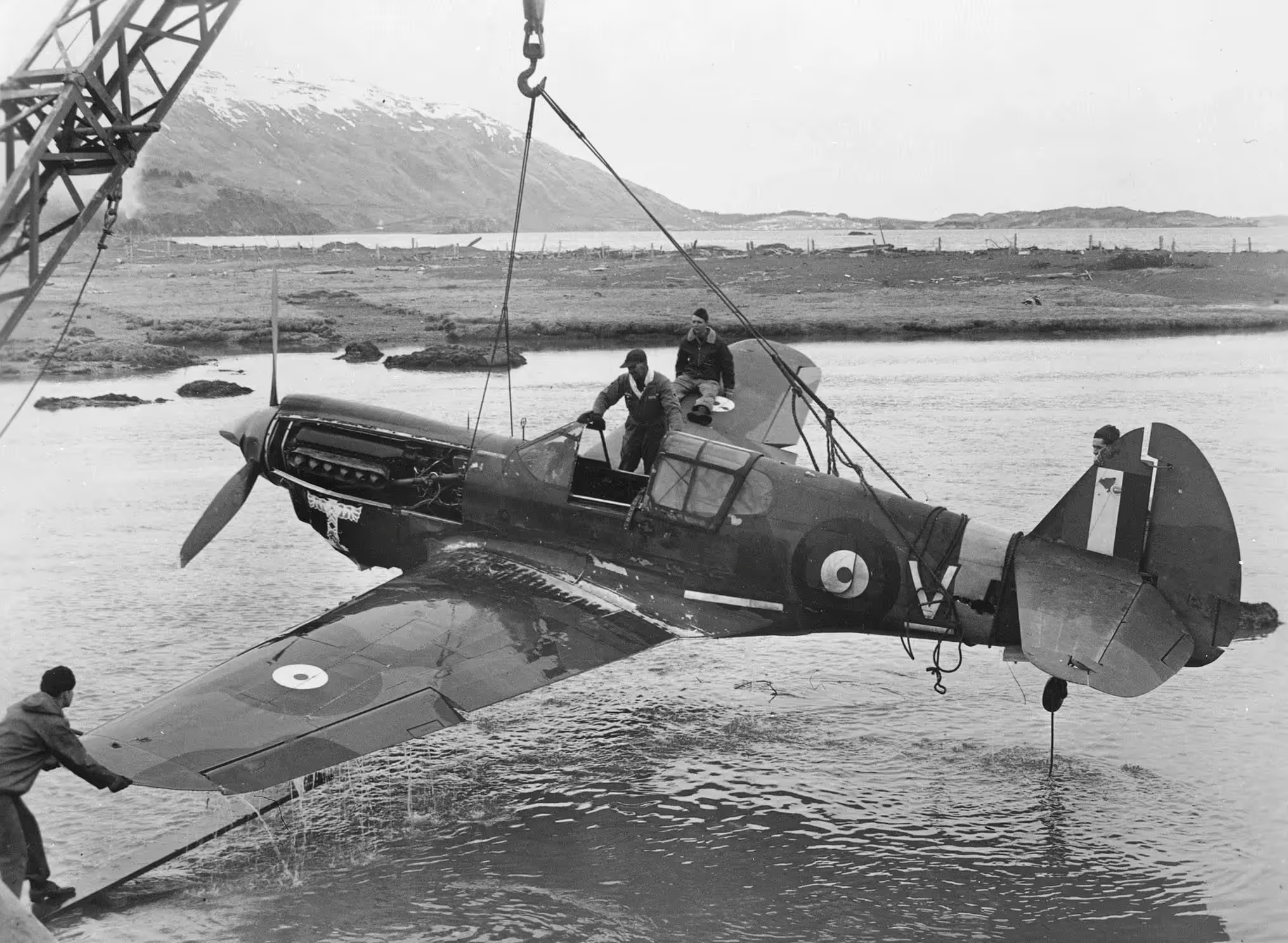
(RCAF Photo)
Curtiss P-40E Kittyhawk RAF (Serial No. AL194), RCAF (Serial No. 1087), coded LZ-V, No. 111 (F) Sqn, being recovered from the water at Fort Greely, Kodiak Island, Alaska, 19 Apr 1943. The pilot was R104777 WO2 S. R. J. McLeod. He was doing a test flight checking the engine, when the electrical system failed. He carried out a flapless landing and ended up dropping over the edge of the runway and into five feet of water. Co-incidentally, he also had another accident with the same aircraft on the 18th of September, 1942 at Elmendorf Field. (Chris Charland)
“Y” Wing. HQ Annette Island, Alaska.
No. 115 (BR) Squadron
No. 115 Squadron flew anti-submarine patrols along the coasts of British Columbia and Southeast Alaska as part of Western Air Command.
On 7 July 1942, Flight Sergeant PMG W. E. Thomas and the crew of Fairchild Bolingbroke maritime patrol aircraft No. 9118 sighted a target breaking the surface and emitting white “smoke” in the Pacific Ocean 130 kilometres (70 nmi; 81 mi) northwest of the Queen Charlotte Islands. At first thinking it was a whale, they quickly concluded that they could see the underwater silhouette of submarine at least 100 feet (30 m) in length and attacked, dropping a single 250-pound (113 kg) or 500-pound (227 kg) (sources disagree) bomb from an altitude of 500 feet (152 m) which landed just forward of the submarine’s conning tower. They claimed to have damaged the submarine. Based on the Bolingbroke’s report, the United States Coast Guard cutter USCGC McLane (WSC-146), the U.S. Coast Guard-manned United States Navy patrol vessel USS YP-251, and the Royal Canadian Navy minesweeper HMCS Quatsino proceeded to the area on 9 July 1942 and began a search for the submarine, which McLane and YP-251 claimed to sink later that day. The Bolingbroke crew shared credit with McLane and YP-251 for the sinking, and in 1947 the Joint Army-Navy Assessment Committee identified their victim as the Imperial Japanese Navy submarine Ro-32. In 1967, however, the U.S. Navy retracted this assessment because Ro-32 had been inactive in Japan at the time of the sinking and was found afloat in Japan at the end of the war. The submarine reportedly sunk on 9 July 1942 remains unidentified. No. 115 Squadron disbanded at Tolfino, British Columbia, on 23 August 1944. The squadron flew Fairchild Bolingbroke Mk. IV and Lockheed Ventura GRV.
One hypothesis about the identity of the submarine sunk on 9 July 1942 is that she was the Soviet Navy submarine Shch-138, which the Soviet Navy reported missing on 10 July 1942, the day following the sinking. The Soviet Union later claimed that Shch-138 sank in the harbor at Nikolayevsk-on-Amur on the Amur River in the Soviet Union on 18 July 1942 after the explosion of four of her torpedoes, was refloated immediately, sank again the following the day during a storm while under tow, and finally was refloated a second time on 11 July 1943 and scrapped. A photograph of the submarine reportedly taken by the crew of the Bolingbroke involved in her sinking purportedly shows a gray submarine — submarines of the Soviet Pacific Ocean Fleet were painted gray during World War II, while Japanese submarines were black — and the number “8” among characters painted on her conning tower, consistent with the markings on Shch-138′s conning tower. Some researchers have suggested that the Soviet narrative of Shch-138′s loss at Nikolayevsk-on-Amur may be intended to cover up Shch-138′s loss while clandestinely collecting information along the coast of the United States and Canada. (See Bruhn, p. 128, and Coyle.)
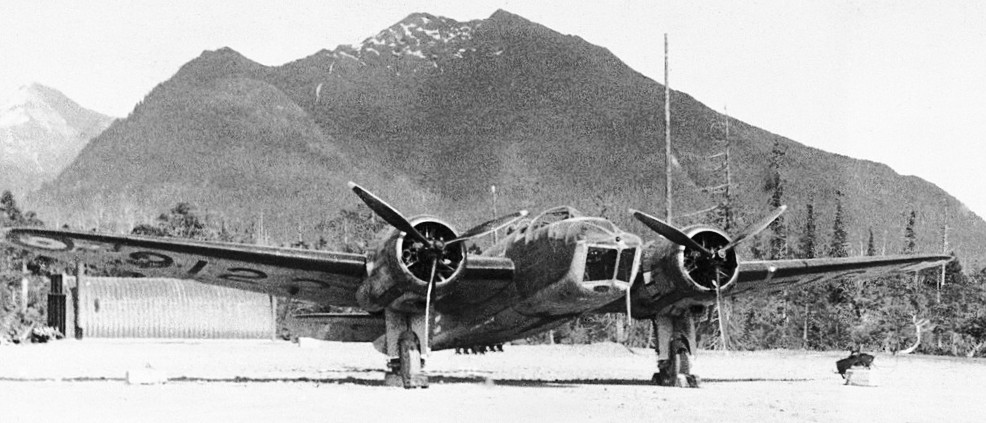
(RCAF Photo)
Commanding Officer’s Fairchild Bolingbrok of No. 115 (BR) Squadron, Annette Island, Alaska, Feb 1943. The Bolingbroke is in a dispersal area by the Administration Building. The mountains are to the East.
No. 118 (F) Squadron
On 1 September 1934 that the unit was authorized in Montreal, Quebec as No. 18 Bomber Squadron (Auxiliary). Following the recruitment and training of the cadre personnel forming the basic structure of the Squadron, flight training operations began in May 1936 from St-Hubert on the south shore of Montreal following the reception of the first two of four de Havilland DH.60 Moths. Squadron leader Marcel Dubuc, a veteran pilot with recognized qualities, was appointed its first commanding officer in May 1936. The unit was renumbered No. 118 (Bomber) Squadron on November 17, 1937 as part of a restructuring of RCAF squadrons. Two additional aircraft arrived in 1938 and the size of the squadron was increased to 114 members.
The unit was redesignated No.118 (Coast Artillery Co-operation) Squadron on 1 September 1939, activated for voluntary wartime service on 3 September, and moved to Saint John, New Brunswick on 28 October. 17 (Aux) Sqn from St-John N.B. was simultaneously absorbed into the unit along with personnel transferred in from No. 2 (AC) Sqn with their Atlas aircraft. These reinforcements formed a new A flight that would operate out of Halifax airport[6] until 31 March 1940 when they moved to RCAF Station Dartmouth.
The squadron was reequipped with Westland Lysanders and Blackburn Sharks better suited to this new role which consisted of patrolling the coast for enemy naval activity and directing coastal artillery batteries when/if required. Westland Wapiti aircraft borrowed from No.10 (B) Sqn were also used for a few months until more Atlases became available.
After nearly a year of coastal sweeps, the occasional patrol for convoys close inshore, dive-bombing exercises with army batteries and naval anti-aircraft gunners, air gunnery training and aerial photographic duties, the squadron was temporarily deactivated on 27 September 1940 pending redesignation and the arrival of more modern aircraft. The squadron was reactivated at Rockliffe, Ontario on 13 January 1941 with the new designation No.118 (Fighter) Squadron[2] and reequipped with the Grumman Goblin, an American biplane design which were licence built in Canada by Canadian Car and Foundry. The unit moved to Dartmouth, Nova Scotia in July being at that time, the sole fighter squadron available for East Coast defence. In October 1941 the more capable Curtiss Kittyhawk replaced the obsolete Goblin.
The RCAF was facing a serious shortage of frontline fighters, having sent its Hawker Hurricanes off to the UK with No. 1 (F) Squadron, it was having a hard time procuring additional fighters to meet its needs. For these reasons, 50 Canadian built Sea Hurricanes destined for the British Royal Navy were retained in Canada. All were placed on strength of 118 Sqn in November 1941.
These brand new fighters were test flown by 118 squadron pilots upon arrival or reassembly. Many were put in temporary storage, the few others still leaving with the RAF were also test flown by 118 pilots prior to fitting to catapult equipped merchant vessels. 118 Sqn formed a “Hurricane Flight” and more than a dozen were regularly flown by squadron personnel. No. 118 Squadeon was operating a full complement of Kittyhawks, Sea Hurricanes, and a few Harvards, and was still flying its Goblins well into January 1942. These catapult spool and arrestor hook equipped Sea Hurricanes were painted in the British Fleet Air Arm paint scheme of dark greys with ‘Royal Navy’ painted on the fuselage, looking oddly out of place on an RCAF ramp. On 27 April 1942, the Sea Hurricanes, many of which with their naval modifications now removed, along with many 118 Sqn personnel from the “Hurricane Flight” formed the nucleus of the newly formed 126 (F) Sqn also at Dartmouth. This new unit would be temporarily under the command of Flight Lieutenant Arthur Yuile who had previously been in charge of the flight. On January 16, 1942, when two 118 Squadron Kittyhawks spotted and attacked a surfaced German U-boat approximately 10 miles off the coast between Halifax and Sydney. Flying Officer W.P. Roberts in Kittyhawk AK851 was able to fire six bursts and obtain a number of hits around the conning tower before the submarine dove underwater and disappeared from sight.
The squadron code displayed on all unit aircraft was “RE” from January 1941 to May 1942 when it changed to “VW”.
With the entry of the United States into the war following the Japanese attack on Pearl Harbor, the Canadian Government of Prime Minister Mackenzie King offered military naval and air support to the then limited American capabilities facing Japanese expansion in the Aleutian Islands.[8] Two fighter and light bomber wings were formed for service on the Pacific coast, X and Y Wings composed of Kittyhawk fighters and Fairchild Bolingbroke light bombers under the RCAF Western Air Command. 118 Sqn and 115 Squadron formed Y Wing. For the historic cross-continent flight of 4,000 miles, 118 was led by Flight Lieutenant Yuile. Squadron Leader Hartland Molson, 118 Squadron’s commanding officer and a veteran Hurricane pilot of the Battle of Britain, remained in Dartmouth to assume command of 126 (F) Squadron.
The squadron left Dartmouth on the morning of 6 June 1942 for Annette Island, Alaska. The squadron made refuelling stops at Penfield Ridge, New Brunswick, Saint-Hubert, Quebec, North Bay, Ontario, Porquis Junction, Ontario, Winnipeg, Manitoba, Saskatoon, Saskatchewan, Edmonton, Alberta, and Prince George, British Columbia. They arrived on 21 June; A Flight was armed and refuelled ready for action within 15 minutes of landing. The squadron moved to Sea Island British Columbia on 20 August 1943 and would remain there until ordered overseas. Five pilots died in non-combat-related crashes during this period of home defence. (Wikipedia)
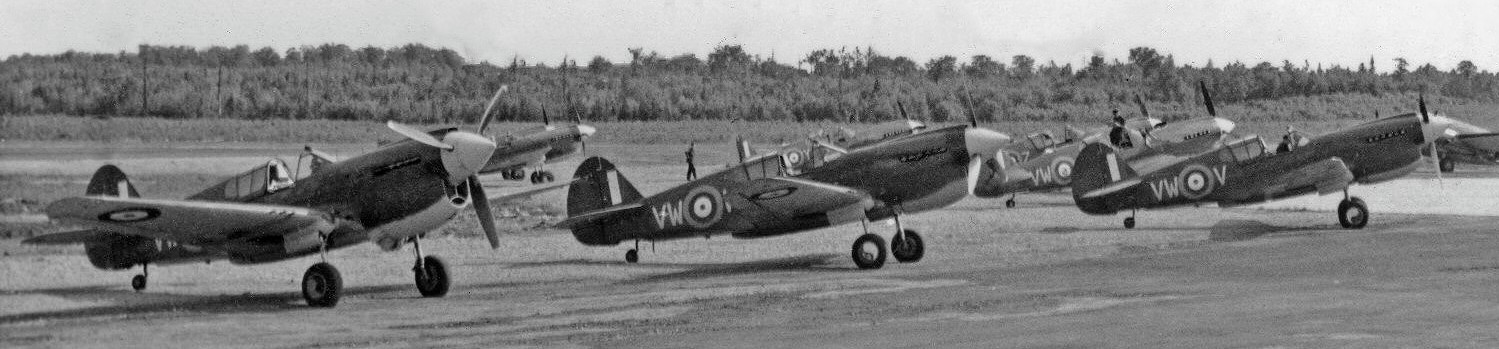
(No. 438 Squadron Archives Photo)
No. 118 (F) Squadron RCAF, Curtis Kittyhawks, Annette Island Alaska, 1942.
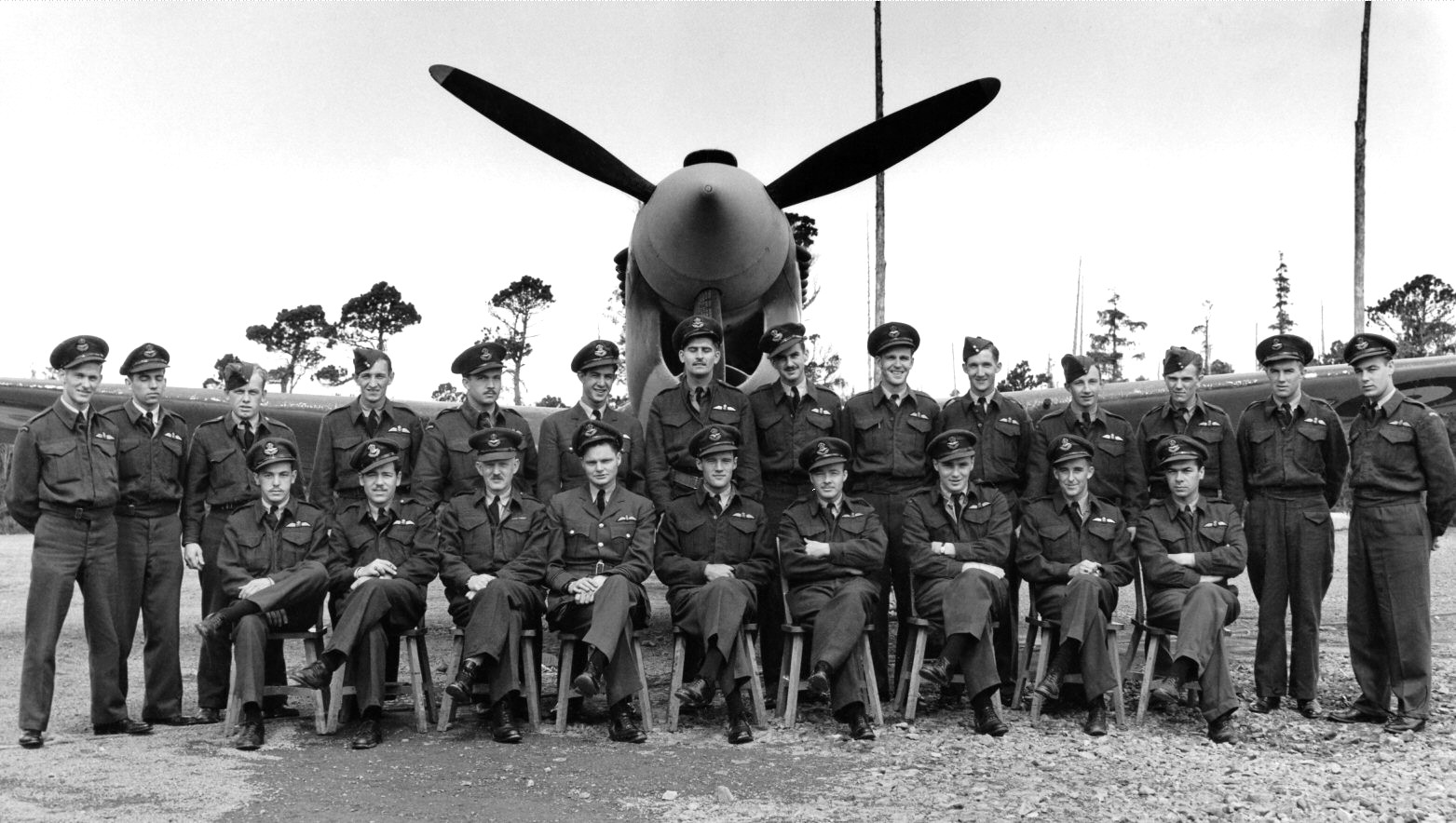
No. 118 (F) Squadron pilots in front of a Curtis Kittyhawk, Sea Island B.C. 1943.
Leaving their Kittyhawks behind, the 142 strong squadron crossed Canada by rail embarking on 2 November 1943 in Halifax for the sea voyage to the United Kingdom. The squadron was once again redesignated, this time as No.438 (Fighter Bomber) Squadron upon arriving at Royal Air Force Station Digby, Lincolnshire on 18 November. RCAF squadrons were renumbered between 400 and 449 to avoid confusion with other British Empire units also operating from the United Kingdom.
Other RCAF Squadrons in British Columbia during the war
RCAF Patrol activity was joined by the Operational Training Schools (OTS) operated by No. 4 Training Command of the BCATP. They were the No. 3 OTS flying the Canso and Catalina and No. 32 OTS with Ansons, Beauforts and Swordfish at Patricia Bay. In April, 1944 the No. 5 OTS Heavy Conversion unit stood up at Boundary Bay when 16 B-24 Liberators arrived fresh from American factories. By the end of September 1944, RCAF No. 5 OTU had grown to a sizeable force of some 87 aircraft including 38 B-24 Liberators, 35 B-25 Mitchells, 5 Bolingbrokes, 8 Kittyhawks and a single Norseman.
No. 3 Operational Training School (OTS)
No. 32 Operational Training School (OTS)
32 OTU was formed at West Kirby, Liverpool, the personnel then moved by ship to Patricia Bay, British Columbia, as part of No. 4 Training Command. Tasked to train general reconnaissance crews, and the first Avro Ansons arrived in September 1941, and Bristol Beaufighters arrived in October 1942. With the start of the war in the Pacific, the unit was declared an operational squadron to protect the Canadian coast from Japanese raids and re-designated No. 32 Operational Squadron on 15 December 1941. After a few days mounting patrols, it became clear that the Japanese were unlikely to attack Canada, and it reverted to an Operational Training Unit on 29 December 1941. Re-designated No. 6 Operational Training Unit RCAF in June 1944.
No. 5 Operational Training School (OTS) Heavy Conversion Unit.
No. 5 Operational Training Unit (OTU). Formed 1 April 1944 at Boundary Bay, British Columbia. Disbanded 31 October 1945.
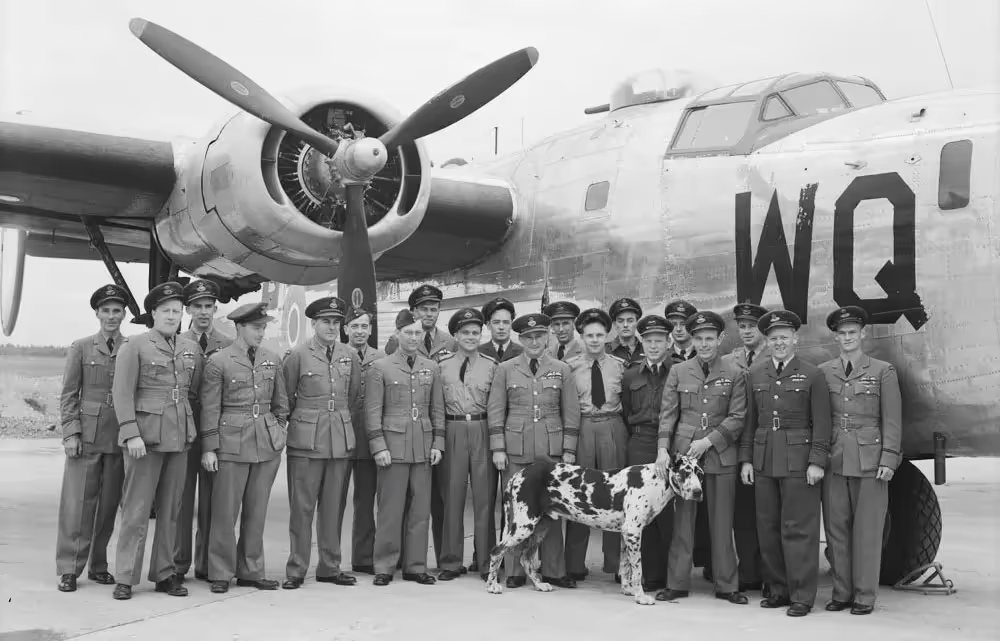
(Library and Archives Canada Photo, MIKAN No. 3602845)
Consolidated Liberator G.R. Mk. VI, coded WQ, No. 5 Operational Training Unit (OTU) Abbotsford, British Columbia, flying instructors with “King”, the Station mascot, a 29 May 1945.
From the Station Diary: “May 29/45 Weather very good. The programme of flying consisted of local day, dual fighter affiliation, night bombing, day and night cross country exercises, for a total of 94:40 hours. Take-offs – 69 and landings – 68. Liberator ‘WQ’ made an emergency landing without mishap. 40 bombs were dropped during practice. Skeet shooting and revolver firing was held on the Range. The Senior Equipment Officer, F/L Anstead, is on Temporary Duty at Western Air Command to discuss plans and organization for the forthcoming conversion from Liberators to Lancasters.” “signed, Wing Commander D. J. Williams Officer Commanding 5 Operational Training Unit, Abbotsford Detachment. (Abbotsford FB page via B.E. Thistle)
(Library and Archives Canada Photo, MIKAN No. 3199204)
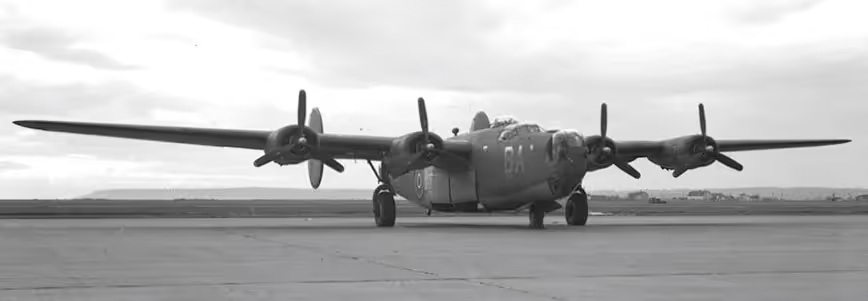
Consolidated Liberator B Mk. VI (Serial No. KH285), coded BA, 5 OTU, RCAF Station Boundary Bay, British Columbia, 28 Dec 1944. This is one of the 59 B-24 J (B Mk. VI) that were taken on strength by 5 OTU. This one is seen here at Boundary Bay but was also used by the Detachment at Abbotsford.
(Library and Archives Canada Photo, MIKAN No. 3523319)
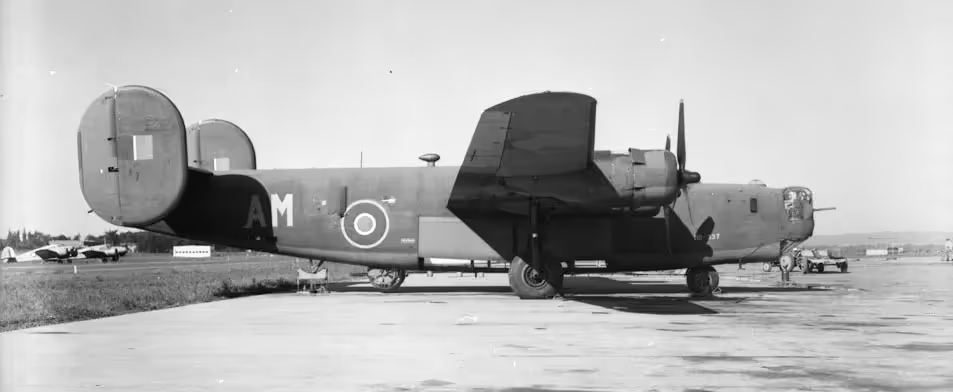
Consolidated Liberator G.R. Mk. VI, RCAF (Serial No. KG923), coded AM, No. 5 Operational Training Unit (OTU), 23 Aug 1944. No. 5 OTU was a satellite detachment of No. 5 OTU Boundary Bay, British Columbia. No. 5 took over the facilities at RCAF Station Abbotsford, BC, on 15 Aug 1944, and began to train aircrew on the B-24 Liberator. The aircrews trained in Abbotsford on the B-24 were largely RAF, veterans of the Allied air war, and were intended to serve in the RAF’s air offensive in Southeast Asia. No. 5 OTU Boundary Bay ceased operations on 31 Oct 1945.
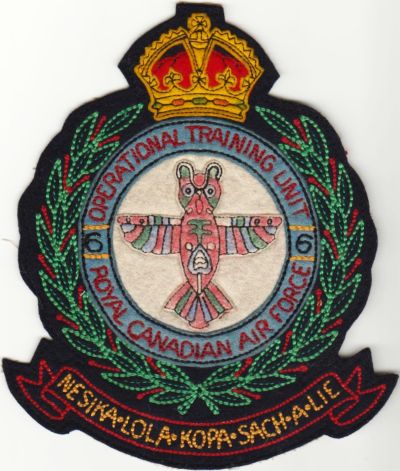
No. 6 Operational Training Unit (OTU). 25 May 1944. Moved to Comox, British Columbia. 1 June 1944. Re-designated No. 6 (RCAF) OTU. 15 January 1946. Moved to Greenwood, Nova Scotia. 31 March 1946. Disbanded.
No. 11 (BR) Squadron, Patricia Bay, British Columbia. Consolidated Liberator Mk. III and Consolidated Liberator Mk. 15 Sep 1945, disbanded.
(Library and Archives Canada Photo, MIKAN No. 3650493)
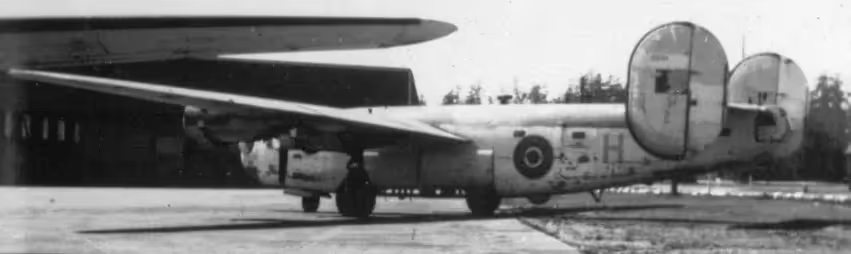
Consolidated Liberator G.R. Mk. VI, coded H, formerly of No. 11 (Bomber Reconnaissance) Squadron, RCAF, Patricia Bay, BC, 1945.
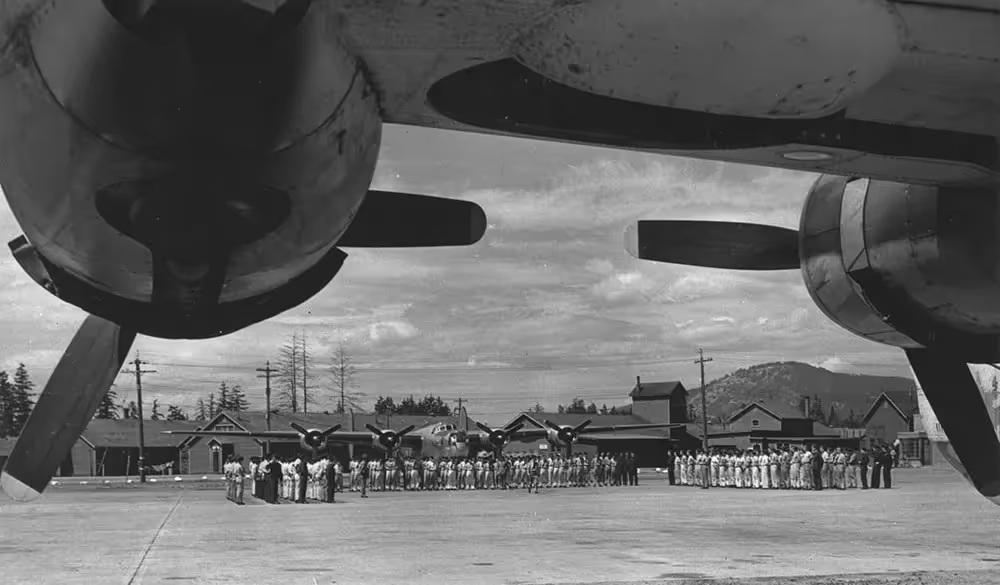
(Library and Archives Canada Photo, MIKAN No. 11507). Note, different photo, duplicate MIKAN No.
Consolidated Liberator memorial service, RCAF Station Patricia Bay, British Columbia, 1945.
No. 14 (F) Squadron, Sea Island, British Columbia. Curtis Kittyhawk Mk. I.
No. 112 (AC) Squadron (Reserve), Winnipeg, Manitoba. Avro 626 Prefect. May/June 1940, sent to England.
No. 113 (F) Squadron (Reserve), Calgary, Alberta. No aircraft. 30 Sep 1939, disbanded.
No. 166 (Communications) Squadron, Sea Island, British Columbia. Various aircraft. 10 Sep 1945, disbanded.
RAF, USAAF and RCAF Stations in British Columbia during the Second World War
RCAF Station Abbotsford
The RCAF purchased the land to build Abbotsford Airport in 1940. In 1943 the construction of the three 1,555 m × 60 m (5,100 ft × 200 ft) runways based on a triangular layout was complete. The same year, under the British Commonwealth Air Training Plan, the No. 24 Elementary Flying Training School started operations from this location until 1944. The No 5 Operational Conversion Unit was split between Abbotsford and Boundary Bay Airport.
RCAF Station Alliford Bay
Western Air Command’s 1938 plan for the defence of the west coast called for an advanced bomber reconnaissance squadron on the Queen Charlotte Islands. The location for the seaplane base was decided upon as a result of the search carried on by the B.C. Recon-naissance Party in 1937. The site chosen was Alliford Bay which was located in Skidegate Inlet opposite Queen Charlotte City. RCAF Stn Alliford Bay had the distinction of being the most westerly and the most isolated of all the West Coast Flying Boat Stations but having the reputation of being the happiest, most colourful and most self-contained station.
Construction at this base had begun in 1938 but as the war clouds gathered construction was speeded up and continued through 1939. On the outbreak of war a detachment was dispatched at once to protect this base from possible damage or capture. On 27 April 1940, No.6 (BR) Squadron, stationed at Jericho Beach, Vancouver, received orders to move to its war station at Alliford Bay. The move began on 13 May 1940. The Shark aircraft on the strength of the squadron flew to the new base and the personnel were transported by H.M.C.S. “Sans Peur” and coastal steamer.
On 26 June 1940 the Irish Fusiliers took over the duty of ground defence for the seaplane base and thereafter the rotation continued semi-annually. On February 19, 1941 the Rocky Mountain Rangers arrived to relieve the Irish Fusiliers in the defence of the station. They were in turn relieved On 29 July 1941 by the 2nd Battalion, Canadian Scottish. On the 3rd March 1942, the Edmonton Fusiliers replaced the Canadian Scottish for aerodrome defence duties and so on until the end of the war.
The first operational flight was carried out on 30 May 1940 when F/L Gill in Shark 524 made a reconnaissance flight around the north end of the Queen Charlotte Islands. On several occasions the squadron was able to lend assistance to the inhabitants of the island by undertaking mercy flights or search missions. On 16 November 1942 W.A.C. ordered No. 6 (BR) Squadron to move to Bella Bella. The move was completed on 19 November. This was part of a plan to give practice to entire squadrons in mobility in case of emergency. No. 6 (BR) remained at Bella Bella until 3 December 1942 carrying out local operations. 9 (BR) Squadron from Bella Bella took over squadron duties at Alliford Bay.
During April 1943, the first Canso aircraft arrived. On 10 July 1943, two more Cansos were delivered to Alliford Bay which brought the aircraft attached to three Stranraers and three Cansos. Now it was possible for the station to carry out longer patrols and training that was more consistent with modern up-to-date operational requirements. This station was a very important one in the scheme of defence for Canada’s west coast. It was able to fulfil its service responsibility now that it had proper equipment. By March, 1944, there were 7 Cats, 2 Canso “A”s an1 Stranraer on strength.
On April 21, 1944 No. 6 (BR) Squadron received orders to begin a move to Coal Harbour on Holberg Inlet on the north end of Vancouver Island. The move was completed on April 23rd. 7 (BR) moved from Prince Rupert to Alliford Bay on 22 April 1944 to replace No. 6 as Prince Rupert was no longer an operational station. During their year at the Station the Squadron aircrews set several records. On 14 June 1944 a fisherman reported sighting with the aid of binoculars a sub surfaced off Zayas Island in Dixon Entrance. Four patrols were made from 0425 hrs.to 2300 hrs. Although the anti-sub equipment on one of the patrolling aircraft reacted once, the fog was too thick to make visual contact. One patrol lasted 18.10 hrs the longest one made in W.A.C.to that point then on June 24, a Canso completed a night patrol of 20 hours and 40 minutes – the longest patrol in Western Air Command records.
Number 7 (BR) Squadron completed its last mission on July 14, 1945. F/O Craddock and crew flew Canso A 10070 from Alliford Bay on an anti-submarine patrol. The Squadron was disbanded at Alliford Bay on July 24, 1945 and the Station was reduced to care and maintenance basis.
RCAF Station Bella Bella
The Royal Canadian Air Force determined quite early that the community of Bella Bella was strategic to its needs when flying along the British Columbia west coast. With war clouds on the horizon it established a detachment here in 1938. It was soon decided that the best location of the station would be on Denny Island adjacent to Klik-Tso-Atli Harbour with the station constructed behind Shearwater Island.
In June 1940 construction began on a full sized RCAF Station, which would include two full size flying boat hangars with ramps for beaching its aircraft as well as accommodations for up to 1,000 men, a hospital, administration and messing facilities. By November 1941 twenty-one buildings were ready for use. The Coast Construction Company of Vancouver accomplished the actual construction with considerable help from the local Heiltsuk native workers one of which was the future chief Vivian Wilson.
On 7 Dec 1941 the station received notification that a state of war existed with Japan after that country had attacked Pearl Harbor in the Hawaiian Islands. On December 8, 1941 Squadron Leader Fred. S. Carpenter arrived at the station with two Supermarine Stranraer flying boats from Patricia Bay at Victoria. Carpenter immediately assumed command of No 9 (BR) Bomber Reconnaissance Squadron.
Operational patrols commenced immediately with the two Stranraer flying boats #949 and #936 that responded to an alert that a Japanese submarine had been sighted north of Vancouver Island in Queen Charlotte Strait. On the aircrafts return they were both fueled to capacity from a tender, which carried 45-gallon drums. Aircraft patrols continued from the station day and night in most weather conditions searching for the nine enemy submarines that had been sinking vessels proceeding up and down the coast. By February 1942 the station personnel now numbered 455 airmen that made for crowding of the unfinished barrack buildings. The off duty airmen used their time efficiently by building the Santa Bella Trail from the RCAF station to the B.C Packers store and post office on the opposite side of Denny Island.
In December 1942 the station received its first Consolidated PBY-5A Canso aircraft, which would allow the 9BR Squadron to extend its patrols out over the Pacific for up to 28 hours. In April 1943 the station Commanding Officer S/L Galloway decided that a control tower was needed on Shearwater Island and ordered its construction but the tower operators found that the tops of the island’s trees obscured their view. Galloway responding by ordering his Armaments Officer to top the trees with machine gun fire which worked fine but an army detachment across the bay had to take cover as their position was peppered by the gunfire.
By the end of July 1944, the station’s strength, including army personnel, was 750. By this time the Japanese had suffered major defeats and the threat of an invasion on the west coast of North America had diminished. For economic reasons as well as the difficulty of supply for these remote stations a decision was made to disband No 9 (BR) Squadron and the station. RCAF Station Bella Bella was closed effective 1 Sep 1944. The last entry in the Station’s diary sums up the unsung heroism on the Bella Bella Station: “The reports of the presence of enemy craft in our waters are investigated thoroughly and, no matter how inaccurate the report may seem to be, the squadron personnel embark on the searches with enthusiasm and keenness. The fact that the West Coast stations saw little action is in part due to their unceasing vigilance. They made the waters of the Pacific adjacent to the coast a most unhealthy and unproductive locality for the enemy. Theirs was not a glamorous job. They received no applause from the people and none from the Service. They had a dirty, dangerous, monotonous job to do and they did it. That was their reward”
RCAF Station Boundary Bay
After the British Commonwealth Air Training Plan came into effect in 1939, the Royal Canadian Air Force began looking for locations at which to train aircrew for the Second World War. Boundary Bay was one location that was selected, and in 1940, land from three farms was appropriated for an airport. Construction proceeded slowly as boggy areas had to be filled with hay and gravel, but gravel roads and runways were in place for the airfield’s opening on 10 April 1941. No. 18 Elementary Flying Training School (No. 18 EFTS) was the first unit established at the newly created Royal Canadian Air Force Station Boundary Bay. Flying De Havilland Tiger Moth biplanes, No. 18 EFTS’s training was provided by private civilian instructors. The aerodrome was officially opened on 2 July 1941. This school was sponsored by the Aero Club of B.C and named the Vancouver Air Training Co. Ltd. (VATC). On 25 May 1942, No. 18 EFTS was disbanded as a direct result of the attack on the American Naval station at Pearl Harbor. It was felt that the west coast was now vulnerable to attack by the Japanese and Boundary Bay was the most advantageous location for a fighter squadron to protect Vancouver and the surrounding coast. No. 18’s personnel and equipment were transferred to Royal Air Force No. 33 RAF EFTS in RCAF Station Caron, where the civilian staff took over operations from RAF staff.
Between early 1942 and April 1944 three operational fighter squadrons rotated through Boundary Bay. No. 133 Squadron, equipped with Hawker Hurricanes was the first, while No. 14 and No. 132, both of which flew Curtiss Kittyhawks, were assigned later. On 1 April 1944 No. 5 Operational Training Unit, (OTU), was established at Boundary Bay. No. 5 OTU was created for the purpose of training Commonwealth crews to fly the American-built Consolidated Liberator. By 1944 the Royal Air Force had decided to increase bombing operations in southeast Asia and the Pacific and the bomber of choice was the B-24. Boundary Bay was chosen because of its close proximity to the mountains and ocean which, it was believed, helped to create similar flying conditions that would be found in the future theater of operations. In addition to the Liberator, the North American Mitchell was used as a stepping stone to the four-engined Liberators. Other aircraft used by the unit included the Bristol Bolingbroke for target-towing, the Curtiss Kittyhawk for fighter affiliation exercises and a Noorduyn Norseman as a utility aircraft. Shortly after the first course graduated, it was decided that the crews would require additional air gunners. Therefore, a satellite unit was needed to facilitate the additional staff. On 15 July 1944 No. 5 OTU Abbotsford Detachment was created and the Liberators moved to Abbotsford. Boundary Bay was now responsible for the initial training and the Liberator crews would graduate out of Abbotsford. After the war, the airport was no longer needed. No. 5 OTU left the airfield on 31 October 1945, and the RCAF decommissioned the station in 1946. RCAF Boundary Bay’s last official function of the war was to act as a demobilization centre for the Royal Canadian Air Force.
The site was left unused until it was transferred to Royal Canadian Corps of Signals in 1949. Re-established as the Vancouver Wireless Station call sign WVS, the site operated radio equipment for communication and gathering signals intelligence. The Vancouver Wireless Station had facilities much like other post-war bases, including singles quarters, 150 permanent married quarters, dining halls and messes, a Medical Inspection Room, administration building, gymnasium with a sport field with 2 ball diamonds and tennis courts, a chapel, woodworking and automotive shops, a grocery store (later CANEX), engineering and transport sections and a fire hall. Most of these facilities were located on a property directly north of the airfield.When the Canadian Forces were unified in 1968, the site was renamed Canadian Forces Station Ladner. The downsizing associated with unification would soon hit CFS Ladner, and in 1971 it was permanently closed.
When it became apparent that Vancouver International Airport could no longer sustain general aviation and commercial traffic, Transport Canada proposed reactivating Boundary Bay for general aviation. The airport underwent restoration, and on 11 July 1983 two of the three runways were reopened as Boundary Bay Airport. The other runway and some ramp space was made available for driver training and other events. (Wikipedia)
RCAF Station Sea Island
No 8 Elementary Flying Training School (EFTS) was formed at Sea Island on 22 July 1940. After the war the station was renamed RCAF Station Vancouver. No 123 Rescue Flight and NO 121 Composite Flight (KU) were also formed at Sea Island. RCAF Station Vancouver closed on 31 March 1964. Today this area is the site of Vancouver International Airport.
RCAF Station Tofino
The site was developed during the early days of the Second World War and was opened in 1943 as an RCAF “Radio Detachment”. The radar at the base was used to protect the Pacific coast from enemy attack. Due to the site’s remote location it was equipped with its own airfield. The base was protected by an RCAF Squadron. The site was decommissioned in 1945. In 1955 the station was reopened again as a radar station in the Pinetree Line. The site was under the control of NORAD. The radar station was closed on 10 January 1958 and is now operated as the Tofino Airport.
RCAF Station Coal Harbour
The outbreak of hostilities in 1939 hastened the decision to build a wartime station at Coal Harbour, and construction details were given emergency priority. In June 1940, Western Air Command (WAC) informed Air Force Headquarters in Ottawa that construction crews were ready to begin work. They also requested permission to place an eight man detachment on the Station to operate W/T (radio) communication and provide drivers for road and marine transport. Authorization was received and WAC announced its intention to open the RCAF Station Coal Harbour at the end of August 1940. On 1 August 1940, No. 120 (BR) Squadron, flying Lockheed Hudson aircraft, moved to RCAF Stn Patricia Bay. On 21 November, No. 120 (BR) Squadron received orders to move to their war Station at Coal Harbour. On 7 December, four days before theOn 1 August 1940, No. 120 (BR) Squadron, flying Lockheed Hudson aircraft, moved to RCAF Stn Patricia Bay. On 21 November, No. 120 (BR) Squadron received orders to move to their war Station at Coal Harbour. On 7 December, four days before the Squadron was expected to arrive at Coal Harbour, Japan attacked Pearl Harbor. On 11 December 1941, the day after their arrival at the Station, the Squadron completed the first anti-submarine patrol in Stranraer No. 950.
In January 1942, P/0 D.E. Hornell (j.7594) was posted to Coal Harbour. He was awarded the Victoria Cross posthumously in 1944 for his outstanding acts of bravery in carrying out an attack on a U-boat in the North Atlantic and which cost him his life. In April 1942, the Squadron recorded its first submarine sighting. Through a break in the undercast of low fog and shifting rain, a Stranraer patrol caught a glimpse of a submarine below them. The pilot circled and passed over the area at a lower altitude but crew members were unable to relocate the submarine – it had disappeared. On 4 June 1942, Japanese forces launched air strikes from their aircraft carriers against the port of Dutch Harbor on Unalaska Island and on 21 June 1942, a Japanese submarine surfaced and shelled Estevan Point. This critical situation forced Western Air Command to order the evacuation of the small dependants’ settlement at Coal Harbour. By the summer of 1942, all families at RCAF Station Coal Harbour had been removed.
On 26 January 1943, in accordance with a new WAC directive designed to improve squadron efficiency to rapidly deploy, No. 120 (BR) Squadron moved to Ucluelet and No. 4 (BR) Squadron moved to Coal Harbour. On 8 February, after two weeks away from “home”, each Squadron returned to its respective Station. The first Canso arrived at RCAF Station Coal Harbour and took off on the daily patrol on 6 April 1943.
On 21 April 1944, No. 120 (BR) Squadron flew its final patrol and was disbanded on 1 May 1944. No. 6 (BR) Squadron replaced No. 120 Squadron by relocating from Alliford Bay to Coal Harbour on 23 April 1944. No. 6 Squadron was authorized as a Torpedo Bomber unit at Trenton, Ontario on 4 March 1936. The squadron commenced service training in November of that year with Vedette flying boats. It received Shark aircraft from England in January 1937, moved to Jericho Beach (Vancouver), British Columbia in November 1938, mobilized on 10 September 1939. Redesignated Bomber Reconnaissance on 31 October, the squadron flew Shark, Stranraer, Catalina and Canso aircraft on West Coast anti-submarine duty before being transferred to Coal Harbour.
In January 1945, a Station Canso forced down a Japanese Fire Balloon which settled in tangled undergrowth less than a mile inland on Rupert Inlet. It consisted of approximately eight hundred pounds of loosely packed, ” slippery material, stretched into a limp, snake-like package, forty-five feet long and at least two feet thick. After a difficult four hours of foot by foot endeavour, the recovery team finally covered the three quarters of a mile to the inlet. The balloon was recovered nearly intact and is now displayed in the national War Museum. On 1 August 1945, No. 6 (BR) Squadron flew its last patrol. The Squadron was disbanded at Coal Harbour on 7 August 1945.
RAF/RCAF Station Comox
The Royal Air Force (RAF) constructed the airfield at the strategic location of Comox in spring 1942. RAF Station Comox was built to guard against any possible threat from the Imperial Japanese Navy to North America. In approximately 1942, the aerodrome was listed as RCAF Aerodrome – Comox, British Columbia at 49°43′N 124°54′W with no listed variation or elevation. In 1943, the RCAF took over control of the airfield, renaming the facility RCAF Station Comox. The RCAF used Comox for training crews of transport aircraft for the rest of the Second World War, basing a training squadron there, flying the Douglas Dakota in 1944. From 1946 until 1952, the base was mothballed until tensions resulting from the Korean War and Cold War prompted reactivation and the establishment of a permanent RCAF base on Canada’s Pacific coast.
RCAF Station Dog Creek
The Dog Creek Station of the RCAF opened during the Second World War as an RCAF supplementary aerodrome. In approximately 1942 the aerodrome was listed as RCAF Aerodrome – Dog Creek, British Columbia at 51°38′N 122°16′W with a variation of 26 degrees 16′ E and elevation of 3,250 feet (991 m). The airfield was in the standard triangle-pattern, with double, side-by-side runways. The aerodrome was taken over by Department of Transport in 1946.
Northern Rockies Regional Airport/RCAF Aerodrome – Fort Nelson
The Northern Rockies Regional Airport was established in 1941[4] as part of the United States Army Air Forces (USAAF) Northwest Staging Route and was used to ferry and refuel aircraft en route to Russia during the Second World War. The building of the airport was logistically challenging, as Fort Nelson lies 180 air miles north-north-west of Fort St. John and required traveling over roads only passable in winter or dry weather, or via dog team along frozen rivers; in the summer months, material was carried by rail and then transported by steamship up the Athabasca, Slave and McKenzie rivers, and then via barge up the Liard and Fort Nelson rivers. The first working runway was put in commission on 1 Sept 1941. In 1947 the airport was acquired by the Royal Canadian Air Force, and was listed as RCAF Aerodrome – Fort Nelson, British Columbia at 58°50′N 122°40′W with a variation of 34 degrees east and elevation of 1,170 ft (360 m).
RCAF and D of T Aerodrome – Fort St. John
In approximately 1942 the aerodrome was listed as RCAF & D of T Aerodrome – Fort St. John, British Columbia at 56°14′N 120°44′W with a variation of 31 degrees east and elevation of 2,400 ft (730 m).
RCAF and D of T Aerodrome – Hope
In approximately 1942 the aerodrome was listed as RCAF & D of T Aerodrome – Hope, British Columbia at 49°22′N 121°29′W with a variation of 23 degrees 40′ east and elevation of 117 ft (36 m).
RCAF Station Holberg
The northern portion of Vancouver Island has had an association with military radar for well over 75 years. The first radar unit was No. 10 Radio Detachment which was set up at Cape Scott in 1942 as part of the Radar Detection Finder units and operated until 1945. In the late 1940s, the cold war threat of air attack from the USSR prompted the federal government to invest in air defences. A vital part of this investment was the RCAF’s ‘Pinetree Line,’ and Holberg was to be the western end of this chain of 44 radar stations across Canada. These stations were a major part of Canada’s commitment to NORAD, the air defence of North America.
RCAF Station Jericho Beach
RCAF Station Jericho Beach, originally known as the Vancouver Air Station, was one of the first Canadian air stations opened by the Canadian Air Board. Jericho Beach is located in Vancouver, British Columbia. The Vancouver Air Station was one of five stations established by the Canadian Air Board’s Flying Operations Branch during its first summer of operations in 1920. Its location at Jericho Beach was on government-owned land which had been declared a naval reserve in 1859, but had been logged and used as a golf course since 1889. The establishment of the station was authorized on 14 February 1920 and construction began in June of that year. The first Curtiss HS-2L aircraft, shipped from the Dartmouth Air Station by rail, was assembled and test flown on 24 September 1920. Various survey, patrol, and transportation flights were flown on behalf of other government departments that fall.
In 1921, Vancouver was second only to High River in number of hours flown among Canadian air stations. The station operated several HS-2L flying boats and a single Felixstowe F.3 on a variety of missions including forest fire patrol, forestry survey, anti-smuggling patrol, fisheries patrol, and transportation in remote areas. In 1922, a permanent hangar and fuel tank were built at the station. Major Clarence MacLaurin, who had helped select the site and been superintendent of the station since its establishment, was killed in an HS-2L crash on 11 September 1922.
Following the cancellation of part-time training for military pilots on 31 March 1922, the Air Board restructured its flying operations, merging the Flying Operations Branch into the Canadian Air Force in June. Changes to the organization of the air stations were deferred to the fall to avoid administrative issues during the flying season. On 25 November 1922 the Vancouver Air Station was renamed CAF Unit Vancouver and the civilian personnel were commissioned or enlisted into the Canadian Air Force. The name changed again when the Canadian Air Force was granted the royal prefix effective 13 March 1923, becoming RCAF Unit Vancouver, then RCAF Station Vancouver in early October. None of these changes, nor the official formation of the Royal Canadian Air Force on 1 April 1924, substantially altered the role of the station.
In 1923, the majority of the station’s flying was “preventive patrols” to counter smuggling and illegal fishing. With the passage of the Eighteenth Amendment to the United States Constitution, patrols were required to combat rum-running in addition to narcotics smuggling. On behalf of the Department of Marine and Fisheries, an HS-2L was detached to Prince Rupert to spot vessels fishing illegally. The station also began conducting experimental flights to capture samples of white pine blister rust to analyze airborne transmission patterns for the Department of Agriculture. The same year the station became the RCAF’s main center for seaplane conversion training for pilots trained on landplanes at Camp Borden. For 1924 the station’s aircraft consisted of two HS-2Ls and a Vickers Viking.
In July 1925, retroactive to 1 April, all the RCAF’s civil operations stations were re-designated as numbered squadrons, with Vancouver becoming No. 1 (Operations) Squadron. The majority of flying time that year was dedicated to fisheries patrol, with 3 HS-2Ls detached to Casey Cove near Prince Rupert for much of the summer and a single aircraft to Bamfield for the same purpose in the fall. In 1926 fisheries patrol operations were curtailed by budget cuts.
On 1 July 1927 the RCAF’s civil operations were transferred to the new Directorate of Civil Government Air Operations (CGAO). The reorganization left Camp Borden and Vancouver as the only military air stations in Canada and No. 1 (Operations) Squadron again became RCAF Station Vancouver. Nos 4 and 5 squadrons, for training and service respectively, were authorized to form at Vancouver but were never organized in practice. The station instead retained a small staff to provide seaplane training.
By 1928 the last HS-2L flying boats had been replaced by Avro 504N floatplanes for seaplane training.[2]: 209 In 1930, responsibility for administrative and supply support to No. 1 Photographic Detachment was transferred to Vancouver from High River. No. 1 PD had been conducting photographic survey along the British Columbia coast using Fairchild FC-2 floatplanes each summer since its formation in 1928 and was disbanded at the end of 1931. By 1931 the station’s fleet of training seaplanes included de Havilland Gipsy Moths, Canadian Vickers Vedettes, Canadian Vickers Vancouvers, a Consolidated Courier, and the Canadian Vickers Vista.
In May 1932 No. 11 (MP) Detachment was formed at Bamfield to assist the Royal Canadian Mounted Police in combatting rum-running, and in 1933 No. 1 General Purpose Detachment was assigned to Vancouver on photographic survey duties. In the spring of 1934 RCAF Station Vancouver and its two detachments (Nos. 1 and 11) were re-organized into No. 4 (Flying Boat) Squadron, which had been authorized to form at Vancouver effective 17 February 1933. No. 4 Squadron began training in Royal Air Force coastal reconnaissance tactics using the Vickers Vancouvers in addition to the civil duties inherited from its detachments. Effective 1 April 1937, a station headquarters for RCAF Station Vancouver was again authorized, with No. 4 Squadron and No. 3 Repair Depot (authorized to form at Jericho Beach on the same date) as subordinate units.
By 1940, the seaplane squadrons had moved to RCAF Station Sea Island, and No. 3 Operational Training Unit (OTU) began operations, training aircrew on flying boats.[citation needed] No. 3 Repair Depot was also established in 1940, and along with No. 3 OTU, would remain until 1945.
In 1942 the army’s Pacific Command Headquarters moved to Jericho Beach, and in 1947, the army took control of the station. There remained, however, a small RCAF presence. Over the years, the station hosted many other army and Canadian Forces units. Most of the base facilities were transferred to the City of Vancouver in 1969, and the area renamed “Jericho Park.” Jericho Beach detachment was closed in 1996. Most of the base’s buildings, including the old flying boat hangars, have been taken down. The few that remain and are being used for non-military purposes. (Wikipedia)
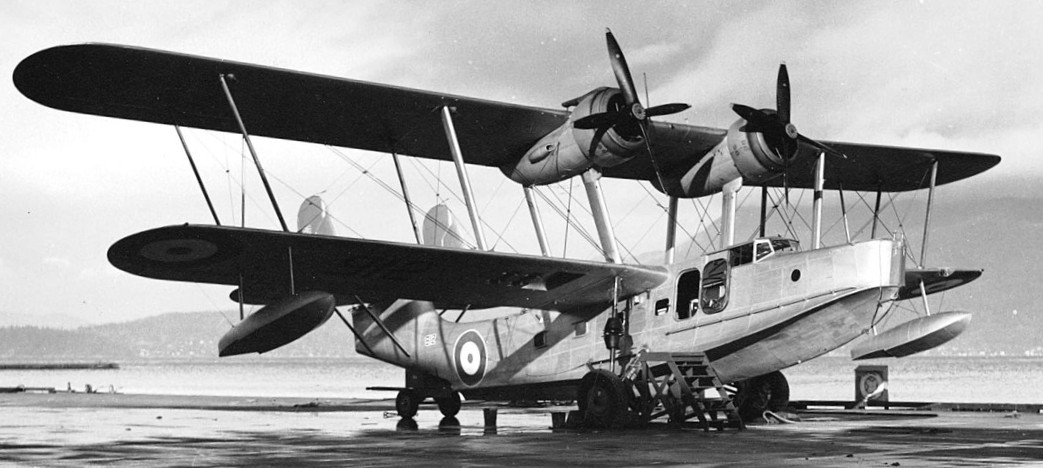
(City of Vancouver Archives Photo, CVA 677-380)
Canadian Vickers Stranraer, RCAF (Serial No. 912), at RCAF Station Jericho Beach, British Columbia.
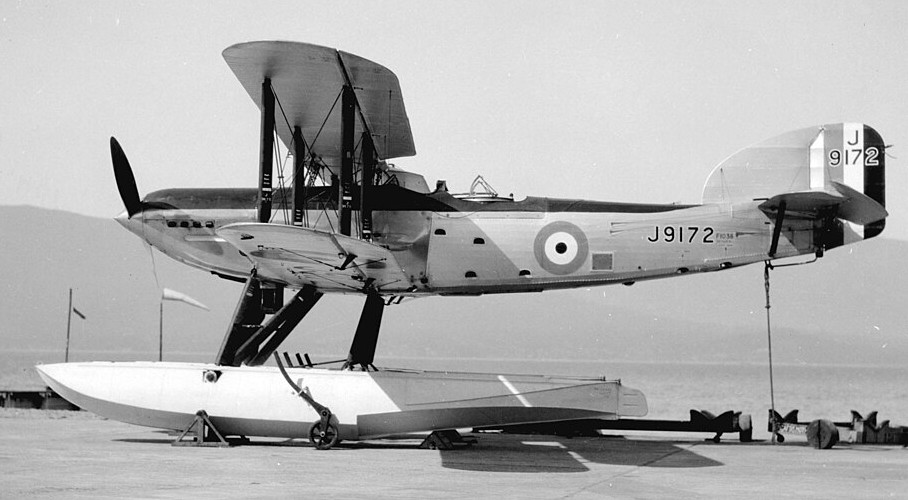
(City of Vancouver Archives Photo, CVA 99-2155)
Fairey III F Mk. IV G.P. floatplane, RCAF (Serial No. 9172) at RCAF Station Jericho Beach. The sole British-built Fairley III F to serve in Canada. It was used for trials October 1929 to September 1930.
RCAF Aerodrome – Midway
In approximately 1942 the aerodrome was listed as RCAF Aerodrome – Midway, British Columbia at 49°01′N 118°47′W, with no listed variation and elevation of 1,950 ft (590 m).
RCAF Aerodrome – Oliver
In approximately 1942 the aerodrome was listed as RCAF Aerodrome – Oliver, British Columbia at 49°10′N 119°33′W with a variation of 24 degrees E and elevation of 1,100 ft (340 m). The aerodrome was listed with three runways.
RAF/RCAF Aerodrome – Patricia Bay
The airport started in 1939 as a grass strip, and was used as a military training airfield. During the early part of the Second World War (1940–1941), the airfield was used as Royal Air Force Station Patricia Bay, providing basic flight training for Royal Air Force pilots preparatory to returning them to the UK. In approximately 1942 the aerodrome became a Royal Canadian Air Force (RCAF) installation listed as RCAF Aerodrome – Patricia Bay, British Columbia at 48°39′N 123°26′W with a variation of 24 degrees east and elevation of 25 ft (7.6 m). The aerodrome was listed with three runways. The airport is located beside Patricia Bay, which, due to the prevalence of flying boats at the time, proved to be an excellent location. The Department of Transport took over the airport in 1948. The last RCAF unit left the airport in 1952.
RCAF and D of T Aerodrome – Penticton
Initial examination for the construction of what would become Penticton Regional Airport began in 1937, at two locations. The proposed areas—west of Penticton’s city centre and north of the Skaha Lake—were owned by the Penticton Indian Band. The land for the airport was expropriated from the band in 1939 under the War Measures Act, with the preliminary development of the airfield completed in 1941. Because of wartime military air transportation concerns, the airport acted as an emergency landing strip until its tarmac was completed. Rights for a temporary public use airport were secured in 1945 for an operation of 24 hours a day. In 1946, more land was acquired from the Penticton Indian Band for the airport’s use. In approximately 1942 the aerodrome was listed as RCAF & D of T Aerodrome – Penticton, British Columbia at 49°28′N 119°36′W with a variation of 24 degrees E and elevation of 1,120 feet (341 m).
RCAF Aerodrome – Port Hardy
In approximately 1942 the aerodrome was listed as RCAF Aerodrome – Port Hardy, British Columbia, at 50°40′N 127°23′W, with a variation of 26 degrees E and elevation of 40 feet (12 m). The aerodrome was listed as “serviceable” with three runways.
USAAF/D of T Aerodrome – Prince George
The airport opened in 1920, and until 1932, the site was the bypass highway that ran from Tenth Avenue to Eighteenth Avenue. The airport served as a stopover for aircraft including United States Army flights going to Alaska. In 1932, the airport was moved to the intersections of Highway 97 and Highway 16, near Carney Hill (the same site is now the Prince George Golf and Curling Club). At this second, newer airport, USAAF aircraft also flew in large numbers to Alaska prior to the United States declaring war on Japan. This airport was used until about 1942 and was closed for good on 31 March 1944. In approximately 1942 the aerodrome was listed as D of T Aerodrome (old)- Prince George, British Columbia at 53°54′N 122°46′W with a variation of 28 degrees E and elevation of 1,900 ft (579 m). The aerodrome was listed with two runways.
RCAF Station Prince Rupert
RCAF/D of T Aerodrome – Princeton
In approximately 1942 the aerodrome was listed as RCAF & D of T Aerodrome – Princeton, British Columbia at 49°28′30″N 120°31′15″W with a variation of 24 degrees E and elevation of 2,310 feet (704 m).
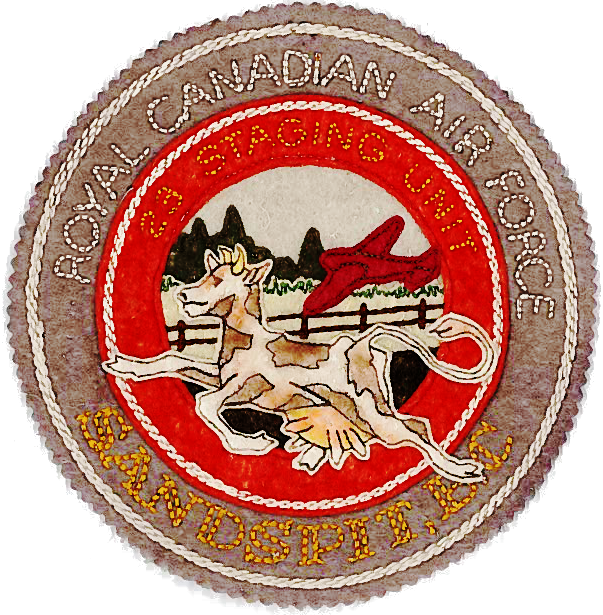
RCAF Station Sandspit
April 1936, S/L L.F. Stevenson and F/Sgt Winney carried out a survey flight of the Queen Charlotte Islands, where they were to locate sites for potential airports and flying boat stations in preparation for the defence of the west coast in the event of war. The airport site selected was at Sandspit on the farm of the Matthers family, and this property was secured on September 15, 1937. Initial plans for the airport called for a steel mat strip runway to accommodate fighter aircraft for the defense of the nearby Alliford Bay flying boat station. This was later modified to make it a staging base for Alaska bound aircraft and an emergency field. The RCAF unit at Sandspit was very small with only 20 personnel and six buildings which included a dining room, kitchen, lounge, canteen, and sleeping quarters. On the 11 Aug 43 the initial draft of Airmen was dispatched to Sandspit to start clearing for the runway construction. One scow of tractors and a boatload of equipment and 50 additional men were dispatched on the following day. Although the runway was reported completed towards the end of September, it was not officially handed over until early 1944. It took a month less a day to lay the 4,800 foot asphalt runway. This would be the last airport project for Western Air Command and No. 9 (CMU) Construction Maintenance Unit. Members based in Sandspit and some from Alliford Bay began constructing cabins along the beach at Sachs Creek for their families. After the closing of the station the cabins were relocated to Sandspit to provide housing for the town’s residents and are still used by the local residents.
Effective 1 April 1944, RCAF Station Sandspit was to be re-organized as No. 23 Staging Unit. RCAF Sandspit served in this capacity until the spring of 1946, when F/L Inglis was appointed Officer Commanding of the unit and Pacific Mills constructed a cottage for the officer’s residence. RCAF Sandspit was closed on August 1, 1946, and F/L Inglis turned over the station to the Department of Transport representative, Mr. Austin.
RCAF Station Sea Island
No 8 Elementary Flying Training School (EFTS) formed here on 22 July 1940. In approximately 1942 the aerodrome was listed at 49°11′N 123°10′W with a Var. 24 degrees E and elevation of Sea level. After the war the station was renamed RCAF Station Vancouver. RCAF Station Vancouver closed on 31 March 1964.
RCAF/D of T Aerodrome – Smithers
In 1929, the Board of Trade purchased the Ed Hill Ranch a few miles south of Smithers, calling it the Smithers Aviation Park, comprising a 1,200-foot (370 m) runway. With financial assistance from the Department of National Defence, the project was completed in 1933. Owing to size limitations, the Department of National Defence rebuilt at the present location in 1942. Designated RCAF & D of T Aerodrome – Smithers, British Columbia at 54°49′N 127°09′W with a variation of 29 degrees E and elevation of 1,710 feet (521 m), the aerodrome was listed as having one runway. After the war, the airport transferred to civilian use.
RCAF Station Telegraph Cove
In 1940, the RCAF decided to build an airport on an uninhabited stretch of land some fifty miles north of Telegraph Cove. RCAF Stn Port Hardy had three crash boats, the Takuli, the Huron, and the Montagnais, and one or other of them was always stationed in the little weatherproof harbour. These boats were designed to come to the aid of planes if they crashed.
RCAF Station Terrace
YXT was originally constructed in 1943 as an RCAF airbase during the Second World War. It formed part of Canada’s Pacific defence strategy against potential Japanese threats. The facility hosted fighter and bomber squadrons, including the Hawker Hurricanes of No. 135 Squadron and Ventura bombers of No. 149 Squadron. Construction challenges, such as harsh weather and limited resources, delayed the base’s operational readiness. By 1944, as the perceived threat diminished, the airbase shifted to a support role, and in 1945, RCAF decommissioned the base.
RCAF Aerodrome – Tofino
The site was developed during the early days of the Second World War and was opened in 1943 as a RCAF “Radio Detachment”. The radar at the base was used to protect the Pacific coast from enemy attack. Due to the site’s remote location it was equipped with its own airfield. The base was protected by a RCAF Squadron. The site was decommissioned in 1945. In 1955 the station was reopened again as a radar station in the Pinetree Line. The site was under the control of NORAD. The radar station was closed on 10 January 1958 and is now operated as the Tofino Airport. In approximately 1942 the aerodrome was listed as RCAF Aerodrome – Tofino, British Columbia at 49°05′N 125°46′W with a variation of 24.5 degrees east and elevation of 65 ft (20 m). The following RCAF units were based at Tofino: No. 4 Squadron RCAF – anti-submarine unit under Western Air Command 1941-1945, No. 132 Squadron RCAF – fighter unit under Western Air Command 1943–1944; disbanded at Sea Island in 1944, No. 133 Squadron RCAF – fighter unit under Western Air Command spent time in Tofino, No. 52 Aircraft Control & Warning Squadron – Pinetree Line 1955-1958.
RCAF Station Quesnel
In 1942, the DND developed the present site as an intermediate facility between Williams Lake and Prince George. The airport was called RCAF Station Quesnel. In May 1943, the airport was designated the No. 13 Staging Unit. In the event of a Japanese invasion, fighter aircraft could be operated from the airstrip as a second line of defence. The RCAF established a radio range aircraft navigational facility nearby.
RCAF Station Ucluelet
The Aircraft Detection Corps (ADC)
In 1939 it would have been easy for enemy aircraft to reach Canada’s Atlantic or Pacific shores and to enter its air space without being detected. Canada had no radar alert system. To counter such possibility, the Royal Canadian Air Force (RCAF) established the Aircraft Detection Corps (ADC) in May 1940. The principle was quite straightforward and inexpensive: unpaid civilians were enlisted to monitor the air space and to warn the RCAF of any suspicious activity.
The ADC’s military personnel made sure that enough civilians were watching the skies in areas that enemy bombers or reconnaissance planes could enter. The ADC handed out documents to assist in identifying the different types of aircraft; telephone companies did their part as well by transmitting free of charge messages intended for ADC stations.
ADC observers, therefore, worked as an early warning system before a radar station network could be built. Actually an efficient air detection radar network was not set up before 1942, and its implementation not completed before 1945. Enemy air raids against Canada were so few that ADC volunteers had little opportunities to distinguish themselves. But their reports were useful to locate lost aircraft and the information they provided increased the efficiency of rescue missions.
The Air Detection Corps was divided into three regional units, placed respectively under Western Air Command (WAC), Eastern Air Command (EAC) and, in central Canada, the RCAF HQ. When it was abolished at the end of 1943, the ADC grouped some 33,000 volunteers. (Juno Beach Centre)
(National Defence Image Library Photo, PL 17189)
With a smile on her face and binoculars around her neck, this Aircraft Detection Corps volunteer served her country and helped to ensure Canada’s safety, June 1943.
Canadian West Coast defence and domestic politics were closely intertwined during the war. In March 1942, the Vancouver Sun newspaper accused the government of unpreparedness. It also declared that both military and political leaders were indifferent and incompetent. The newspaper was charged under the Defence of Canada Act and fined $300. Defence Minister J.L. Ralston, accompanied by senior officers, made a hurried tour of Pacific coast defences.
Civilian fears were usually based on “worst case” scenarios, which envisaged Japanese ships and landing parties seizing coastal ports. They took no account of actual enemy capabilities. In December 1942, the Chiefs of Staff Committee dealt with requests for anti-aircraft guns to protect the Consolidated Mining and Smelting Company plants in the Kootenays. The threat was deemed unrealistic, given that a carrier strike would have to be launched at least 200 miles offshore, penetrate a further 300 miles inland and cross three mountain ranges on what could only be a one-way mission. Nevertheless, civilian anxieties led the federal cabinet to reinforce Western Air Command out of proportion to the threat, and to maintain forces long after any dangers had passed.
The fall of Singapore in February 1942 shocked many, both civil and military, who had overestimated its strength. If such a fortress could be taken, and so quickly, what place was safe? Questions were raised within WAC about the wisdom of building bases at isolated points on the western side of Vancouver Island. Would an airfield at Ucluelet be vulnerable to capture, and hence become an enemy facility rather than a Canadian one? Meanwhile, the loss of Singapore vested new importance on Esquimalt, which now possessed the only major Commonwealth drydock in the Pacific.
Even before that event, WAC and American authorities had recognized the need for radar sites. On Dec. 9, 1941, the U.S. War Department proposed establishment of two “aeroplane detection” sites in Canada. This was agreed upon. American construction crews were initially assigned to the task, but these were withdrawn in July 1942 as the RCAF itself became involved in building and manning a chain of “radio” detachments. The word “radar” was still very hush-hush. These detachments were integrated into a system that ran from Alaska to California. (Hugh A. Halliday, Legion Magazine)
All comments are subject to our Comment Policy. You must be at least 18 years old to comment.
See a comment that violates our guidelines? Report it here.