
RCAF History, Second World War era
The outbreak of the Second World War saw the RCAF fielding eight of its eleven permanent operational squadrons, but by October 1939 15 squadrons were available (12 for homeland defence, three for overseas service). Twenty types of aircraft were in service at this point, over half being for training or transport, and the RCAF started the war with only 29 front-line fighter and bomber aircraft. The RCAF reached peak strength of 215,000 (all ranks) in January 1944. By the end of the war the RCAF would be the fourth largest Allied air force. Approximately 13,000 RCAF personnel were killed while on operations or died as prisoners of war. Another 4000 died during training or from other causes. During the war, the RCAF was involved in three areas: the British Commonwealth Air Training Plan (BCATP), home defence, and overseas operations.
British Commonwealth Air Training Plan
In 1939, Canada, the United Kingdom, Australia and New Zealand agreed to train aircrew for wartime service. The training plan, known as the British Commonwealth Air Training Plan (BCATP), was administered by the Canadian government and commanded by the RCAF; however, a supervisory board with representatives of each of the four involved countries protected the interests of the other three countries. Training airfields and other facilities were located throughout Canada. Although some aircrew training took place in other Commonwealth countries, Canada’s training facilities supplied the majority of aircrew for overseas operational service. Schools included initial training schools, elementary flying training schools, service flying training schools, flying instructor’s schools, general reconnaissance schools, operational training units, wireless schools, bombing and gunnery schools, a flight engineers’ school, air navigation schools, air observer schools, radio direction finding (radar) schools, specialist schools, and a few supplementary schools. The BCATP contributed over 130,000 aircrew to the war effort.
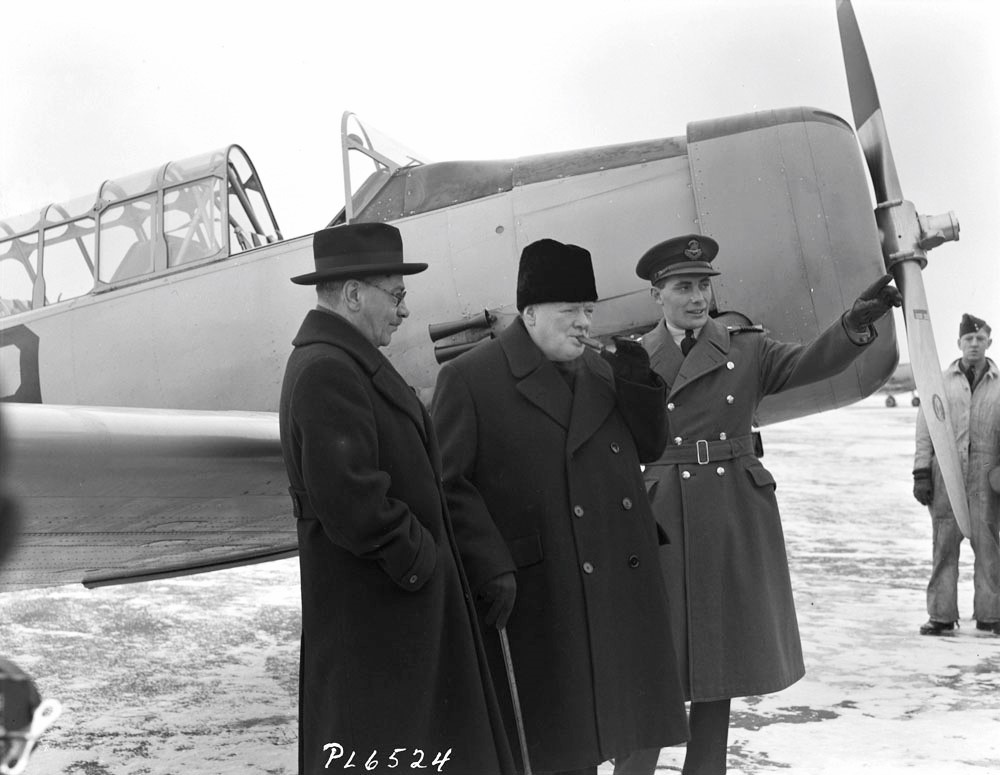
(Library and Archives Canada Photo, MIKAN No. 5722207)
Every detail of the advanced training of Royal Canadian Air Force pilots is studied closely by Great Britain’s Prime Minister, the Right Honourable Winston Churchill, shown here alongside a Harvard as he visits No. 2 Service Flying Training School, Uplands, near Ottawa. He is with Major the Honourable C.G. Power, M.C., (left) Canada’s Minister of National Defence for Air, and Wing Commander W.R. MacBrien (right) Commanding Officer of the Station, 1941.
Home Defence
Home defence was overseen by two commands of the Home War Establishment: Western Air Command and Eastern Air Command. Located on the west and east coasts of Canada, these commands grew to 37 squadrons, and were responsible for protecting Canada’s coasts from enemy attack and for protecting allied shipping. Threats included German U-boats along the east coast and in Atlantic shipping lanes and the potential of attack by Japanese forces. After the attack on Pearl Harbor in 1941, more squadrons were deployed to the west. Canadian units were sent to Alaska to assist the Americans in Alaska’s defence during the Aleutian Islands Campaign.
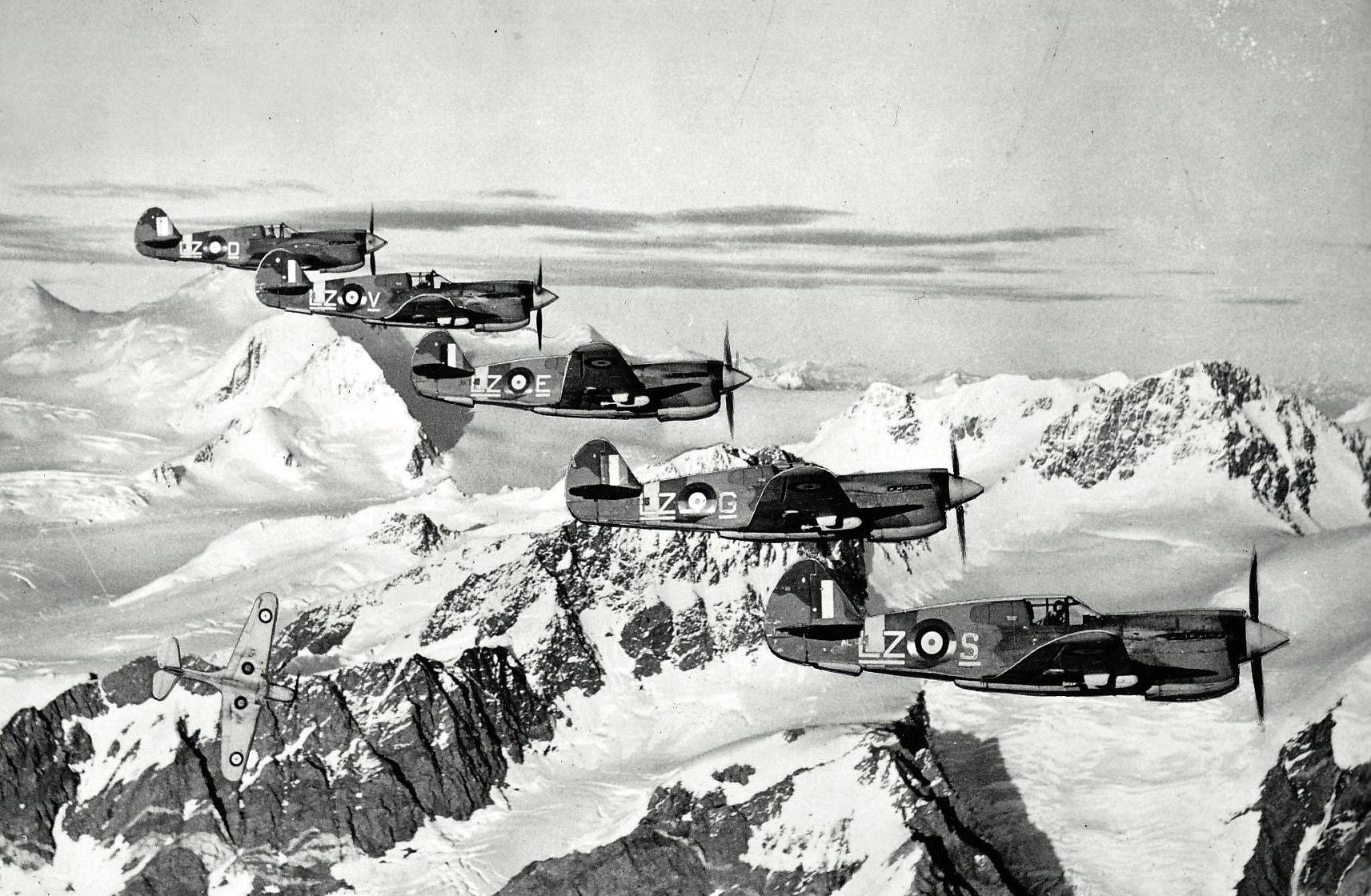
(DND Photo)
RCAF Curtiss Kittyhawk formation including (Serial No. AZ138) coded LZ-S, and LZ-G, LZ-E, LZ-V and (Serial No. AL166), coded LZ-O, No. 111 (F) Squadron over the Rockies, ca 1942.
Operations Overseas
Forty-eight RCAF squadrons were involved in overseas operational duties in Britain, northwest Europe, North Africa, and Southeast Asia. These squadrons participated in most roles, including fighter, night fighter, fighter intruder, reconnaissance, anti-shipping, anti-submarine, strategic bombing, transport, and fighter-bomber. RCAF squadrons often included non-RCAF personnel, and RCAF personnel were also members of Royal Air Force (RAF) squadrons. High-scoring Canadian fighter pilots include George Beurling, Don Laubman, James (Stocky) Edwards and Robert Fumerton.
The RCAF played key roles in the Battle of Britain, antisubmarine warfare during the Battle of the Atlantic, the bombing campaigns against German industries (notably with No. 6 Group, RAF Bomber Command), and close support of Allied forces during the Battle of Normandy and subsequent land campaigns in northwest Europe. RCAF squadrons and personnel were also involved with operations in Egypt, Italy, Sicily, Malta, Ceylon, India, and Burma.
By October 1942, the RCAF had five bomber squadrons serving with Bomber Command. 425 Squadron was made up of French-Canadians, through English was the language of command for all squadrons. In January 1943, 11 bomber squadrons were formed by transferring all of the Canadians serving in the RAF to RCAF, which became No. 6 Group RCAF of Bomber Command under Air Vice-Marshal G.E. Brookes. The air crews serving in 6 Group were based in the Vale of York, requiring longer flights to Germany. The Vale of York was also a region inclined to be foggy and icy in the winter, making take-off and landings dangerous. Furthermore, 6 Group continued to fly obsolete Wellington and Halifax bombers and only received their first Lancaster bombers in August 1943.
No. 6 Group lost 100 bombers in air raids over Germany, suffering a 7% loss ratio. Morale suffered because of the heavy losses, with many bombers became unserviceable, failed to take off or returned early. On the night of 20 January 1944, 6 Group was ordered to bomb Berlin. Of the 147 bombers ordered to bomb Berlin, 3 could not take off, 17 turned back over the North Sea, and nine were shot down. The next night, when 125 bombers were ordered to strike Berlin, 11 failed to take off, 12 turned back and 24 were shot down over Germany. The losses together with the morale problems were felt to be almost a crisis, which led to a new commander for 6 Group being appointed.
On 29 February 1944, Air Vice-Marshal C.M “Black Mike” McEwen took command of 6 Group and brought about improved navigational training and better training for the ground crews.[44] In March 1944, the bombing offensive against Germany was stopped and Bomber Command began bombing targets in France as a prelude to Operation Overlord, As France was closer to Britain than Germany, this required shorter flights and imposed less of a burden on the bomber crews.
Only in October 1944 did the strategic bombing offensive resume and 6 Group went back to bombing German cities. By the end of 1944, 6 Group was suffering the lowest losses of any of the Bomber Command groups and the highest accuracy in bombing targets. Altogether, 9,980 Canadians were killed in bombing raids against German cities between 1940 and 1945, making the strategic bombing offensive one of the most costly operations for Canada in the Second World War.
By spring 1945, the BCATP was discontinued and the RCAF was reduced from 215,000 to 164,846 (all ranks) and by VJ Day on 2 September 1945, it was proposed that the RCAF maintain a peacetime strength of 16,000 (all ranks) and eight squadrons. By the end of 1947 the RCAF had five squadrons and close to 12,000 personnel (all ranks). Peacetime activities resumed and the RCAF participated in such pursuits as aerial photography, mapping and surveying, transportation, search and rescue, and mercy missions. In March 1947 the RCAF’s first helicopters, several Sikorsky H-5s, were delivered, which were used for training and search and rescue. Interest in the Arctic led to several northern military expeditions supported by the RCAF. (Desmond A. Morton, A Military History of Canada. Toronto: McClelland & Stewart, 1999), Greenhous, Brereton; Halliday, Hugh A. Canada’s Air Forces, 1914–1999. Montreal: Editions Art Global and the Department of National Defence, 1999.
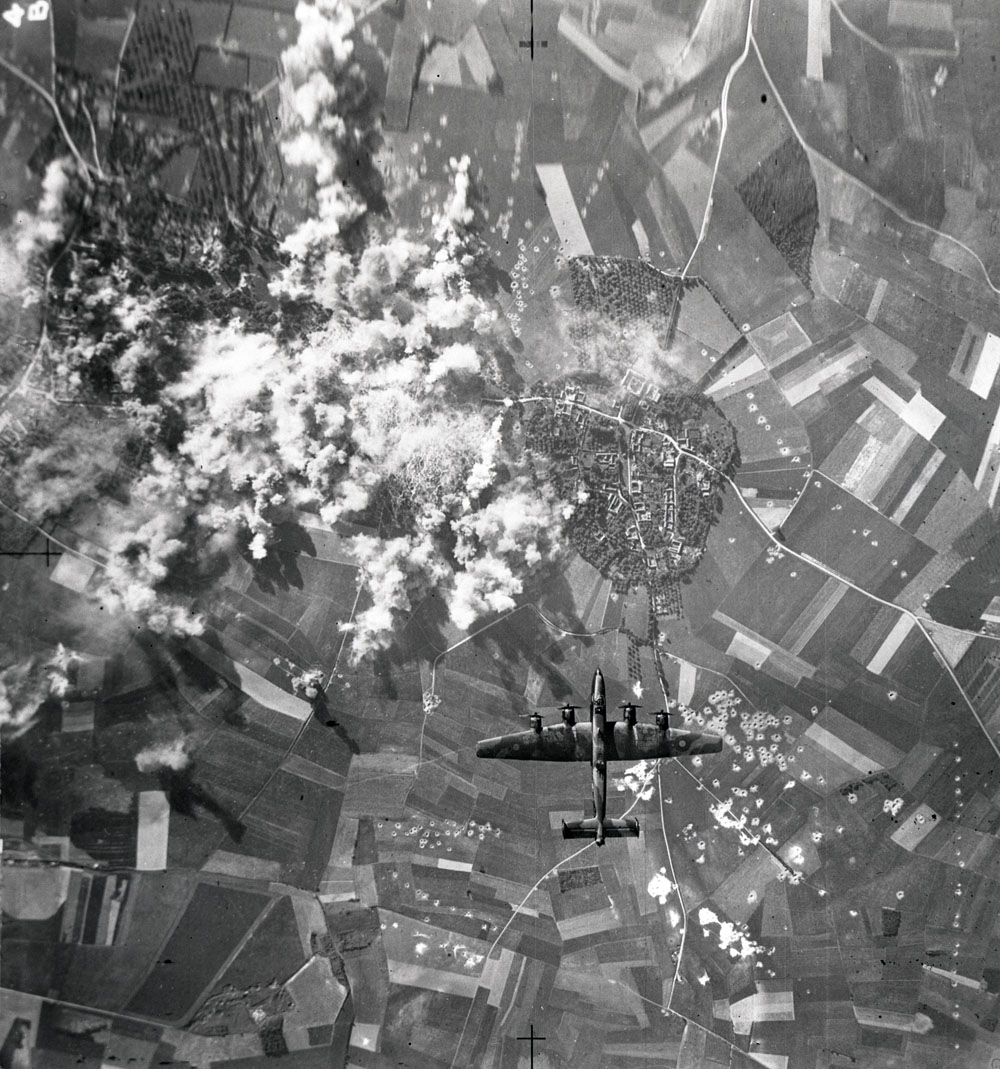
(Library & Archives Canada Photo, MIKAN No. 4002568)
Handley Page Halifax on a bomb run over Europe. Photo taken during a No. 6 (RCAF) Group attack on V-1 launching sites in France in July 1944. The Halifax is flying over craters from previous raids. Flying bomb sites were extremely difficult to destroy.
Photos of RCAF airmen and women, the aircraft they served with, and details on a number of operations at home and overseas may be found on separate pages on this website.
All comments are subject to our Comment Policy. You must be at least 18 years old to comment.
See a comment that violates our guidelines? Report it here.