
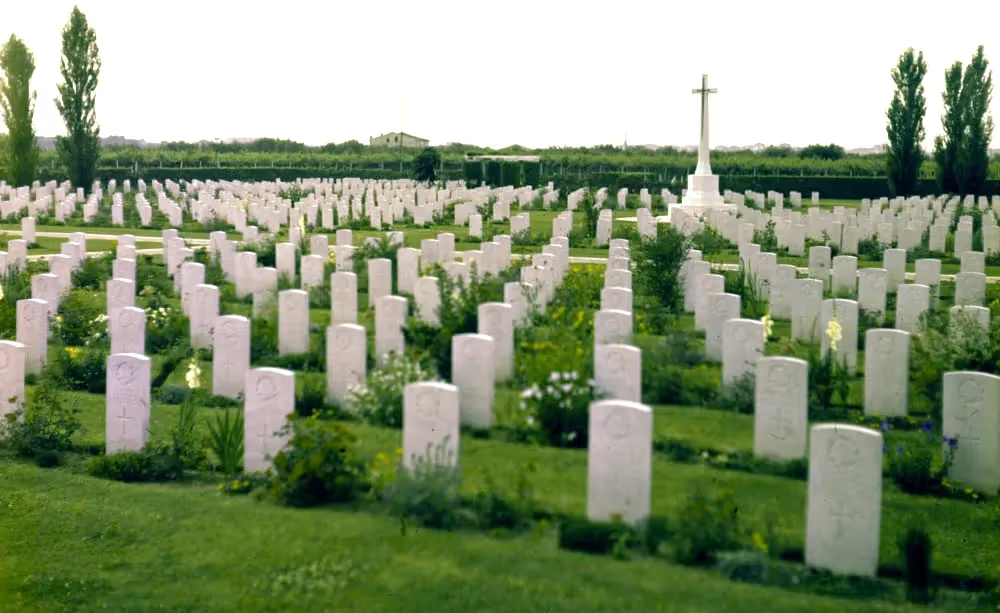
(Library and Archives Canada Photo, MIKAN No. 4235522)
The Moro River Canadian War Cemetery, located about five kilometres south of Ortona, contains 1,615 graves, of which 1,376 are for Canadians and 50 which are unidentified. The Moro River Canadian War Cemetery is located on high ground near the Adriatic Sea at San Donato, in the Commune of Ortona (about 5 kilometres south of the town) and the Province of Chieti. In January 1944 the Canadian Corps selected this site, intending that it would contain the graves of those who died during the Ortona battle and in the fighting in the weeks before and after it.
Most of the Canadians who fell in the Liri Valley are buried in two cemeteries in the area south of Rome: Caserta War Cemetery, where 98 Canadian soldiers and one Canadian airman are buried, and Cassino War Cemetery, farther north and just off the road to Rome. The latter is the largest Second World War cemetery in Italy. Among the over 4,200 headstones located here are those of 855 Canadians who died during the battles of the Hitler Line and the advance toward Rome. Also found in this cemetery is the Cassino Memorial which lists the names of 4,054 men who died in the Sicilian and Italian campaigns and have no known grave, and includes the names of 193 Canadians.
At Beach Head War Cemetery in Anzio on Italy’s west coast, 69 Canadians lie among the 2,313 war dead.
Rome War Cemetery has 22 Canadian graves – those of administrative staff and prisoners who died in captivity.
In Florence War Cemetery, east of the city on the north bank of the Arno, the graves of 50 Canadians can be found among those of 1,637 Commonwealth soldiers who died in action before the city was captured.
“They shall grow not old, as we that are left grow old: Age shall not weary them, nor the years condemn. At the going down of the sun and in the morning, We will remember them.” (Lawrence Binyon)
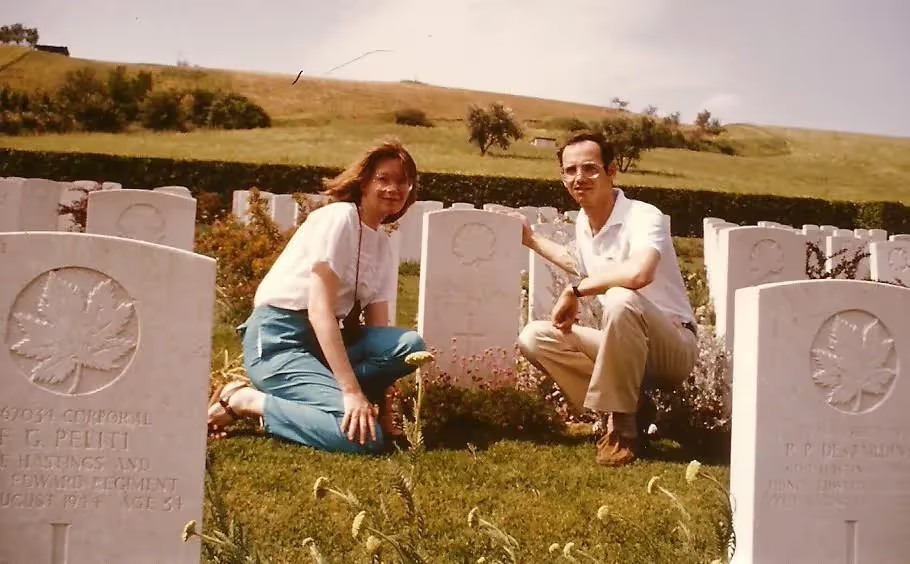
My wife Faye and I visiting my uncle Harold Jorgen Skaarup’s grave, Montecchio, Italy. He was one of a number of 8th Hussars who never came home. We never met, but I do carry his name. The high ground above and behind you is Point 111, the first feature taken in the breaking into the Gothic Line by D Coy, Perth Regiment followed by the capture of Point 147.
The Allies began the day of August 30th with an air bombardment against German positions at dawn. At 5.30 p.m., the Perth Regiment attacked the end of a ridge northeast of Montecchio, while a knoll at the west end of the town and the high ground beyond were the objectives of the Cape Breton Highlanders. Both units faced incessant fire from the heights as well as minefields along the flat lands. The Perth Regiment managed to break through the line first, reaching and passing their objective.
The Cape Breton troops had the support of tanks from the 8th Princess Louise’s (New Brunswick) Hussars, which helped three of their companies make it to the base of the knoll. After each attempt, however, they were driven back to the Foglia, with casualties totaling 19 members killed and 46 wounded. The Irish Regiment, which had been in reserve, was moved through the path of the Perths. Tanks and artillery guns were not yet available here and as a result the regiment lost 19 killed and 31 wounded. In the end, however, the knoll position was successfully taken, and 121 Germans captured, thanks to Allied artillery assaults and crafty positioning of the Irish Regiment soldiers who caught the enemy from behind. The 4th Princess Louise Dragoon Guards (4 PLDG) were also involved in these actions as they had been assigned “mop up” duties.
LCol G.W.L. Nicholson, The Canadian Army in the Second World War, Volume II, The Canadians in Italy, (Queen’s Printer, Ottawa, 1956), p. 504.
Begun as a battlefield cemetery, this site is in the rural locality of Montecchio, in the commune of Sant’Angelo (in Lizzola) and the province of Pesaro-Urbino. It is located 12 kilometres west of Pesaro and was chosen as a permanent battlefield in the autumn of 1944, when the Allies were fighting to break through the Gothic Line. During the war, Montecchio was situated on the east end and just to the south of this highly effective defensive barrier. In fact, an anti-tank ditch which formed part of the line ran through the valley that lies below the cemetery.
Two cemeteries near the Adriatic Sea were begun during the fighting to breach the Gothic Line: Ancona War Cemetery, where over a thousand Commonwealth soldiers and airmen are buried, including 161 Canadians; and Montecchio War Cemetery, further north and 13 kilometres inland from Pesaro, where 289 graves, of a total of 582, belong to Canadians.
In Gradara War Cemetery, the 1,192 Commonwealth headstones, including those of 369 Canadians, are mute testimony of the Allied sacrifice in the advance from Ancona to Rimini.
Coriano Ridge War Cemetery also contains 1,940 graves of those killed on the advance to Rimini, including 427 Canadian graves.
A total of 937 Commonwealth soldiers who died in the winter of 1944-45 are buried in Ravenna War Cemetery, including 438 Canadians.
A half-hour drive from Ravenna is the Casena War Cemetery where 307 Canadian graves can be found among the 775 graves dating from November 1944.
In Villanova Canadian War Cemetery, 206 of the 212 graves belong to Canadians. This cemetery has been described as a memorial to the fallen of the 5th division as 85 members of two battalions of this division are buried here.
While Canadians did not fight in the area of Argenta Gap War Cemetery, north of Ravenna, this cemetery contains the graves of 77 Canadian soldiers and airmen who were brought here from battlefield graves farther south.
All comments are subject to our Comment Policy. You must be at least 18 years old to comment.
See a comment that violates our guidelines? Report it here.