
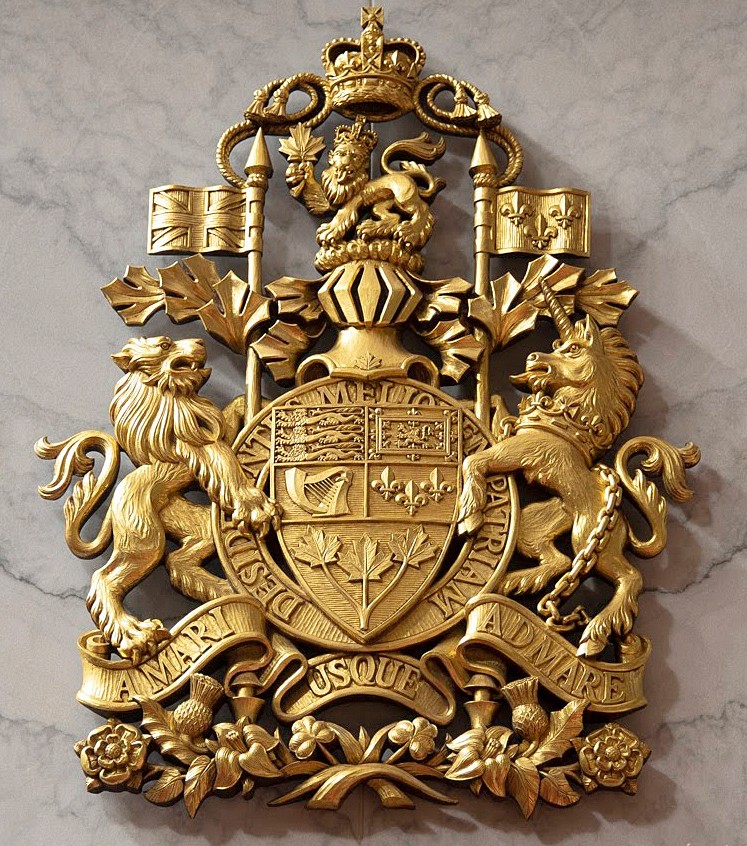
Coat of Arms of Canada
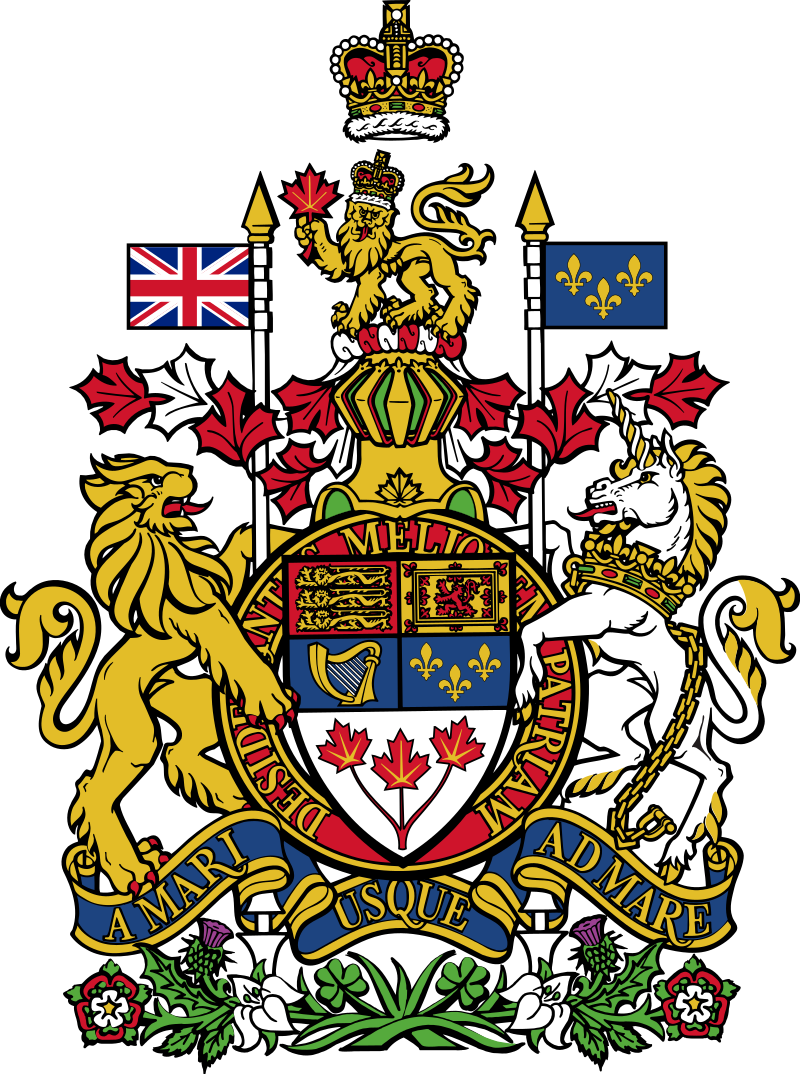
The coat of arms of Canada,[a] also known as the Royal Coat of Arms of Canada or, formally, as the Arms of His Majesty The King in Right of Canada, is the arms of dominion of the Canadian monarch and, thus, also the official coat of arms of Canada. In use since 1921, it is closely modelled after the royal coat of arms of the United Kingdom, with French and distinctive Canadian elements replacing or added to those derived from the British version.
The maple leaves in the shield, blazoned “proper” (i.e., in natural colour), were originally drawn vert (green), but were redrawn gules (red) in 1957 and a circlet of the Order of Canada was added to the arms for limited use in 1987. The arms are registered with the Canadian Heraldic Authority and protected under Crown copyright; they are used to signify national sovereignty and the federal government uses the arms to represent the state under the Federal Identity Program. Elements of the coat of arms are also used in other designs, with the shield being used in the various royal standards belonging to members of the royal family and the crest of the arms serving as the focal point of the governor general’s flag.
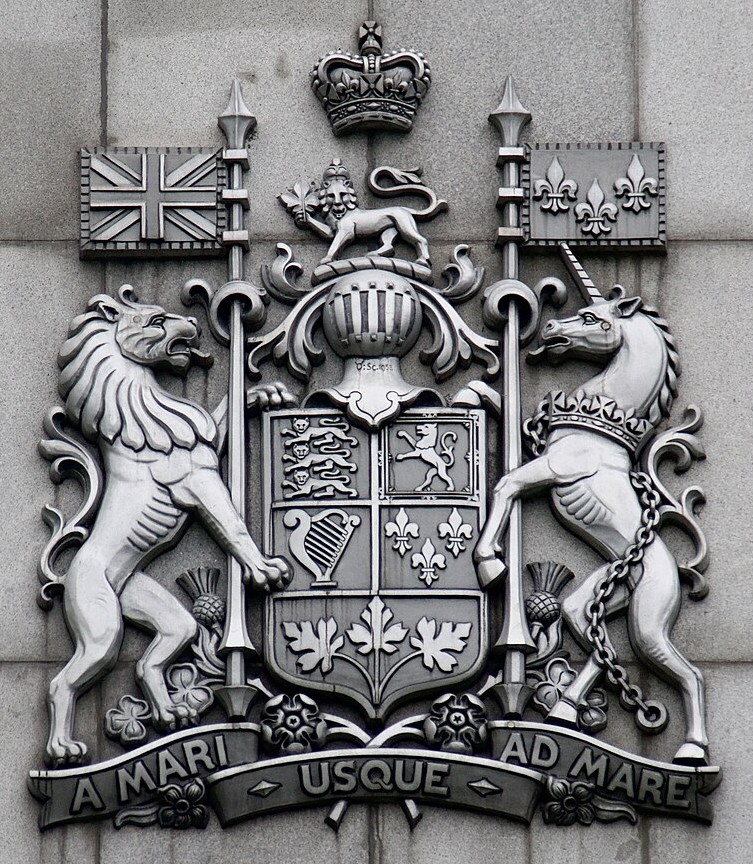
(Hayden Soloviev Photo)
Symbols
The coat of arms are surmounted by a rendition of St. Edward’s Crown, which has been used in the coronations of Canada’s monarchs. This element represents Canada’s status as a constitutional monarchy headed by a sovereign king or queen. This style of crown was that preferred by Queen Elizabeth II, and was modernized in 1957 from the 1921 design, which used the Tudor crown.
The crest is based on the Royal Crest of the United Kingdom but differenced by the addition of a maple leaf, and symbolizes the sovereignty of Canada.[68] It appears on the flag of the Governor-General, symbolizing that the Governor-General is a representative of the Sovereign. The crest consists of a crowned gold lion standing on a twisted wreath of red and white silk and holding a maple leaf in its right paw.
The arms show a royal helmet, which is a barred helm of gold embossed with a maple leaf design looking outward, with mantling of white and red, stylized in the official version to look like maple leaves.
The escutcheon is divided into five sections.
The first division at the viewer’s top left contains the three golden lions that have been a symbol of England since at least the reign of King Richard I.The second quarter bears the red lion rampant of Scotland in a double treasure border with fleurs-de-lis, used as a symbol of Scotland since at least the reign of William I. The third quarter shows the Irish harp of Tara. The fourth quarter shows the Royal Banner of France or “Bourbon Flag” with three gold fleurs-de-lis on blue field arranged two and one, symbolizing royal France.
The fifth charge, a sprig of red maple leaves at the bottom, is, at first, a distinctly French Canadian symbol that became gradually identified with the entire country throughout the end of the 19th century. The arrangement of three leaves on one sprig was first seen on a Saint-Jean-Baptiste Day poster in 1850. They were first proposed as a symbol in 1834, were established in 1868 on the arms of Quebec and Ontario and officially became the national emblem in 1965, with the proclamation of the Flag of Canada. Initially, the leaves were depicted as coloured green on the coat of arms because it was thought to represent youth, as opposed to the red colour of dying leaves in autumn. However, they are blazoned as “proper”, so could be shown as either red or green, and it is the blazon, rather than any depiction, which is regarded as authoritative. The leaves were later redrawn in official depictions in 1957 with the current colour to be in line with the official colours of Canada. They are further stylized in that natural maple leaves do not grow in sprigs of three. Beginning in the 1960s, there developed an interpretation of the leaves as symbolic of Canadian multiculturalism; the country’s different groups of people separate, but also joined together. There is, however, no record from the designing committee indicates there was any intention behind the particular arrangement of the leaves; the choice of three leaves appears to have been aesthetic.
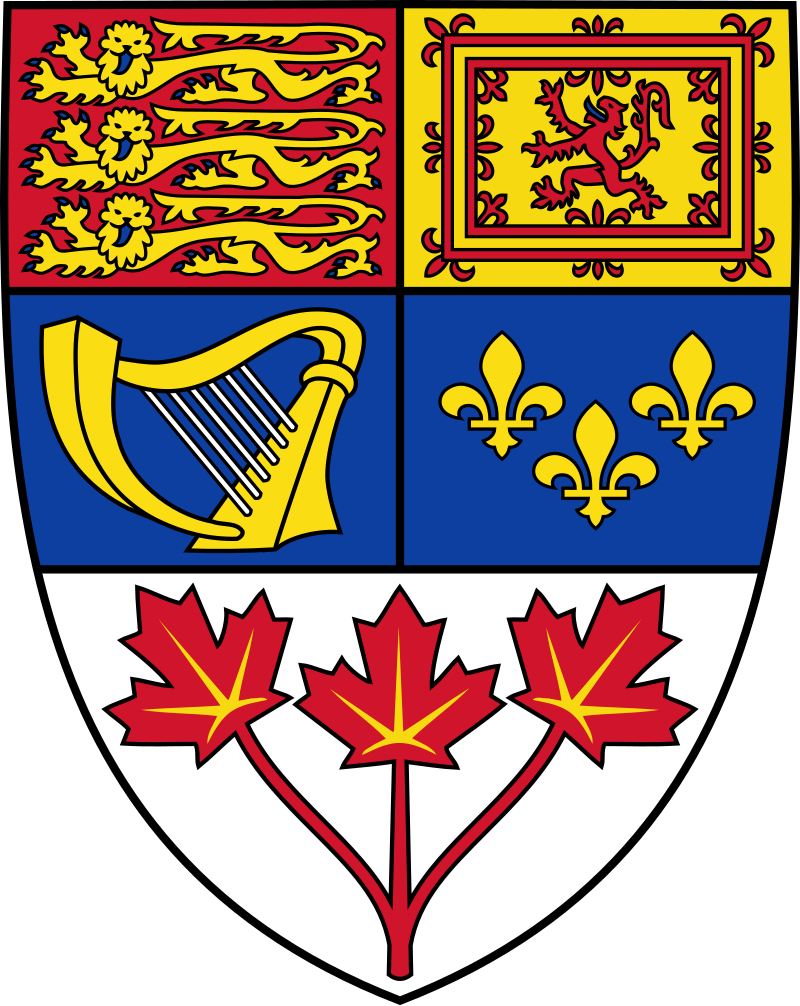
The shield forms the basis of the royal standards of Canada.
The ribbon is marked desiderantes meliorem patriam, meaning “desiring a better country”, which is the motto of the Order of Canada, taken from Hebrews 11:16. This component was added by the Queen in 1987 on the advice of Prime Minister Brian Mulroney. With the patriation of oversight of arms to Canada through the Canadian Heraldic Authority the following year, the constitution of the Order of Canada was amended to include entitlement by all recipients to encircle their own arms with the ribbon if arms are granted to them. Since 1994 the arms used by government ministers and institutions have slowly changed to reflect the new version with the ribbon.
The motto of Canada is in Latin a mari usque ad mare (From sea to sea), a part of Psalm 72:8. This phrase was suggested by Joseph Pope, then-Under Secretary of State, when the Arms were redesigned in 1921. The motto was originally used in 1906 on the head of the mace of the Legislative Assembly of Saskatchewan.
In March 2006, the premiers of Canada’s three territories called for the amendment of the motto to better reflect the vast geographic nature of Canada’s territory, as Canada has coastlines on the Arctic, Atlantic, and Pacific Oceans. Two suggestions for a new motto are A mari ad mare ad mare (from sea to sea to sea) and A mari usque ad maria (from the sea to the other seas).
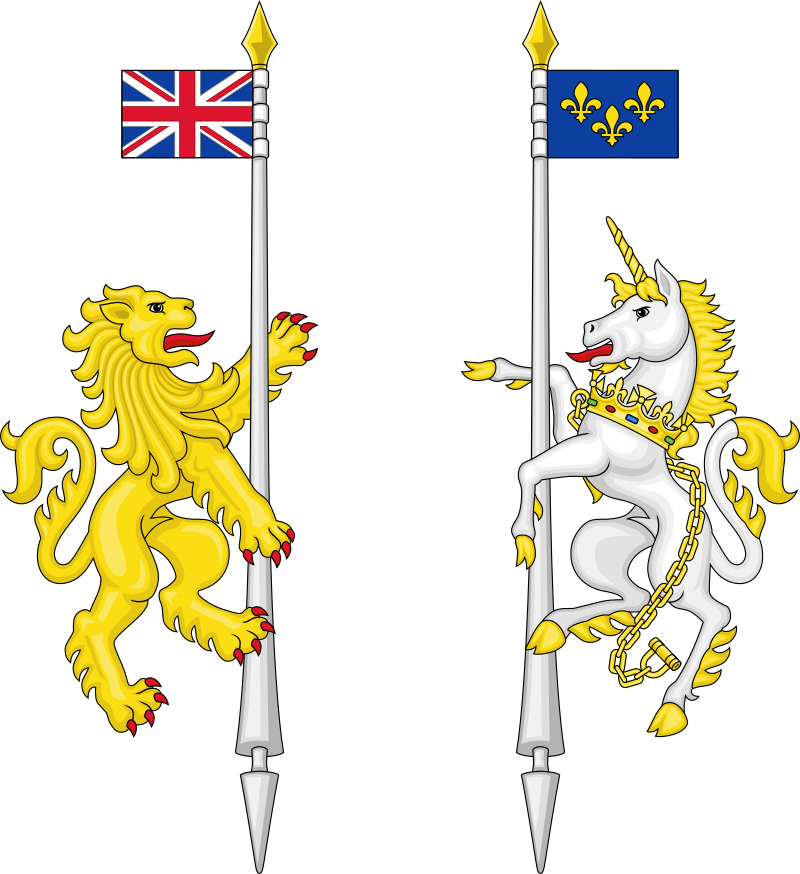
Supporting the shield on either side are the English lion and Scottish unicorn, which are also the supporters of the UK coat of arms. The English lion stands on the viewer’s left and holds a gold-pointed silver lance flying the Royal Union Flag. The Scottish unicorn has a gold horn, a gold mane, gold hooves, and around its neck a gold, chained coronet of crosses and fleurs-de-lis; it holds a lance flying a banner of royalist France, the three gold fleurs-de-lis on a blue background. Unlike the British version, the lion is not crowned, nor is it facing the viewer. The broken chain on the unicorn symbolizes the unicorn’s resistance to oppression.
The entire coat of arms rests on the compartment, which is made up of the floral emblems of the founding nations. The Tudor rose is the floral badge of England and Wales, combining the White Rose of York and the Red Rose of Lancaster. The thistle and shamrock are the symbols of Scotland and Ireland, respectively, while the fleur-de-lis has been the royal symbol of France since the 12th century.
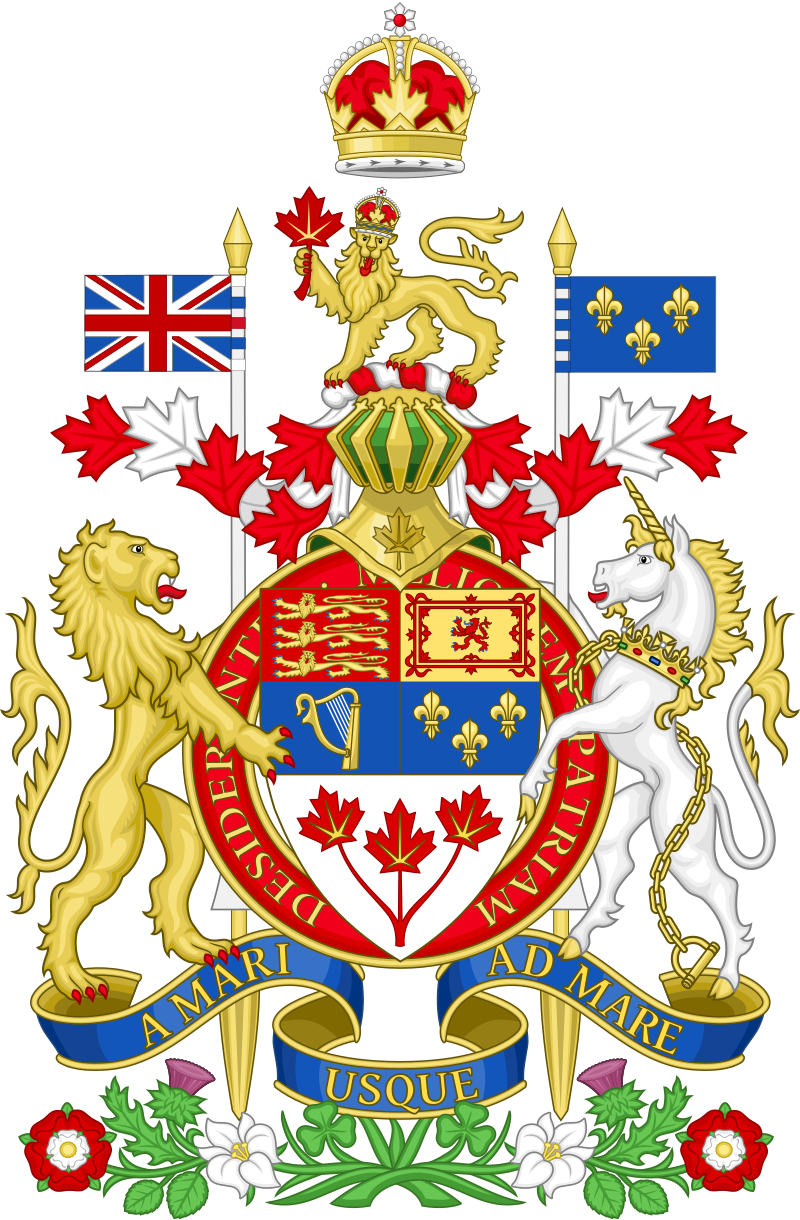
Coat of arms of Canada as of 2023 replacing the former rendition which used the St. Edwards crown.
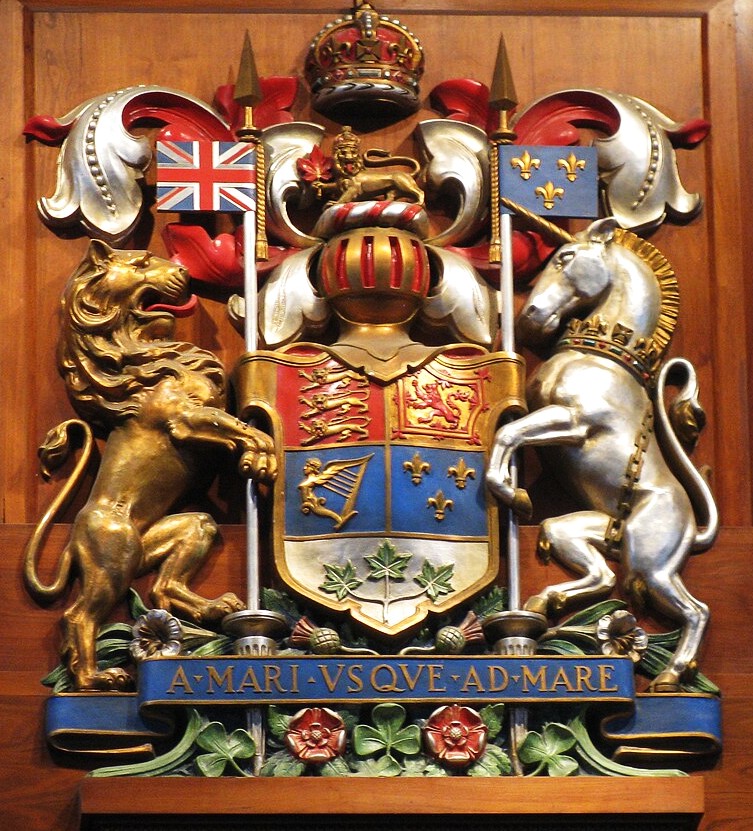
(Robert Lindsell Photo)
Supreme Court of Canada, Wellington St, Ottawa, Ontario.
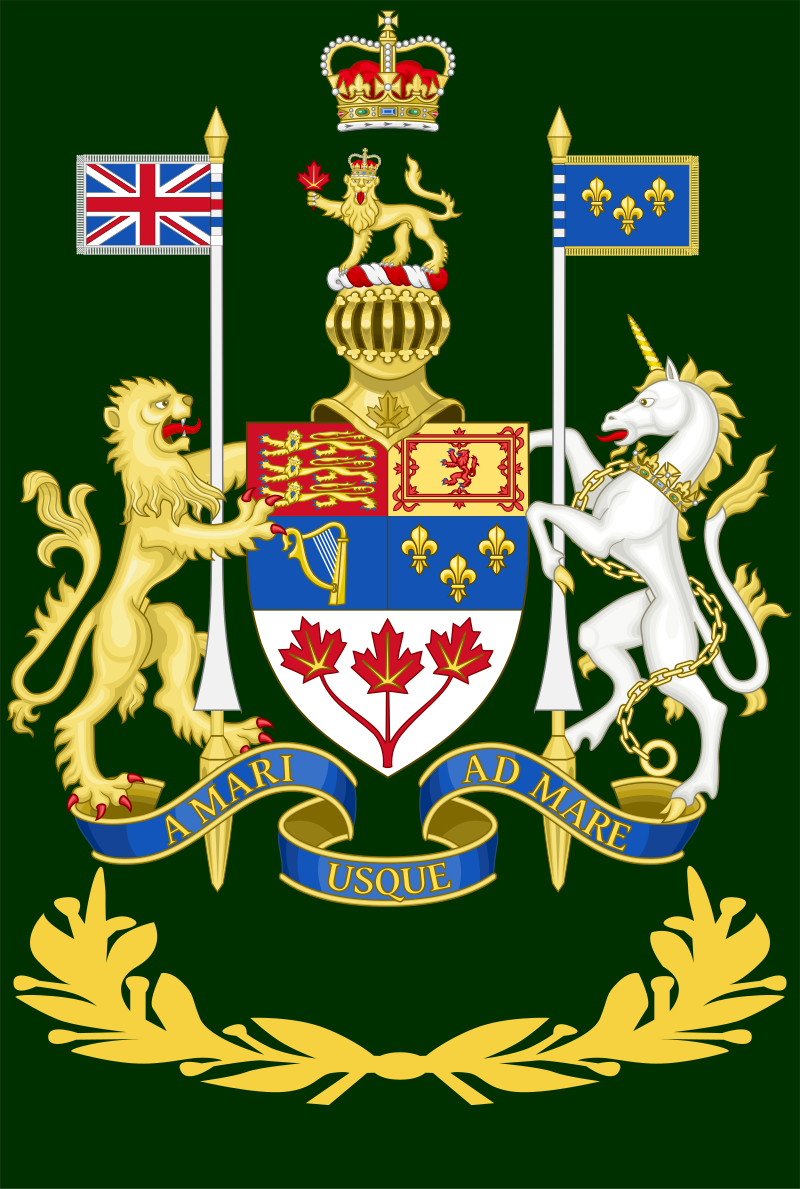
Canadian Army rank insignia for Command Chief Warrant Officer
All comments are subject to our Comment Policy. You must be at least 18 years old to comment.
See a comment that violates our guidelines? Report it here.