
Canada Aviation and Space Museum,
Musée de l’Aviation et de l’Espace du Canada,
Vickers Viscount
The Canada Aviation and Space Museum is located at 11 Aviation Parkway, Ottawa, Ontario.
The aim of this website is to locate, identify and document every historical Warplane preserved in Canada. Many contributors have assisted in the hunt for these aircraft to provide and update the data on this website. Photos are by the author unless otherwise credited. Any errors found here are by the author, and any additions, correctons or amendments to this list of Warplanes in Canada would be most welcome and may be e-mailed to the author at hskaarup@rogers.com.
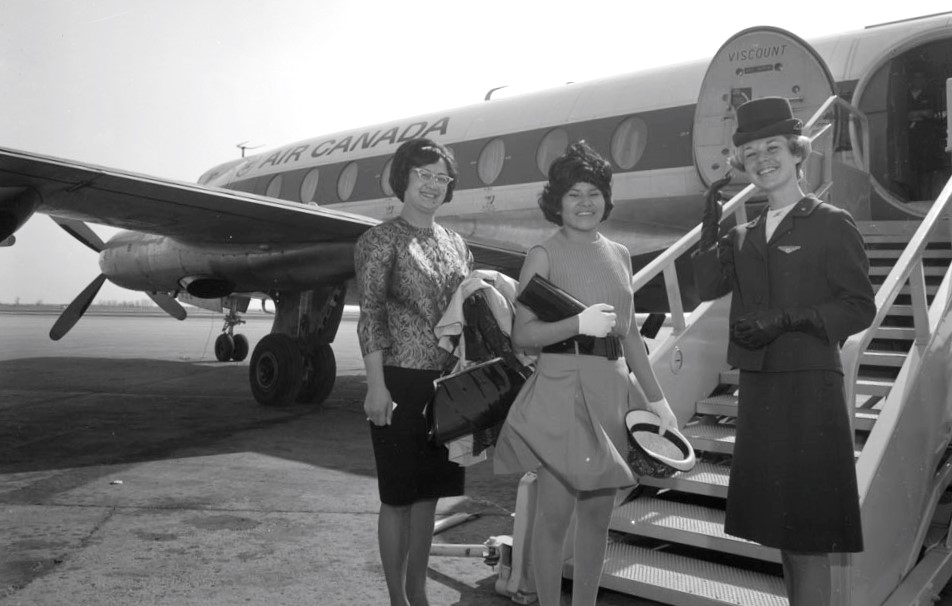
(Library and Archives Canada Photo 3580129)
Verna Kirkness, Rosalie Kirkness and an a flight attendant standing by the ramp of an Air Canada Vickers Viscount, April 1967.
The Vickers Viscount is a retired British medium-range turboprop airliner first flown in 1948 by Vickers-Armstrongs. It entered service in 1953 and was the first turboprop-powered airliner. The Viscount was well received by the public for its cabin conditions, which included pressurisation, reductions in vibration and noise, and panoramic windows. It became one of the most successful and profitable of the first postwar transport aircraft;1] 445 Viscounts were built for a range of international customers, including in North America. (Wikipedia)
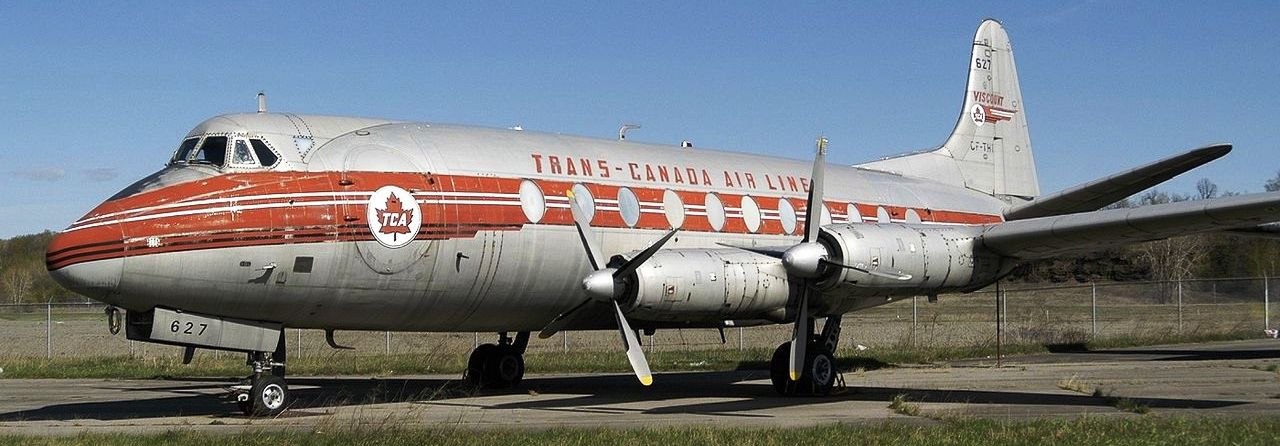
(Alain Rioux Photo)
Vickers Viscount 757 (Serial No. 270), CF-THI, 8 May 2005. The Vickers Viscount 757 was a groundbreaking British turboprop airliner used by Trans-Canada Air Lines (TCA) (now Air Canada), making TCA the first North American airline with turboprop service starting in 1955, known for its quiet, smooth, and comfortable flights, with TCA receiving 51 of these versatile aircraft for short-haul routes and adapting them for Canadian winters.
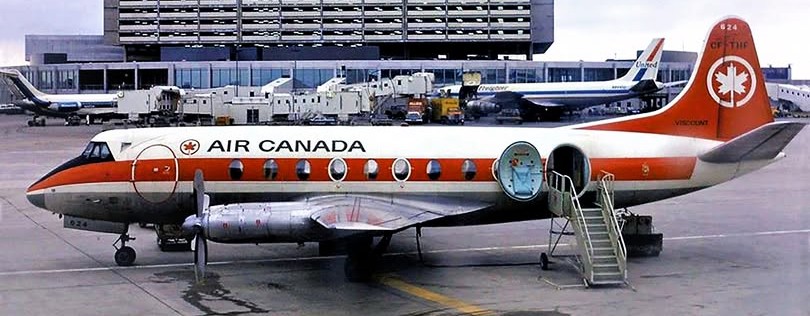
(Jeff Hickinbotham Photo)
Air Canada Type 757 Viscount CF-THF taken at Toronto, Ontario the 1970s.
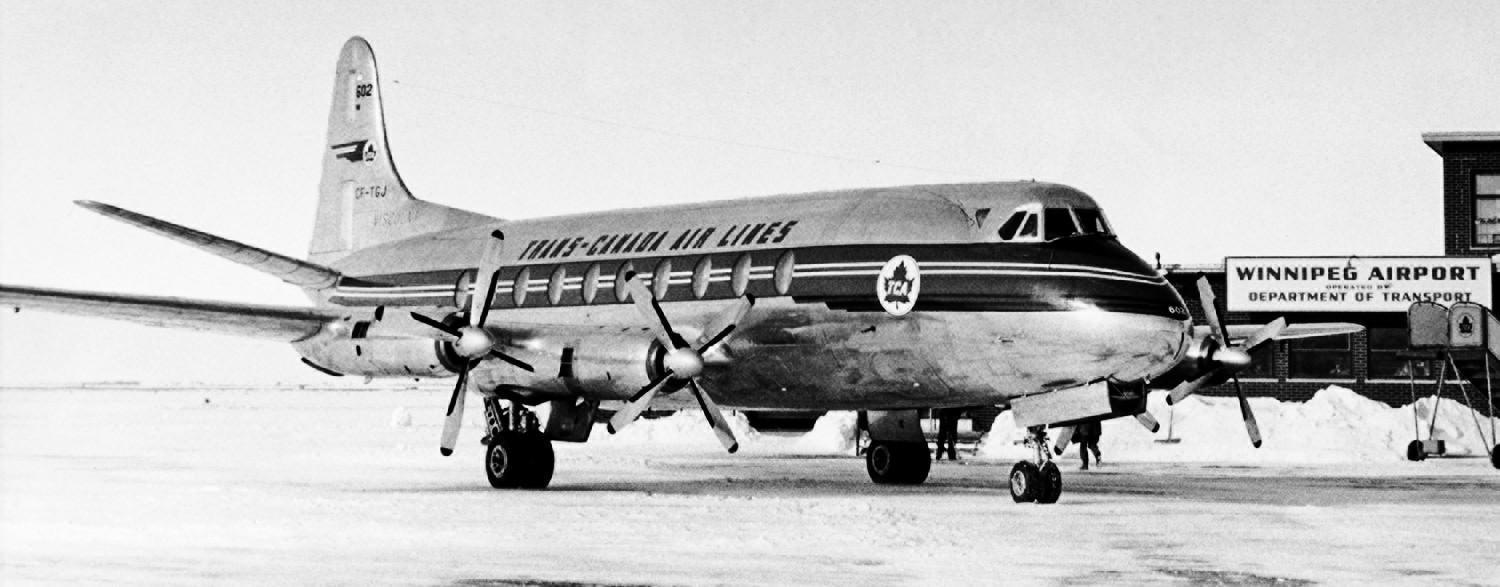
(RAMWC Photo)
The Vickers Viscount became the world’s first turboprop airliner and first turbine-powered aircraft to enter scheduled service in North America. Its initial flight took place on July 16, 1948. Built by Vickers Armstrong, Trans-Canada Air Lines purchased 51 Viscounts from the plant in Weybridge, Surrey, England, between December 6, 1954, and May 2, 1959. These planes were equipped with four Rolls-Royce Dart turboprop engines. The first aircraft to be delivered was registered as CF-TGI, which first flew on April 1, 1955, on the Montreal-Toronto-Fort William-Winnipeg route.
The Viscounts destined for the Trans-Canada Air Lines fleet were adapted to cold-weather operations, and as Canada had similar operations regulations to the U.S., this was seen as a step toward Trans-Canada Air Lines entering a difficult U.S. market. Cold-weather trials were conducted in Churchill, Manitoba. The adaptations raised the $1 million price tag of each plane by $25,000. By the end of 1955, the Viscounts were serving 14 cities in Canada, and the U.S. Air Canada retired its fleet of Viscounts in 1974.
The museum’s Viscount, CF-THS, entered service on the Montreal-Winnipeg route in February 1958. It operated from the Trans-Canada Air Lines hangar in Winnipeg (now the Royal Aviation Museum of Western Canada) until it was withdrawn from service by Air Canada and stored in Winnipeg in April 1974. It had two other owners before being donated to the museum in September 1982. Volunteers overhauled its interior, and the plane was also given a new paint job by Air Canada, sporting the original Viscount Air Canada livery. CF-THS is part of the Royal Aviation Museum of Western Canada’s permanent collection. (RAMWC)
All comments are subject to our Comment Policy. You must be at least 18 years old to comment.
See a comment that violates our guidelines? Report it here.