
Warships of Russia: Novorossiysk
(Архив фотографий кораблей русского и советского ВМФ)
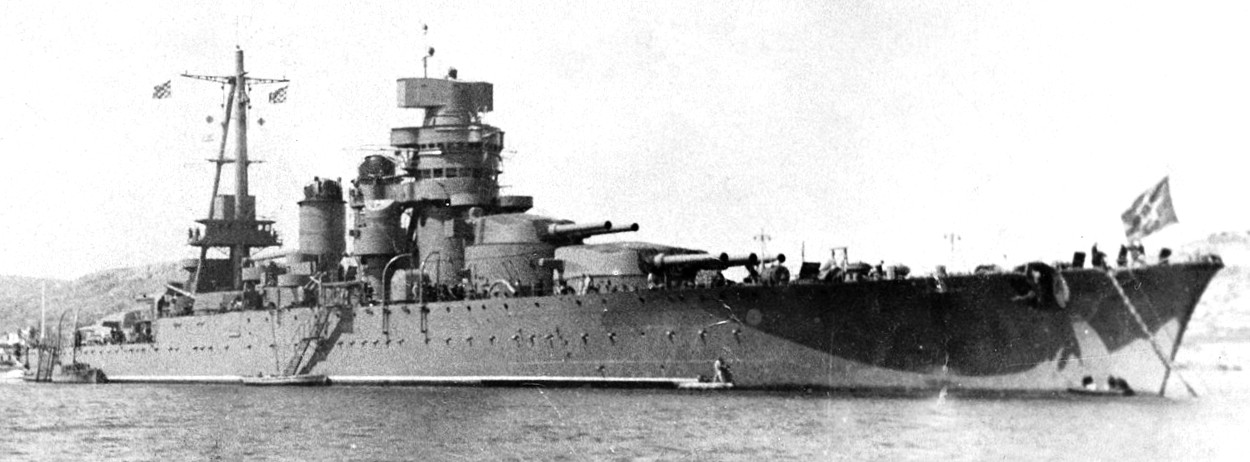
Novorossiysk at anchor in Sevastopol, flying the Soviet jack, 1950.
Giulio Cesare was one of three Conte di Cavour-class dreadnought battleships built for the Royal Italian Navy (Regia Marina) in the 1910s. Completed in 1914, she was little used and saw no combat during the First World War. The ship supported operations during the Corfu Incident in 1923 and spent much of the rest of the decade in reserve. She was rebuilt between 1933 and 1937 with more powerful guns, additional armor and considerably more speed than before.
During the Second World War, both Giulio Cesare and her sister ship, Conte di Cavour, participated in the Battle of Calabria in July 1940, when the former was lightly damaged. They were both present when British torpedo bombers attacked the fleet at Taranto in November 1940, but Giulio Cesare was not damaged. She escorted several convoys to North Africa and participated in the Battle of Cape Spartivento in late 1940 and the First Battle of Sirte in late 1941. She was designated as a training ship in early 1942, and escaped to Malta after the Italian armistice the following year. The ship was transferred to the Soviet Union in 1949 and renamed Novorossiysk (Новороссийск). The Soviets also used her for training until she was sunk in 1955, with the loss of 617 men, by an explosion most likely caused by an old German mine. She was salvaged the following year and later scrapped. (Wikipedia)
After the war, Giulio Cesare was allocated to the Soviet Union as part of war reparations. She was moved to Augusta, Sicily, on 9 December 1948, where an unsuccessful attempt was made at sabotage. The ship was stricken from the naval register on 15 December and turned over to the Soviets on 6 February 1949 under the temporary name of Z11 in Vlorë, Albania. She was renamed Novorossiysk, after the Soviet city of that name on the Black Sea. The Soviets used her as a training ship, and gave her eight refits. In 1953, all Italian light AA guns were replaced by eighteen 37 mm 70-K AA guns in six twin mounts and six singles. Also replaced were her fire-control systems and radars. This was intended as a temporary rearmament, as the Soviets drew up plans to replace her secondary 120 mm mounts with the 130 mm/58 SM-2 that was in development, and the 100 mm and 37 mm guns with 8 quadruple 45 mm. While at anchor in Sevastopol on the night of 28/29 October 1955, an explosion ripped a 4-by-14-metre (13 by 46 ft) hole in the forecastle forward of ‘A’ turret. The flooding could not be controlled, and she capsized with the loss of 617 men, including 61 men sent from other ships to assist.
The cause of the explosion is still unclear. The official cause, regarded as the most probable, was a magnetic RMH or LMB bottom mine, laid by the Germans during World War II and triggered by the dragging of the battleship’s anchor chain before mooring for the last time. Subsequent searches located 32 mines of these types, some of them within 50 metres (160 ft) of the explosion. The damage was consistent with an explosion of 1,000–1,200 kilograms (2,200–2,600 lb) of TNT, and more than one mine may have detonated. Other explanations for the ship’s loss have been proposed, and the most popular of these is that she was sunk by Italian frogmen of the wartime special operations unit Decima Flottiglia MAS who – more than ten years after the cessation of hostilities – were either avenging the transfer of the former Italian battleship to the USSR or sinking it on behalf of NATO. Novorossiysk was stricken from the naval register on 24 February 1956, salvaged on 4 May 1957, and subsequently scrapped. (Wikipedia)
(Архив фотографий кораблей русского и советского ВМФ)
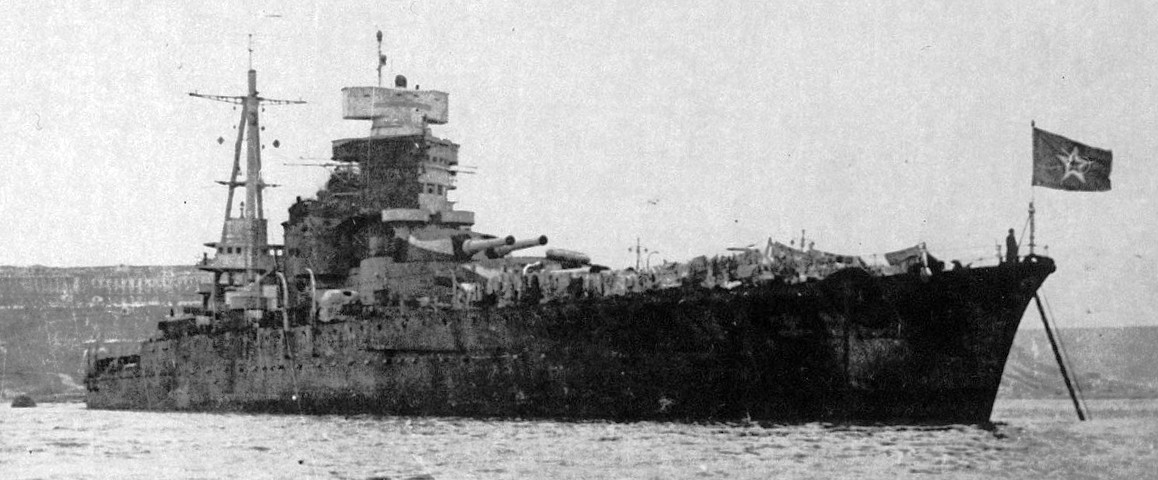
Novorossiysk at anchor in Sevastopol, 1949.
(Архив фотографий кораблей русского и советского ВМФ)
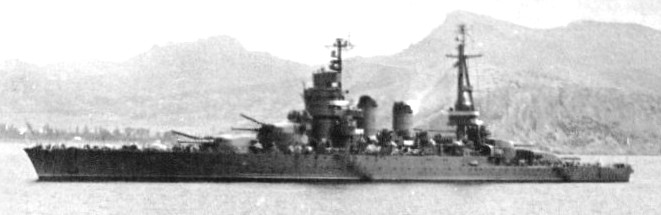
Novorossiysk, c1955.