
Royal Navy pre-dreadnought battleships: HMS Centurion, HMS Barfleur, HMS Renown
The Centurion class, designed by White, completed the initial ten new battleships called for by the Naval Defence Act 1889. They were intended to serve as flagships of the Pacific and China Stations, and as such, their design differed significantly from the Royal Sovereigns, though they were in many respects a scaled-down version of White’s previous design. Because they would operate abroad, they required a significantly greater cruising range, and because dry dock facilities were limited in East Asia and the Pacific, their hulls were coppered to reduce biofouling and allow them to go longer between hull cleanings. Their most likely opponent at the time would have been Russian armoured cruisers, so they carried a lighter main battery of 10 in (254 mm) guns and thinner armour compared to the Royal Sovereigns.
Centurion served as the flagship of the China Station from her commissioning while Barfleur was initially sent to the Mediterranean Fleet, where she also joined the International Squadron in 1897. She moved to Chinese waters in 1898, and both ships were involved in the suppression of the Boxer Uprising in China in 1900, during which they sent landing parties to participate in the Battle of the Taku Forts and the Battle of Tientsin. Both ships returned to Britain in 1901 for reconstruction and Centurion briefly served in the China Station until 1905, when the renewal of the Anglo-Japanese Alliance rendered the presence of a significant British squadron redundant. The two vessels were placed in reserve that year and saw little activity before being placed for sale in 1909 and scrapped the following year. (Wikipedia)
HMS Centurion
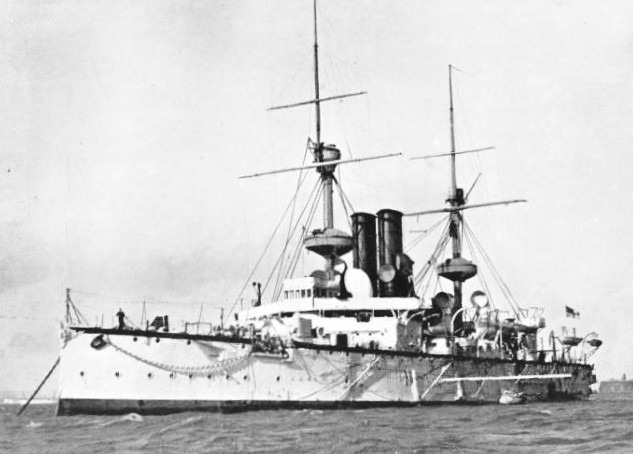
(Royal Navy Photo, c1894-1897)
HMS Centurion was the lead ship of her class of two pre-dreadnought battleships built for the Royal Navy in the 1890s. Intended for service abroad, they exchanged heavy armour and a powerful armament for high speed and long range to counter the foreign armoured cruisers then being built as commerce raiders and were rated as second-class battleships.
Completed in 1894, Centurion was assigned to the China Station as its flagship. Together with her sister ship, Barfleur, she supported Allied operations during the Boxer Rebellion of 1899–1901 and contributed landing parties to participate in the Battles of the Taku Forts and of Tientsin. The ship returned home in 1901 to be rebuilt with a more powerful secondary armament. Centurion rejoined the China Station two years later and remained there until 1905 when she returned to Britain. Already made obsolete by the increasing speeds of the cruisers the ship was designed to defend against, she was placed in reserve until 1909. Centurion was decommissioned that year and sold for scrap in 1910. (Wikipedia)
HMS Barfleur
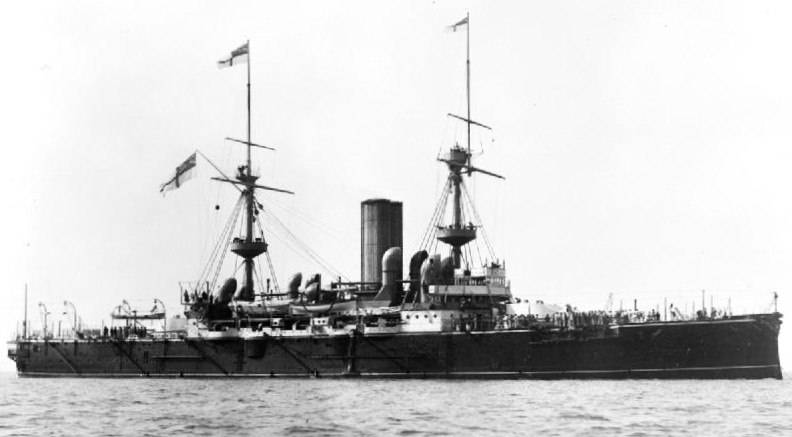
(Royal Navy Photo)
HMS Barfleur was the second and last of the Centurion-class pre-dreadnought battleships built for the Royal Navy in the 1890s. Intended for service abroad, they exchanged heavy armour and a powerful armament for high speed and long range to counter the foreign armoured cruisers then being built as commerce raiders and were rated as second-class battleships.
Barfleur was assigned to the Mediterranean Fleet in 1895 and participated in the blockade of Crete imposed by the Great Powers after a Greek rebellion began on Crete against their Ottoman overlords in February 1897. She joined her sister ship Centurion on the China Station the following year and became the flagship of the station’s second-in-command. During the Boxer Rebellion in 1900, both ships contributed landing parties to participate in the Battles of the Taku Forts and of Tientsin.
Already made obsolete by the increasing speeds of the cruisers the ship was designed to defend against, she was placed in reserve in 1904, although Barfleur often participated in the annual fleet manoeuvres. She also served as a flagship in the reserve for several years before the ship was listed for disposal in 1909. After being sold for scrap the following year, Barfleur got jammed underneath the piers of a swing bridge on her way to the scrapyard, forcing it to remain open and blocking traffic while she had to be freed. (Wikipedia)
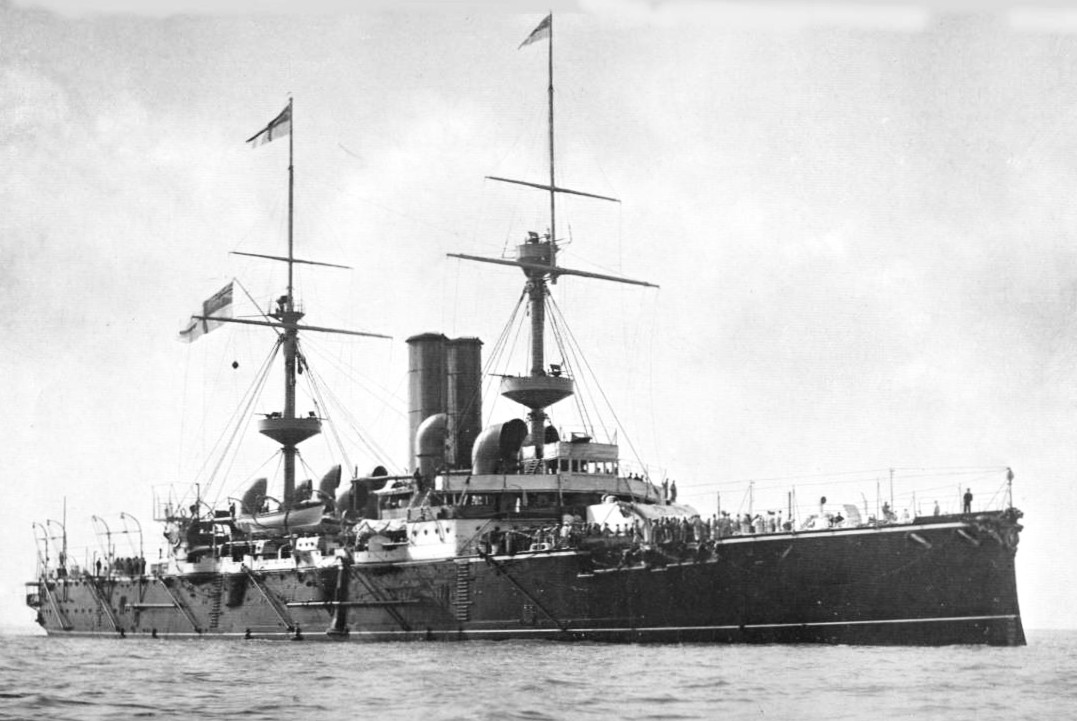
(Royal Navy Photo)
HMS Barfleur before 1898.
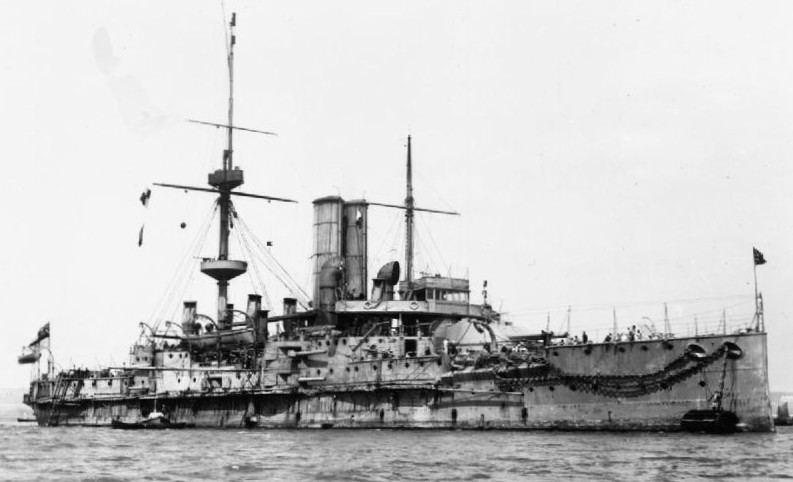
(IWM Photo, Q 38237)
HMS Barfleur at anchor, after 1904.
HMS Renown
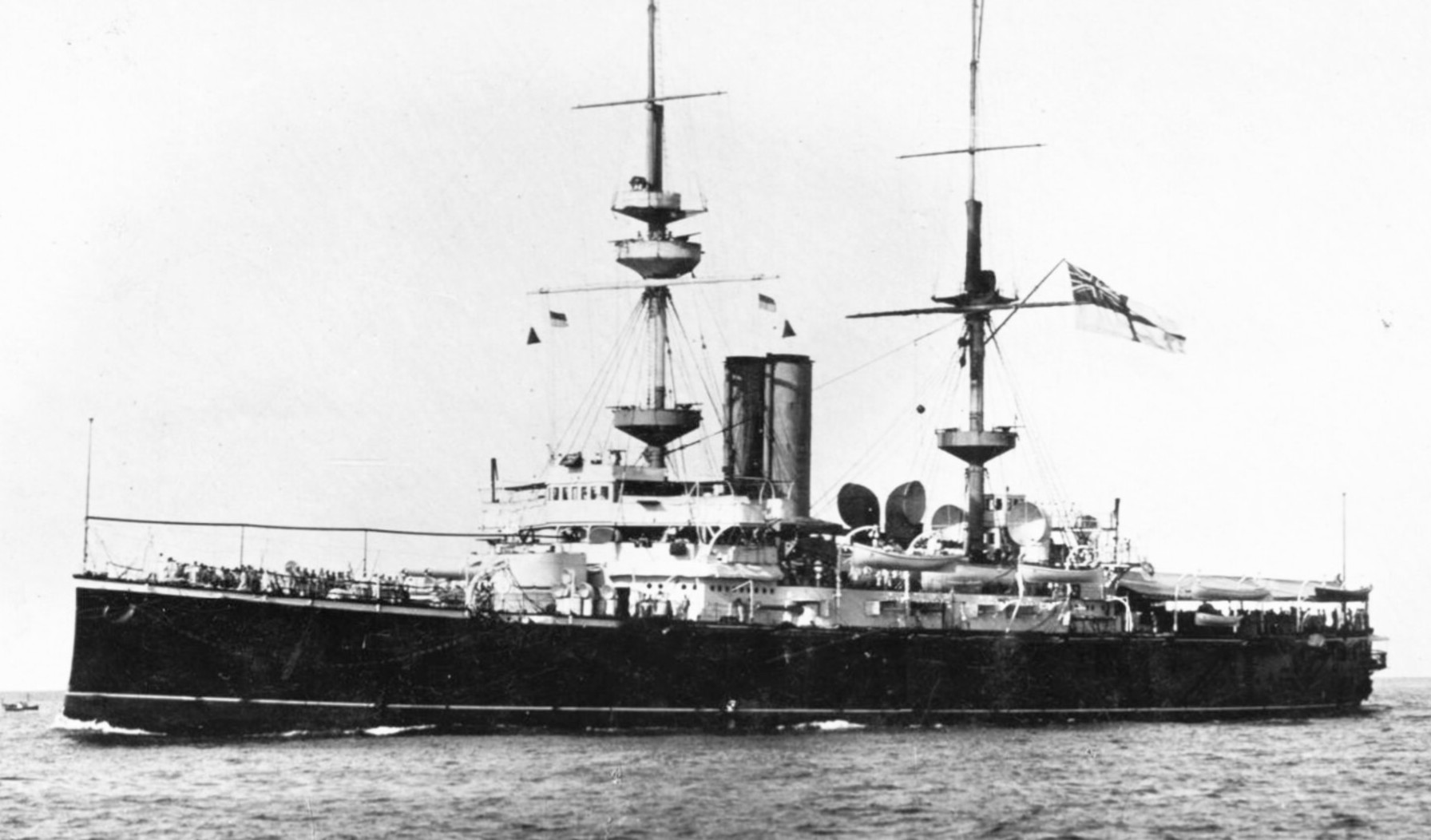
(Royal Navy Photo, 1895)
The 1892 construction programme had initially called for three new first-class battleships that were to be armed with a new 12 in (305 mm) gun, but development of the gun was delayed. At the request of the Controller of the Navy, Rear Admiral John A. “Jacky” Fisher, and the Director of Naval Intelligence, Captain Cyprian Bridge, an improved Centurion design was prepared, despite the fact that no requirements for a third vessel of the second class existed. Another White design, Renown incorporated several advances, including the first use of Harvey armour in the Royal Navy, the first sloped armour deck, and the first adoption of modern, enclosed gun shields (which would come to be known as gun turrets). Fisher pressed for six of the vessels to be built instead of what was to become the Majestic class, but the Admiralty rejected the request on the grounds that the 10 in (250 mm) main guns were insufficient for use against enemy battleships, and there was no need for large fleets of the vessels overseas.
Renown served as the flagship of the North America and West Indies Station, initially under Fisher’s command. In 1899, she was refitted before being reassigned to the Mediterranean Fleet as its flagship, which was by then commanded by Fisher. In 1902, she was refitted again to carry the Duke and Duchess of Connaught on a royal tour of India, for which she was nicknamed the “battleship yacht”. After a brief period in reserve in 1905, she received additional modifications for use as a royal yacht, and later that year she carried the Prince and Princess of Wales—the future King George V and Queen Mary—on a tour of India. She was used in a variety of subsidiary roles before being withdrawn from service in 1911 and broken up in 1914. (Wikipedia)
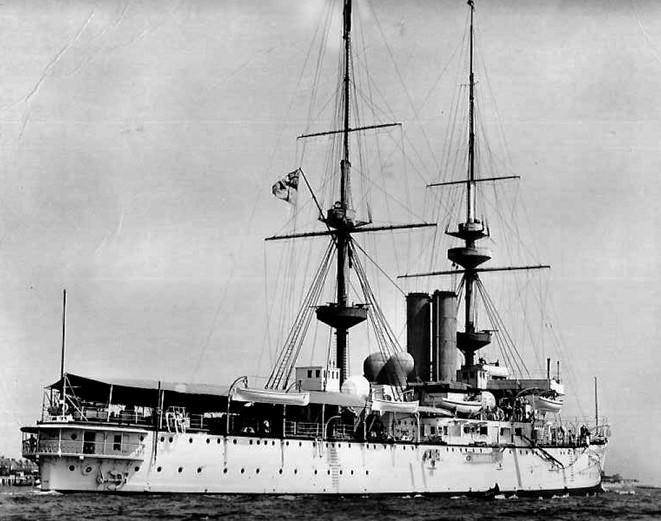
(Royal Navy Photo)
HMS Renown.