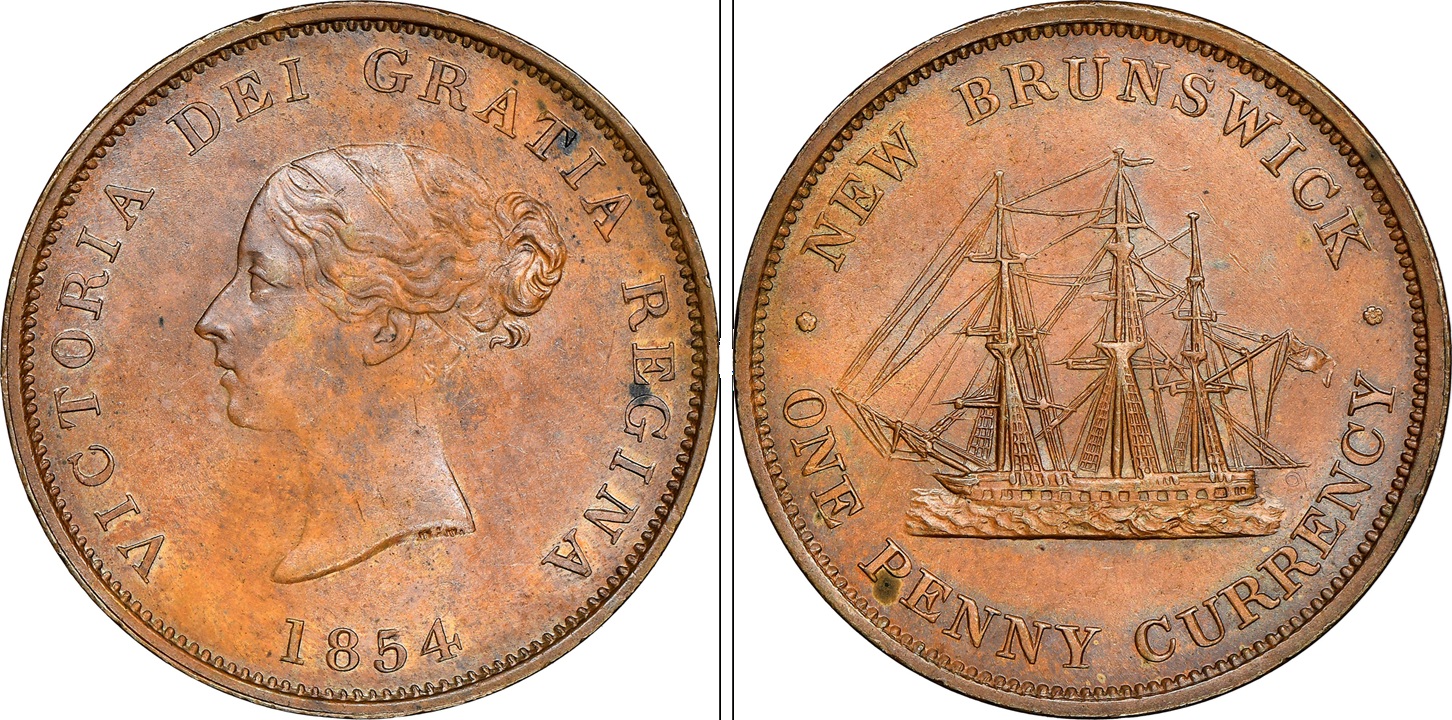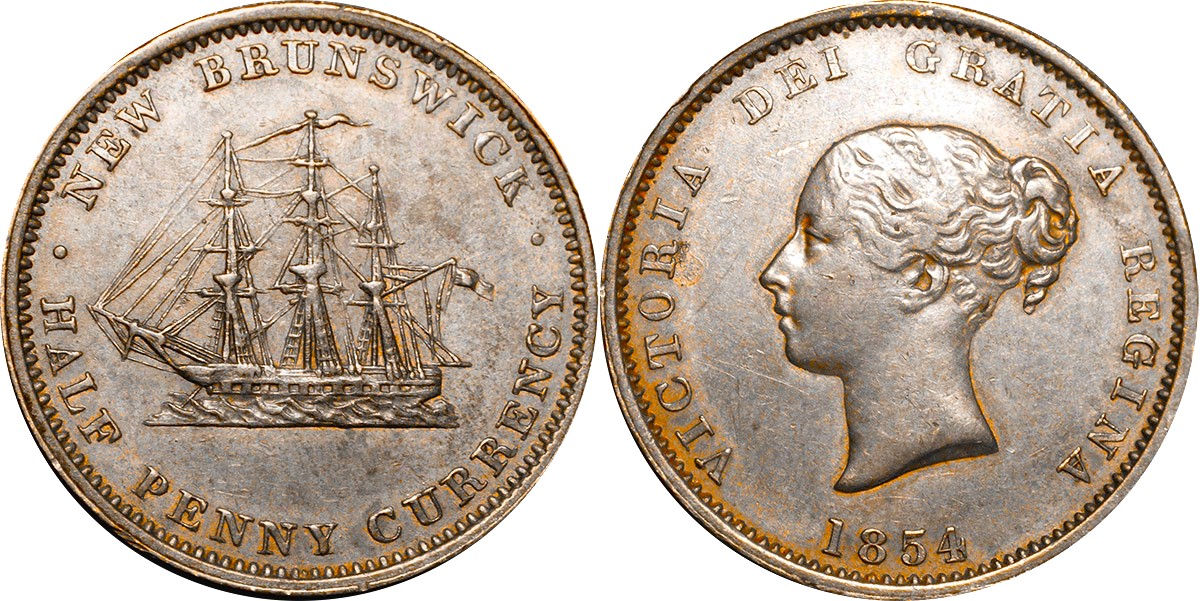
New Brunswick, Provincial government, pre-Confederation 1843 penny tokens and 1854 penny currency
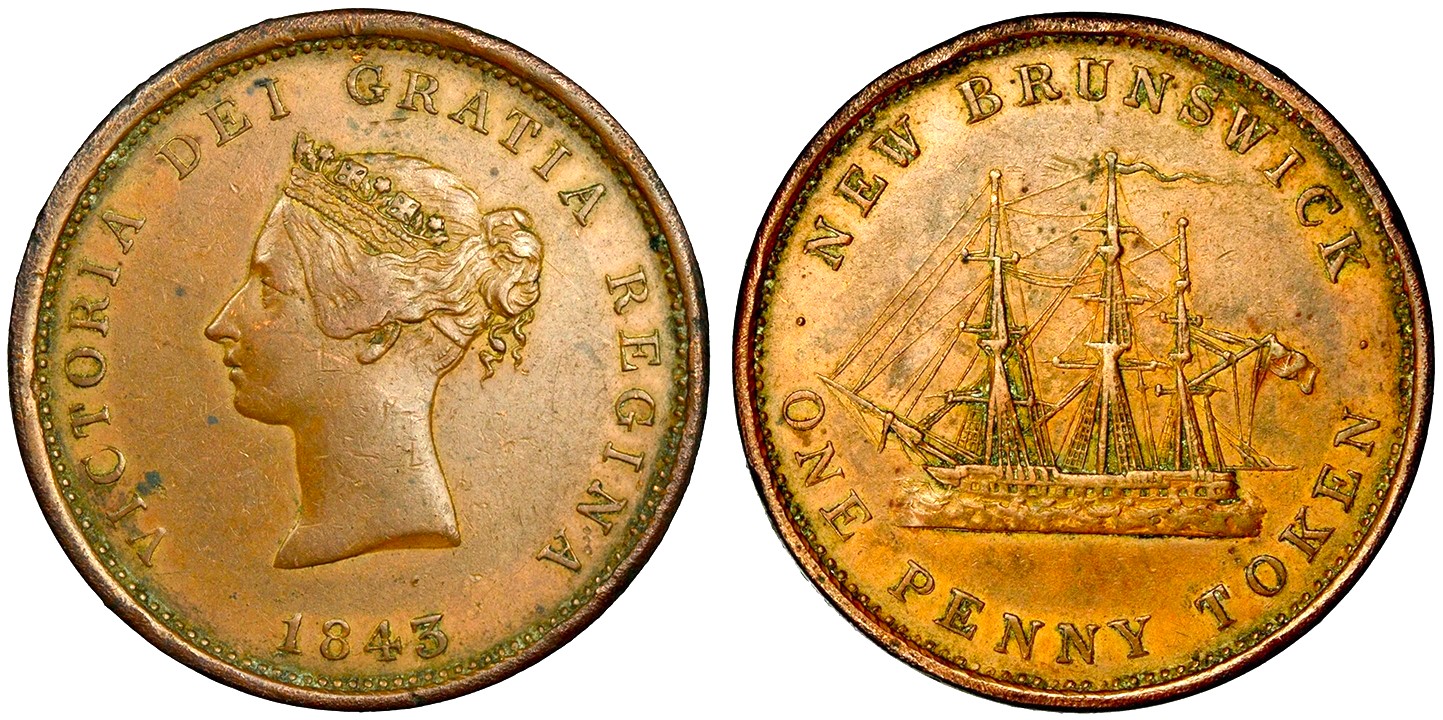
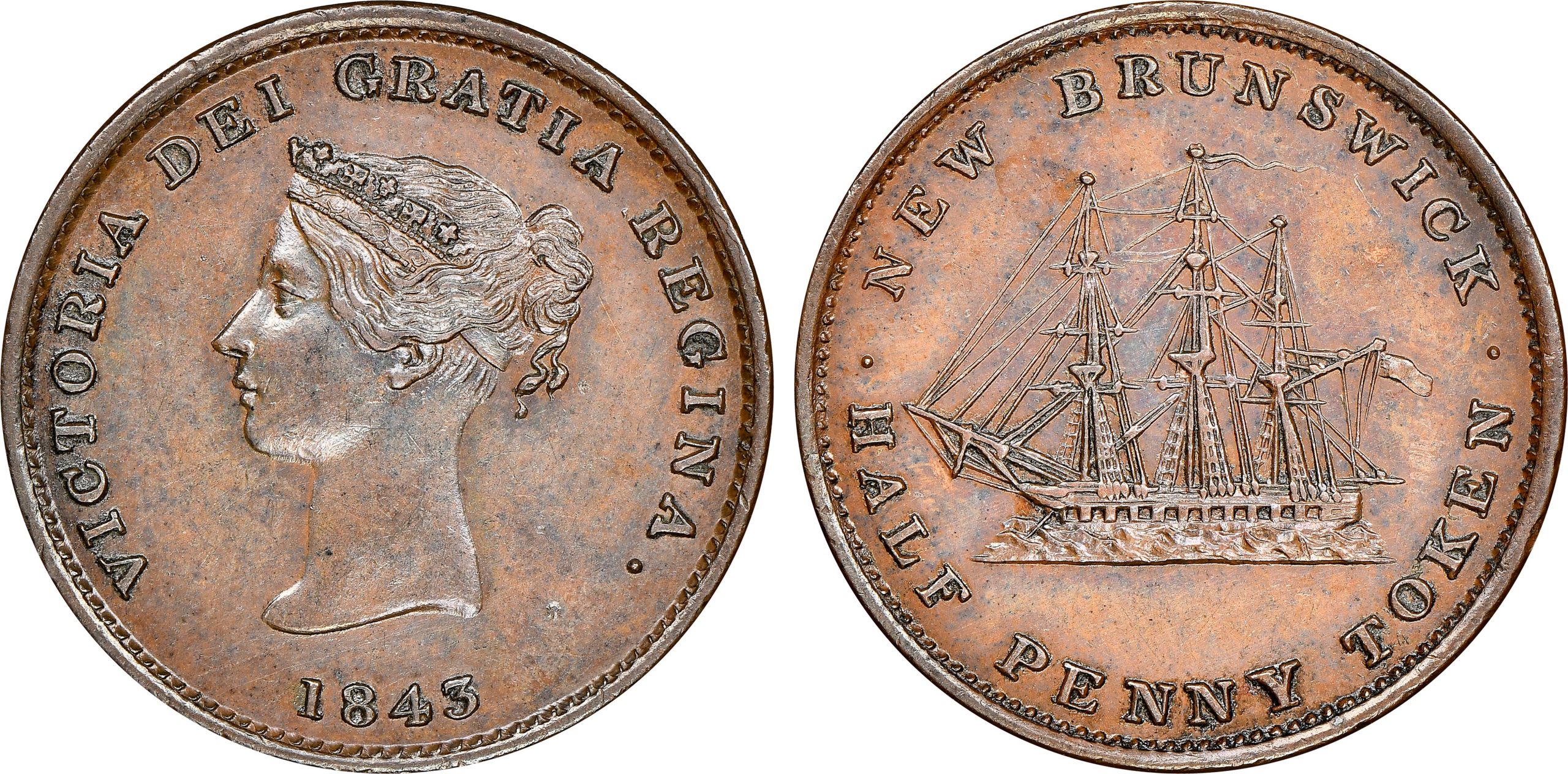
New Brunswick, which was originally part of Nova Scotia, was established as a separate colony in 1784. For several decades thereafter, a mixture of foreign coins obtained in trade provided an adequate circulating currency for the new colony. By the 1840s New Brunswick’s population and trade had expanded to the point where there was a real need for a local currency, and in 1843 the legislature decided to issue copper penny and halfpenny tokens. The order for the coins was placed without imperial sanction, however, and when the British authorities learned of the proposed coinage New Brunswick was ordered to abandon its plans immediately. The Colonial Office was informed that the contract had been cancelled, but the coins (dated 1843) were still put into circulation. This issue was sufficient to meet the needs of the growing colony for the next ten years.
By 1853 additional currency was required and the New Brunswick government requested permission to issue a copper coinage of pennies and halfpennies under the provisions of the Currency Act of 1852. Imperial sanction for this coinage was granted and the new issue appeared in 1854. The reverse design of both issues featured a frigate riding at anchor, reflecting the importance of shipbuilding as one of the earliest industries in the maritime provinces. On the 1854 coins the denomination appears as ONE PENNY CURRENCY in contrast with the phrase ONE PENNY TOKEN used on the l843 issue. The frigate pennies and halfpennies are considered to be among the most attractive of the British colonial series. The copper penny illustrated is about the size of a silver dollar and is part of the YSHS Fredericton Region Museum Currency Collection.
The four copper coins issued by the pre-Confederation province of New Brunswick bear a portrait of Queen Victoria (1855-1901) engraved by William Wyon on the obverse. The 1843 coins are similar to British pennies of the time but made with the Queen wearing a crown – the British coins do not have a crown. The 1854 coins reflect the change in approval, and the Queen is shown with out a crown to match the British versions.
The 1843 copper coins have been described as emergency coinage and are designated as official necessity coins. Value ½ Penny (1⁄480), Currency Pound (1852-1860). The lettering in Latin script reads: VICTORIA DEI GRATIA REGINA, NEW BRUNSWICK HALF PENNY TOKEN, 1843, and NEW BRUNSWICK PENNY TOKEN, 1843. NEW BRUNSWICK HALF PENNY CURRENCY, 1854, NEW BRUNSWICK PENNY CURRENCY, 1854.
The Reverse image is a profile of HMS New Brunswick sailing left. The milled coins have a plain edge, a weight of 8.6 – 9.0g, a thickness of 2-mm, and a diameter of 28.2-mm. There are slight variations in the minting of the coins:
NB-1A1 Three complete groups of heraldic flowers in queen’s diadem; Proofs exist.
NB-1A2 Two complete groups of heraldic flowers, third group has the thistle missing.
Minor variations exist in the ship’s rigging. (Library and Archives Canada)