ROLL CALL
NEWSLETTER OF THE FRIENDS OF THE NEW BRUNSWICK MILITARY HISTORY MUSEUM
AMIS/AMIES DE MUSEÉ D’HISTOIRE MILITAIRE DU NOUVEAU-BRUNSWICK
Volume 12, Issue 1 April 2026
Roll Call is published four times a year: Spring, Summer, Fall, and Winter. This issue is the first for 2026. Submissions or comments can be sent to the Editor, Hal Skaarup at hskaarup@rogers.com. For details on joining the Friends, please contact the Museum at 506-422-1304 or email us at: friendsnbmhm@gmail.com.
Friends of the New Brunswick Military History Museum Executive:
President – Brian MacDonald
Vice-President – Hal Skaarup
Secretary – Doug Hall
Treasurer – Randall Haslett
Directors – Gary Campbell, Brent Wilson, Harold Wright, Troy Middleton, Nicole O’Byrne, John Logan
Opening of the New Brunswick Military History Museum, 6 June 2014
by J. Brent Wilson
Between 2011 and 2014, I worked with museum directors Kevin Anderson and Greg Fekner, museum technician Jason Meade, and designer George Quigley to transform the Base Gagetown Museum into the New Brunswick Military History Museum. Below are the remarks I made at Museum reopening on 6 June 2014.
***
Colonel Malejczuk, members of Base Gagetown, members of the Museum’s staff, Friends of the Museum, ladies and gentlemen. Good afternoon and thank you for the opportunity to speak today. It’s my great pleasure to address you on behalf of the Gregg Centre for the Study of War and Society at the University of New Brunswick and bring you greetings from our director, Dr. Marc Milner, who is on the beaches of Normandy as we speak, and Drs. Lee Windsor, our deputy director, and Cindy Brown, both of whom just returned from the battlefields of Italy – Lee is in Toronto today – as well as Dr. David Charters and our office manager Valerie Gallant who have remained behind to carry on our work on the home front.
The Gregg Centre has worked in close partnership with the museum from the beginning of its transformation from the Base Gagetown Museum to the New Brunswick Military History Museum, which now chronicles the province’s more than 400 years’ association with Canada’s military participation in its wars, both at home and overseas. Beginning with the First Nations peoples, and early French and British colonial eras, through Canada’s early national period and up to the present, thousands of New Brunswickers have served in the armed forces of the day, while their families supported them from home. And it is the aim of the museum to tell this history as comprehensively as possible so that New Brunswickers from across the province can learn more about the experiences of their ancestors and communities over the years.
Using artifacts and images from its own collections as well as other sources, the museum highlights many of these events and those who took part in them, ranging from the Siege of Fort La Tour in 1645 and winter march of the 104th New Brunswick Regiment during the War of 1812, to the surrender of the Boers at Paardeberg in South Africa in 1900, the capture of Passchendaele in 1917, the landing in Normandy on D-Day in 1944 (70 years ago today), and the recent conflicts in Bosnia and Afghanistan.
As we approach the centenary of the First World War, the experience of the thousands of New Brunswickers who joined up during that conflict as well as the challenges facing those who supported them from home will take centre place in our acts of commemoration and remembrance that have already begun to occur around the province. Tomorrow the Albert County Museum in Hopewell Cape will be hosting an event called “Albert County Remembers.”
Among the exhibits the military experiences of individuals from the province are featured, including three New Brunswickers during the Frist World War: Midshipman Victor Hatheway from Fredericton, who was among the first Canadians to die in the war when his ship, H.M.S. Good Hope, was sunk in November 1914; Captain Jean V. Gaudet of Memramcook, the chaplain of the 165th (French Acadian) Battalion; and Lieutenant Milton F. Gregg of Mountain Dale, who received the Victoria Cross in September 1918.
The exhibits also tell the story of how New Brunswickers on the home front have supported Canada’s wars over time, including the 17,000 soldiers who were recruited from the province during the Great War, and the many warships that were constructed and repaired at the St. John Drydock and Shipbuilding Company in Saint John during the Second World War. They also record how many New Brunswick women worked in factories like the McAvity Foundry during both world wars and served as nursing sisters and members of the three services beginning in the early twentieth century.
Of course, the significance of today’s date is lost on no one here today, June 6, being the 70th Anniversary of the D-Day invasion and the beginning of the grueling two- month Normandy Campaign in which hundreds of New Brunswickers fought and many were lost. We are very honoured to have one of those New Brunswickers with us today, the Honourable Justice David M. Dickson [point out]. On D-Day Justice Dickson was Brigade Major with the 9th Canadian (Highland) Infantry Brigade and landed later in the day on the sixth. He remained on the staff of 9th Brigade until later in 1944 when he took command of a company of the North Nova Scotia Highlanders and was seriously wounded in March 1945. After the war Justice Dickson became involved in the Royal Canadian Legion, serving as president of the Fredericton branch in the 1950s, and was a strong advocate on behalf of veterans. Justice Dickson, we thank you for your service.
So, we congratulate the museum’s staff and friends on having risen to the challenge of transforming itself into the New Brunswick Military History Museum so successfully and thank the Base for giving the Gregg Centre the opportunity to participate in this very worthwhile and important project, and we look forward to continuing our partnership with the museum in the future.
Thank you.
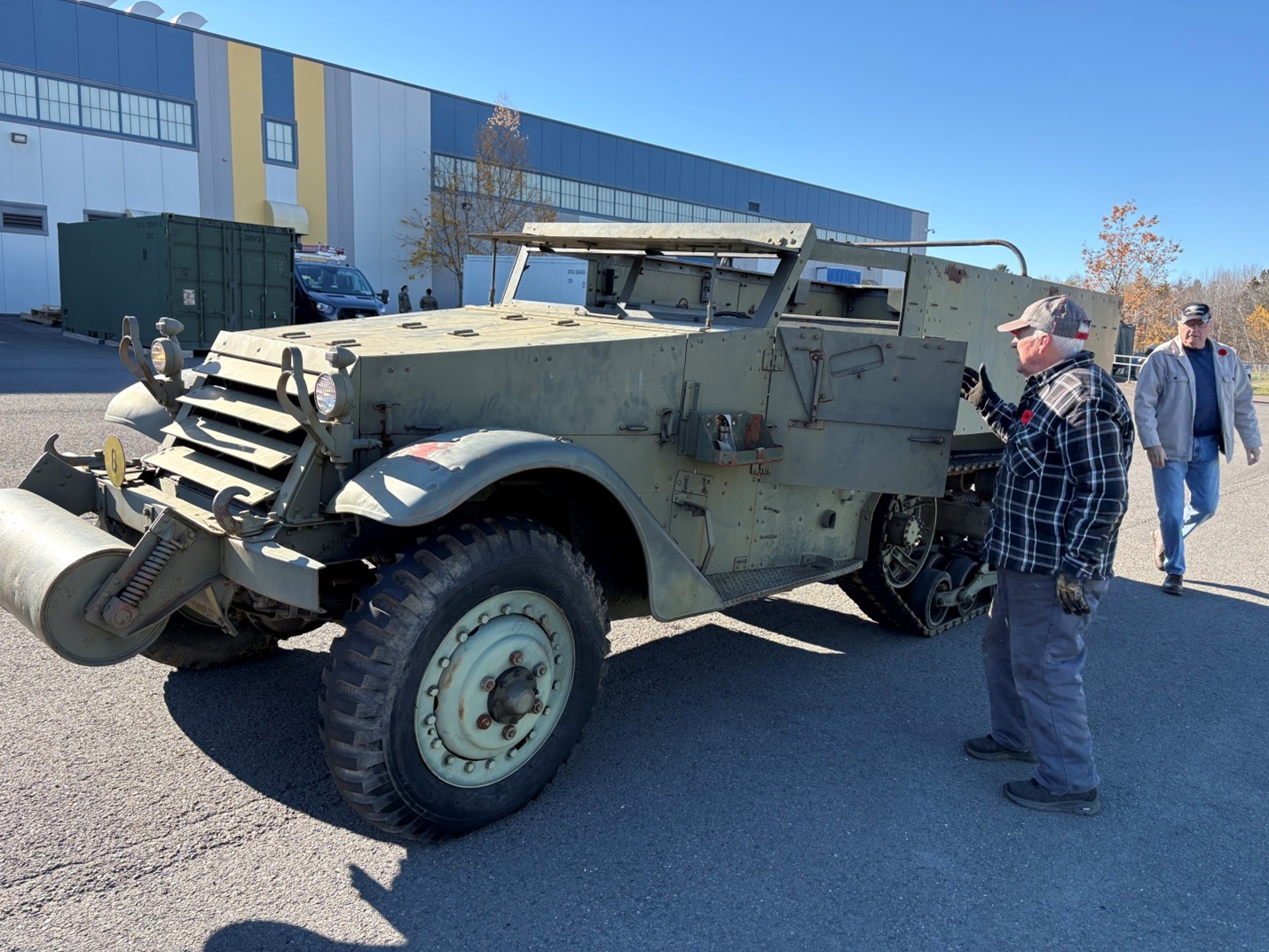
Before the vehicle was moved to the hanger, the Restoration Team of MWO (retired) Don Swain
1942 White M3 Half Track Restoration, CZ 4036146
Brief History
The M3 was extensively modified with several dozen variant designs produced for different purposes. It was an armoured vehicle with wheels at the front and propelled by tracks underneath the main body. During the Second World War, the M3 and its variants were supplied to the US Army and Marines, as well as British Commonwealth including Canada and Soviet Army forces, serving on all major fronts throughout the war. The M3 and its variants were produced by many manufacturers including Diamond T, White Motor Company, and Autocar. They were adapted for a wide variety of uses, such as a self-propelled anti-aircraft weapon or self-propelled artillery. Although initially unpopular due to its lack of significant armour or a roof to protect the passengers and crew from shrapnel, it was used by most of the Allies during the war.
Soviet Army forces, serving on all major fronts throughout the war. The M3 and its variants were produced by many manufacturers including Diamond T, White Motor Company, and Autocar. They were adapted for a wide variety of uses, such as a self-propelled anti-aircraft weapon or self-propelled artillery.Although initially unpopular due to its lack of significant armour or a roof to protect the passengers and crew from shrapnel, it was used by most of the Allies during the war.
CZ 4036146 was acquired by the Royal New Brunswick Regiment (Carleton & York) by Major RN Haslett OC Support Company in the summer of 1983 from the owner in Maine who resided in Boiestown, NB for almost twenty years. It was sandblasted and repainted by Base Maintenance and made road worthy. It was used for ceremonial occasions such as the Fortieth Anniversary of D-Day in Grand Falls and the Combat Training Centre of Major General Lewis Mackenzie in July 1990. For several reasons, the halftrack (CZ) was donated to the NBMHM.
In preparation for the upcoming NB Military History Expo, the Museum Manager, David Hughes decided it would be a good idea to get the half rack back in running order. Under the supervision of Randall Haslett, Treasurer of the Friends, a volunteer team was put together to make it a runner again. The CO 2 RCR gave his approval for NBMHM to restore the vehicle in of one of the vehicle bays (Golf Company) while the unit was deployed to Latvia.
Canadian Artillery in St. Lucia, 1915-1919
Hal Skaarup
Canadian gunners served in St. Lucia from 1915 to 1919 during the First World War. In March and April 1915 detachments of the Royal Canadian Artillery and the Canadian Garrison Artillery landed in St. Lucia, with a force of nine officers and 105 other ranks. The contingent of officers and men manned the artillery installed to protect the Castries harbour, the Castries coaling station and the Royal Navy Station in the southern Caribbean.
This force, at the Armistice in 1918, consisted of fourteen officers and two hundred and four other ranks of the Royal Canadian Artillery, two officers and twenty-eight other ranks of the Royal Canadian Engineers, and one officer and eight other ranks of the Canadian Army Medical Corps. Royal Canadian Horse Artillery, “C” Battery, was stationed at Castries from October of 1917 until 1919. One draft of the 1st (Halifax-Dartmouth) Field Artillery Regiment helped to form No. 6 Company, Siege Artillery, which served in St. Lucia.
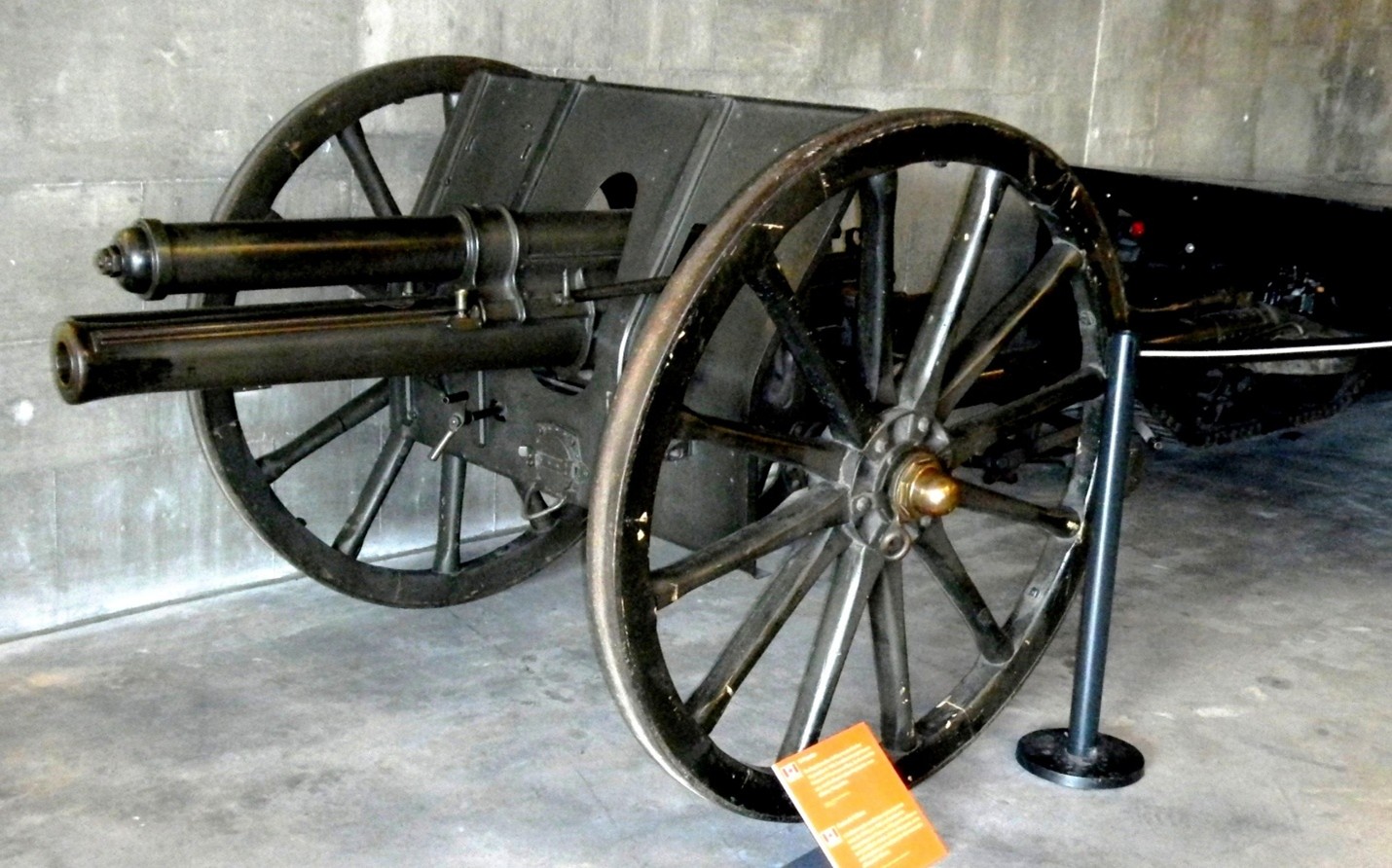
The Canadian gunners were equipped with the Ordnance QF 13-pounder (quick firing) field gun, which was the standard equipment of the British and Canadian Royal Horse Artillery when the First World War broke out in 1914. It was developed as a response to combat experience gained in the Boer War and entered service in 1904. It was intended as a rapid-firing and highly-mobile yet reasonably powerful field gun for RHA batteries supporting Cavalry brigades, which were expected to be engaged in mobile open warfare.
Nursing Sisters
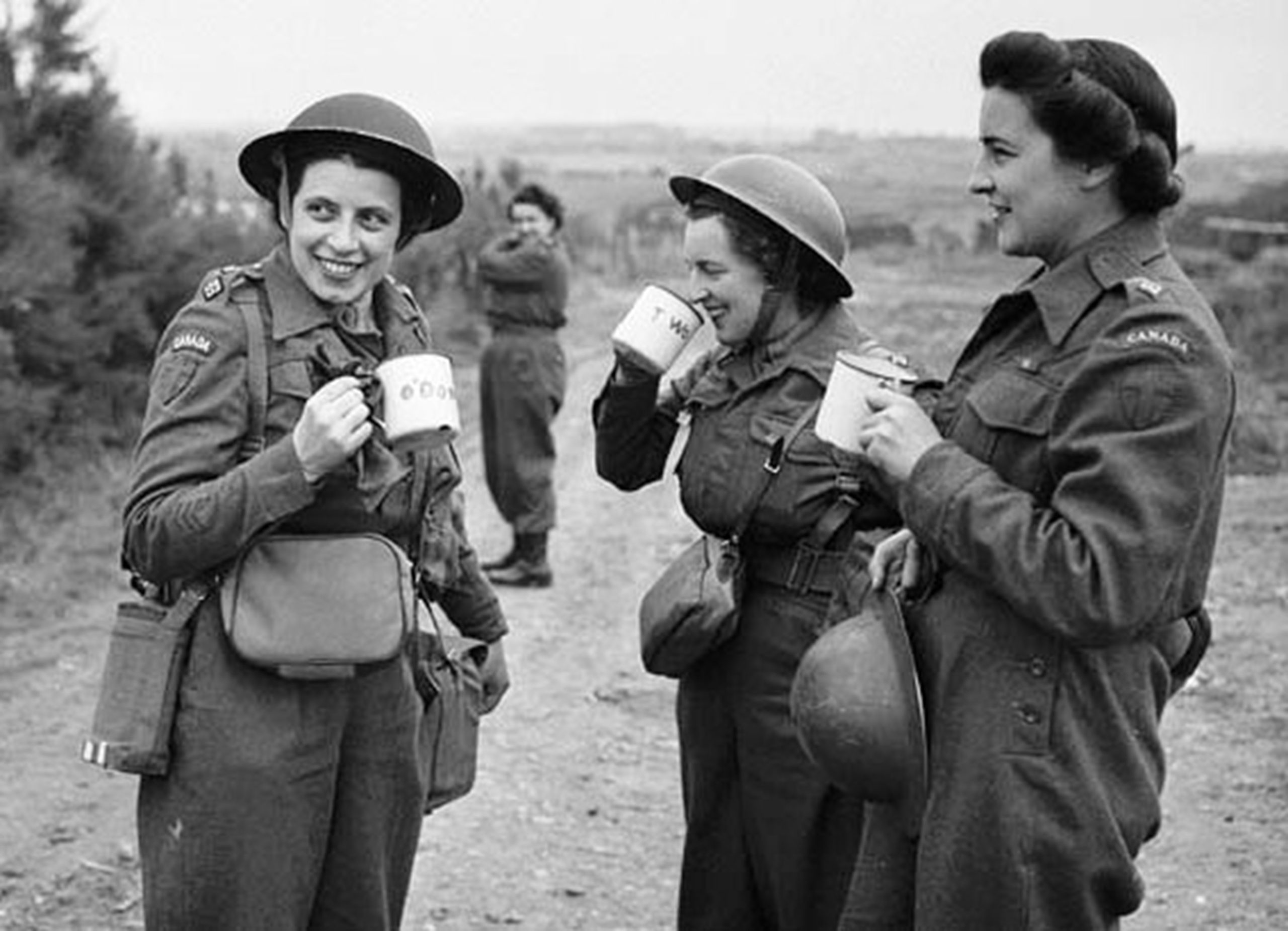
(Library and Archives Canada Photo, MIKAN No. 3191691)
Nursing sisters of Canadian General Hospital, No. 10, Royal Canadian Army Medical Corps, having a cup of tea upon arriving at Arromanches, France, 23 July 1944.
The Nursing Service of the Royal Canadian Air Force was authorized in November 1940. More than 100 station hospitals were built and the Nursing Sisters were more and more in demand. Some of them were trained for evacuation by air, 12 served in Newfoundland to participate in air-sea rescue missions and 66 served overseas. By the end of the Second World War, 3,649 Nursing Sisters had served in the Army, 481 in the Air Force and 343 in the Navy.
No account of military service in the Second World War would be complete without mention of the contribution made by the four special branches of the nursing service – the Physiotherapists, Occupational Therapists, Dietitians and Home Sisters. Also, the sisters who served on the hospital trains returning the wounded to destinations across Canada.
The end of the Second World War brought the closure of military and station hospitals across Canada. A total of 80 nurses, 30 RCAMC, 30 RCAF and 20 RCN sisters joined the permanent force and served at military establishments across the country; many more staffed the Department of Veterans Affairs’ hospitals to care for hundreds of returning Veterans. (Internet: http://www.veterans.gc.ca/eng/remembrance/those-who-served/women-and-war/nursing-sisters)
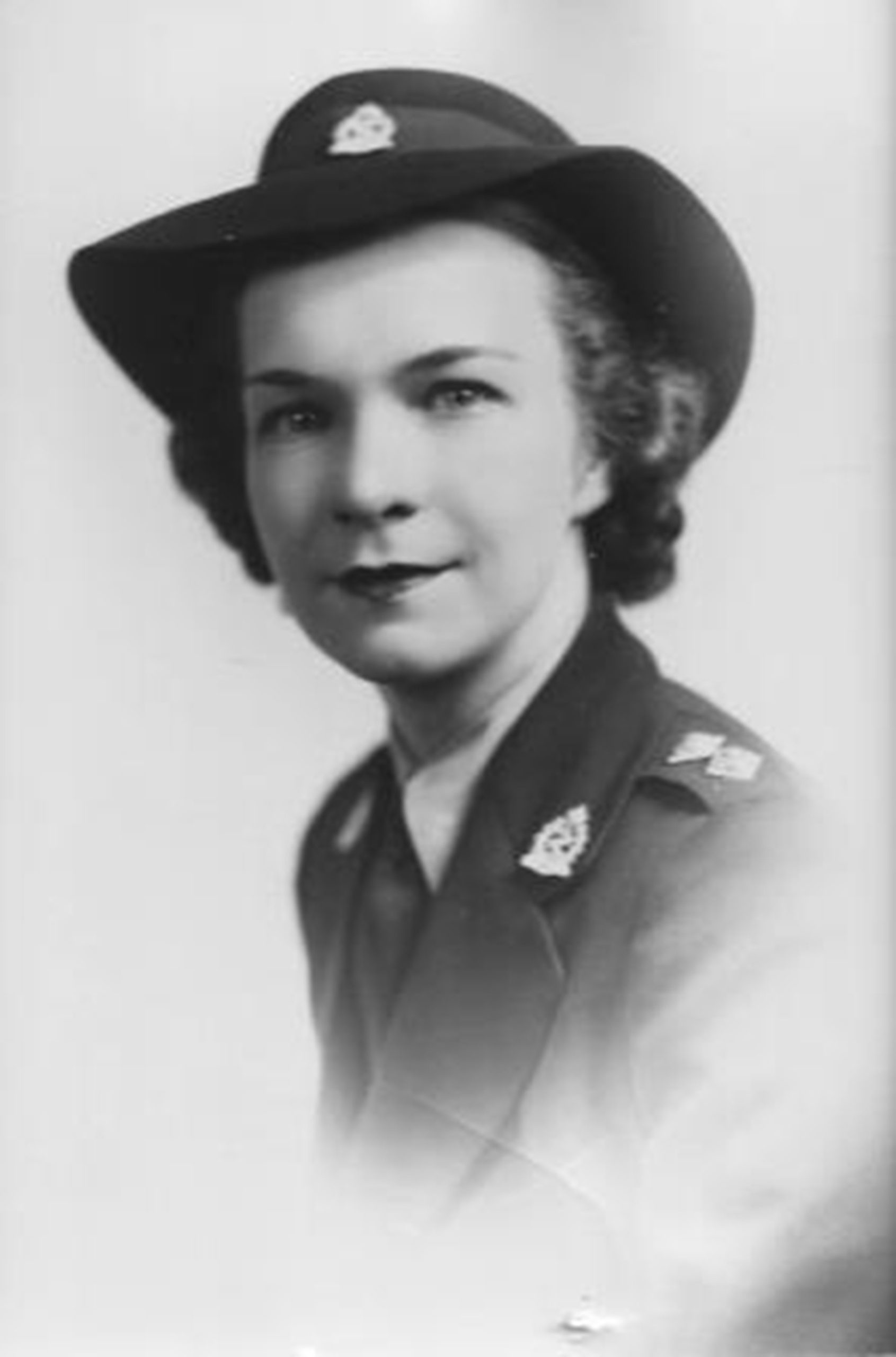
(Photo courtesy of Andrea Folster)
Lieutenant Mary Pauline Montgomery, born 9 Jan 1913, in Woodstock, New Brunswick was one of the Nursing Sisters who served in Northwest Europe during the war. Her parents were Agnes Josephine Sproul(e) and Charles Augustus Montgomery. She graduated from Woodstock Secondary School and took a commercial certificate at Carleton County Vocational School. She later graduated from the Saint John General Hospital School of Nursing. Before the war she served from 1935-37, Private Duty Nursing; 1937-39 1 year General Duty Nursing at Long Island College Hospital; and 1 year at St John’s Hospital, Brooklyn, New York. 1940-41, Private duty Nursing and 2 months floor duty at Montreal Shriners’ Hospital.
She enlisted in The Royal Canadian Army Medical Corps (RCAMC) on 10 Mar 1942 and was appointed as Nursing Sister to the Sussex Military Hospital, New Brunswick, serving there and at Saint John, Sussex (again), and Brockville, Ontario. On 10 Sep 1942 she was commissioned (Service No. 87349) as a Lieutenant in the RCAMC and on 14 Sep 1943, despite the fact that she was terrified of flying, left Montreal, Quebec on a drafty, noisy flight via Gander, Newfoundland and Reykjavik, Iceland to England to serve with Canadian General Hospital, No. 2 (CGH) at Colchester and Bramshott. On 10 Aug 1944 she flew to France and was posted at Canadian General Hospital, No. 2, at Bayeux, Normandy and in December at No. 10 CGH at Ghent, Belgium, where she remained until her return to Canada on 30 Jul 1945. She was returned to Reserve Status on 9 Mar 1946. Source: Library and Archives Canada, File A-2011-05138 / KJ. (Official History of the Canadian Medical Services 1939-1945 Volume 1. Organization & Campaigns, Feasby B.A., M.D., W.R., Queen’s Printer, Ottawa. 1956).
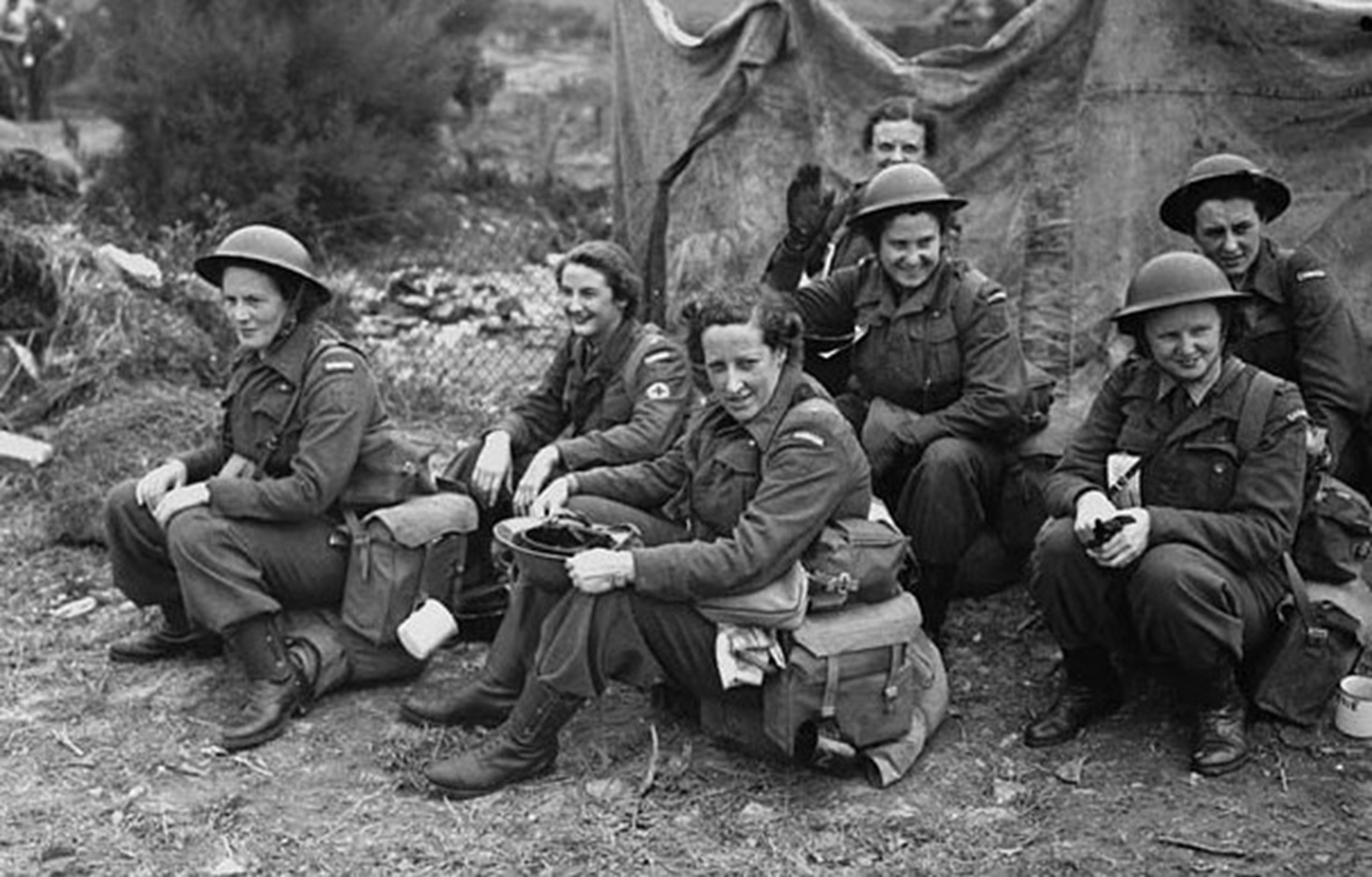
(Library and Archives Canada Photo, MIKAN No. 3194289)
Nursing Sisters, Canadian General Hospital, No. 10, Arromanches, France, 23 July 1944.
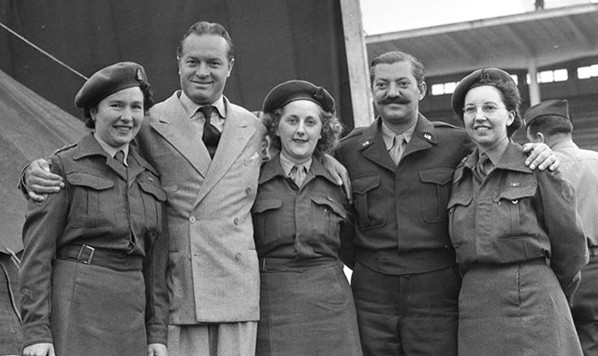
(Library and Archives Canada Photo, MIKAN No. 3624888)
Canadian Nursing Sisters talking with members of the Bob Hope Show, 24 July 1945.