
Laniakea
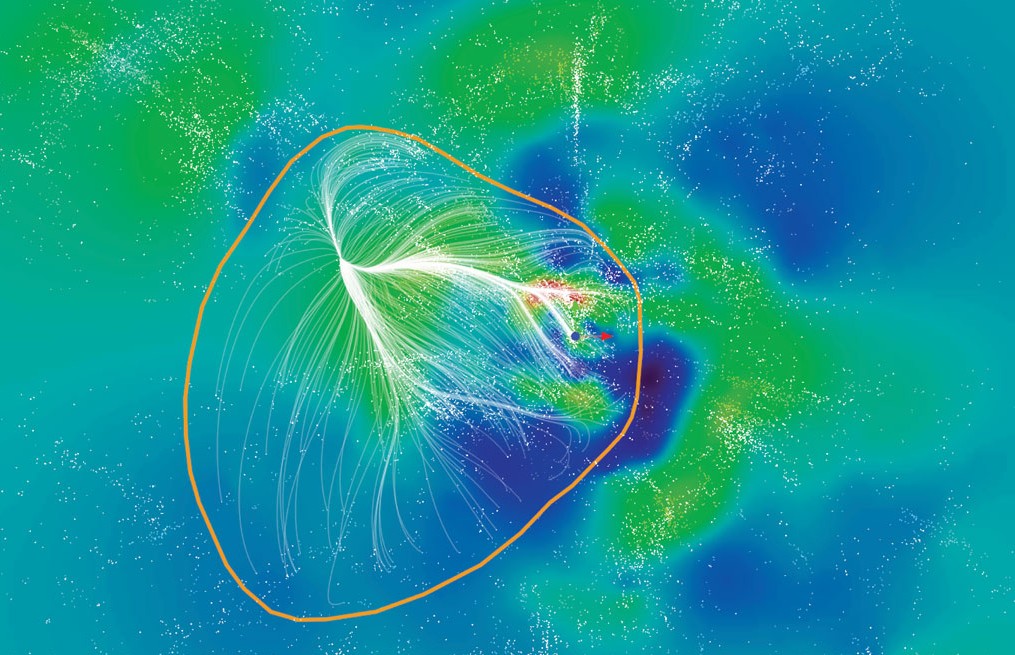
Our Milky Way galaxy and Local Group lie in the Laniakea Supercluster. The Laniakea shown in a computer-generated visualization in an orange outline, with white lines inside indicating motions of galaxies towards its center. The blue dot shows the location of the Milky Way. (Courtesy: Brent Tully et al./Nature)
The Laniakea Supercluster or Laniakea for short (Hawaiian for “open skies” or “immense heaven”) is the large-scale structure centered around the Great Attractor that is home to the Milky Way and approximately 100,000 other nearby galaxies. It was originally defined in September 2014 as a galaxy supercluster, when a group of astronomers, including R. Brent Tully of the University of Hawaiʻi at Mānoa, Hélène Courtois of the University of Lyon, Yehuda Hoffman of the Hebrew University of Jerusalem, and Daniel Pomarède of CEA Université Paris-Saclay published a new way of defining superclusters according to the relative velocities of galaxies as basins of attraction. The new definition of the Local Supercluster subsumes the then prior defined Virgo and Hydra-Centaurus Supercluster as appendages, the former being the historical local supercluster.
Follow-up studies suggest that the Laniakea is not gravitationally bound. It will disperse rather than continue to maintain itself as an overdensity relative to surrounding areas. In addition, some papers favored the traditional definition of superclusters as high-density regions of the cosmic web; basins of attraction including Laniakea were therefore proposed to be called “supercluster cocoons” (or “cocoons” for short), containing smaller traditional superclusters, which evolve inside their parent cocoon.
The Laniakea is the inner part of the local superstructure, also known as Pisces–Cetus Supercluster Complex. Both are among the largest known cosmic structures in the observable universe. Latest observations of basins of attraction suggested a basin of attraction around Ophiuchus Cluster may be associated with Laniakea, and also have found both are moving toward the Shapley Concentration and may thus be part of this greater structure. (Wikipedia)
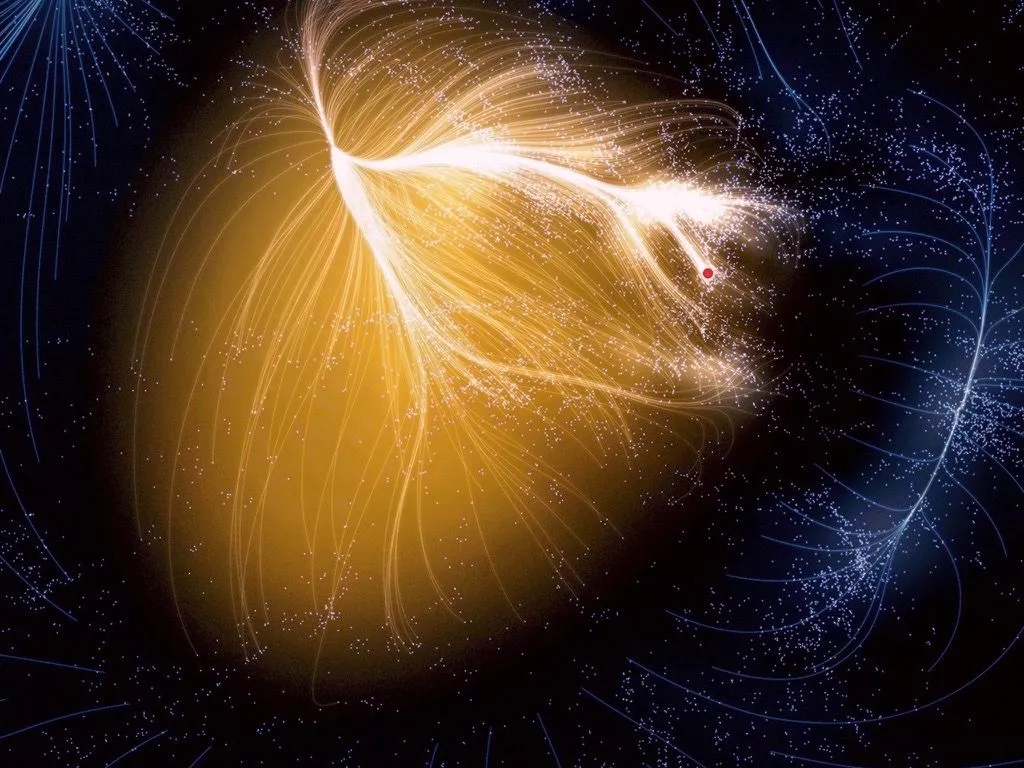
Laniakea Supercluster Photograph by Claus Lunau/science Photo Library
Laniakea is a supercluster of about 100,000 large galaxies that includes our own Milky Way and spans nearly a half-billion light years. Laniakea encompasses about 100,000 galaxies and spans an incredible expanse of approximately 520 million light-years.
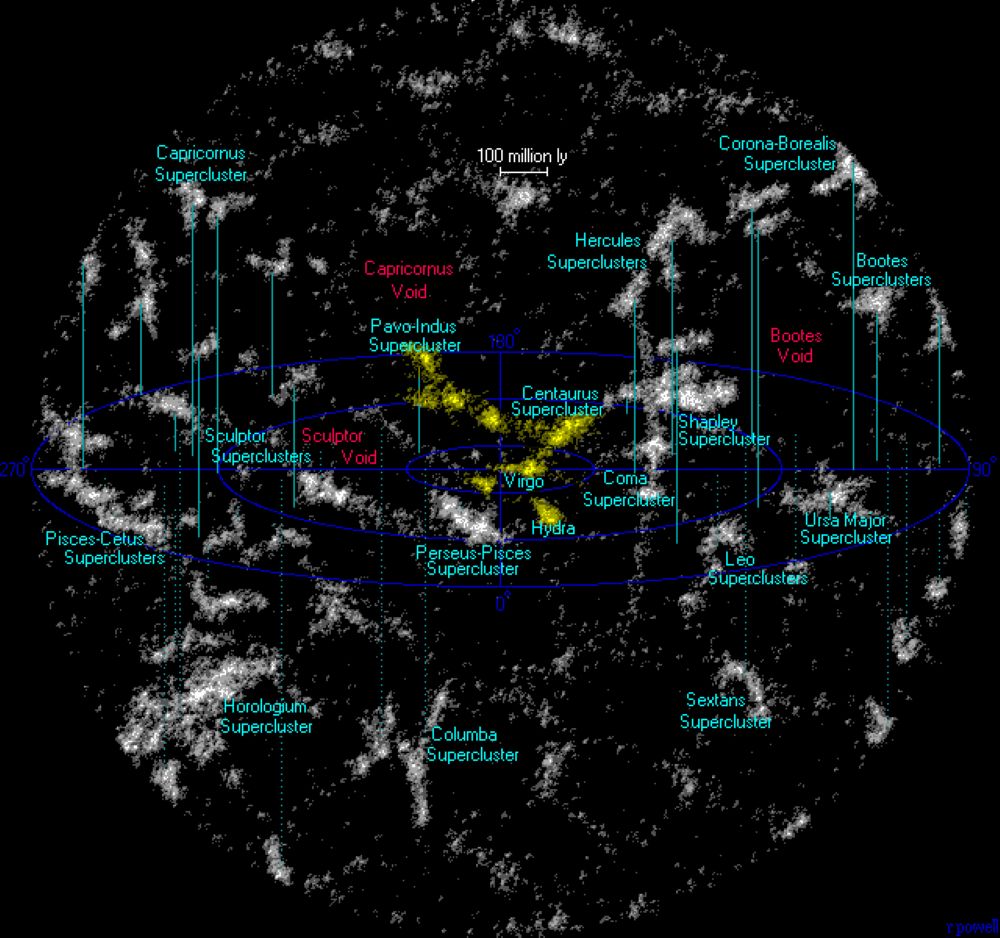
(Richard Powell Map)
Map of superclusters of galaxies and voids in a distance of one billion light years from the milky way. The supercluster Laniakea is marked in yellow.
Laniakea is a fascinating concept that describes the size and structure of the observable universe. The term “Laniakea” comes from the Hawaiian language and means “immeasurable heaven” or “vast celestial empyrean.” It refers to the huge supercluster region that includes our Milky Way galaxy.