
Artillery preserved on the island of St. Lucia
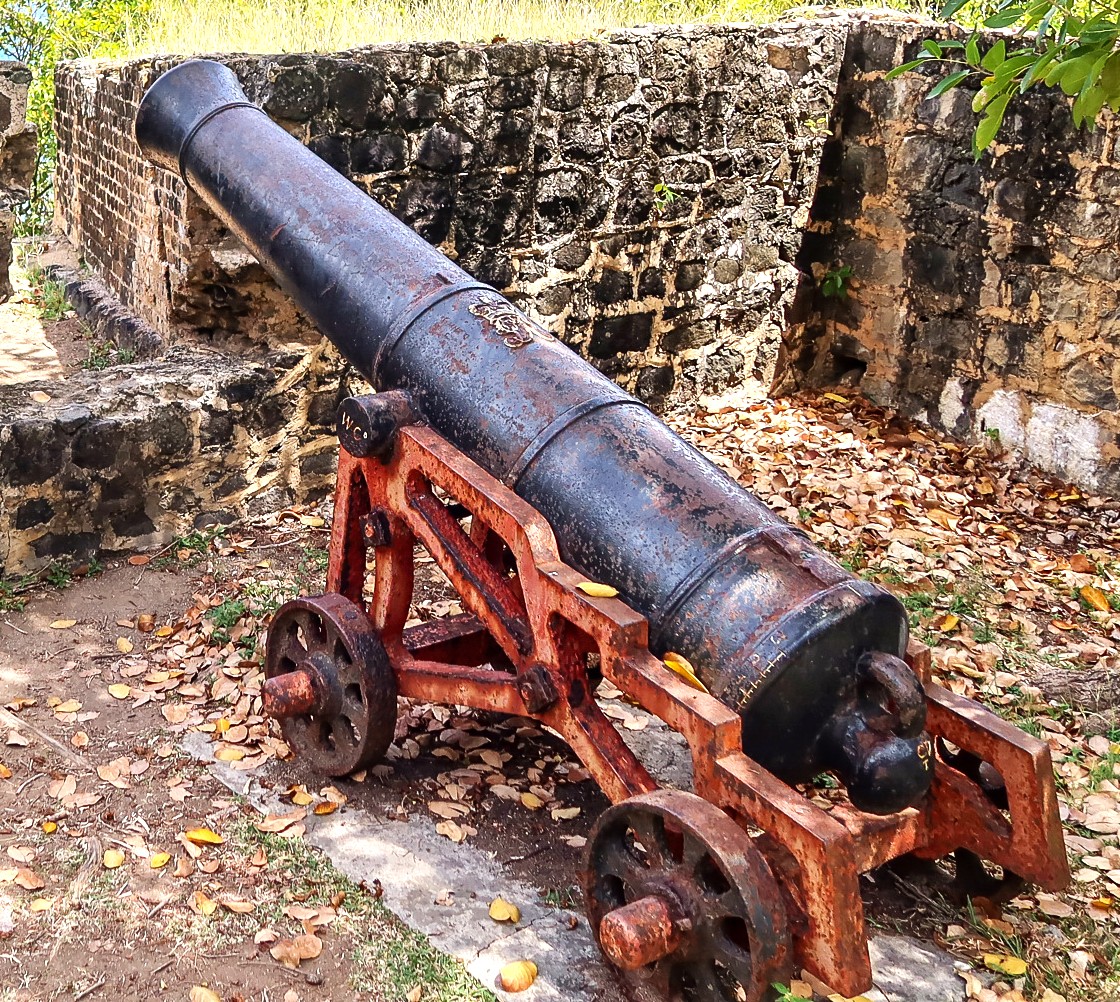
(DWHIKE Photo)
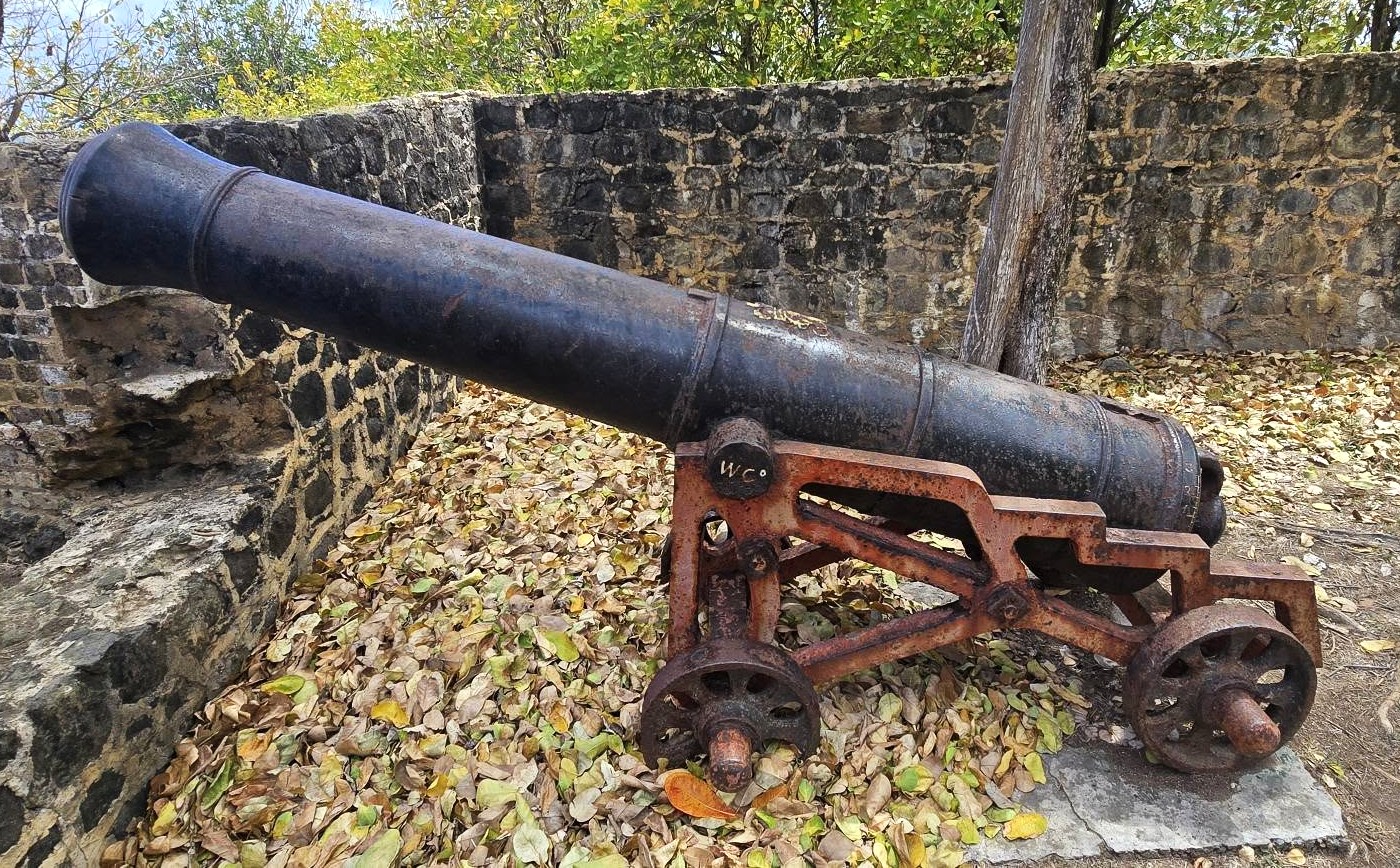
Blomefield Cast 24-pounder Smoothbore Muzzleloading Gun with Walker Company (WCo) on the left trunnion, (Serial No. 166) on the right trunnion, King George 3 cypher, mounted on an iron garrison carriage. No. 1 of 2 in the Two Gun Battery.
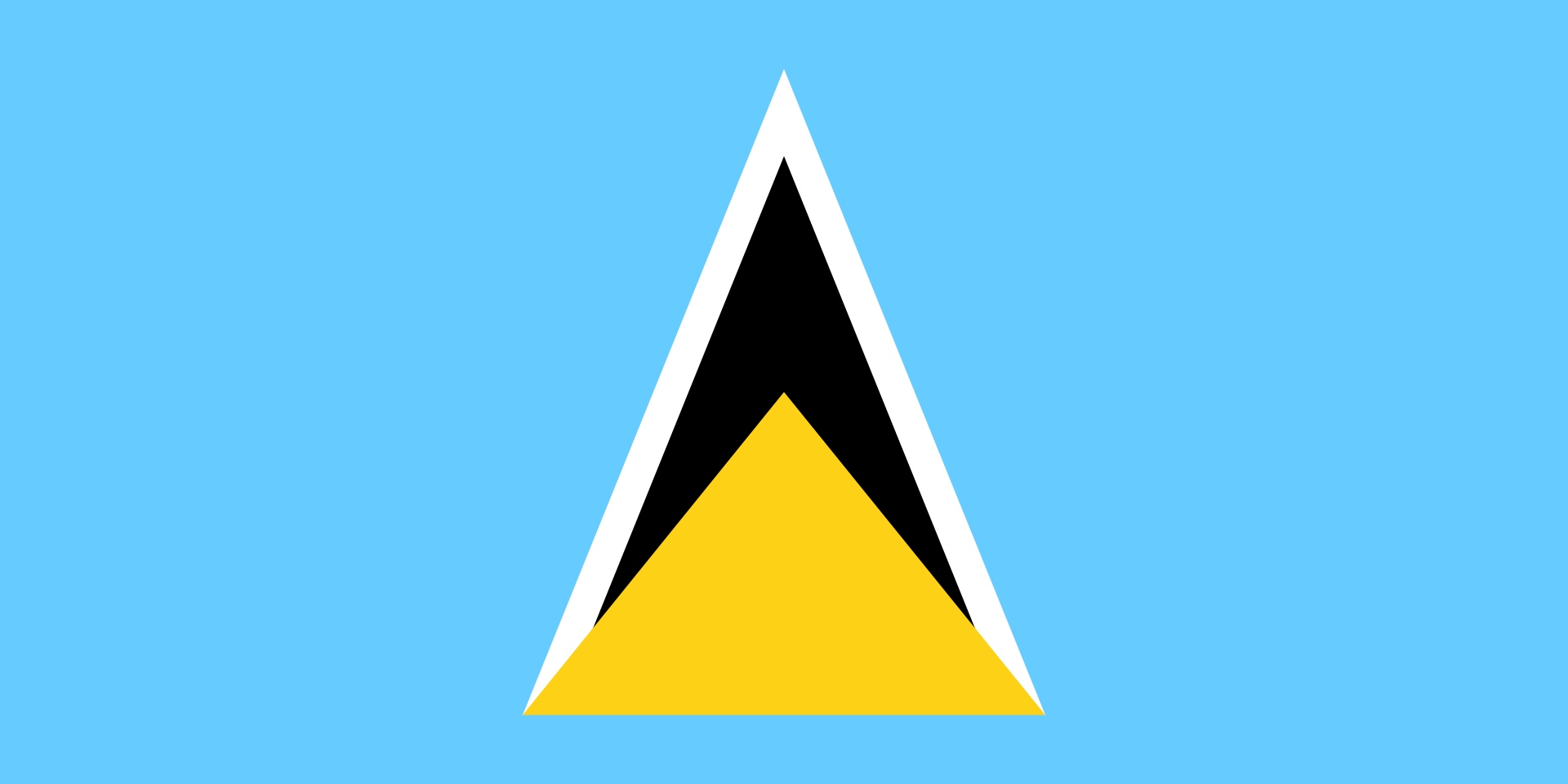 Flag of St. Lucia.
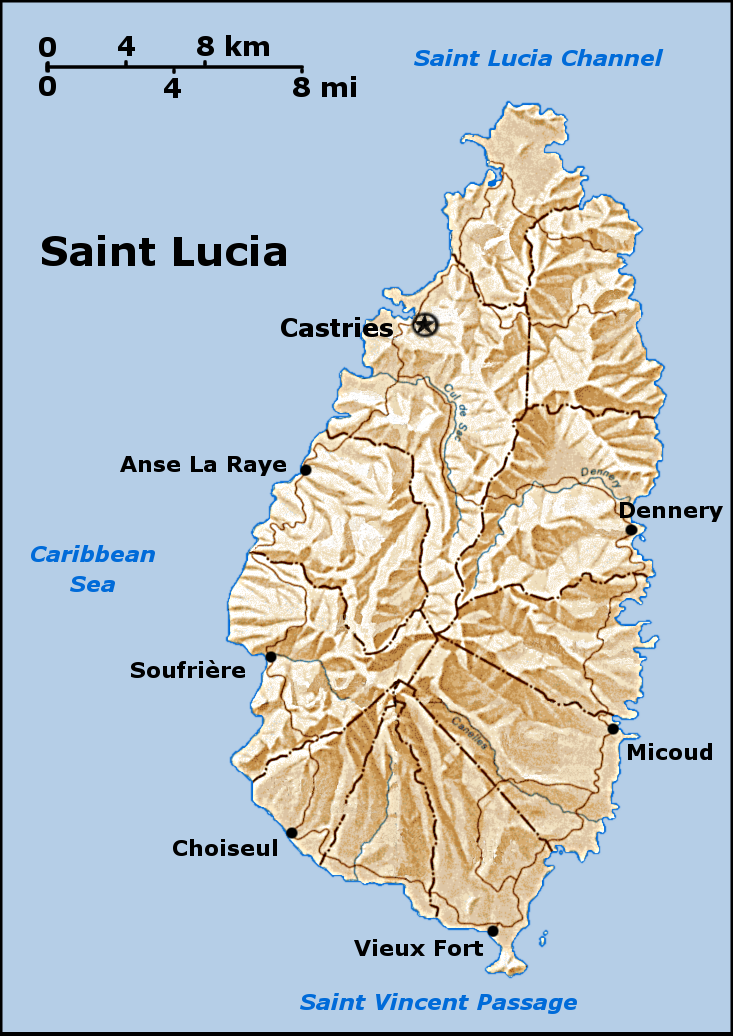
Saint Lucia is an island country in the eastern Caribbean.[9] Part of the Windward Islands of the Lesser Antilles, it is located north/northeast of the island of Saint Vincent, northwest of Barbados and south of Martinique. It covers a land area of 617 km2 (238 square miles) with an officially estimated population of over 184,100 people as of mid 2023. The nation’s capital and largest city is Castrie
Artillery in St. Lucia
Saint Lucia was inhabited by the Arawak and Kalinago Caribs before European contact in the early 16th century. It was colonized by the British and French in the 17th century and was the subject of several possession changes until 1814, when it was ceded to the British by France for the final time. In 1958, St. Lucia joined the short-lived semi-autonomous West Indies Federation. Saint Lucia was an associated state of the United Kingdom from 1967 to 1979 and then gained full independence on 22 Feb 1979.
St. Lucia features extensive 18th and 19th-century British artillery, notably at Fort Rodney on Pigeon Island and the La Toc Battery in Castries, which was established to defend the harbour from French forces. Key sites include 24-pounder cannons, mortar positions, and the restored 12-ton guns at the Apostles’ Battery on Morne Fortune. These fortifications, often overlooking strategic bays, are maintained by the St. Lucia National Trust.
Manning of the Apostles’ Battery on the Morne was begun on 16 Dec 1888, when a detachment of 49 men of the 1st West India Regiment arrived at Castries to begin fortifying the port. The first detachment of Royal Artillery arrived on 12 Nov 1890, along with four huge guns to equip the battery. This, and all other forts in Saint Lucia, were abandoned in 1905 when salvageable metal and hardware was removed. The guns were dismounted and thrown over the abutments and the sites were declared unrequired for military service.
Key Artillery Locations on St. Lucia and History
Fort Rodney (Pigeon Island): Built in 1778, this site features a powder magazine, a 24-pounder smoothbore muzzleloading (SBML) gun and other guns that served to protect St. Lucia against French ships from Martinique.
La Toc Battery: Located above Castries harbour, this battery contains muzzle-loading shell guns, underground storage for shells, and defensive walls designed to protect the coaling station. The old fort was previously garrisoned by British Colonial Forces. Today it is an historical site, with stone walls, secret underground passages, and provides visitors with a glimpse into a past world. There were 60 surrounding forts protecting the valuable coaling harbour at Castries, of which La Toc is the best preserved. It was completed in 1888 and in use until 1905. It was originally built by the British to repel attacks on the harbour.
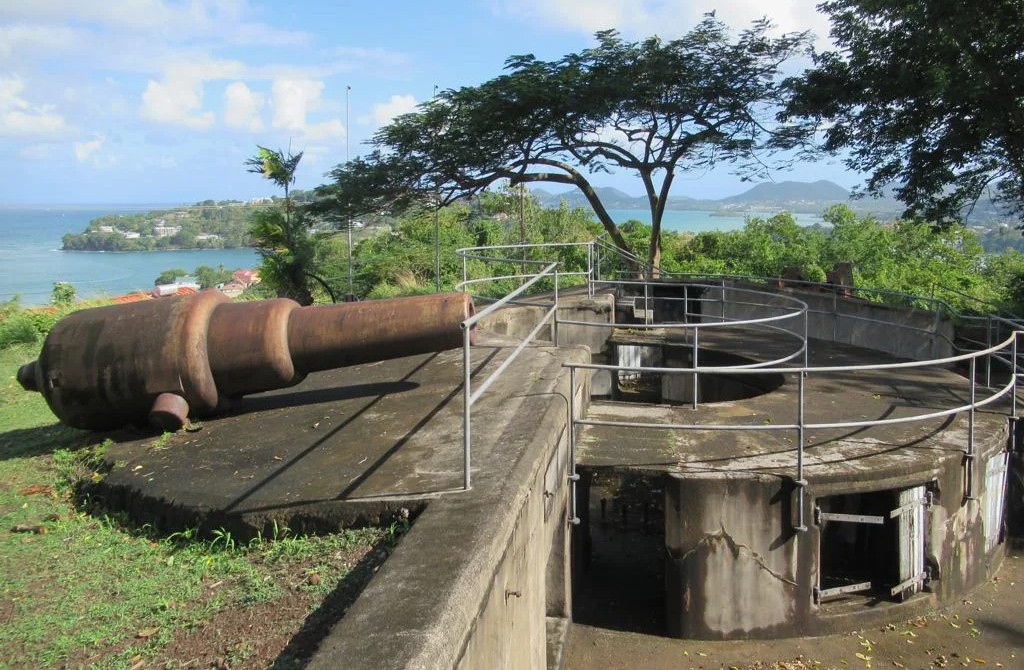
(David Stanley Photo)
The RML 10-inch guns Mk I – Mk II like this one, were large rifled muzzle-loading shell guns designed for British battleships and monitors in the 1860s to 1880s. They were also used for fixed coastal defences around the United Kingdom and around the British Empire until the early years of the 20th century.
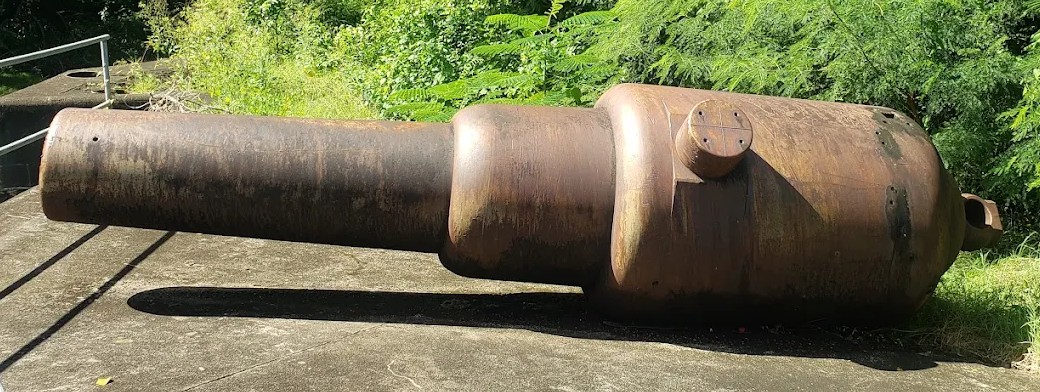
(Steve Eggar Photo)
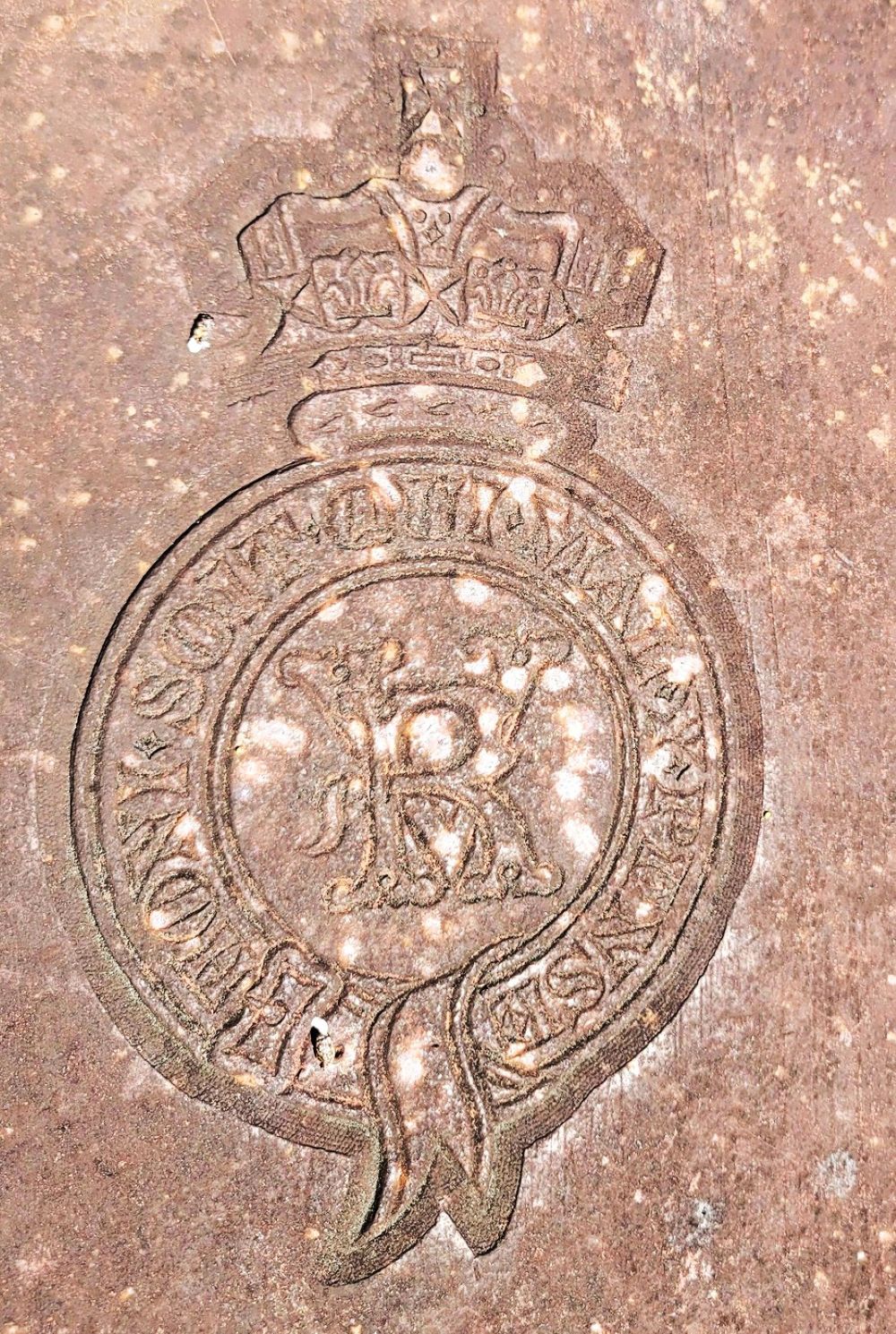
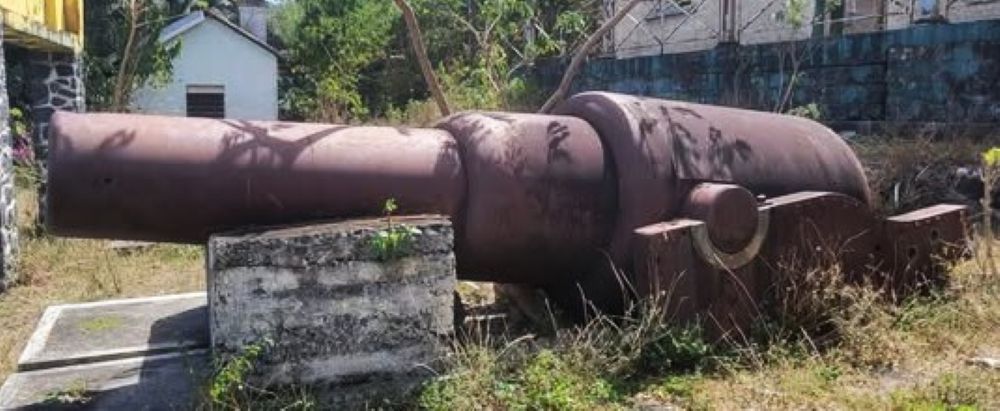
10-inch 18-ton Mk. II Muzzleloading Rifled shell gun, weight unknown, likely in the range of 17-0-0-0 (TBC), (RGF No. unknown, c1870) on left trunnion, (+) on right trunnion, Queen Victoria cypher, normally mounted on an iron traversing carriage. An English ton is 2,240 lbs, therefore the weight for this gun would be (17 X 2,240 lbs = 38,080 lbs) + any additional numbers which could add (number X 112 lbs) which would be close to 20 tons in Canadian weight.
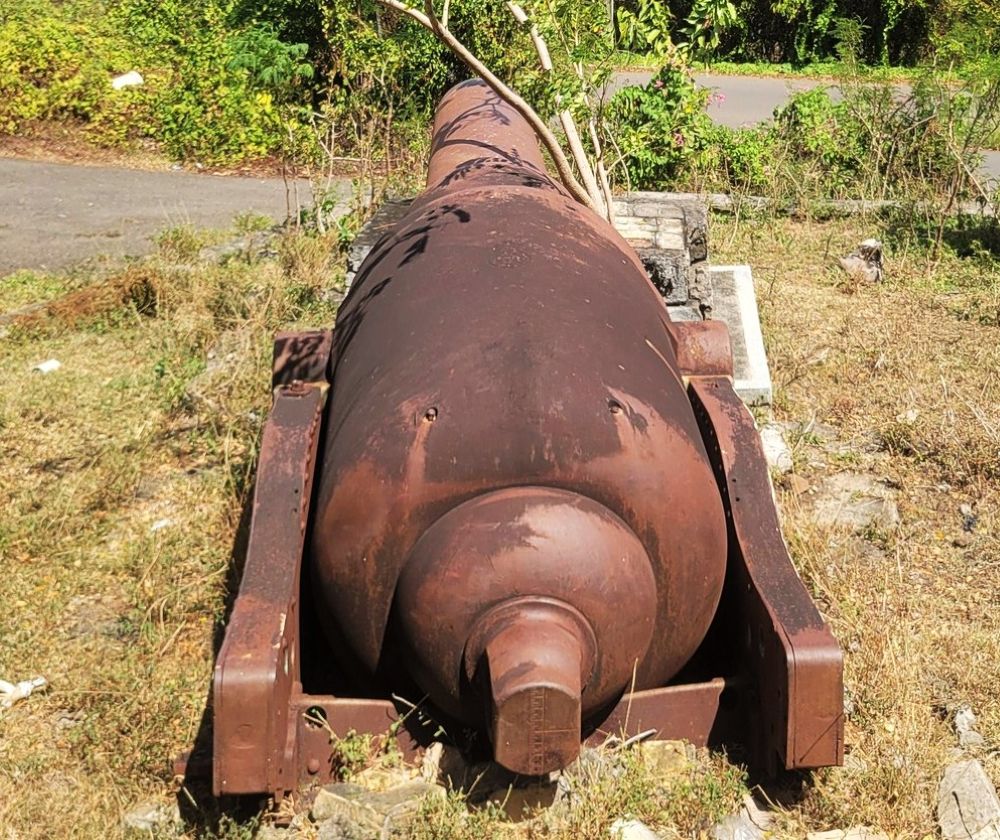
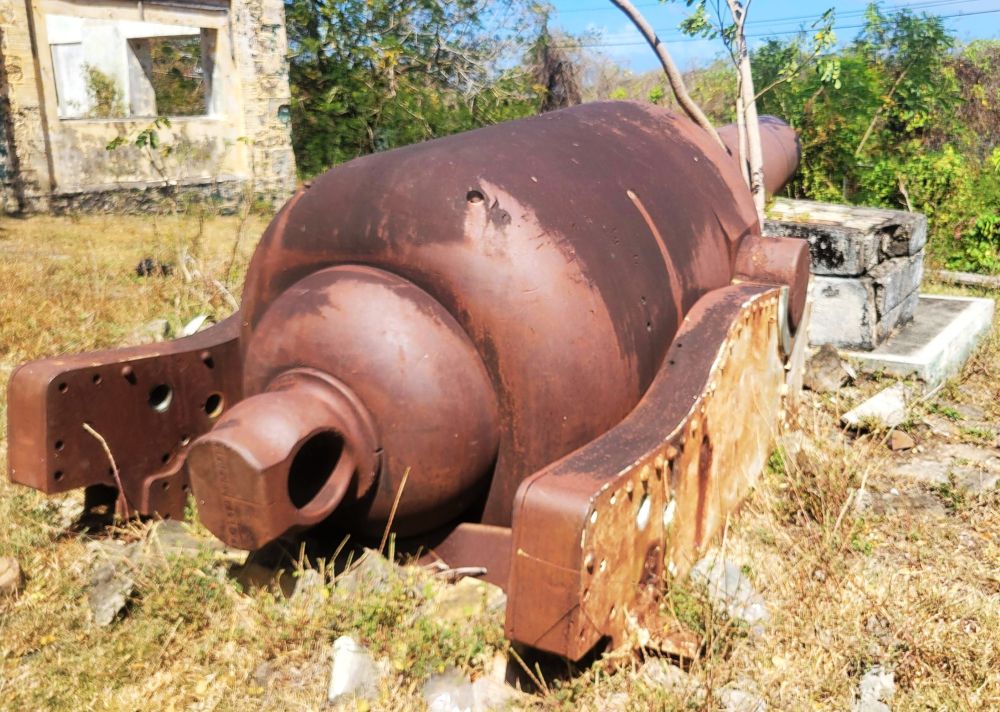
(Don Summers Photos)
10-inch 18-ton Mk. II Muzzleloading Rifled shell gun, weight unknown, likely in the range of 17-0-0-0 (TBC), (RGF No. unknown, c1870) on left trunnion, (+) on right trunnion, Queen Victoria cypher, partially mounted on a concrete stand and part of an iron traversing carriage. Charlotte, Castries.
Morne Fortuné
Originally known as Morne Dubuc, it was renamed Morne Fortuné in 1765 when the French moved their military headquarters and government administration buildings here from Vigie Height. A fort was constructed here by the French, Citadelle du Morne Fortuné, completed in 1784. The fort was first captured by the British on 1 April 1794, but recaptured by the French in June 1795. It was captured again by the British on 24 May 1796. A memorial to the 27th (Inniskilling) Regiment of Foot still stands commemorating the battle. France regained possession in 1802 with the Treaty of Amiens, but Lieutenant-General William Grinfield defeated French Governor Brigadier-General Antoine Noguès in June 1803, and the fort remained a British one until independence in 1979.
Fort Charlotte was named on 4 April 1794 by Prince Edward, Duke of Kent and Strathearn to honor Queen Charlotte. The 1st West India Regiment manned Apostle’s Battery on 16 December 1888 when the port became a coaling station. On 12 November 1890, the Royal Artillery manned the four RML 10 inch 18 ton guns. The fort was abandoned in 1905; a Secondary School occupies the site. The original fortifications also still stand on the summit, and the old military buildings are in a listed historical area. The Saint Lucia National Trust operates this area.
Apostles’ Battery (Morne Fortuné): Commenced in 1888, this battery featured four large guns named Matthew, Mark, Luke, and John, which were restored in 2015 after being abandoned in 1905.
Historic cannon can also be found at locations like Anse Chastanet. These guns were heavily used during the 14 or more recorded battles between British and French forces for control of the island. While many guns were dismounted and thrown over cliffs when the forts were decommissioned in 1905, significant efforts by the St. Lucia National Trust have restored many, such as those at Morne Fortune.
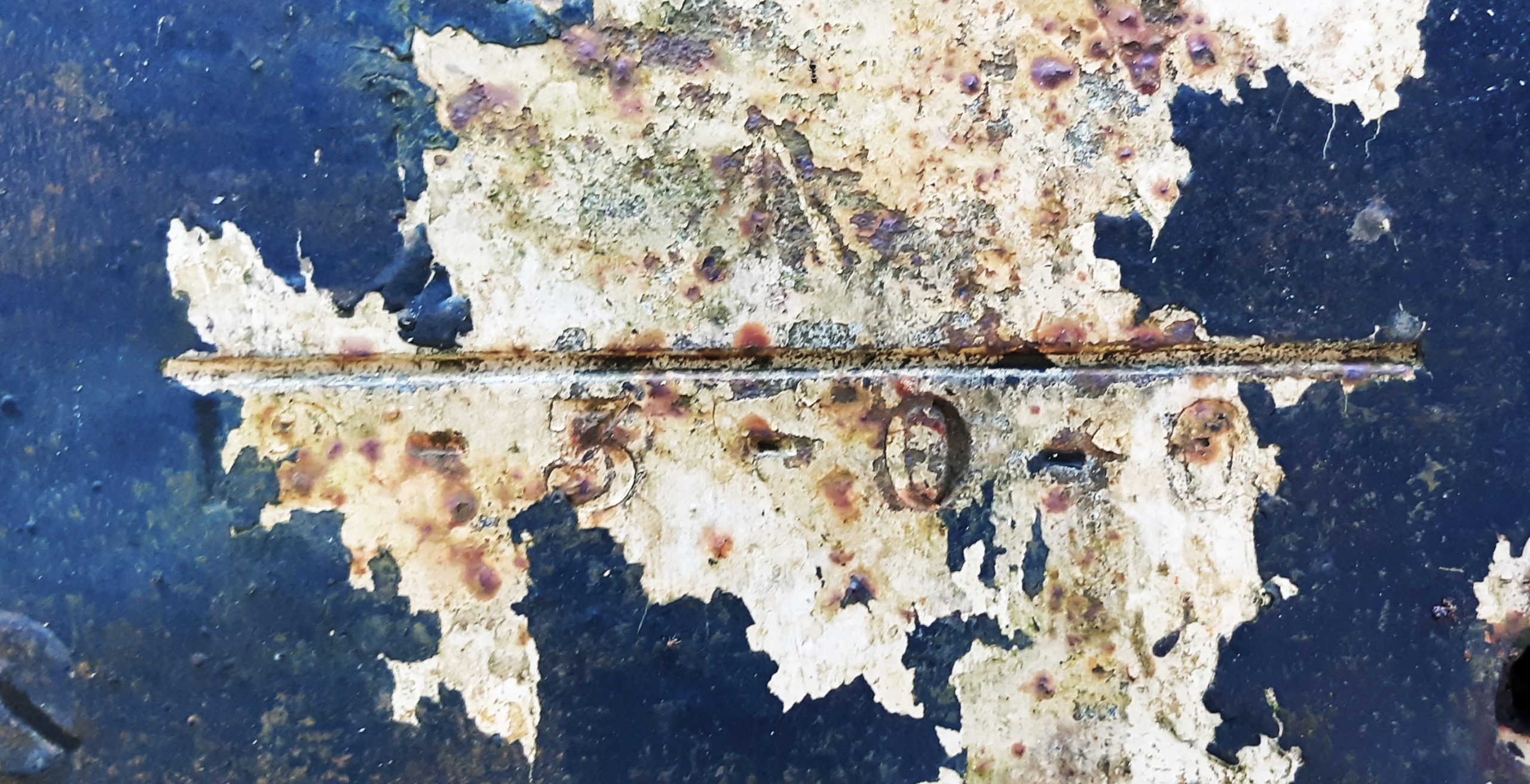
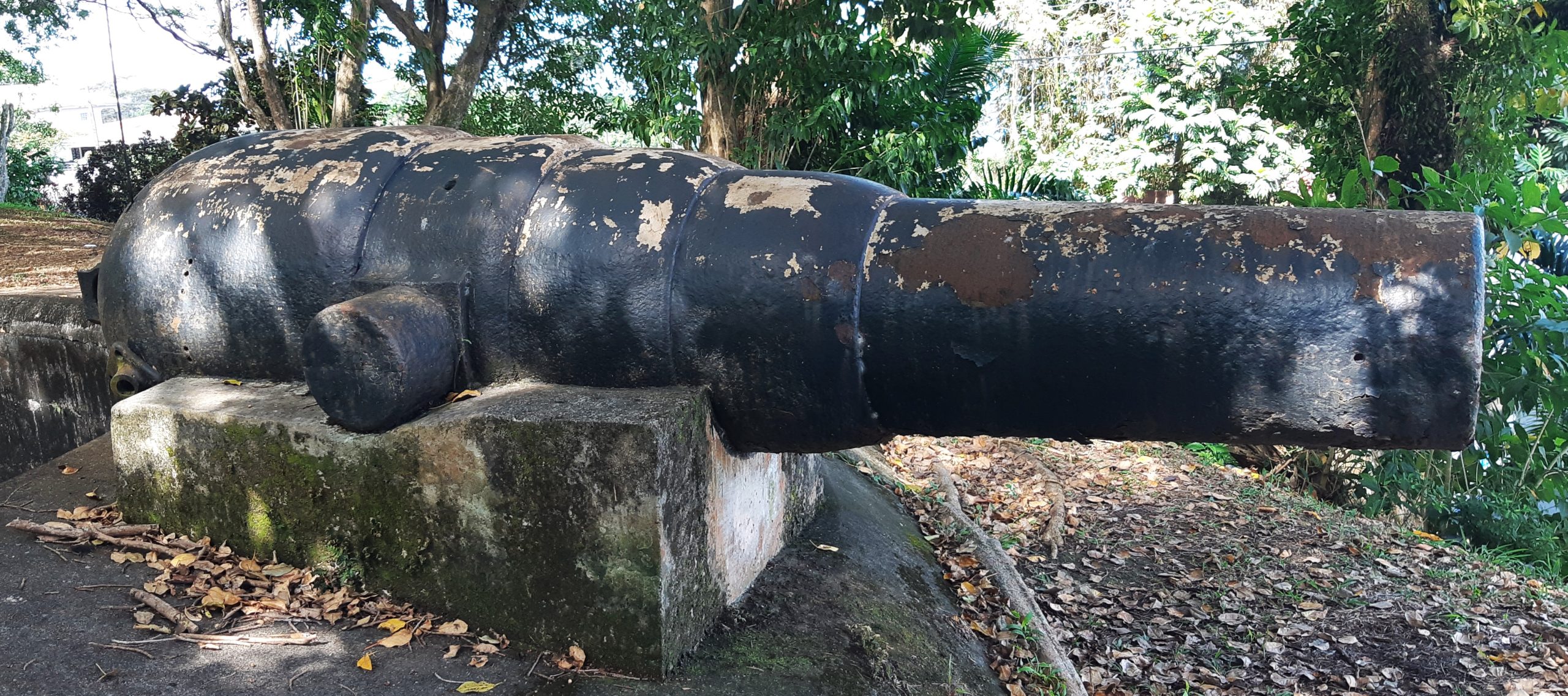
(Author Photos)
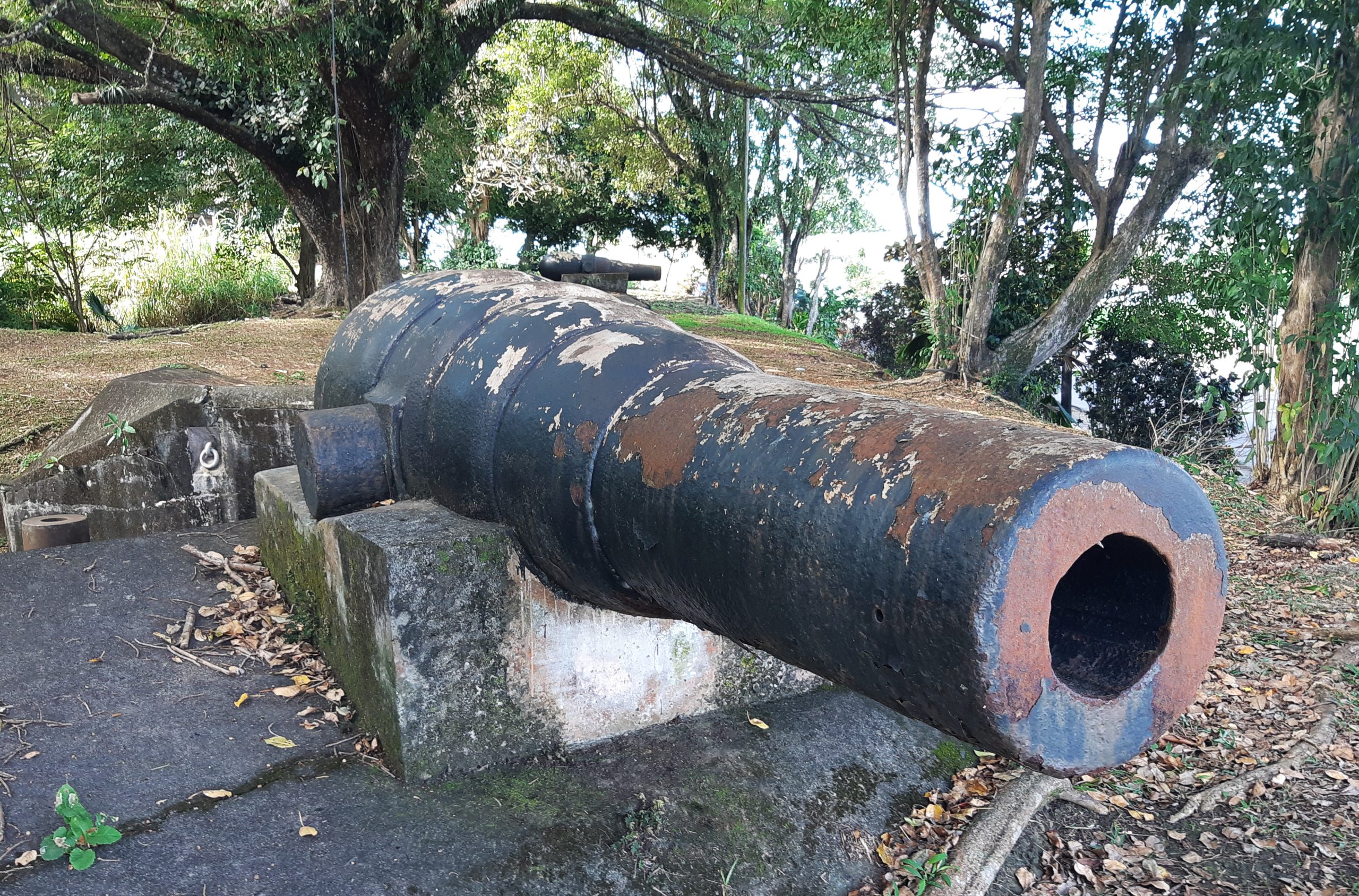
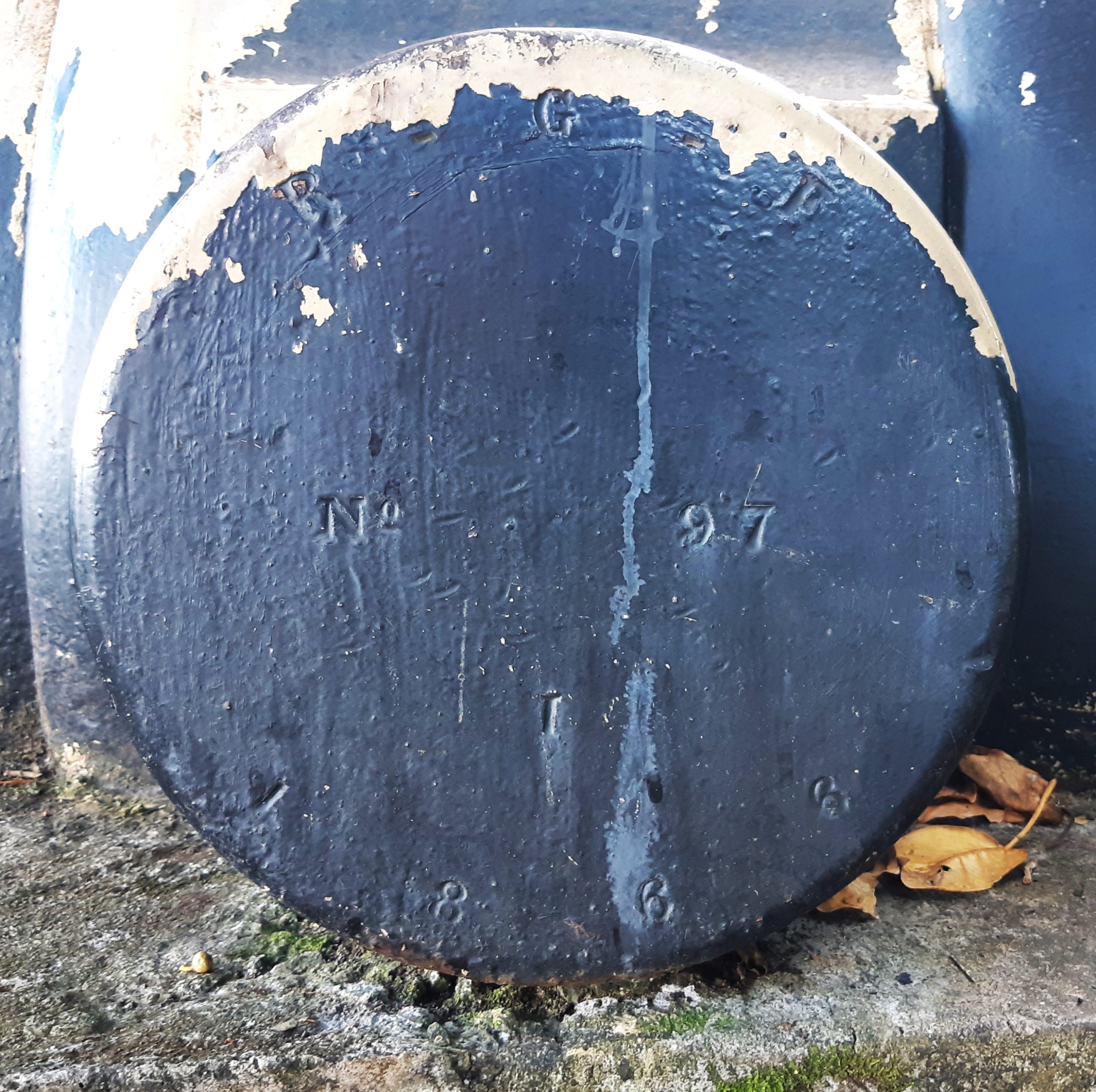
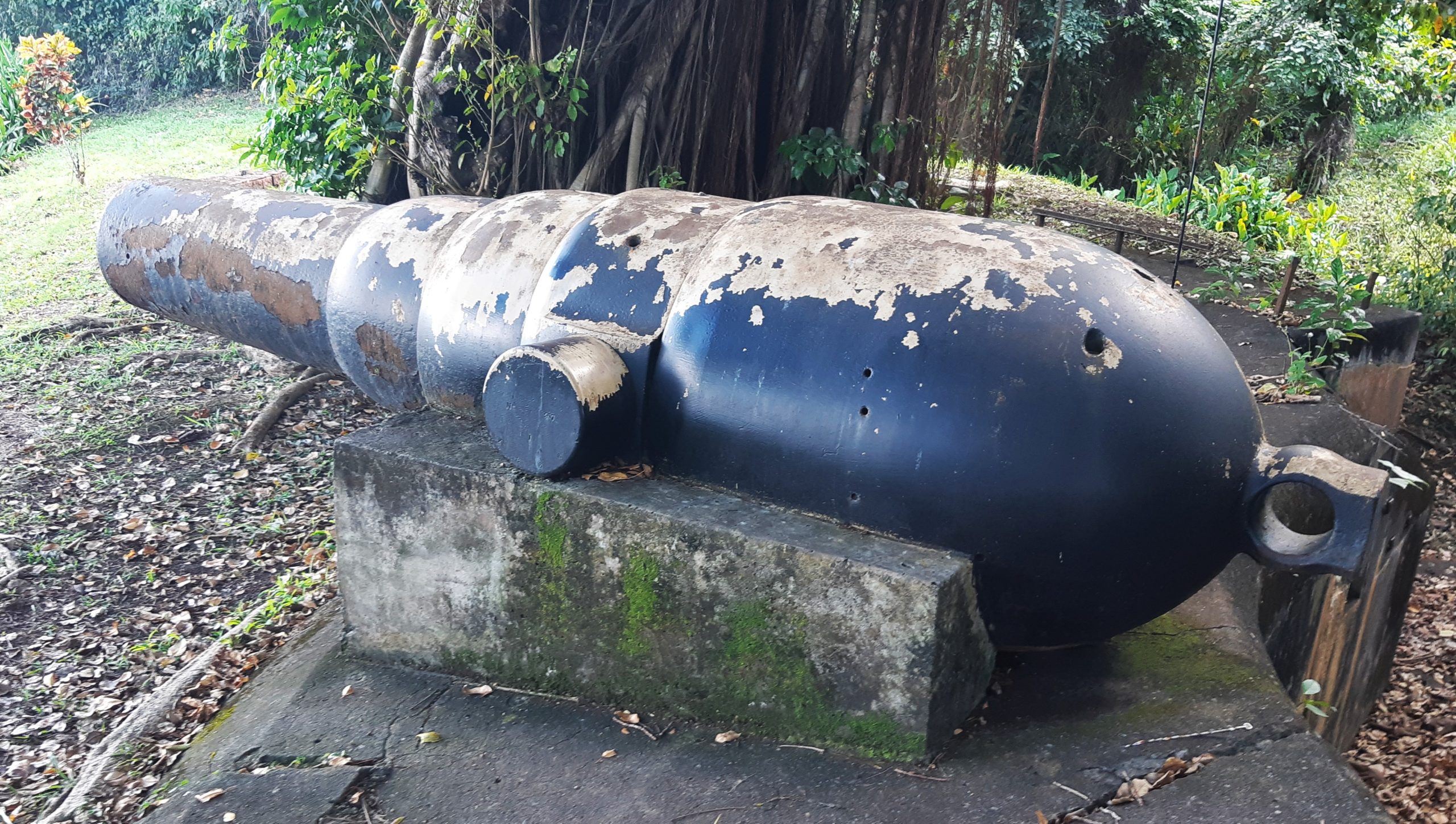
No. 1. 9-inch 12-ton Mk. III Muzzleloading Rifle, weight 12-3-0-0, (28,280 lbs), (RGF No. 97, I, 1866) on left trunnion, (+) on right trunnion, Queen Victoria cypher, mounted on a concrete stand forward of the original concrete gun position.
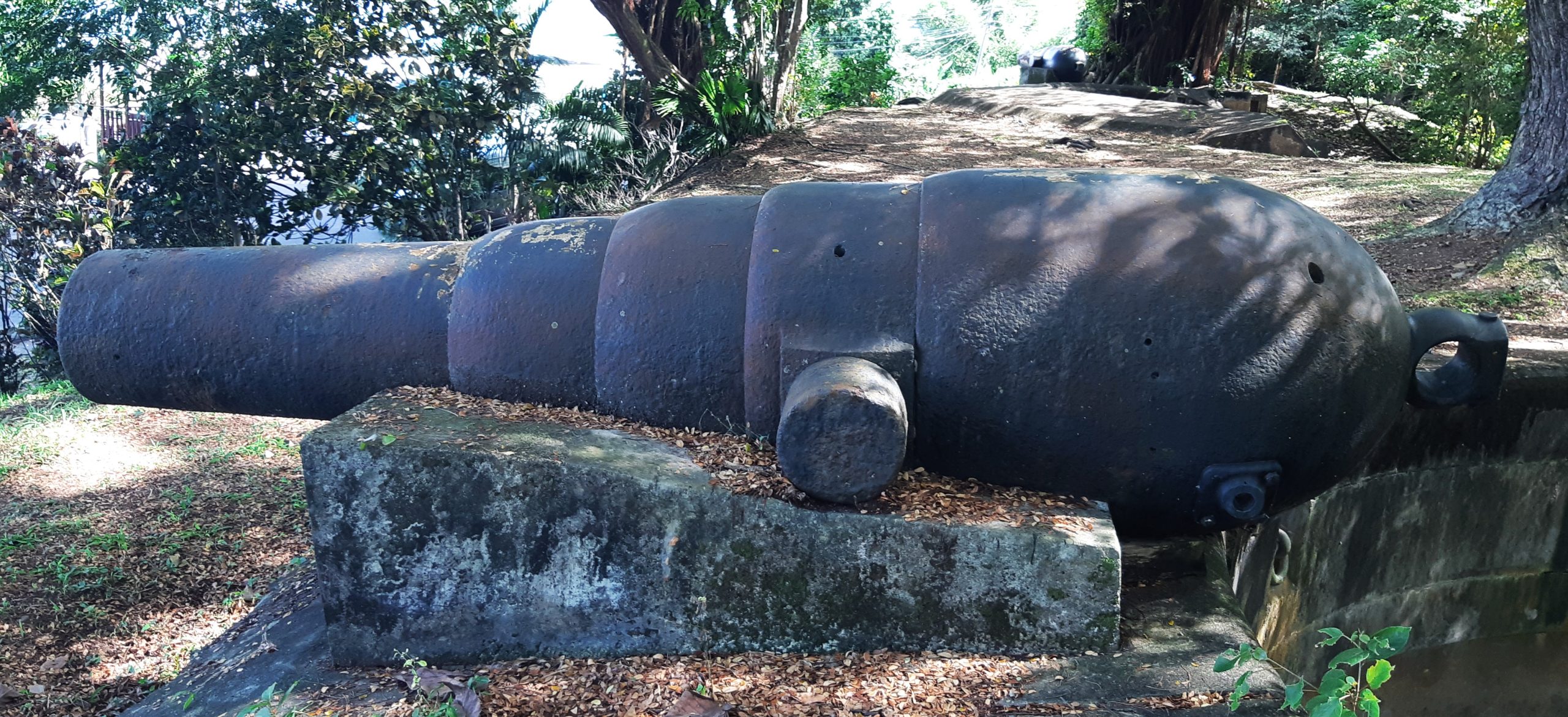
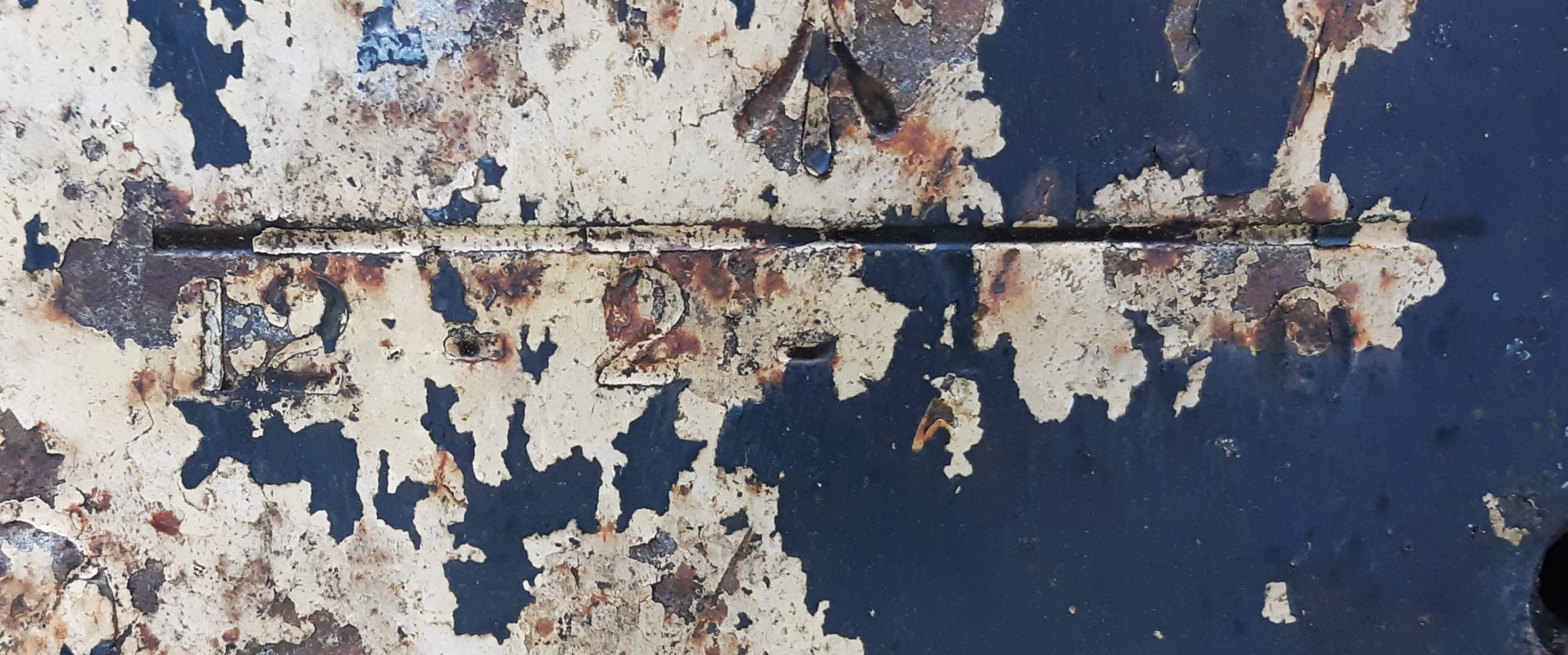
(Author Photos)
No. 2. 9-inch 12-ton Mk. III Muzzleloading Rifle, weight 12-2-0-0, (28,224 lbs), (RGF No. corroded) on left trunnion, (+) on right trunnion, Queen Victoria cypher, mounted on a concrete stand forward of the original concrete gun position.
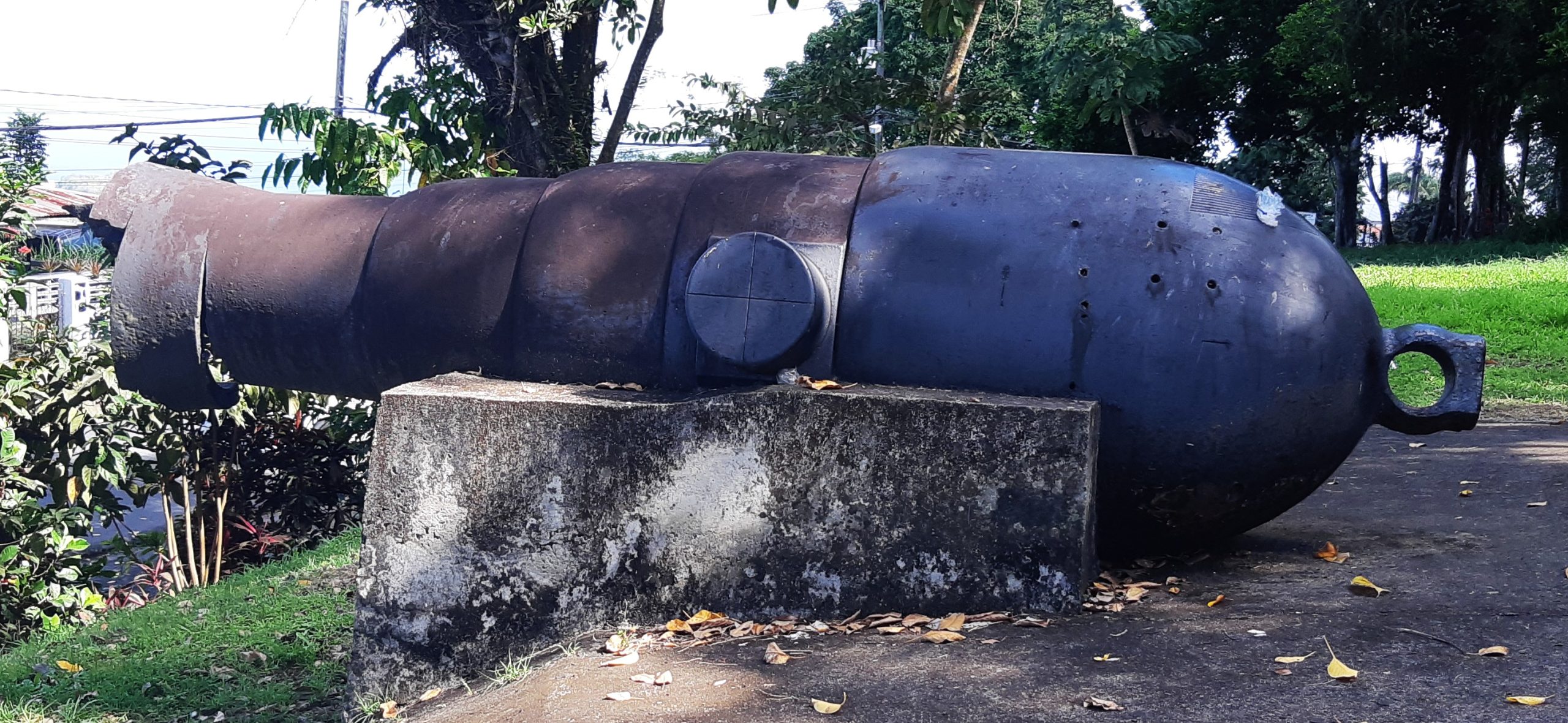
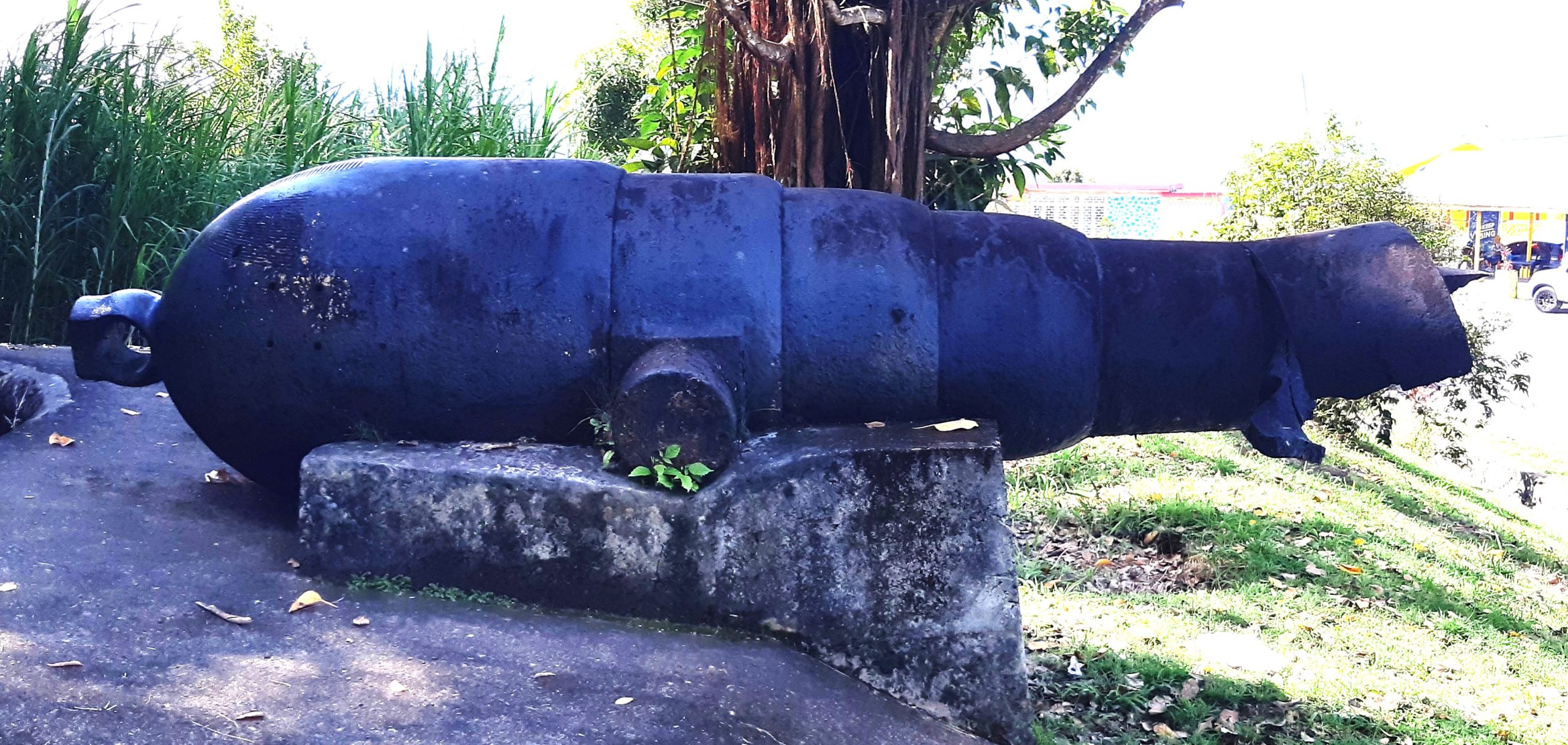
(Author Photos)
No. 3. 9-inch 12-ton Mk. III Muzzleloading Rifle with a blown barrel, weight corroded, (>28,000 lbs), (RGF No. corroded) on left trunnion, (+) on right trunnion, Queen Victoria cypher, mounted on a concrete stand forward of the original concrete gun position.
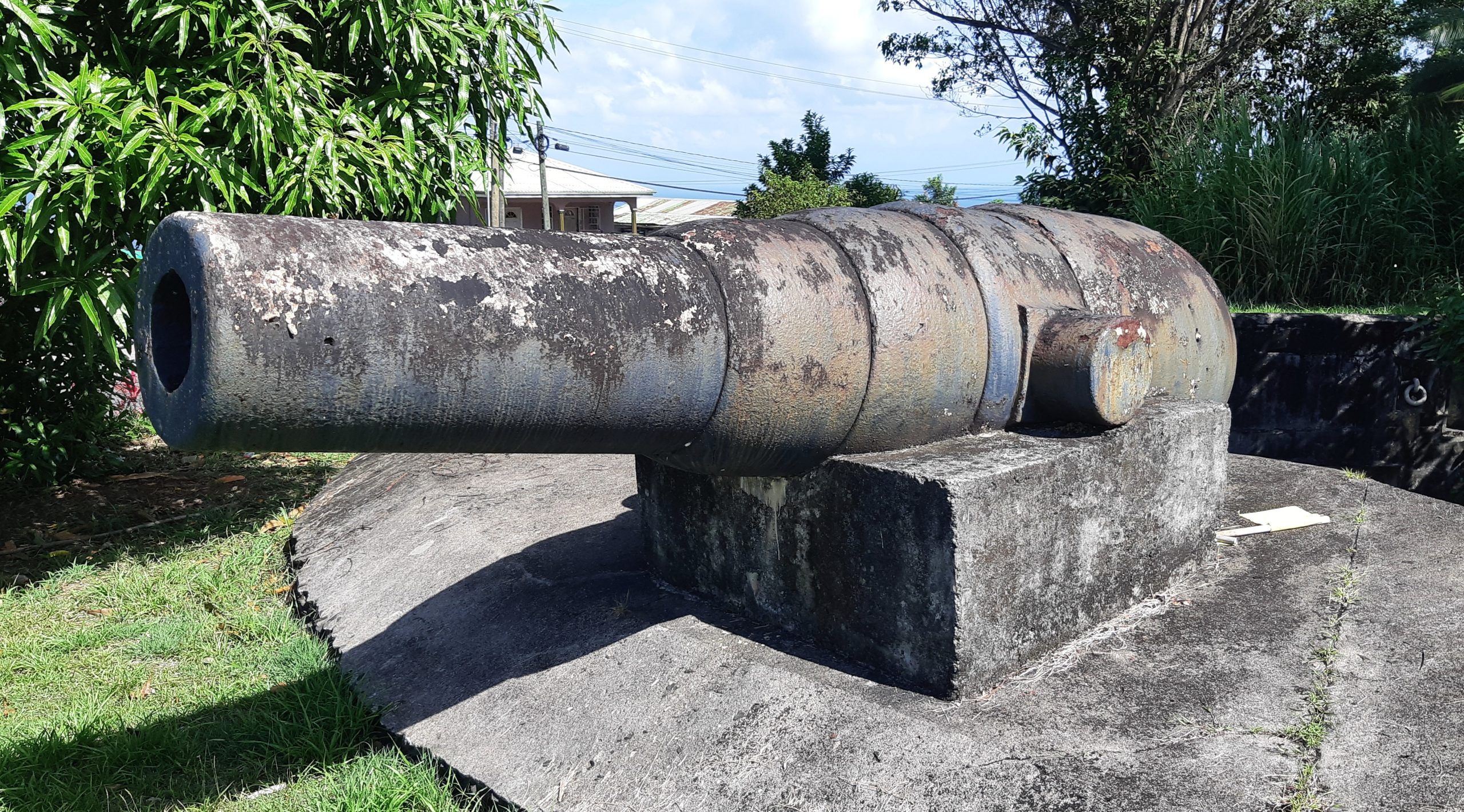
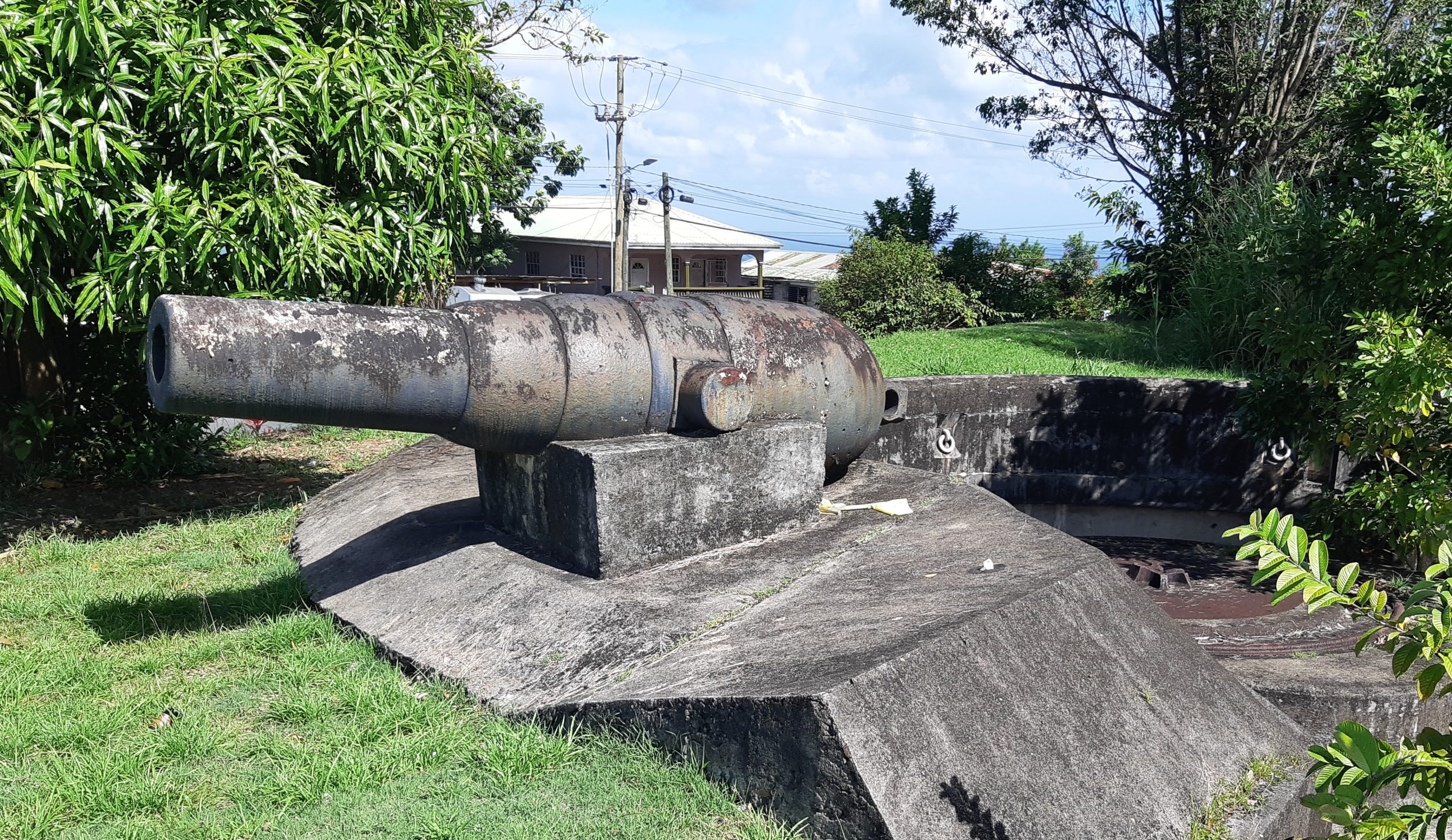
(Author Photos)
No. 4. 9-inch 12-ton Mk. III Muzzleloading Rifle, weight corroded, (>28,000 lbs), (RGF No. corroded) on left trunnion, (+) on right trunnion, Queen Victoria cypher, mounted on a concrete stand forward of the original concrete gun position.
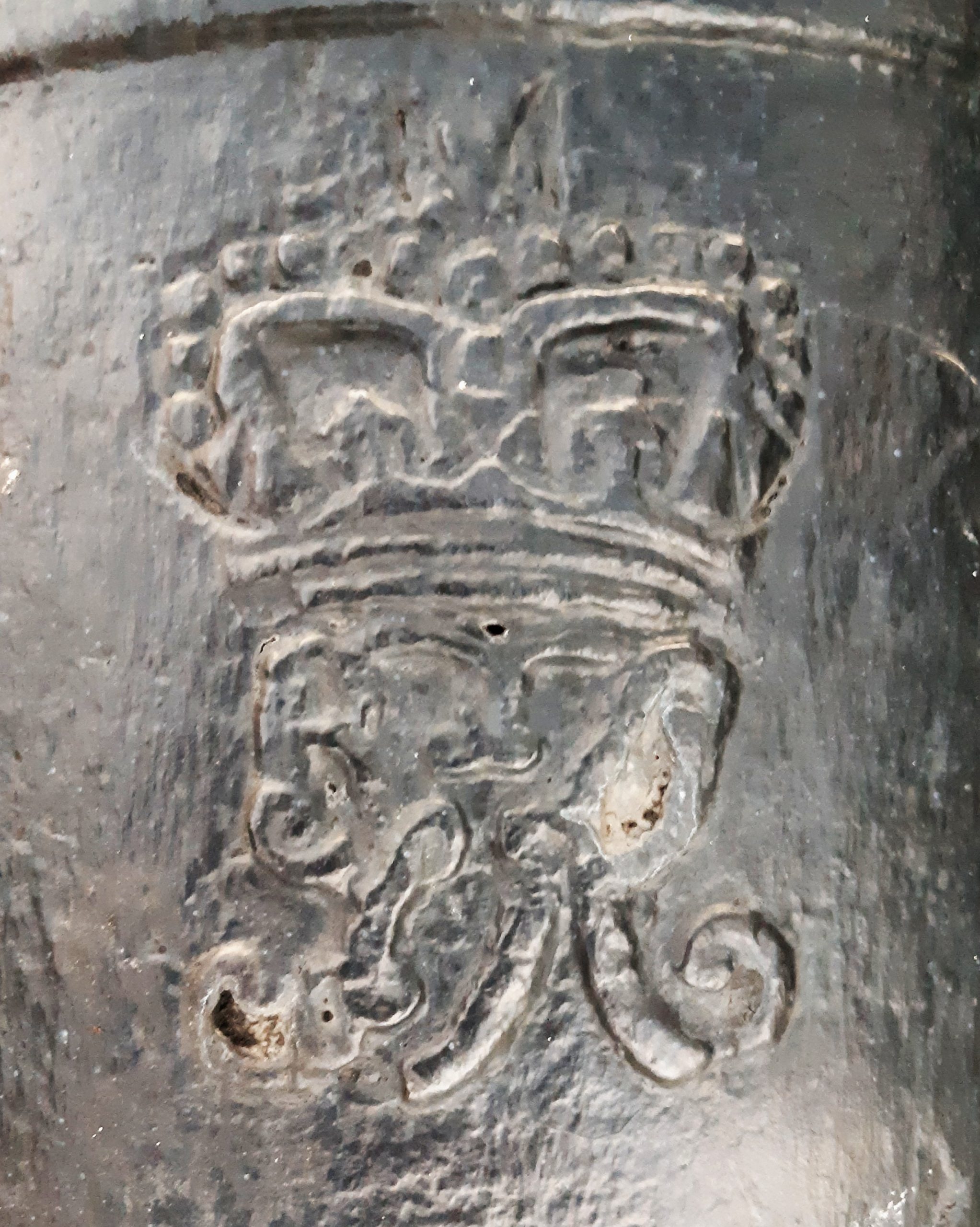
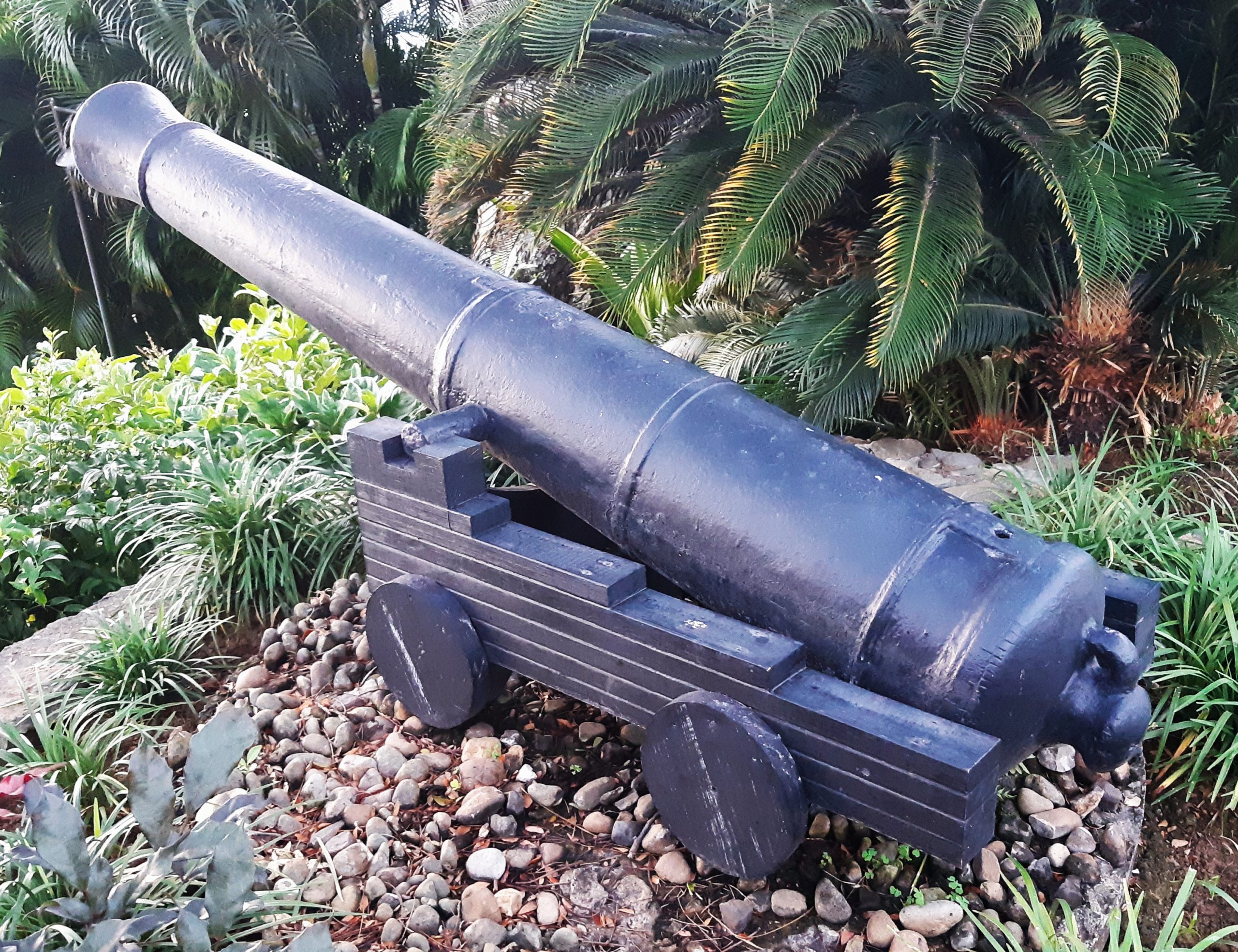
There are four Blomefield Cast Iron 12-pounder Smoothbore Muzzleloading Guns with a likely weight of more than 3,700 lbs), (Serial Nos. and weight numbers heavily corroded, original trunnions broken and replaced with smaller substitutes. The left trunnion would have had a WCo or CARRON maker, and the right trunnion would have had the serial number. All have a visible King George III cypher and broad arrow mark, and are mounted on wood Naval Gun carriages on the grounds of the Sandals Regency La Toc, Saint Lucia.
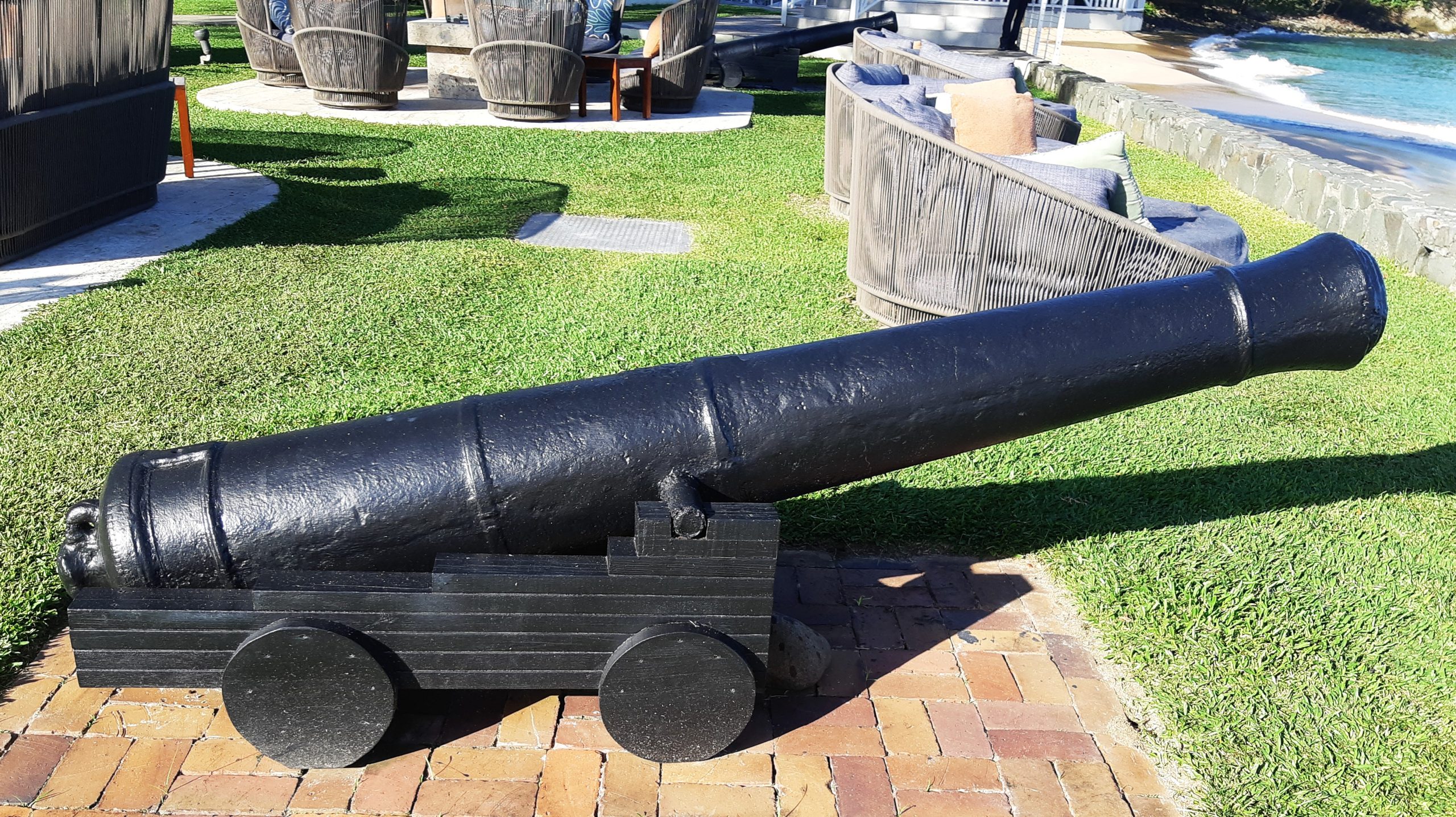
(Author Photo)
No. 1 of four.
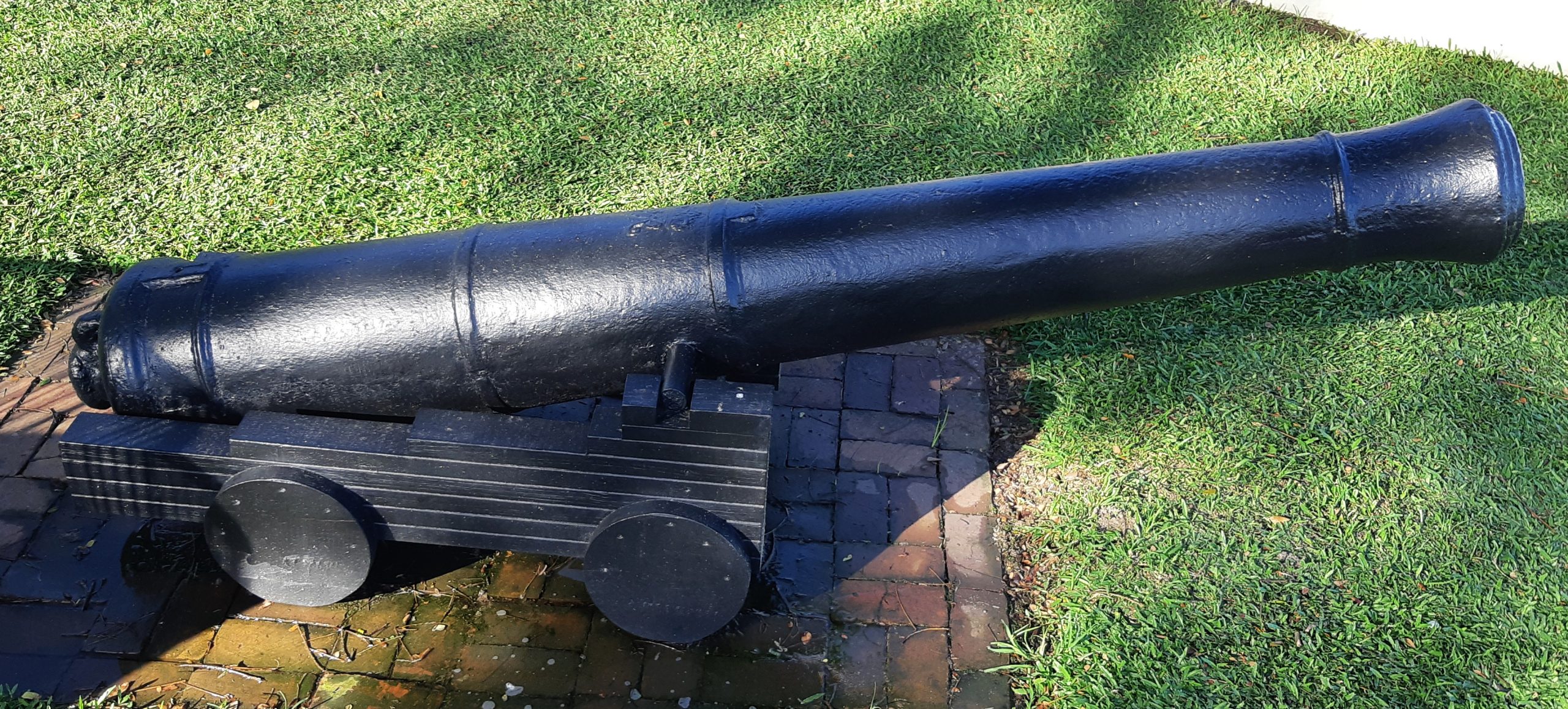
(Author Photo)
No. 2 of four.
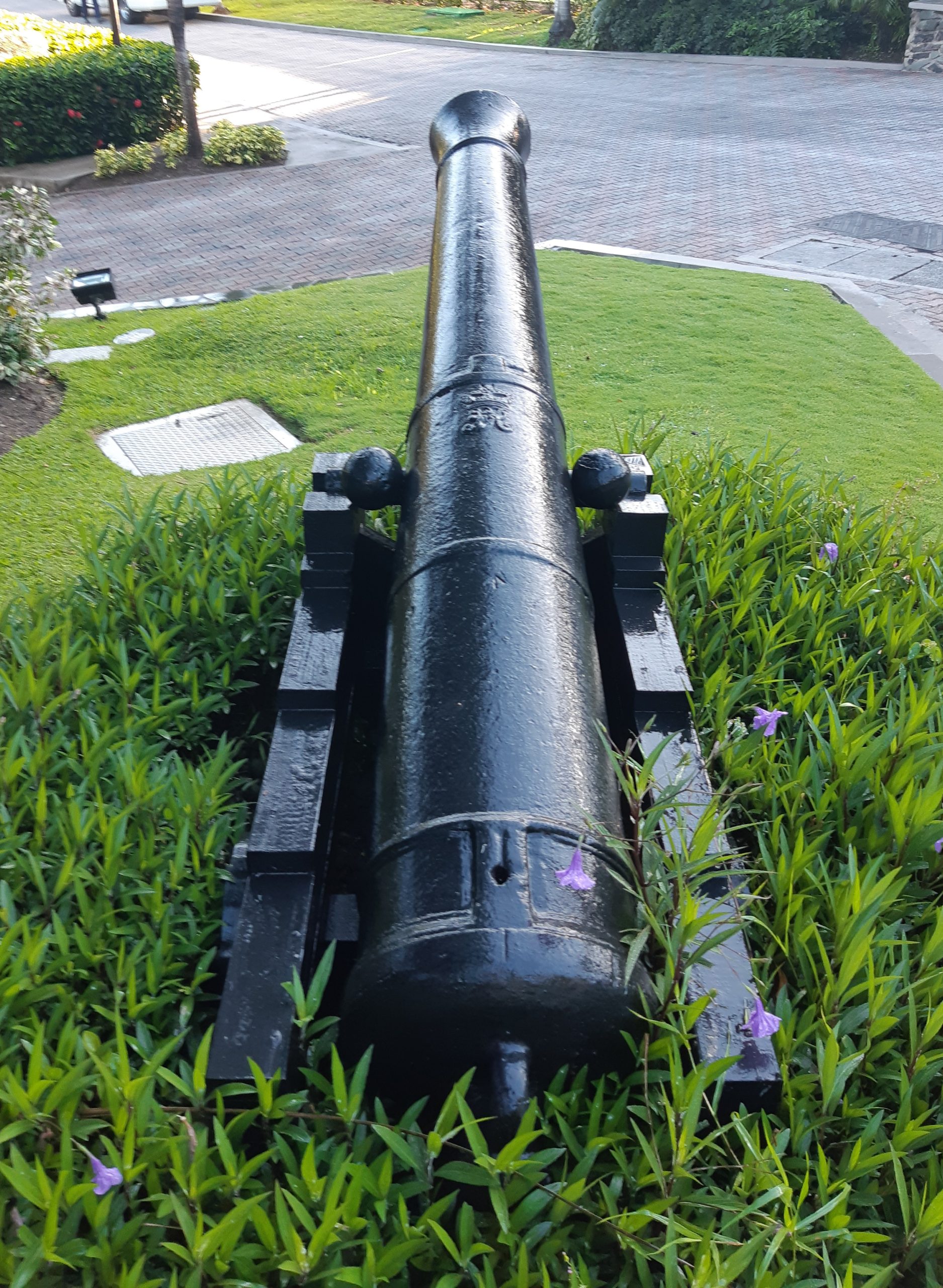
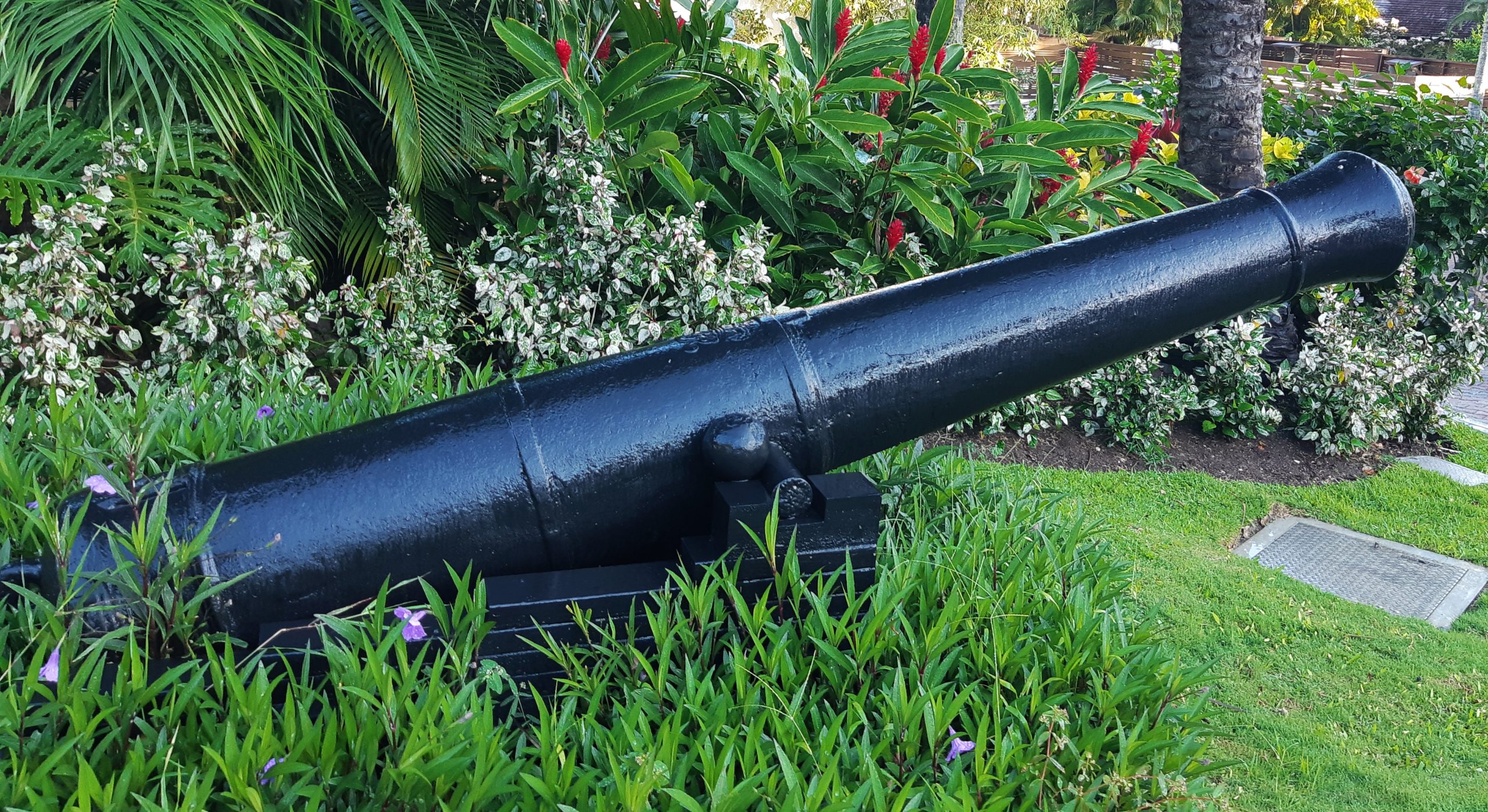
(Author Photos)
No. 3 of four.
(Author Photos)
No. 4 of four on the grounds of Sandals La Toc.
(Island Life Photo)
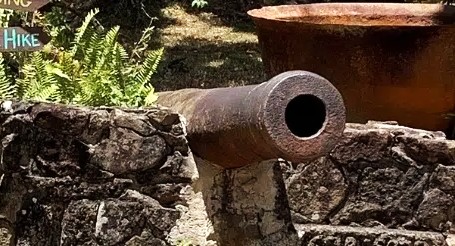
A heavily corroded Cast Iron possibly 12-pounder Smoothbore Muzzleloading Gun, King George 3 cypher, mounted on a stone cairn, stands at the entrance to the Morne Coubaril Historical Adventure Park.
Pigeon Island, built in 1778, originally boasted three 24-pounder cannon along with two 11-1/2-inch mortars. It was built to compliment the already-complete Fort Boyd on nearby Martinique and solidify British control over the islands.
A heavily corroded Cast Iron possibly 24-pounder Smoothbore Muzzleloading Gun, King George 3 cypher, unmounted on a stone cairn, stands at the entrance to the ruins of Fort Rodney on Pigeon Island, Saint Lucia.
(DWHIKE Photo)
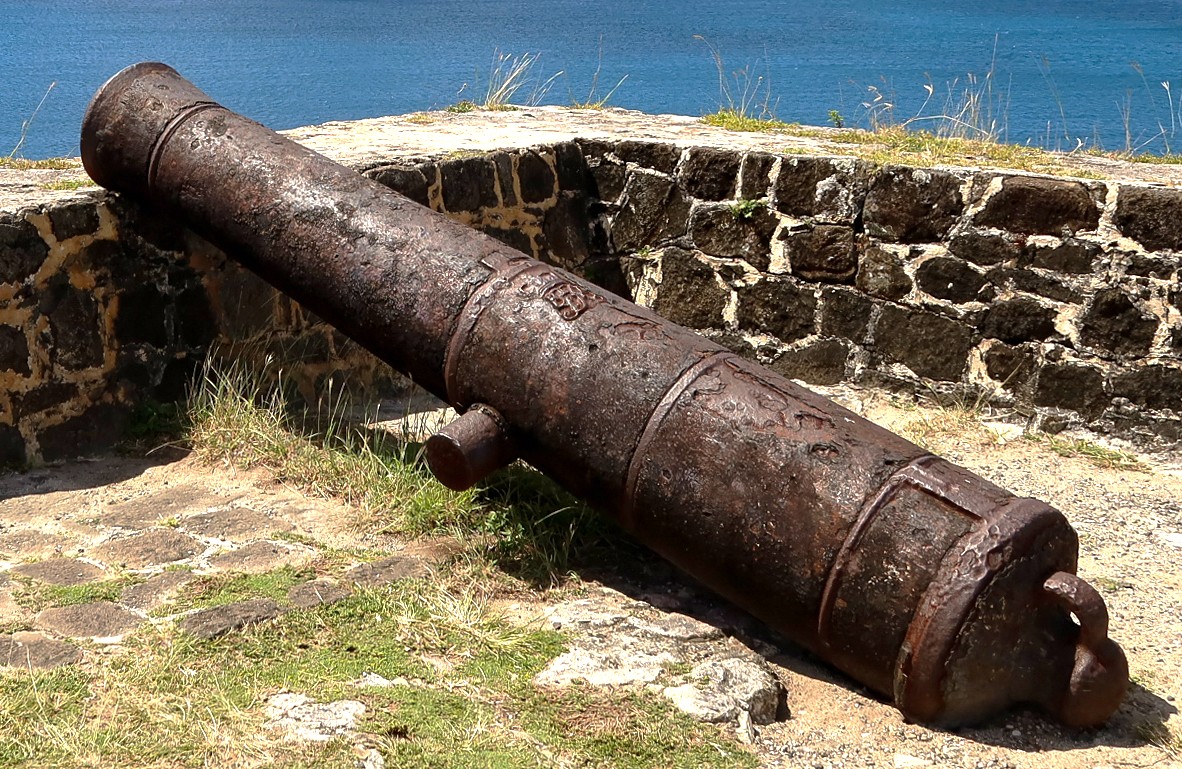
A heavily corroded Blomefield Cast Iron 24-pounder Smoothbore Muzzleloading Gun, King George 3 cypher, unmounted, rests on a corner of the ramparts of Fort Rodney on Pigeon Island, facing Rodney Bay, Saint Lucia. No. 1 of 3.
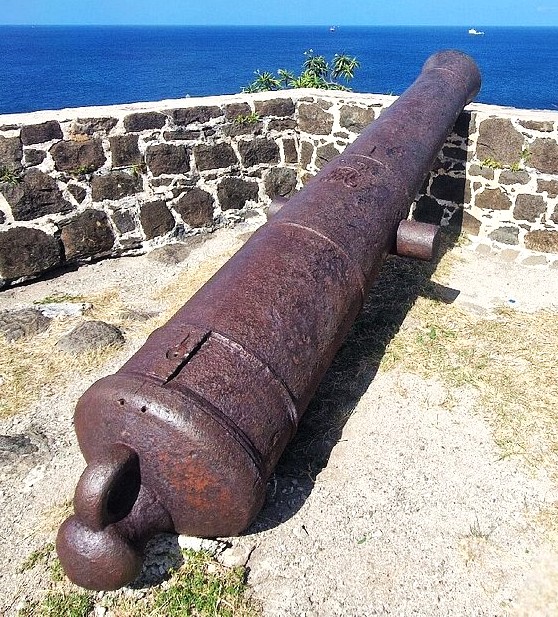
(Travel Guide Photo)
A heavily corroded Blomefield Cast Iron 24-pounder Smoothbore Muzzleloading Gun, King George 3 cypher, unmounted, rests on the ramparts of Fort Rodney on Pigeon Island, facing Rodney Bay, Saint Lucia. No. 2 of 3.
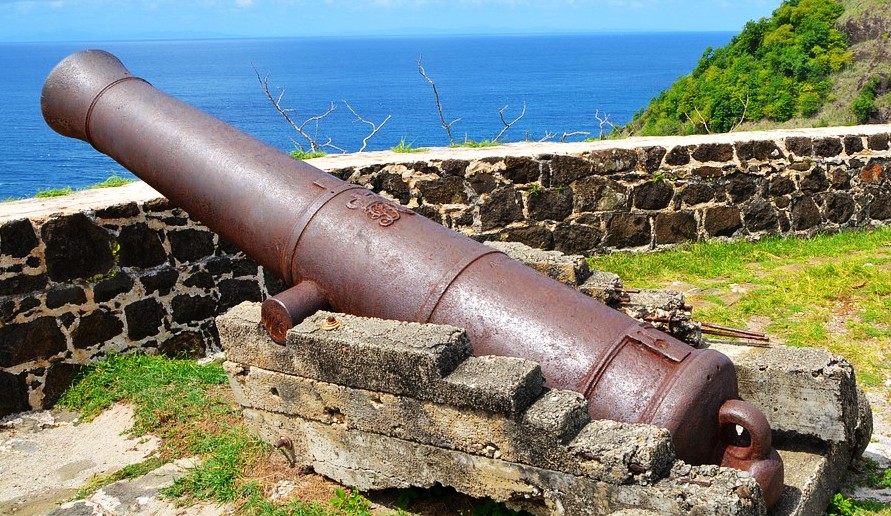
(Arrival Guide Photo)
A heavily corroded Blomefield Cast Iron possibly 24-pounder Smoothbore Muzzleloading Gun, King George 3 cypher, mounted on a crumbling wood naval gun carriage, in the ruins of Fort Rodney on Pigeon Island, facing Rodney Bay, Saint Lucia. No. 3 of 3.
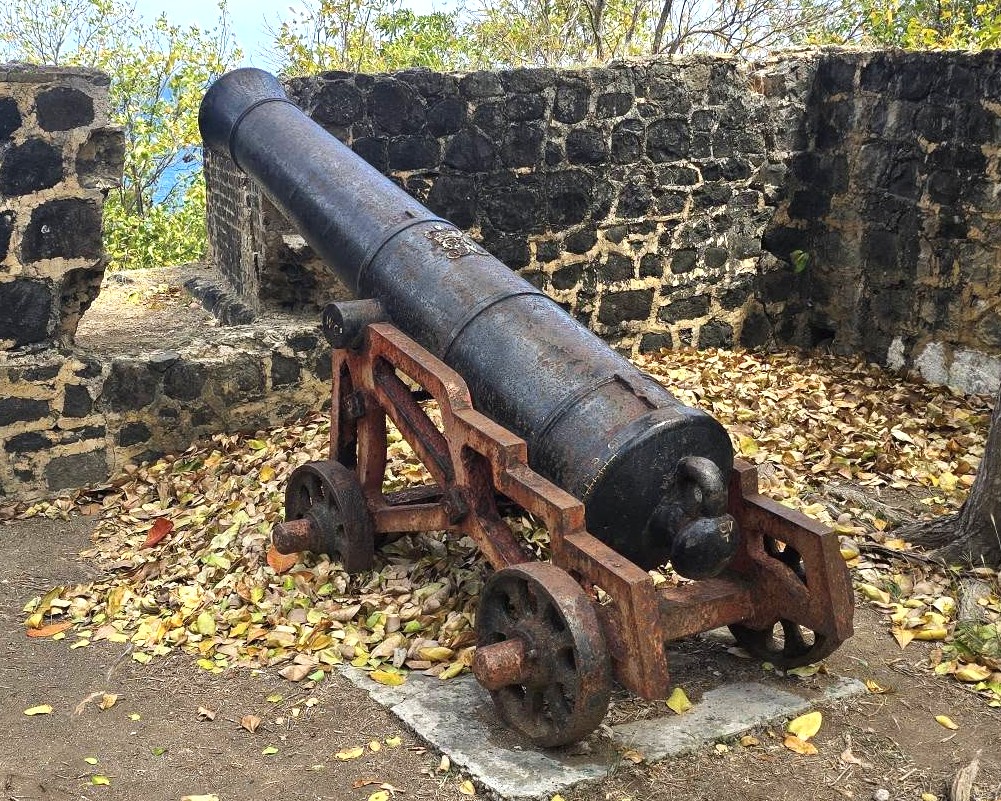
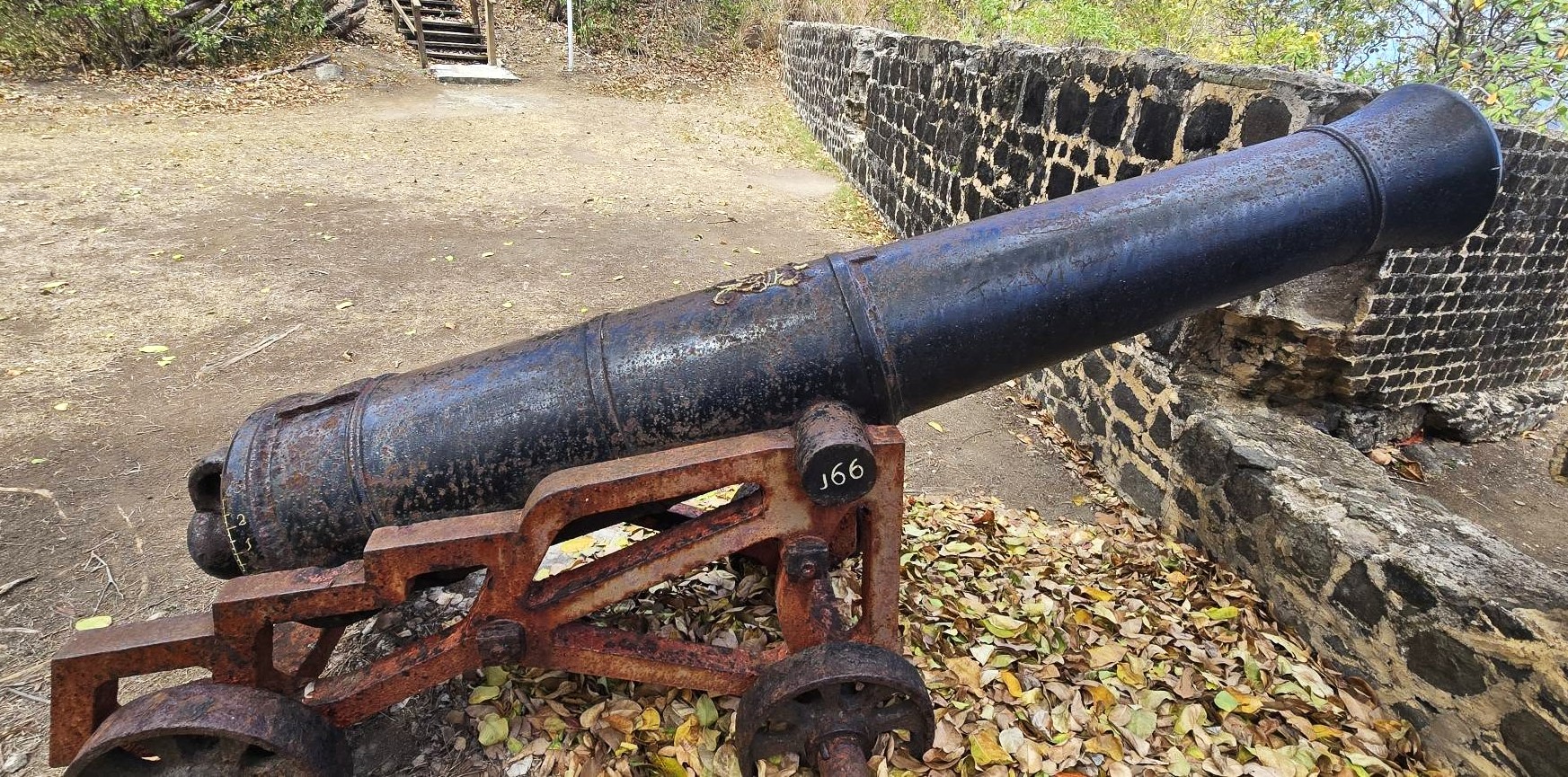
(Photos courtesy of Dr. Geoffrey Ward)
Blomefield Cast 24-pounder Smoothbore Muzzleloading Gun with Walker Company (WCo) on the left trunnion, (Serial No. 166) on the right trunnion, King George 3 cypher, mounted on an iron garrison carriage. No. 1 of 2 in the Two Gun Battery.
The Two-Gun Battery was constructed in 1780, and looks north from Pigeon Island, resting directly below Signal Peak. It was meant to protect against attacks from the sea and/of the adjacent De Longueville Bay. Two Blomefield Cast 24-pounder Smoothbore Muzzleloading Guns stand on the ramparts in the ruins of Fort Rodney.
(DWHIKE Photo)
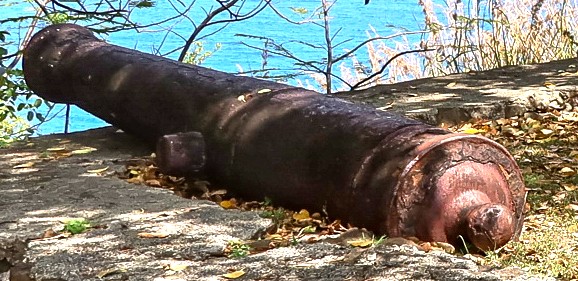
Ridge Battery: The largest gun in the fort was placed here, a 32-pounder SBML cannon which secured the forts dominance over the surrounding waters. It was used to great effect in repelling a French incursion into Gros Islet in 1781.
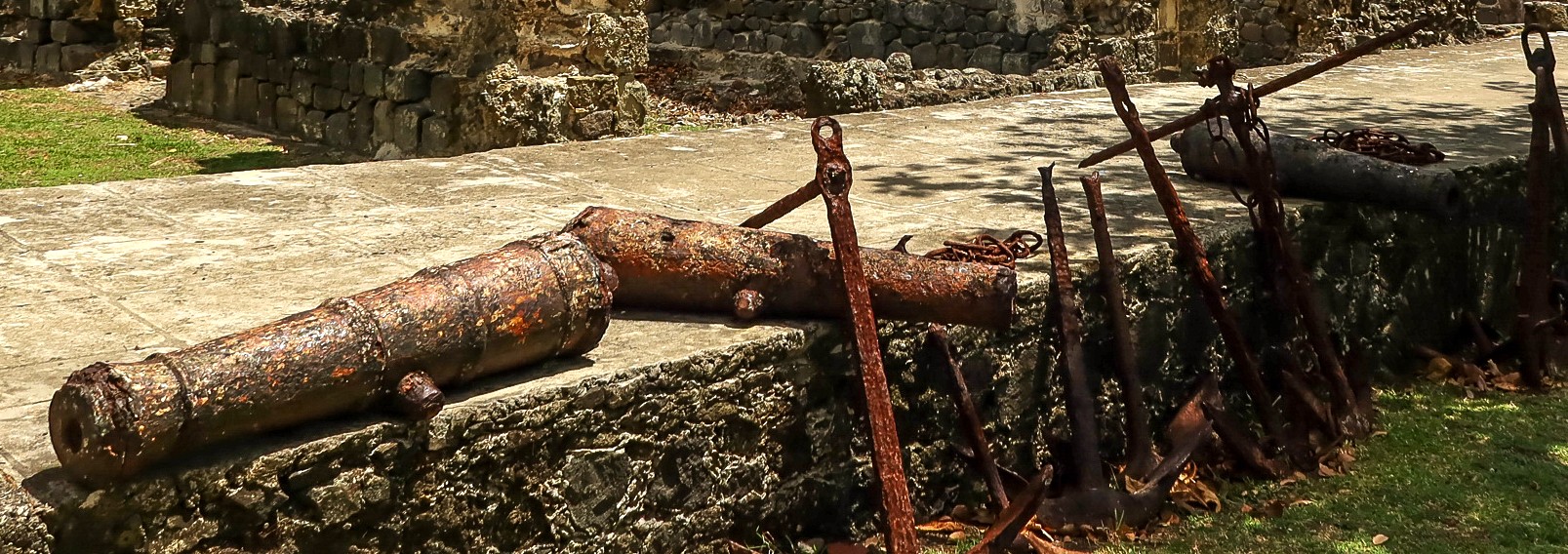
(DWHIKE Photos)
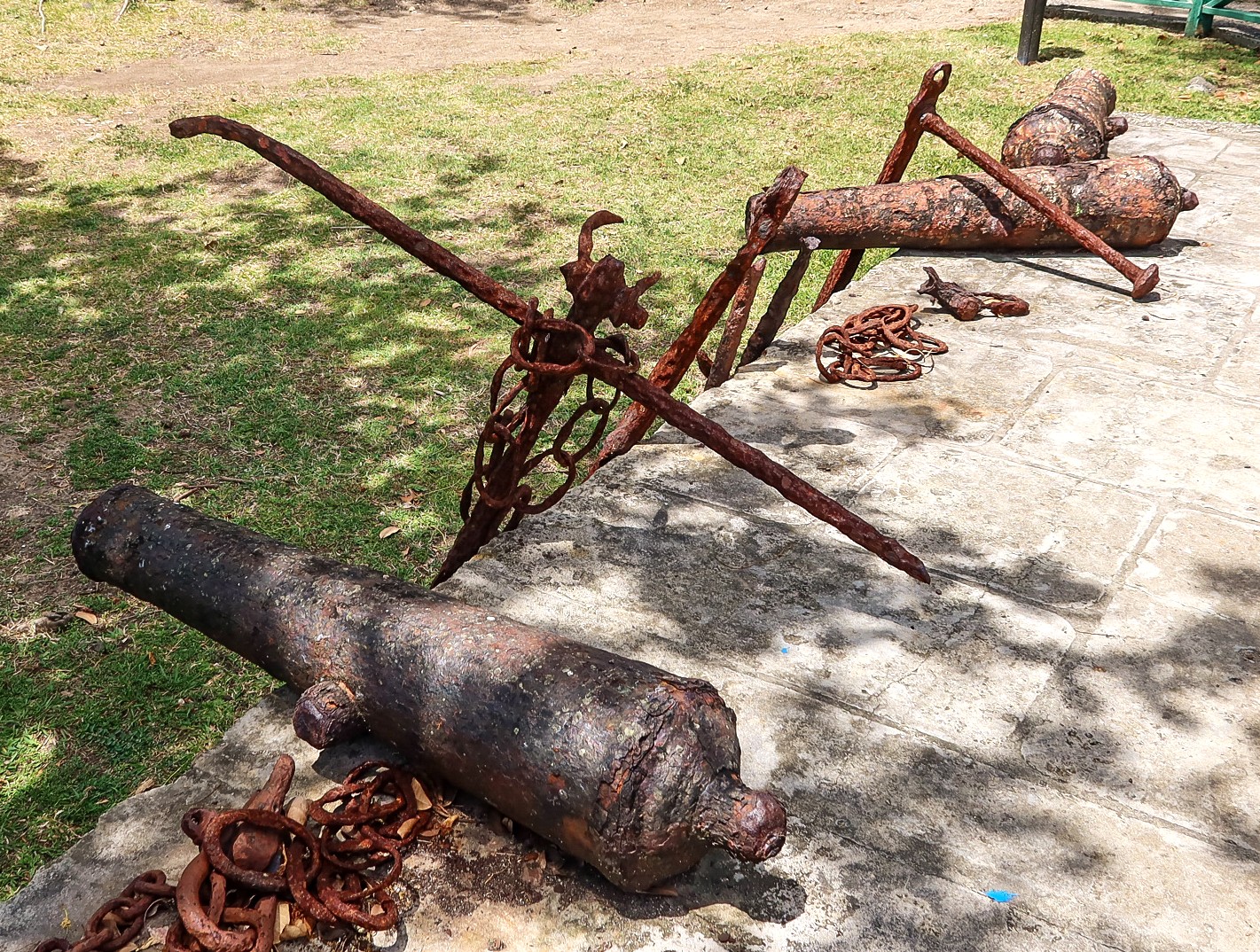
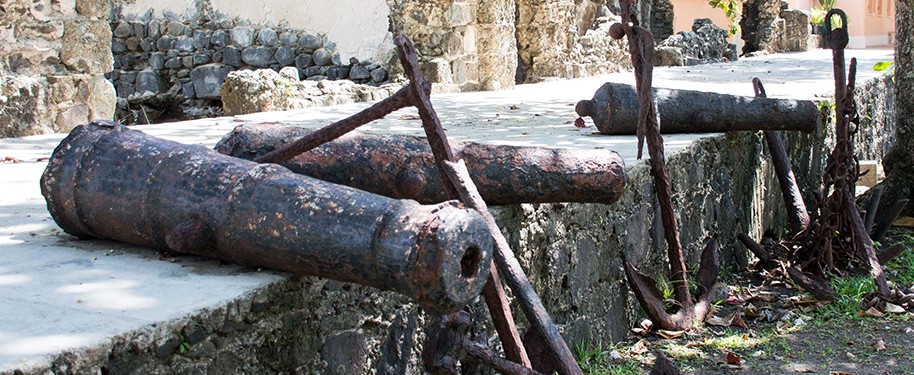
Three heavily corroded possibly 12-pounder SBML cannon lay on the ruined floor of the Officers’ Quarters & Mess, constructed in 1824,
History of Saint Lucia
Saint Lucia was first inhabited sometime between 1000 and 500 BC by the Ciboney, but there is not much evidence of their presence on the island. The first proven inhabitants were the peaceful Arawaks, believed to have come from northern South America around 200-400 AD, as there are numerous archaeological sites on the island where specimens of the Arawaks’ well-developed pottery have been found. There is evidence to suggest that these first inhabitants called the island Iouanalao, which meant ‘Land of the Iguanas’, due to the island’s high number of iguanas.
The more aggressive Caribs arrived around 800 AD, and seized control from the Arawaks by killing their men and assimilating the women into their own society.They called the island Hewanarau, and later Hewanorra (Ioüanalao, or “there where iguanas are found”). This is the origin of the name of the Hewanorra International Airport in Vieux Fort. The Caribs had a complex society, with hereditary kings and shamans. Their war canoes could hold more than 100 men and were fast enough to catch a sailing ship. They were later feared by the invading Europeans for their ferocity in battle.
Christopher Columbus may have sighted the island during his fourth voyage in 1502, since he made landfall on Martinique, yet he does not mention the island in his log. Juan de la Cosa noted the island on his map of 1500, calling it El Falcon, and another island to the south Las Agujas. A Spanish Cedula from 1511 mentions the island within the Spanish domain, and a globe in the Vatican made in 1502, shows the island as Santa Lucia. A 1529 Spanish map shows S. Luzia.
In the late 1550s the French pirate François le Clerc (known as Jambe de Bois, due to his wooden leg) set up a camp on Pigeon Island, from where he attacked passing Spanish ships.
In 1605, an English vessel called the Oliphe Blossome was blown off-course on its way to Guyana, and the 67 colonists started a settlement on Saint Lucia, after initially being welcomed by the Carib chief Anthonie. By 26 Sep 1605, only 19 survived, after continued attacks by the Carib chief Augraumart, so they fled the island. In 1626, the Compagnie de Saint-Christophe was chartered by Cardinal Richelieu, chief minister of Louis XIII, to colonize the Lesser Antilles, between the eleventh and eighteenth parallels. The following year, a royal patent was issued to James Hay, 1st Earl of Carlisle by Charles I of England granting rights over the Caribbean islands situated between 10° and 20° north latitude, creating a competing claim. In 1635, the Compagnie de Saint-Christophe was reorganized under a new patent for the Compagnie des Îles de l’Amérique, which gave the company all the properties and administration of the former company and the rights to continue colonizing neighboring vacant islands.
English documents claim colonists from Bermuda settled the island in 1635, while a French letter of patent claims settlement on 8 March 1635 by a Pierre Belain d’Esnambuc, who was succeeded by his nephew, Jacques Dyel du Parquet. Thomas Warner sent Captain Judlee with 300-400 Englishmen to establish a settlement at Praslin Bay but they were attacked over three weeks by Caribs, until the few remaining colonists fled on 12 October 1640. In 1642, Louis XIII extended the charter of the Compagnie des Îles de l’Amérique for twenty years. The following year, du Parquet, who had become Governor of Martinique, noted that the British had abandoned Saint Lucia and he began making plans for a settlement. In June 1650, he sent Louis de Kerengoan, Sieur de Rousselan and 40 Frenchmen to establish a fort at the mouth of the Rivière du Carenage, near present day Castries. As the Compagnie was facing bankruptcy, du Parquet sailed to France in September 1650 and purchased the sole proprietorship for Grenada, the Grenadines, Martinique and Sainte-Lucie for ₣41,500.
The French drove off an attempted English invasion in 1659, but allowed the Dutch to build a redoubt near Vieux Fort Bay in 1654. On 6 April 1663, the Caribs sold St. Lucia to Francis Willoughby, 5th Baron Willoughby of Parham, English governor of the Caribbean. He invaded the island with 1100 Englishmen and 600 Amerindians in 5 ships-of-war and 17 pirogues forcing the 14 French defenders to flee. However, the English colony succumbed to disease. The French took over again, but the English came back in June 1664 and retained possession until 20 Oct 1665 when diplomacy gave the island back to the French. The English invaded again in 1665, but disease, famine and the Caribs forced their fleeing in Jan 1666. The Treaty of Breda (1667) gave control of the island back to the French. The English raided the island in 1686, but relinquished all claims in a 1687 treaty and the 1697 Treaty of Ryswick.
Both the British, with their headquarters in Barbados, and the French, centered on Martinique, found Saint Lucia attractive after the slave-based sugar industry developed in 1763, and during the 18th century the island changed ownership or was declared neutral territory a dozen times, although the French settlements remained and the island was a de facto a French colony well into the 18th century.
In 1722, King George I of Great Britain granted both Saint Lucia and Saint Vincent to John Montagu, 2nd Duke of Montagu. He in turn appointed Nathaniel Uring, a merchant sea captain and adventurer, as deputy-governor. Uring went to the islands with a group of seven ships, and established settlement at Petit Carenage. Unable to get enough support from British warships, he and the new colonists were quickly run off by the French.
The 1730 census showed 463 occupants of the island, which included just 125 whites, 37 Caribs, 175 slaves, and 126 free blacks or mixed race. The French took control of the island in 1744, and by 1745, the island had a population of 3,455, including 2,573 slaves.
During the Seven Years’ War Britain occupied Saint Lucia in 1762, but gave the island back at the Treaty of Paris on 10 February 1763. Britain occupied the island again in 1778 after the Grand Battle of Cul de Sac during the American Revolutionary War. British Admiral George Rodney then built Fort Rodney from 1779 to 1782.
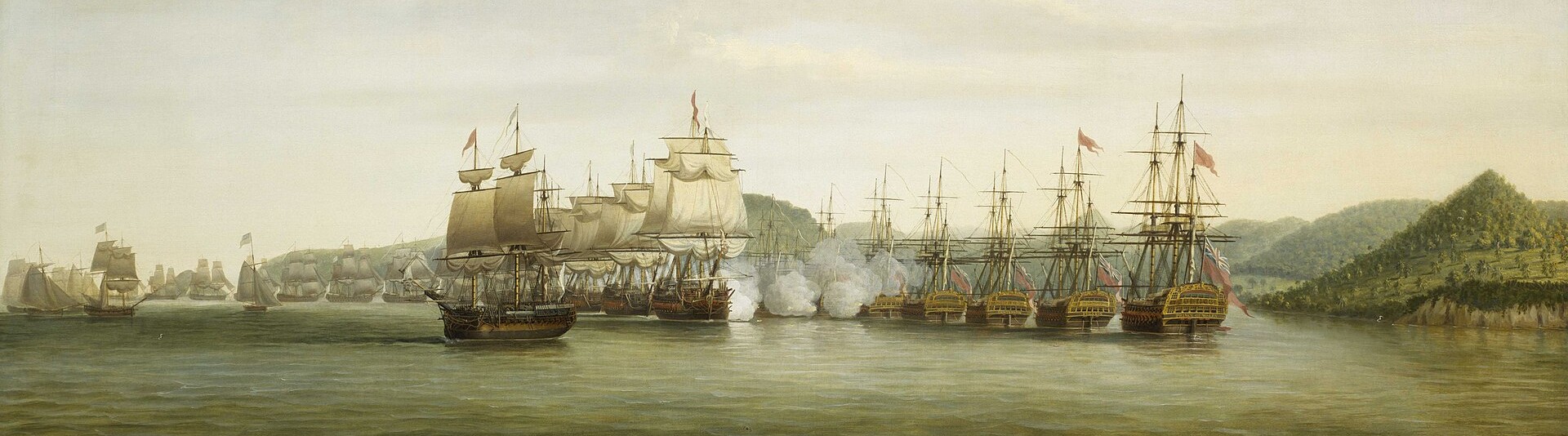
Saint Lucia was constantly fought over by the British and the French during the 18th century, This painting depicts the Battle of St. Lucia, 15 December 1778, when 12 French ships led by Admiral d’Estaing (left) attacked seven British ships (right) commanded by Admiral Barrington.
The French had entered the American Revolutionary War on behalf of the rebels and were conducting actions in the Caribbean to try to take over British colonies there. On 7 September 1778, the French governor of Martinique, the marquis de Bouillé, surprised and captured the British island of Dominica.
On 4 November, French Admiral Jean Baptiste Charles Henri Hector, Comte d’Estaing sailed for the West Indies from the port of Boston, Massachusetts. On that same day, Commodore William Hotham was dispatched from Sandy Hook, New Jersey, to reinforce the British fleet in the West Indies. Hotham sailed with “five men of war, a bomb vessel, some frigates, and a large convoy.”
The convoy Hotham was escorting consisted of 59 transports carrying 5,000 British soldiers under Major General Grant. The French fleet was blown off course by a violent storm, preventing it from arriving in the Caribbean ahead of the British. Admiral Samuel Barrington, the British naval commander stationed on the Leeward Islands, joined the newly arrived Commodore Hotham on 10 December at the island of Barbados. Grant’s men were not permitted to disembark and spent the next several days aboard their transports. Barrington and Hotham sailed for the island of St. Lucia on the morning of 12 December.
On the evening of 13 December and morning of 14 December, Major General James Grant, supported by additional troops under Brigadier General William Medows and Brigadier General Robert Prescott, landed at Grand Cul de Sac, St. Lucia. Grant and Prescott took control of the high ground around the bay, while Medows continued on and took Vigie the following morning (14 December). On 14 December the French fleet under d’Estaing arrived, forcing Admiral Barrington to move his ships into line of battle and forgo his plan of moving the transports into Carénage Bay.
Battle
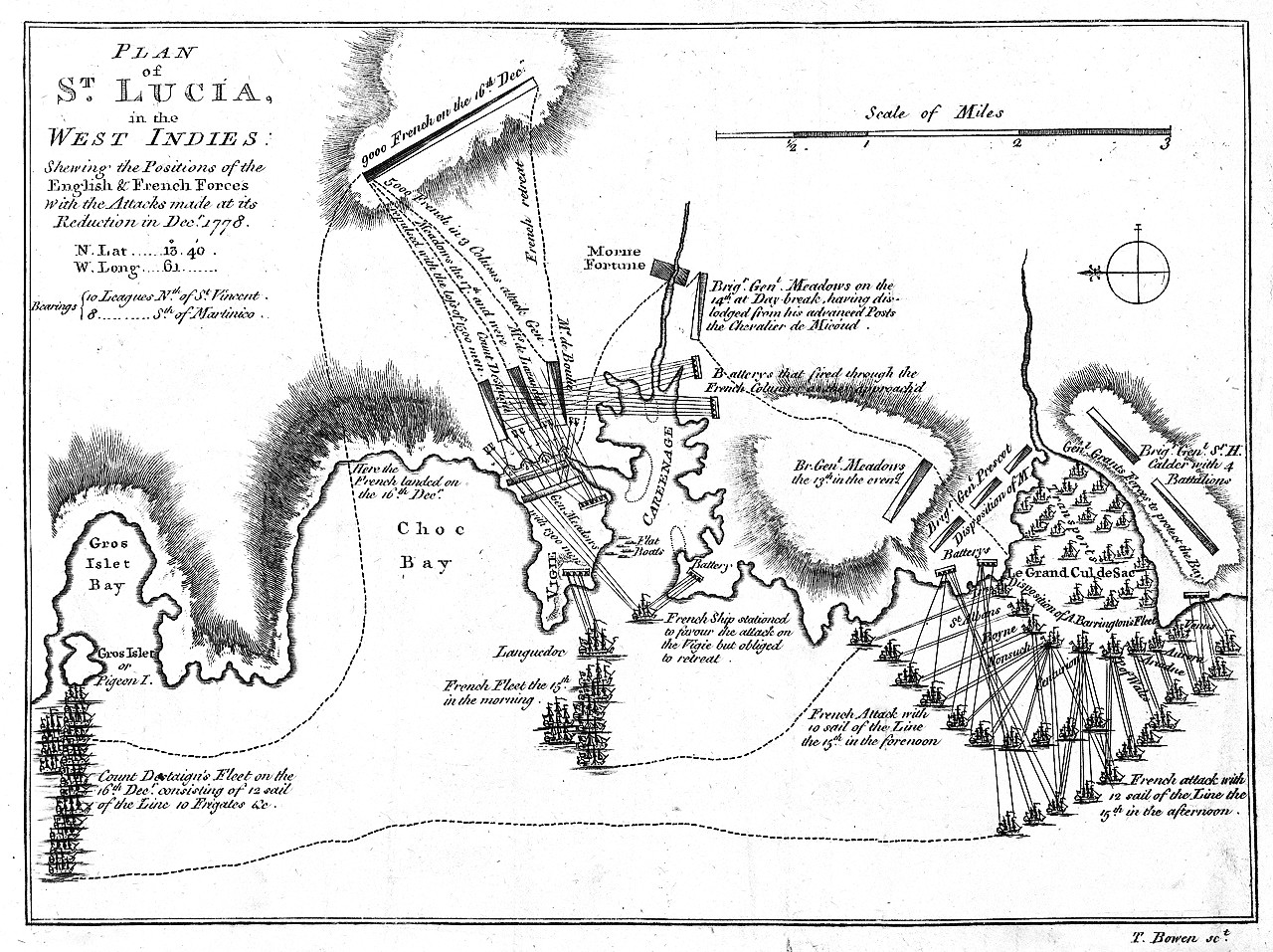
Plan of St. Lucia, in the West Indies, illustrating the positions of the English and French forces with the attacks made at its reduction in December 1778.
Admiral Barrington was alerted to the presence of the French fleet by the frigate Ariadne and organized his line of battle so that Isis and his three frigates (Venus, Aurora, and Ariadne) were close to shore guarding the windward approach, and he placed his flagship, Prince of Wales, toward the leeward. Barrington, in a defensive strategy, placed his transports inside the bay but behind his battle line, which took him the entire evening of 14 December. By 1100 hours the next day, most of the transports had been safely tucked behind his line.
At 1100 hours 15 December Admiral d’Estaing approached St. Lucia with ten ships of the line, and was fired on by one of the shore batteries. D’Estaing moved to engage Barrington from the rear, and a “warm conflict” raged between the two fleets, with the British supported by two shore batteries. D’Estaing was repulsed but succeeded in reforming his line of battle. At 1600 hours d’Estaing renewed his assault by attacking Barrington’s centre with twelve ships of the line. Again, heavy fire was exchanged, and the French were eventually repulsed for a second time.
Outcome
On 16 December Admiral d’Estaing appeared to be preparing for a third assault against Admiral Barrington’s line, but then sailed away towards the windward.[1] On the evening of 16 December d’Estaing anchored in Gros Islet Bay, where he landed 7,000 troops for an assault on the British lines at La Vigie. Three assaults were made but British control of the high ground enabled them to repulse the French. The French troops were re-embarked, and when d’Estaing’s fleet left on 29 December, the island surrendered to the British. (References: Navies and the American Revolution, 1775–1783. Robert Gardiner, ed. Chatham Publishing, 1997, pp. 88–91. Clowes, William Laird (1996) [1900]. The Royal Navy, A History from the Earliest Times to 1900, Volume III. London: Chatham Publishing. pp. 431–432. Contenson, Ludovic (1934). La Société des Cincinnati de France et la guerre d’Amérique (1778–1783). Paris: éditions Auguste Picard.)
By 1779, the island’s population had increased to 19,230, which included 16,003 slaves working 44 sugar plantations. Yet, the Great Hurricane of 1780 killed about 800. By the time the island was restored to French rule in 1784, as a consequence of the Peace of Paris (1783), 300 plantations had been abandoned and some thousand maroons lived in the interior.
In Jan 1791, during the French Revolution, the National Assembly sent four Commissaries to St. Lucia to spread the revolution philosophy. By August, slaves began to abandon their estates and Governor de Gimat fled. In Dec 1792, Lt. Jean-Baptiste Raymond de Lacrosse arrived with revolutionary pamphlets, and the poor whites and free people of colour began to arm themselves as patriots. On 1 Feb 1793, France declared war on England and Holland, and General Nicolas Xavier de Ricard took over as Governor. The National Convention abolished enslavement on 4 Feb 1794, but St. Lucia fell to a British invasion led by Vice Admiral John Jervis on 1 April 1794. Morne Fortune became Fort Charlotte. Soon, a patriot army of resistance, L’Armee Francaise dans les Bois, began to fight back. This was the beginning of the First Brigand War.
A short time later, the British invaded in response to the concerns of the wealthy plantation owners, who wanted to keep sugar production going. On 21 Feb 1795, a group of rebels, led by Victor Hugues, defeated a battalion of British troops. For the next four months, a group of recently freed slaves known as the Brigands forced out not only the British army, but every white slave-owner from the island (coloured slave owners were left alone, as in Haiti). The English were eventually defeated on 19 June, and fled from the island. The Royalist planters fled with them, leaving the remaining Saint Lucians to enjoy “l’Année de la Liberté”, “a year of freedom from slavery…”. Gaspard Goyrand, a Frenchman who was Saint Lucia’s Commissary later became Governor of Saint Lucia, and proclaimed the abolition of slavery. Goyrand brought the aristocratic planters to trial. Several lost their heads on the guillotine, which had been brought to Saint Lucia with the troops. He then proceeded to re-organize the island.
The British continued to harbour hopes of recapturing the island and in April 1796 Sir Ralph Abercrombie and his troops attempted to do so. Castries was burned as part of the conflict, and after approximately one month of bitter fighting the French surrendered at Morne Fortune on 25 May. General Moore was elevated to the position of Governor of Saint Lucia by Abercrombie and was left with 5,000 troops to complete the task of subduing the entire island.
British Brigadier Geneneral John Moore was appointed Military Governor on 25 May 1796, and engaged in the Second Brigand War. Some Brigands began to surrender in 1797, when promised they would not be returned to slavery. Final freedom and the end to hostilities came with Emancipation in 1838.
The 1802 Treaty of Amiens restored the island to French control, and Napoleon Bonaparte reinstated slavery. The British regained the island in June 1803, when Commodore Samuel Hood defeated French Governor Brigadier General Antoine Noguès. The island was officially ceded to Britain in 1814.
Also in 1838, Saint Lucia was incorporated into the British Windward Islands administration, headquartered in Barbados. This lasted until 1885, when the capital was moved to Grenada.
Increasing self-government has marked St Lucia’s 20th-century history. A 1924 constitution gave the island its first form of representative government, with a minority of elected members in the previously all-nominated legislative council.
During the Battle of the Caribbean, a German U-boat attacked and sank two British ships in Castries harbour on 9 March 1942.
Universal adult suffrage was introduced in 1951, and elected members became a majority of the council. Ministerial government was introduced in 1956, and in 1958 St. Lucia joined the short-lived West Indies Federation, a semi-autonomous dependency of the United Kingdom. When the federation collapsed in 1962, following Jamaica’s withdrawal, a smaller federation was briefly attempted. After the second failure, the United Kingdom and the six windward and leeward islands—Grenada, St. Vincent, Dominica, Antigua, St. Kitts and Nevis and Anguilla, and St. Lucia—developed a novel form of cooperation called associated statehood.
By 1957, bananas exceed sugar as the major export crop.
As an associated state of the United Kingdom from 1967 to 1979, St. Lucia had full responsibility for internal self-government but left its external affairs and defence responsibilities to the United Kingdom. This interim arrangement ended on 22 Feb 1979, when St. Lucia achieved complete independence. St. Lucia is a constitutional monarchy with King Charles III as King of St. Lucia and is an active member of the Commonwealth of Nations. The island continues to cooperate with its neighbours through the Caribbean community and common market (CARICOM), the East Caribbean Common Market (ECCM), and the Organisation of Eastern Caribbean States (OECS).
In June 2016, the United Workers Party (UWP), led by Allen Michael Chastanet, won 11 of the 17 seats in the general election, ousting the St Lucia Labour Party (SLP) of the incumbent Prime Minister Kenny Anthony. However, Saint Lucia Labour Party won the next election in July 2021, meaning its leader Philip J Pierre became the ninth Prime Minister of Saint Lucia since the independence. St Lucia Labour party (SLP) of prime minister Philip Pierre kept its majority in the 2025 election. (HARMSEN Jolien, ELLIS Guy Ellis, and DEVAUX Robert, A History of St Lucia, Vieux Fort, St Lucia: Lighthouse Road Publications, 1 June 2014)
Canadian Artillery in St. Lucia, 1915-1919
Canadian artillery served in St. Lucia from 1915 to 1919 during the First World War. In March and April 1915 detachments of the Royal Canadian Artillery and the Canadian Garrison Artillery landed in St. Lucia, with a force of nine officers and 105 other ranks. The contingent of officers and men manned the artillery installed to protect the Castries harbour, the Castries coaling station and the Royal Navy Station in the southern Caribbean. This force, at the Armistice in 1918, consisted of fourteen officers and two hundred and four other ranks of the Royal Canadian Artillery, two officers and twenty-eight other ranks of the Royal Canadian Engineers, and one officer and eight other ranks of the Canadian Army Medical Corps. Royal Canadian Horse Artillery, “C” Battery, was stationed at Castries from October of 1917 until 1919. One draft of the 1st (Halifax-Dartmouth) Field Artillery Regiment helped to form No. 6 Company, Siege Artillery, which served in St. Lucia.
The Canadian gunners were equipped with the Ordnance QF 13-pounder (quick firing) field gun, which was the standard equipment of the British and Canadian Royal Horse Artillery when the First World War broke out in 1914. It was developed as a response to combat experience gained in the Boer War and entered service in 1904. It was intended as a rapid-firing and highly-mobile yet reasonably powerful field gun for RHA batteries supporting Cavalry brigades, which were expected to be engaged in mobile open warfare.
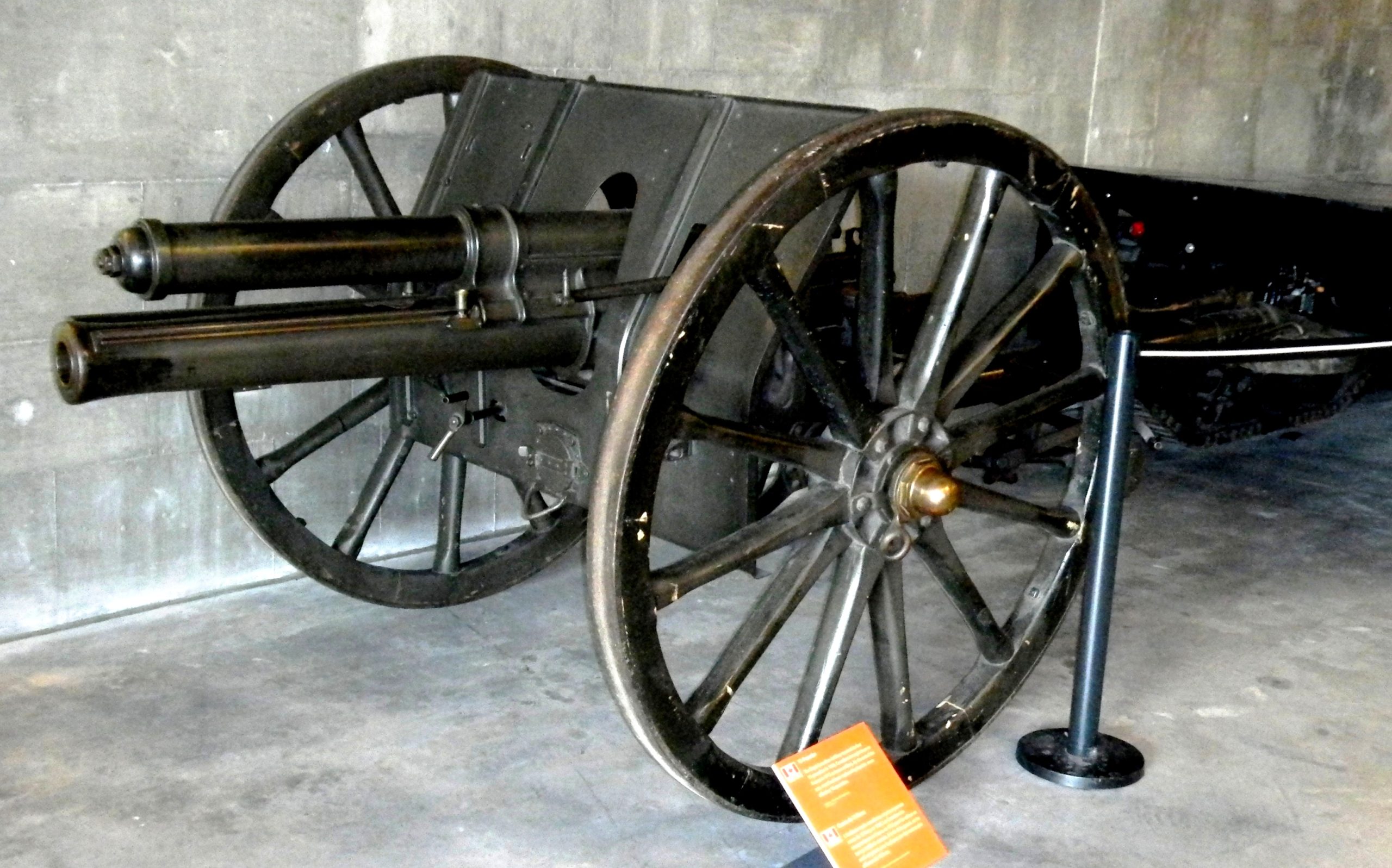
(Author Photo)
13-pounder 6-cwt QF Land Mk. II Field Gun, VSM, broad arrow, 1911, (Serial No. 279), King George V cypher. Canadian War Museum, Ottawa, Ontario.
Key Details of Deployment (1915–1919)
- Purpose: To man coastal defense guns protecting the strategic coaling station at Castries, St. Lucia.
- Personnel: Primarily drawn from the Royal Canadian Garrison Artillery (RCGA), including detachments from Halifax, Saint John, and Esquimalt.
- Force Composition: By 1918, the force included 14 officers and 204 other ranks of the Royal Canadian Artillery, along with Royal Canadian Engineers and Canadian Army Medical Corps.
- Key Figures: Major A.E. Harris commanded the initial contingent.
- Relief: They replaced British garrison troops, allowing them to serve elsewhere.
This contribution was part of a broader, lesser-known effort by Canada to support British defense in the Caribbean, including a similar deployment to Bermuda.
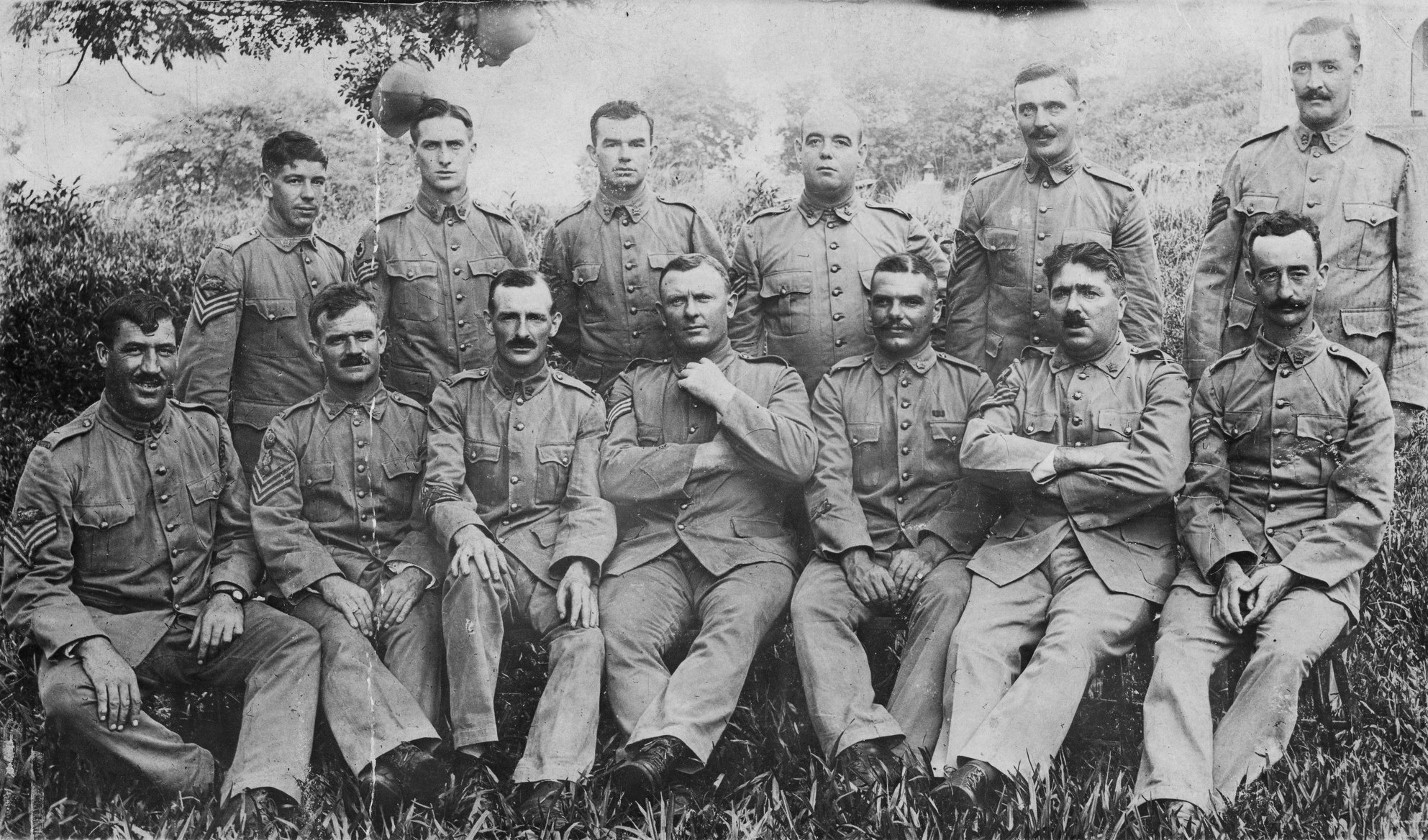
(Dave King Photo)
Some of the Canadian RCGA personnel sent to St Lucia during the First World War. No names unfortunately, but they may be from the 5th Coast Brigade Esquimalt contingent.
The Saint Lucia Battery, No. 6 Company, Royal Canadian Garrison Artillery
Story by Gary Silliker
Throughout the Great War (WWI) there were several strategic operations that provided aid to allies, denied enemy access to large geographical areas and resources, and/or protected vital supply lines and logistic bases. Some of those ‘flank’ operations were large, such as the long and costly East African campaign which tied up at least 300,000 Allied, British, and Commonwealth troops from 3 August 1914 to 25 November 1918. The South West Africa campaign lasted 9 months; while others were of short duration in places like Samoa (2 days), New Guinea (6 weeks), and Togo (20 Days). Many of those vital flank operations continue to be mere footnotes in the history of the Great War. The story of the Canadian gunners of the St Lucia Battery, in the British West Indies, is one such footnote. Many of the St Lucia gunners were from Nova Scotia.
On 13 January 1915, the British War office had the Secretary of State for the Colonies telegram Ottawa requesting that Canada provide a heavy artillery battery for service in St Lucia. This unit was required to protect the vital coaling station at Port Castries in support of Allied Sea power in the region. The official Canadian army history of the unit is noted below.
“Report #87 Historical Section (GS) Army Headquarters 20 October 1959 // “Canadian Forces in Bermuda and St Lucia 1914-1919” // paragraphs 9-13 prepared by Captain JA Sweetenham, Royal Canadian Engineers.
In the Windward Islands, No. 6 Company of the Royal Canadian Garrison Artillery, totaling 123 all ranks, disembarked at Port Castries, St Lucia, in April 1915 and served there until May 1919. The Canadians did not relieve a British garrison, but took over, as a war measure, two forts on either side of the harbour entrance to Port Castries which had not been occupied since 1907. During those eight years an almost impregnable forest of tropical trees and vines had sprung up, so that extensive clearing was necessary before the positions could again be occupied. Malaria was prevalent at first, but by 1918 the clearing of brush, the construction of drains, the oiling of swamps had brought the disease under control.
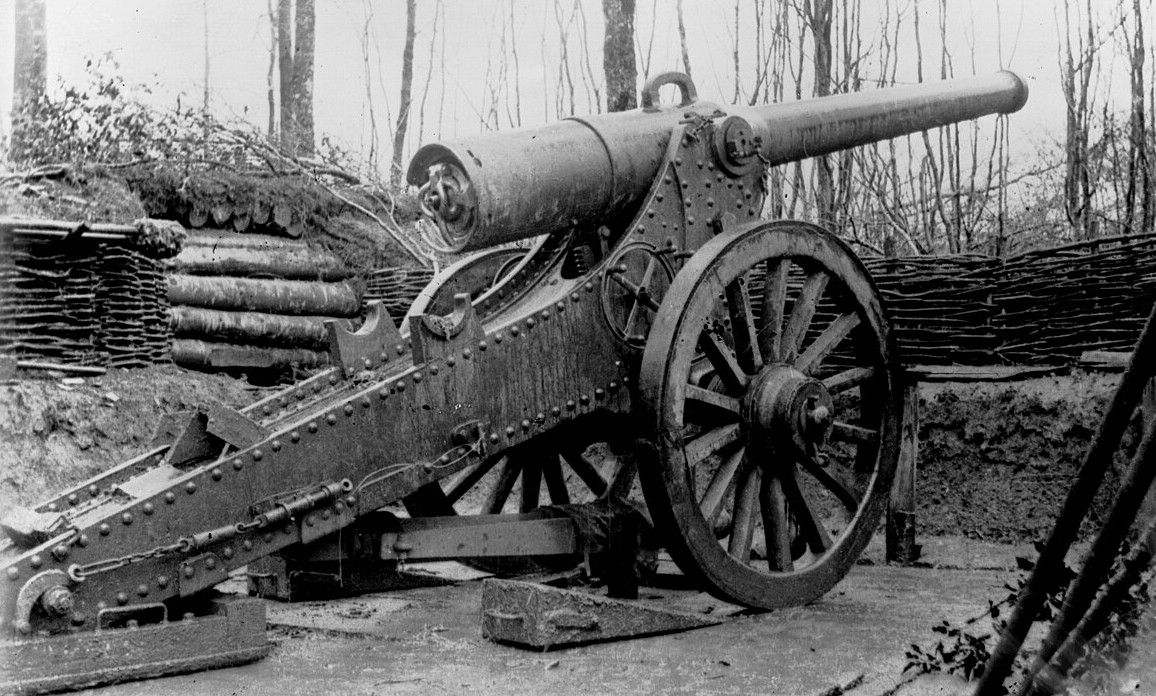
(Bibliothèque nationale de France Photo)
The de Bange 155 mm long cannon mle. 1877 (or more promptly known as the 155 L de Bange) was a French artillery piece that although obsolete by the beginning of the First World War, was nonetheless pressed into service and became the main counter-battery piece of the French army in the first two years of the war.
At the outbreak of war there were no guns on the island. Four French 14-centimeter (5.5-inchpieces were borrowed from Martinique. These had been mounted by French troops before the unit’s arrival.
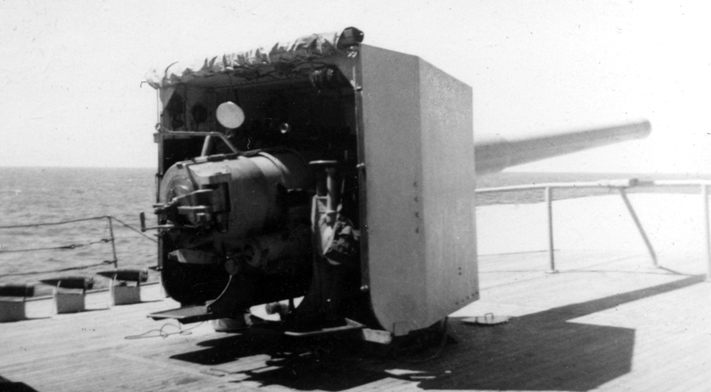
(Alberg22 Photo)
British 6-inch naval gun, HMCS Prince David/
In addition to these, the Canadians mounted two British 6-inch guns from Bermuda between April and July 1915. No further additions were made. Until the end of the war the main task was to man those guns.
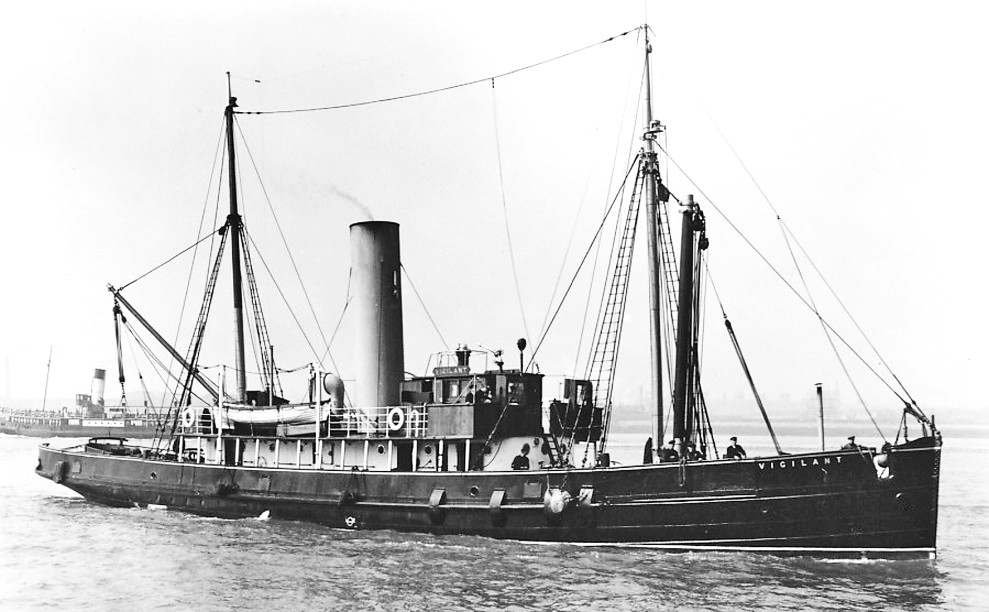
(Scottish built ships Photo)
SS Vigilant
An unusual duty which fell to the lot of the gunners was to provide an examination service. A 70-ton steam pinnace, the SS Vigilant which arrived 20 August 1915, was procured in Trinidad. In the absence of naval personnel No. 6 Company furnished an officer and crew. The work consisted of seeing that no contraband, nor suspicious characters were on board ships entering or passing by the harbour. A customs officer accompanied the army officer on each occasion.
Still more unusual was the task of mine sweeping which was imposed upon the crew of the Vigilant from April 1917. After 5 days of training by a visiting British naval officer, the entrance of the harbour was swept once a week.
The average strength of the unit, due to gradual increases, was 250 all ranks including attached engineer, medical and other services. That sappers were there to set up search lights and improve accommodations. In all, 439 all ranks saw service in St Lucia (five died of sickness).
As noted above five soldiers of the Canadian Expeditionary Force (CEF) died in St Lucia. Malaria claimed the lives of Gunners William Henry Cole and Frank John Bennetts. Corporal Albert Chrow, of the Canadian Engineers, died of the Spanish Flu, while Captain Adam Peden Chalmers, of the Canadian Army Medical Corps (CAMC), died of a heart attack due to stress. There is no recoded cause of death for Gunner James O’Connor.
 (Author Photo)
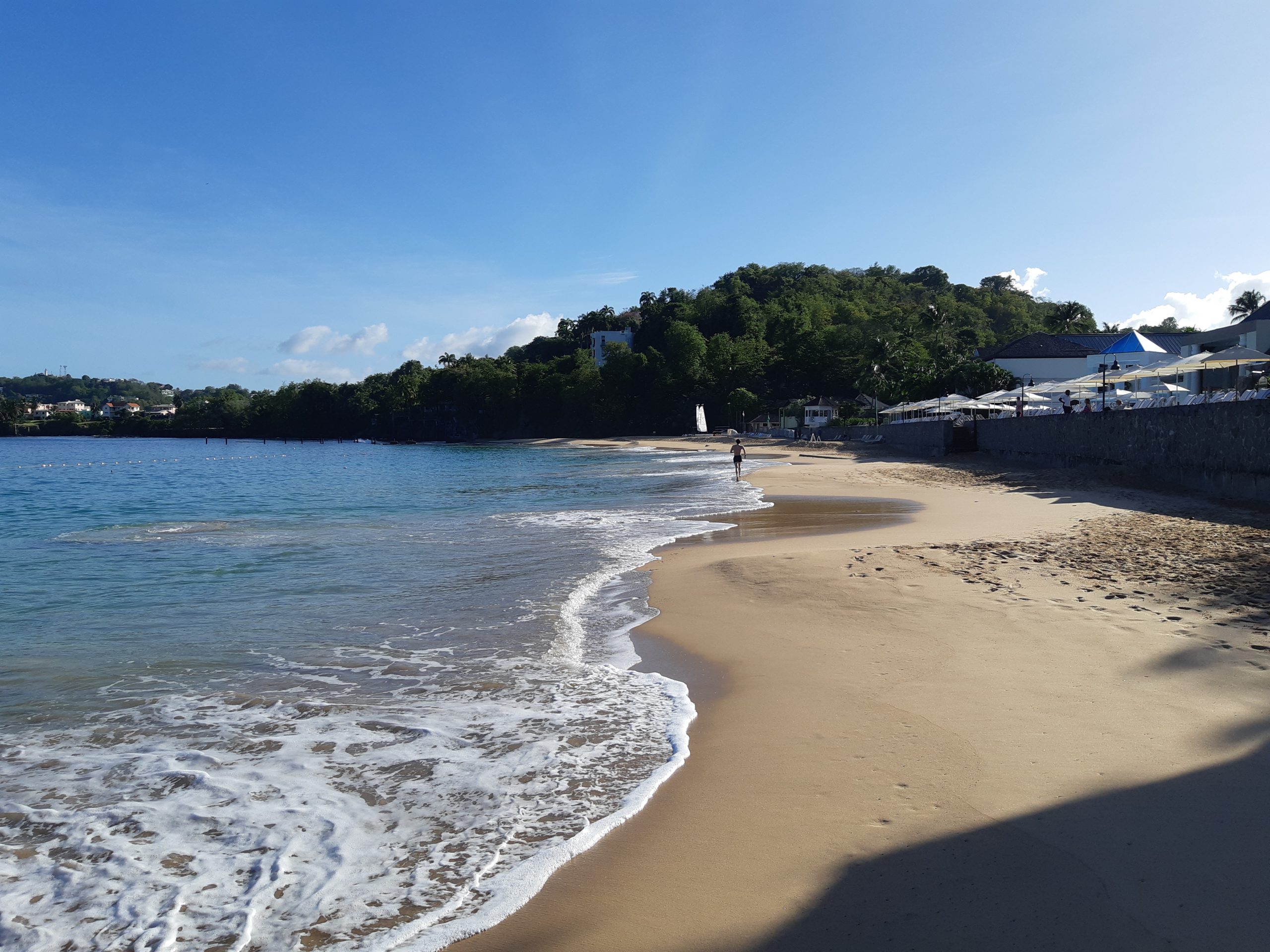
Sandals Regency la Toc, St. Lucia, beach view looking East, Feb 2026.